Weird Contax III
Printed from: USSRPhoto Forums
Topic URL: http://localhost:8088/modern/Forum/topic.asp?TOPIC_ID=3662
Printed on: 9/20/2026 10:33:12 AM
Topic
Topic author: uwittehh
Posted on: 20240508171521
Replies
Reply author: Luiz Paracampo
Replied on: 20240508183008
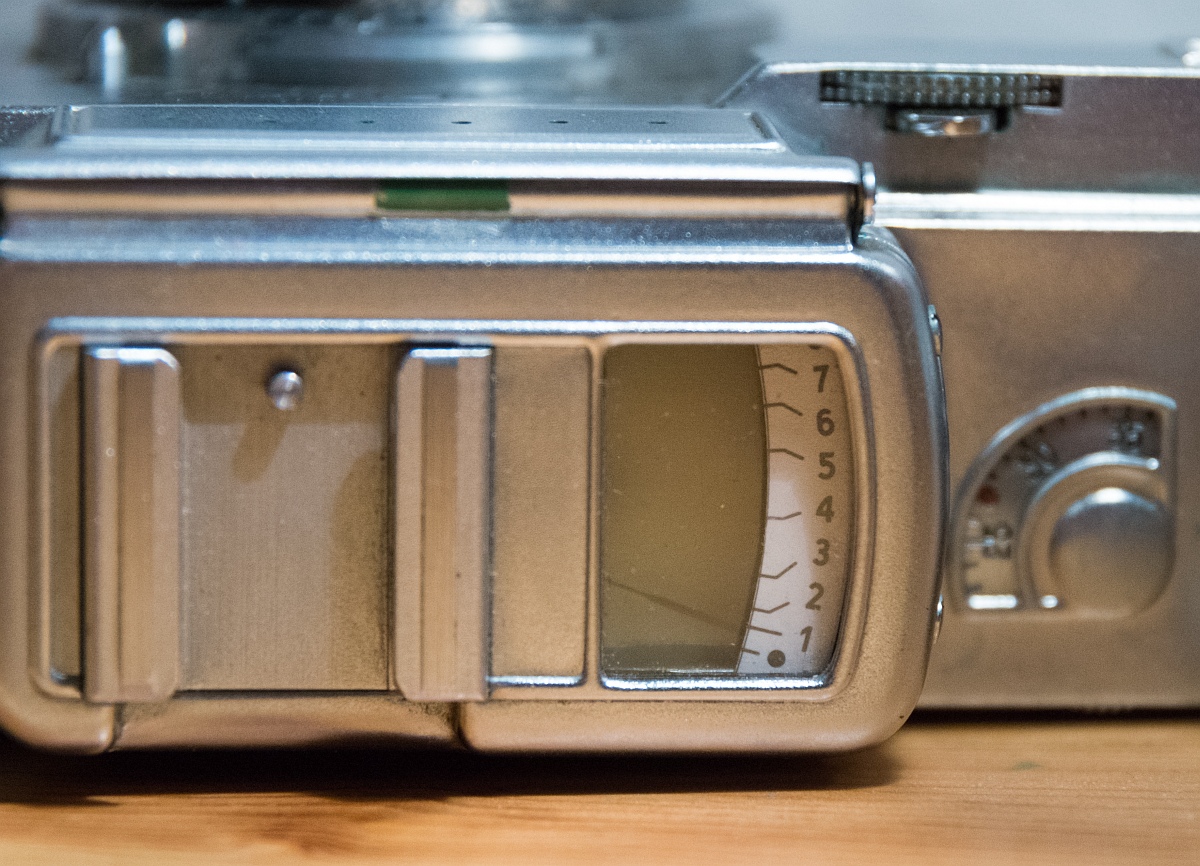
According with Zeiss Historica that was a pilot series with two light levels of measuring.
The same system was applied in the Super ikonta rangefinder 6x6 where could be seen more frequently although super rare "white fly" piece.
Reply author: uwittehh
Replied on: 20240508183848
Luiz, thanks for mentioning the Super Ikonta, I've seen that somewhere before (the perforated flap of the light meter), but I couldn't remember where.
I also understood about the 2 levels of metering, green with the flap closed and otherwise with the flap open. The light meter still reacts when the flap is open, but no longer when it is closed.
Thanks for the info :-)
Ulrich
http://fotos.cconin.deReply author: Luiz Paracampo
Replied on: 20240510121104
the closed position is for using in high lighted summer days. as in Greece for example. Mountais or sea shore.
in Brazil I have gone to Ceará state the light there is so high that exposure meters go to the maximum value at sea shore.
Regards
Reply author: uwittehh
Replied on: 20240510144049
Luiz, thanks for the info. Do you have any idea how many of these Contax IIIs were built?
Ulrich
http://fotos.cconin.deReply author: Jacques M.
Replied on: 20240512104104
What an interesting find!
Do we know if there is something new about the cell inside, compared to the ordinary Contax III? It's curious that this pilot series was not really produced...
Congrats, Ulrich!
Jacques.
Reply author: SteveA
Replied on: 20240514041641
As I understand it, this was a factory conversion that was offered, whereby the old carbon track resistor etc., was replaced with Super Ikonta components. Basically it eliminated the issues experienced with the carbon track, I think the original selenium cell was retained and an in line resistor was replaced to calibrate the cell to the new arrangement, the card register which the needle used to indicate the exposure value was replaced as you no longer zero'd the needle but read off a value. I suspect if Contax III production had continued post-war then this would have been a modification fitted to production cameras, the carbon tracks were always a source of problems as the track gradually wore from use.
Reply author: Jacques M.
Replied on: 20240514104109
Perfectly clear. Thanks Steve.
Reply author: uwittehh
Replied on: 20240514125710
Steve, interesting information. Correct, these carbon tracks are always a problem (also with the Kievs), either they no longer work at all or the pointer always jumps jerkily.
When I have more time next time I will take the Contax apart and have a closer look at what has been installed/modified there.
Ulrich
http://fotos.cconin.deReply author: Luiz Paracampo
Replied on: 20240518084600
A friend of mine has a Superikonta (Post war) bought new in 1951 with Zeiss Opton coated lens, name registered in 1949, witha simitar exposure meter.
Reply author: Luiz Paracampo
Replied on: 20240518091548
Reply author: uwittehh
Replied on: 20240518142643
Luiz,
yes, it looks similar. The difference is that it is conical on the Super-Ikonta, but straight on the Contax. The scale looks identical.
It's also interesting that the window of the scale and the accessory shoe are reversed on the Super-Ikonta.
Incidentally, the Contax also has a built-in flash socket, as you can see in the third picture. It doesn't look like it was retrofitted. But we'll see more when I have the time to take it apart.
Ulrich
http://fotos.cconin.deReply author: Luiz Paracampo
Replied on: 20240520122125
probably this Camera uses remanescent prewar remaining Compur Rapid once Rolleiflex 2.8 from the same era is synchonized
Reply author: Luiz Paracampo
Replied on: 20240520122812
Reply author: uwittehh
Replied on: 20240611152013
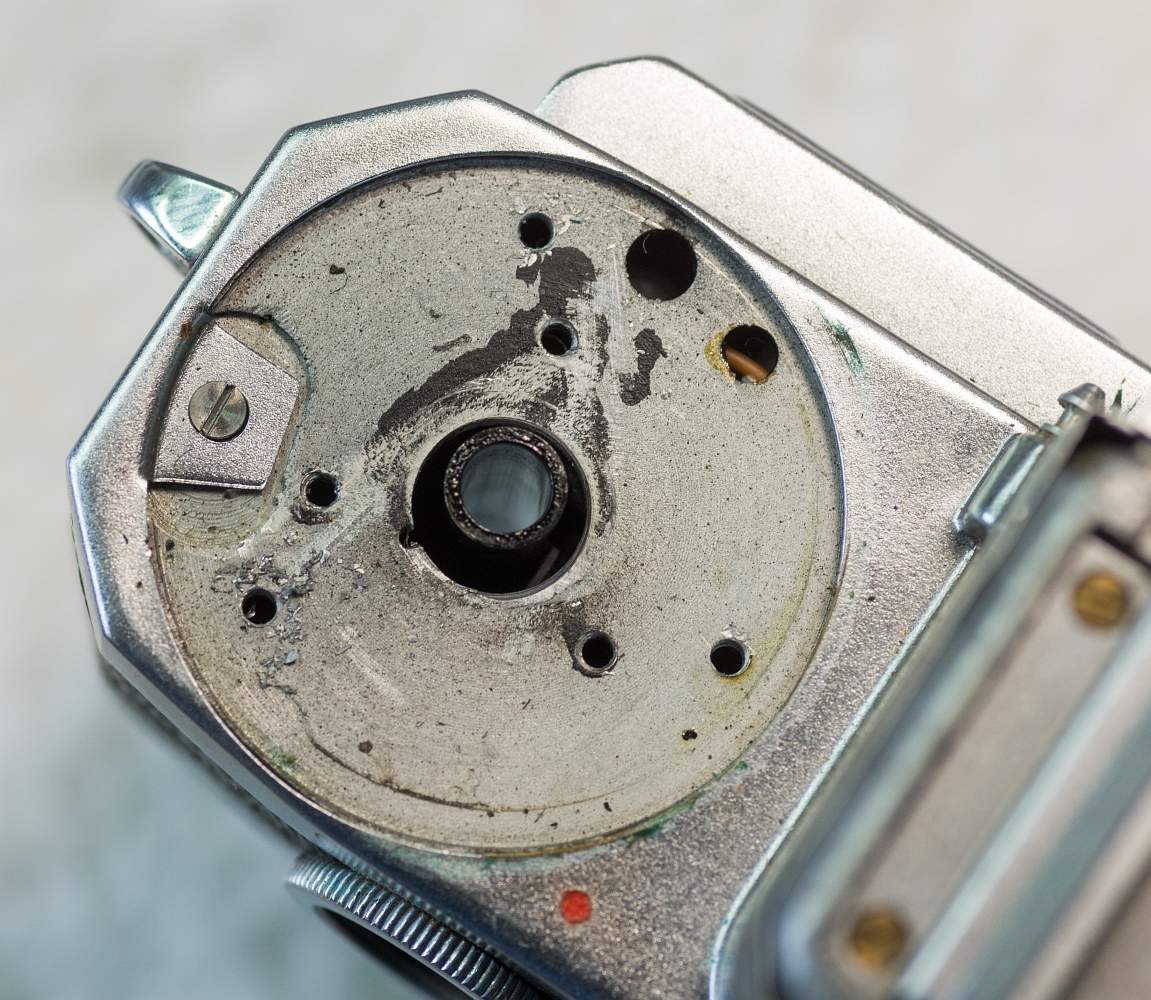
So, I've now got around to disassembling the Contax. It looks like it's not a pilot project after all, but a conversion from 1959, as you can see from the photocell. On the other hand, the photocell may also have been replaced in 1959, it is not known for sure.
In any case, the retrofitted flash connection is very interesting: It has 2 breaker contacts, one under the shutter release, which is closed when the shutter is pressed, and one at the bottom of the housing, which is closed when the shutter is released. When the shutter release button is released, the upper contact is interrupted (the lower one is closed until the camera is cocked again), so that the flash does not fire continuously.
So, unfortunately it doesn't seem to be a pilot project, but it is an interesting modification. The question is, who might have done something like this, a gifted camera repairman, or perhaps even at Zeiss itself?
Take a look at the pictures:

/UserContent2/1162024_IMGL7212.jpg
http://www.ussrphoto.com/UserContent2/1162024_IMGL7212.jpg
/UserContent2/1162024_IMGL7213.jpg
http://www.ussrphoto.com/UserContent2/1162024_IMGL7213.jpg
/UserContent2/1162024_IMGL7214.jpg
http://www.ussrphoto.com/UserContent2/1162024_IMGL7214.jpg
/UserContent2/1162024_IMGL7217.jpg
http://www.ussrphoto.com/UserContent2/1162024_IMGL7217.jpg
/UserContent2/1162024_IMGL7222.jpg
http://www.ussrphoto.com/UserContent2/1162024_IMGL7222.jpg
/UserContent2/1162024_IMGL7223.jpg
http://www.ussrphoto.com/UserContent2/1162024_IMGL7223.jpg
/UserContent2/1162024_IMGL7234.jpg
http://www.ussrphoto.com/UserContent2/1162024_IMGL7234.jpg
/UserContent2/1162024_IMGL7413.jpg
http://www.ussrphoto.com/UserContent2/1162024_IMGL7413.jpg
/UserContent2/1162024_IMGL7418.jpg
http://www.ussrphoto.com/UserContent2/1162024_IMGL7418.jpg
/UserContent2/1162024_IMGL7421.jpg
http://www.ussrphoto.com/UserContent2/1162024_IMGL7421.jpg
/UserContent2/1162024_IMGL7422.jpg
http://www.ussrphoto.com/UserContent2/1162024_IMGL7422.jpg
/UserContent2/1162024_IMGL7424.jpg
http://www.ussrphoto.com/UserContent2/1162024_IMGL7424.jpgUlrich
http://fotos.cconin.deReply author: uwittehh
Replied on: 20240613154006
A few more additions:
- The blue resistor reads 16.6k
- "83" is engraved in the winding button
- The plastic cap in front of the selenium cell (is that even a selenium cell?) has been blackened 2/3 of the way through
- The area under the exposure setting is interesting, the indentation in the metal and the cut-out hole in the sheet metal look very professional
- The way the flash mechanism is installed has the advantage that the shutter can be removed. The cable is often soldered directly to the shutter when the flash connection is retrofitted.
Ulrich
http://fotos.cconin.deReply author: Jacques M.
Replied on: 20240614035333
Many thanks for your photos and your very clear explanations, Ulrich.
All that looks very professional, particularly the flash connexion.
On the contrary, the partial blackening of the plastic cap is odd. Of course, it was made to fit the holes and the extra scale, but that rather looks like an experiment...
Really, a very interesting camera...
Amitiés. Jacques.
Reply author: uwittehh
Replied on: 20250403125439
Jacques,
you wouldn't believe it, but I found another Contax III like this... It also has an additional flash socket on the left side. But this time it's from the B series and not the G series like the previous one.
I'm going to take it apart soon to see if the flash mechanism has been installed in the same way.
Really exciting, these two.
Ulrich
http://fotos.cconin.deReply author: uwittehh
Replied on: 20250403130513
Reply author: Jacques M.
Replied on: 20250403145955
Very happy to know you had it, Ulrich!
I had tried to get it, but it was reserved to the German market...
A bit puzzled by the difference of dates: B to G...
Congratulations!
Jacques.
Reply author: uwittehh
Replied on: 20250403155533
Jacques,
thank you. Sorry, I didn't know you were going to bid on it too. I'm definitely looking forward to seeing what awaits me when I open it this time.
Externally, it looks pretty worn out, the light meter doesn't work, but this time the shutter works well at all speeds. The lens is quite cloudy, let's see if I can fix it.
The different years (1936 and 1938) suggest a later installation.
Ulrich
http://fotos.cconin.deReply author: Jacques M.
Replied on: 20250404032523
Really no problem, Ulrich. The most important is that somebody here took it so that the discussion goes on.
This question of date: B/G series, so prewar, or 1959, as written on the cell, is of course puzzling. Perhaps the taking to pieces of your second weird Contax will give some light...
Amitiés. Jacques.
Reply author: Luiz Paracampo
Replied on: 20250414182030
ABOUT PHOTOCELL i PARTICULARLY BELIEVE BASED IN MY EXPERINCE THAT THIS PARTICULAR ONE CAME FROM A BEWI AUTOMAT B OR A GOSSEN X3
REGARDS
Reply author: Jacques M.
Replied on: 20250415113742
I was thinking too of the Ikoflex Favorit, which had a selenium built-in cell with an EV scale, like on the Super Ikonta shown by Luiz.
But these cameras are postwar ones. I don't understand why this cell was adapted on prewar Contax III rather IIIa which appeared in 1951...
Amitiés. Jacques.
Reply author: Luiz Paracampo
Replied on: 20250417153340
simply jacques the size of Gossen (Sixti) or Bertram (Bewi) have the same size of of this variant Contax III cell wile Ikoflex post war cells are very tiny.
Regards
Reply author: Jacques M.
Replied on: 20250418104529
Reply author: uwittehh
Replied on: 20250418150920
Reply author: cedricfan
Replied on: 20250419102137
Fantastic documentation! And no problem with German for me when it is good language.
Best regards,
Juhani
Reply author: uwittehh
Replied on: 20250420153149
Juhani,
thanks. It was also a lot of work, dismantling, documentation, text, all together it took a good week. But it's fun, interesting and ultimately helps us all.
I already have the next projects, a Zorki 3 with a defective shutter, 2 defective Droug from which I want to make a working one and maybe I will dare to make a Kristall, also with a defective shutter :-)
Ulrich
http://fotos.cconin.deReply author: Jacques M.
Replied on: 20250421102148
Thank you much for this precious documentation, Ulrich.
As you know, I have found too one of these weird Contax, and your doc will help me greatly when I can have a closer look at it (even in German!).
Yes, the Zeiss Historica's article is very interesting. It's just a bit frustrating that we cannot have an idea of the number of these cameras.
Amitiés. Jacques.
Reply author: Jacques M.
Replied on: 20250425080850
Reply author: Jacques M.
Replied on: 20250425081610
Reply author: uwittehh
Replied on: 20250425151134
Jacques,
nice to see that it has arrived safe and sound. It's really interesting that the inside of your cover is blackened and a hole has been glued shut. The cameras were apparently all customized.
Ulrich
http://fotos.cconin.deReply author: Jacques M.
Replied on: 20250425153721
Yes, Ulrich. The flash socket is exactly in the same position as on your own cameras. Really, all that was made by the same worshop quoted in Zeiss Historica article.
I will check this very original flash contact as soon as I can, with your perfect explanations on you site![:)]
Amitiés. Jacques.
Reply author: uwittehh
Replied on: 20260628161142