USSRPhoto.com

Forums / Collectors and Users Open Forum

Jupiter-3 Clean, Lube, Adjust

27 posts in this thread showing replies 1-20 of 26
Reply with Quote Edit Topic Delete Topic
I've created a WIKI entry for doing a Clean-Lube-Adjust on the Jupiter-3. Also included- instructions for adjusting the Jupiter-3 for optimal use on a Leica. Some of the "gotcha's" are from doing a fair number of lenses. Found out the hard way it is best to put screws back into the same hole they came out of! "Ice cube tray" is an important part of my kitchen table repairs.
Reply with Quote Edit Reply Delete Reply
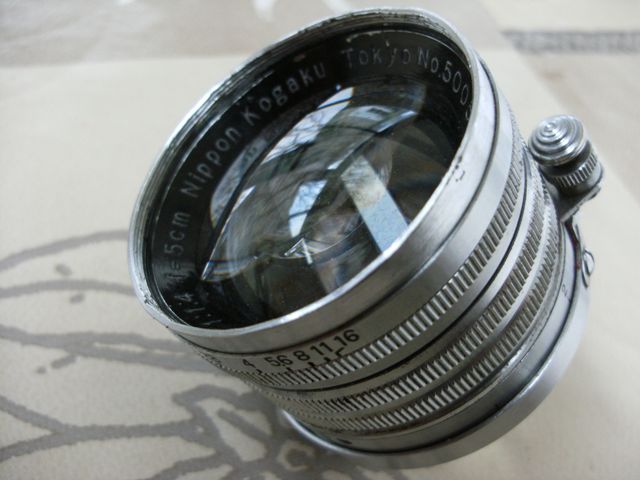
When I get some time- will put together a series of Photographs that illustrate the evolution of the pre-war Zeiss Sonnar from the 1934 Nickel 5cm F1.5 lens through to the 1956 KMZ J-3. I have 12 or so lenses that show a nice, steady progression.

I am a wild and crazy guy... NOT!
Reply with Quote Edit Reply Delete Reply
to my knowledge
1934 nickel plus black (up to f11)
1936 normal but f11
1938 normal but f16
1940 ltm versions various metals and mount
1943 lightermetal mount
1945-46 jena over 3000000 version
1947 Carl zeiss (west version at least 3 variation)
1947 ZK version
1950 jup3... various version
and moderns also

clones and copies : nikkor, canon... ?

Stephan

to brian ... I think that including ltms, i have 16 lenses on my shelf...

Stephan
Reply with Quote Edit Reply Delete Reply
I have a 1936 5cm F1.5 with fully coated optics, SN in the 190xxxx range. Bought off Ebay, noticed the coating after receiving. From taking apart many of these lenses: this one had never been opened. Optics were all hazed over, cleaned up nicely. I also have a 175xxxx lens with a coated front element, thought it was done after manufacture. But- I did a conversion on a second 175xxxx lens that had the identical coating on the front lens only.

My earliest "T" marked lens is a 255xxxx, marked F11 but stops down farther. Heavy barrel, no set screw holding the namering and rear triplet. The 267xxxx "T" lens had F22 marked, and was the lighter allow. It also had a hidden set screw holding the namering in place, and the rear triplet in place. The 272xxxx and 285xxxx wartime lenses had the hidden set screws, but the ZK did not. The 1950 J-3 has the rear triplet stamped with a 86xxxx number: shows at May 1945 in Thiele.

The most strange: a 2767816 5cm f1.5 "T" in Contax mount with an odd rear group. This SN block is missing in Thiele's book, there is a break in the numbers that are accounted for. Working lens, the rear group is smaller than standard F1.5, bigger than an F2. It is a doublet, not a triplet! Lens was in poor condition, but was $70 off Ebay.
Reply with Quote Edit Reply Delete Reply

Some details about the weights of my LTM 1,5/5cm. Interesting!

- Sonnar 2786xxx: 146g.
- ZK 1948: 135g. The lightest!
- Sonnar/Jupiter: 170g.(Sonnar 28608xx inside, 1974 KMZ number on the front)
- Jupiter 3 1951: 169g.

To compare with my 1,5/5cm Sonnars with Contax mount:

- s.n. 2789632: 130g. (on a Jena II O series).
- s.n. 3089445: 150g. (on a Jena Contax II).

I think that the Jup 1951 is a Sonnar too. But I cannot unscrew to check the number, idem for the ZK.
About that, what do you mean exactly by "namering", Brian?

Amitiés. Jacques.
Reply with Quote Edit Reply Delete Reply
Namering- the front ring with the zeiss name, Serial Number, that holds the front element in place. When disassembling Wartime lenses: be sure to take off the aperture ring and look for a hidden set screw. It holds the front namering in place.

The same is true for the rear triplet, you must unscrew the optics module from the focus mount and check if there is a set screw holding the triplet in place. Learned the hard way.

There are so many minor and major variations, improvements were made quickly. My favorite right now is an uncoated 1936 Sonnar with a beautiful bloom to the glass that is as good as a lens coating. Converted to Leica mount, wide-open with an Orange filter.

Reply with Quote Edit Reply Delete Reply

The namerinng is the front ring: that sounds logical...
But I have not seen any screw which could prevent from unscrewing the lens module...

I don't understand: I already did that with two LTM 1,5/5cm Sonnars. These Jup 3 and ZK resist. Perhaps both are "cemented"?

I have dismounted them by the back and cleaned them. But I have not seen the Zeiss number, hidden by the intermediate barrel (rangefinder's).

Anyway, they work better now!

Jacques.
Reply with Quote Edit Reply Delete Reply
I have had optics modules not unscrew for the following reasons:

1) cemented into place, usually because someone used cement instead of a proper shim.
2) Grease in the threads that gets incredibly hard, like cement. I've removed glass from the mount, let the whole fixture soak in 99% Isopropyl alchohol to loosen. This is the most common cause, and I have had good luck. I have let things soak as long as 1 week to loosen up.
3) thin shim (0.01mm or 0.02mm) made of copper, thinner than paper, get caught up in the threads. Sometimes have luck with this.
Reply with Quote Edit Reply Delete Reply
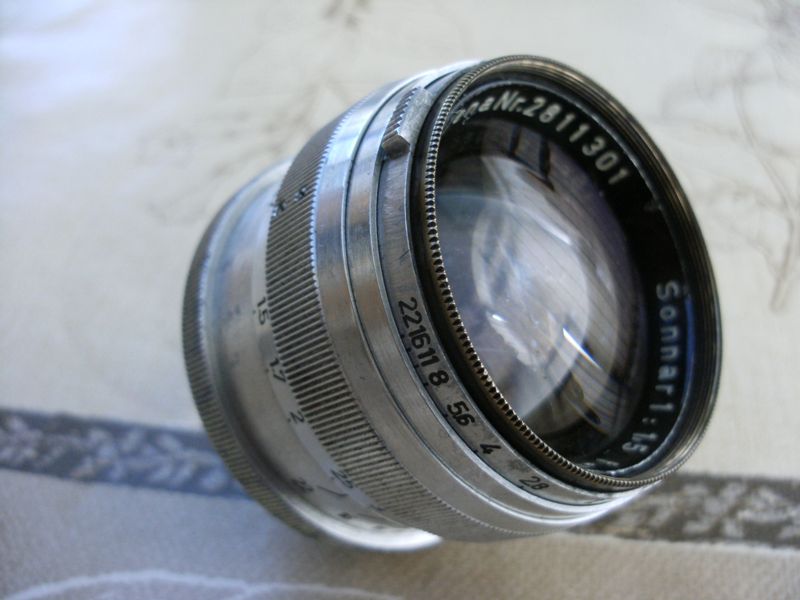
Another LTM Sonnar here.
But quite mysterious: by the serial number, it should be a Biotar 2/4cm for Robot...
The rear module was changed: no Zeiss number. A Jupiter 3 one...
The front one is a Sonnar's by the coating. And m marked on the distance ring, always with the two srews.

It's the heaviest of all my Sonnars (wartime ones): exactly 180g.


http://www.ussrphoto.com/UserContent/3012013_Sonnar 2811301.jpg

Amitiés. Jacques.

Reply with Quote Edit Reply Delete Reply
My personal opinion: these are "transition" lensesmade just after World War II. I have seen several like this in some off serial number ranges, several around 280xxxx. Machining was not uniform between them, some unfinished- look like "one-offs" in a manual machine shop. MAybe done when the factory was recovering from the War?
Reply with Quote Edit Reply Delete Reply

These Sonnars are surprising...

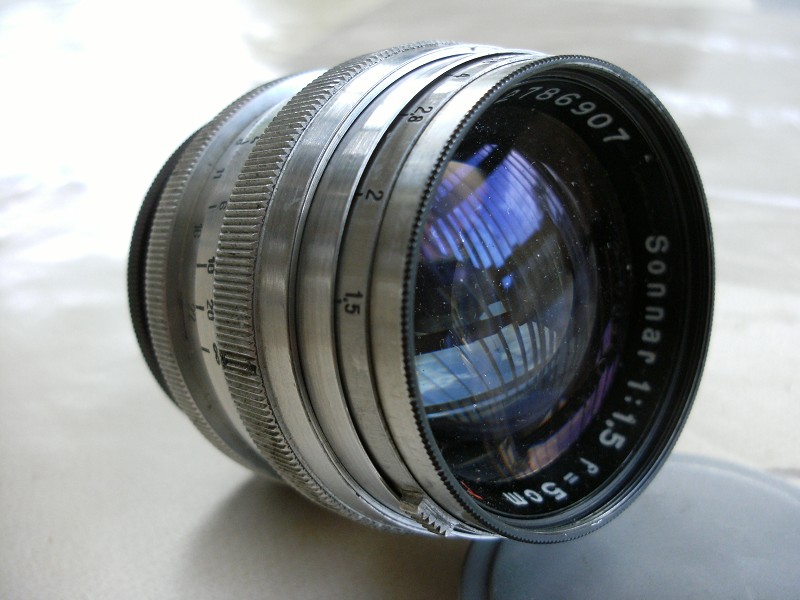
Another odd one here: I has owned this one (1,5/5cm LTM, serial # 2786907) for years. It has a 3/4 turn of the distance ring instead of the regular half one. And the meter scale reads 0,8 - 1 - 1,15 - 1,3 - 1,5 - 2 - 2,5 - 3 - 4 - 6 - 10 - 20 and infinite with small "m" but commas. Not a regular scale...

A picture of this lens:

http://www.ussrphoto.com/UserContent/422013_Sonnar 2786907 002.jpg

If you have an explanation...

Amitiés. Jacques.


Reply with Quote Edit Reply Delete Reply
Thiele lists a 5cm F1.5 Sonnar batch of 300 in Contax mount starting at 2786801 to 2787100, finished in 1943. I am going to guess that is started out in Contax mount and was custom converted to the Leica mount. The Sonnar did not have an equal in the Leica world, and some paid to have them custom converted to the smaller and less expensive Leica. I read that CB used a custom converted Sonnar 5cm F1.5 in Leica mount.

The focus mount looks like a modified German Leica mount. By moving the close-focus stop screw, it is possible to use at 0.8m. I did that with my 1950 Jupiter-3. I know how to do it with the wartime German mount, but have never done the mod. It is not hard.
Reply with Quote Edit Reply Delete Reply
there is a picture of HCB using a leica with a biogon 3,5cm and a finder... in 1947 but to my eyes it looks like a contax biogon on a Orion conversion ring (with or without rf coupling)...

Stephan
Reply with Quote Edit Reply Delete Reply
Having received this J-3 from 1951 today. On the small ebay picture I could see that it has ears, so I must have it :-)

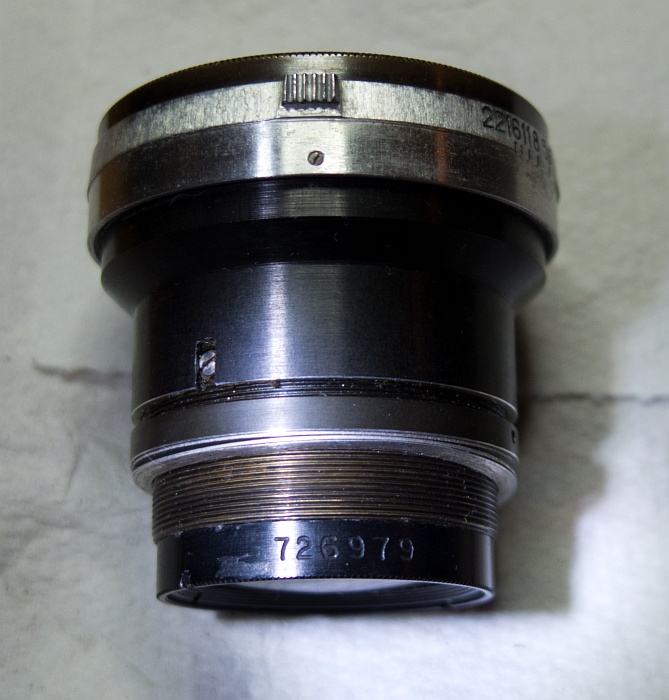
And it's a Sonnar! The lens barrel is made of brass and very heavy and has a number stamped in: 726979 so the real number is 2726979. According to the "zeilei" documents it should be made in 1943.

There is also the fourth bigger screw on the outer barrel which is made of aluminium. And it is light yellow coated on the front lens and light purple on the rear lens.

And it has 13 aperture blades.

I have made some test pictures with it (the screwdrivers) wide open (still soft) and at aperture 4.0 (sharp!) with my Pentax Q.

The fourth screw:
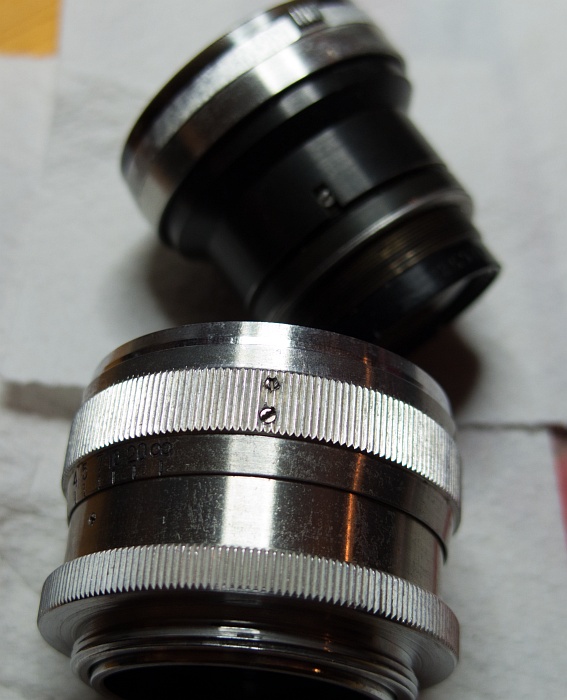


The rear number:


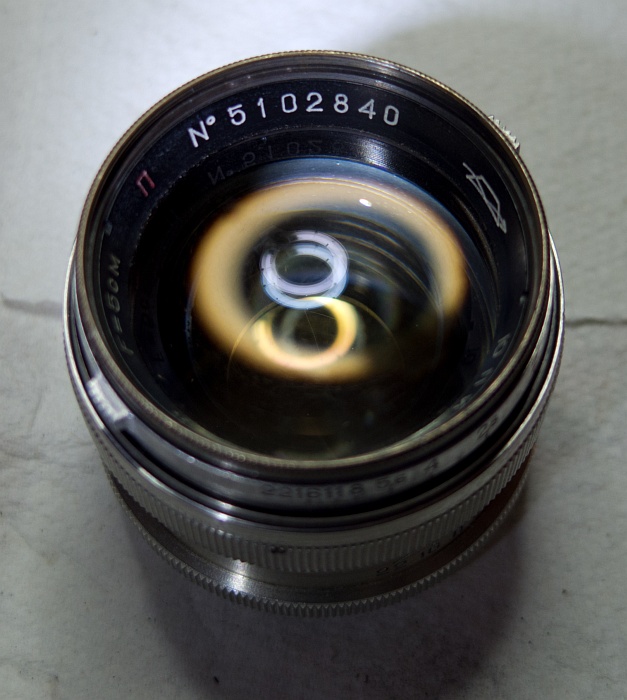
The J-3 engraving and 51 serial number:


Wide open:



Aperture 4.0:



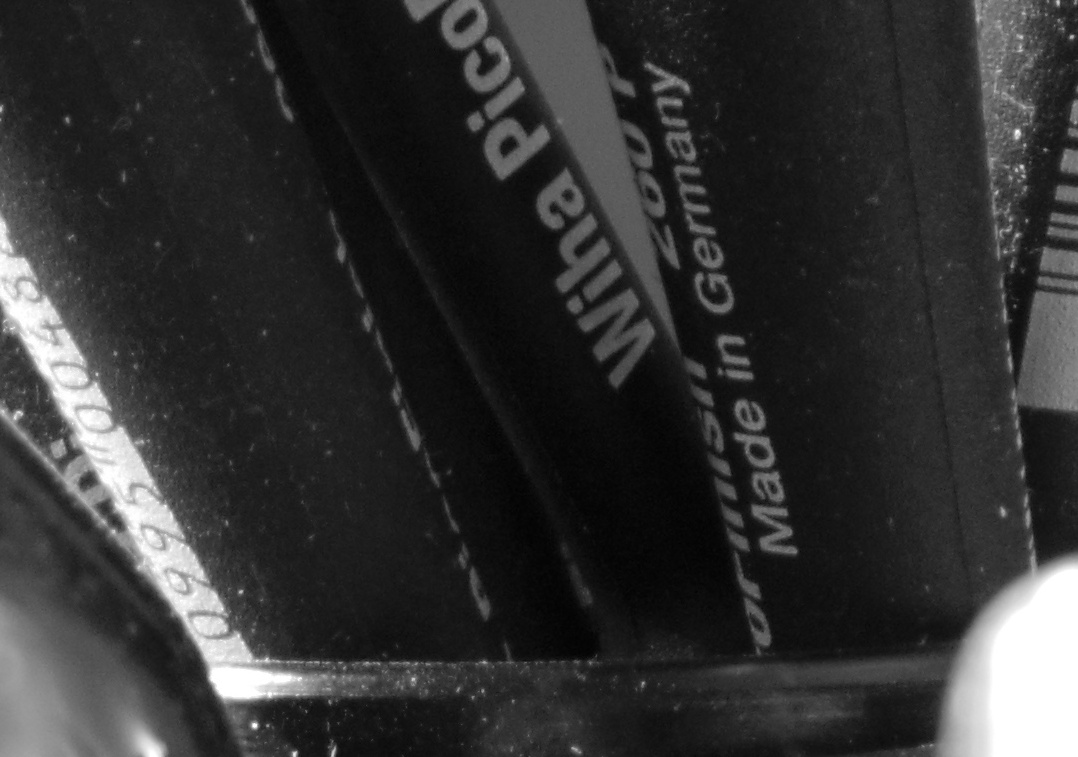
I have added a crop 100% of the picture taken with 4.0. Not sharpened. It's really nice :-)


Ulrich

http://fotos.cconin.de

Reply with Quote Edit Reply Delete Reply
A very fine lens! I had not seen it.
I have too a 1951 Jup 3. But mine is probably more a crossover: no ears. Lens barrel in brass too and external one in aluminium.

The coating is green (really!): never seen till now, except on a 42mm Jup 3 from 1951 too (on eBay). I wonder where this coating comes from...

Something else interesting: the serial number with 4 digits (510383) compared to yours: 5 digits.

Bravo! Amitiés. Jacques.
Reply with Quote Edit Reply Delete Reply
Jacques,

yes it's a nice find. I have found a nice detail in the "zeilei" documents. There are 3 Sonnar 1,5/50 described, first one for the Contax with serial number 2724821, one in M39 mount with serial number 2725477 and a Kiev Sonnar with number 2725552.

These lenses are all from a batch of 3000 lenses that was made in January 1943.

And there is one very special thing: The Kiev Sonnar with inside barrel number (2)725552 hat a KMZ logo and the Jupiter 3 engravings. And it has serial number 5103194.

Now compare these numbers to mine: (2)726979 on inner barrel and 5102840 on front ring. Very close. So I think that mine is also from this batch from January 1943. A very well dated lens Smile

Ulrich

http://fotos.cconin.de
Reply with Quote Edit Reply Delete Reply
Ulrich,

No doubt your lens was delivered the 29/01/1943, by Thiele. As a German lens...
The main problem, for me, is to know what the Russian made of these lenses, and in which order.
Generally speaking, one can find Sonnars converted to ZK, or to Jupiter, or remaining Sonnars, all that from the same batch. I try to find sense in all that mess and for the moment...Disapprove

Another question about our two Jupiter 3-s: why such differences?

Jacques.
Reply with Quote Edit Reply Delete Reply
Jacques,

as a "real german lens" it should be delivered on 30.1.43, exactly ten years after Hitler was made to dictator ... Big smile Just kidding.

But it's an interesting question, I also wondered why this lens was sold so late, in 1951 with a Sonnar barrel and why there are earlier lenses without the number on rear barrel.

I don't know. Maybe it easy to explain. They have found a box full of half assembled lens barrels in the early 50ies, or maybe there were so much left over after the war (I wondered a bit about a batch of 3000! lenses in only one month during the war at a time were cities like Hamburg were bombed twice a week and in Dresden/Jena they produce 100 1,5/50mm Sonnar lenses a day ;-), so that they could use the lenses such a long time.

And in the same time they began to redesign the original Sonnar lens design to the Jupiter design and so we can find this variations Smile

Ulrich

http://fotos.cconin.de

Reply to Topic

Forum code enabled