
The photographic plate in the role of Sherlock Holmes.
Entirely exceptional prospects are opened by the method of photographic analysis. In forensic examination, in the study of old parchments and documents, in astronomy, in photo-technology, it has opened wide horizons that broaden with every hour.
The method of photo-analysis and its application are themselves simple: a thoughtful photographer can draw enormous benefit from it and apply it wherever this kind of analysis leaves all others far behind.
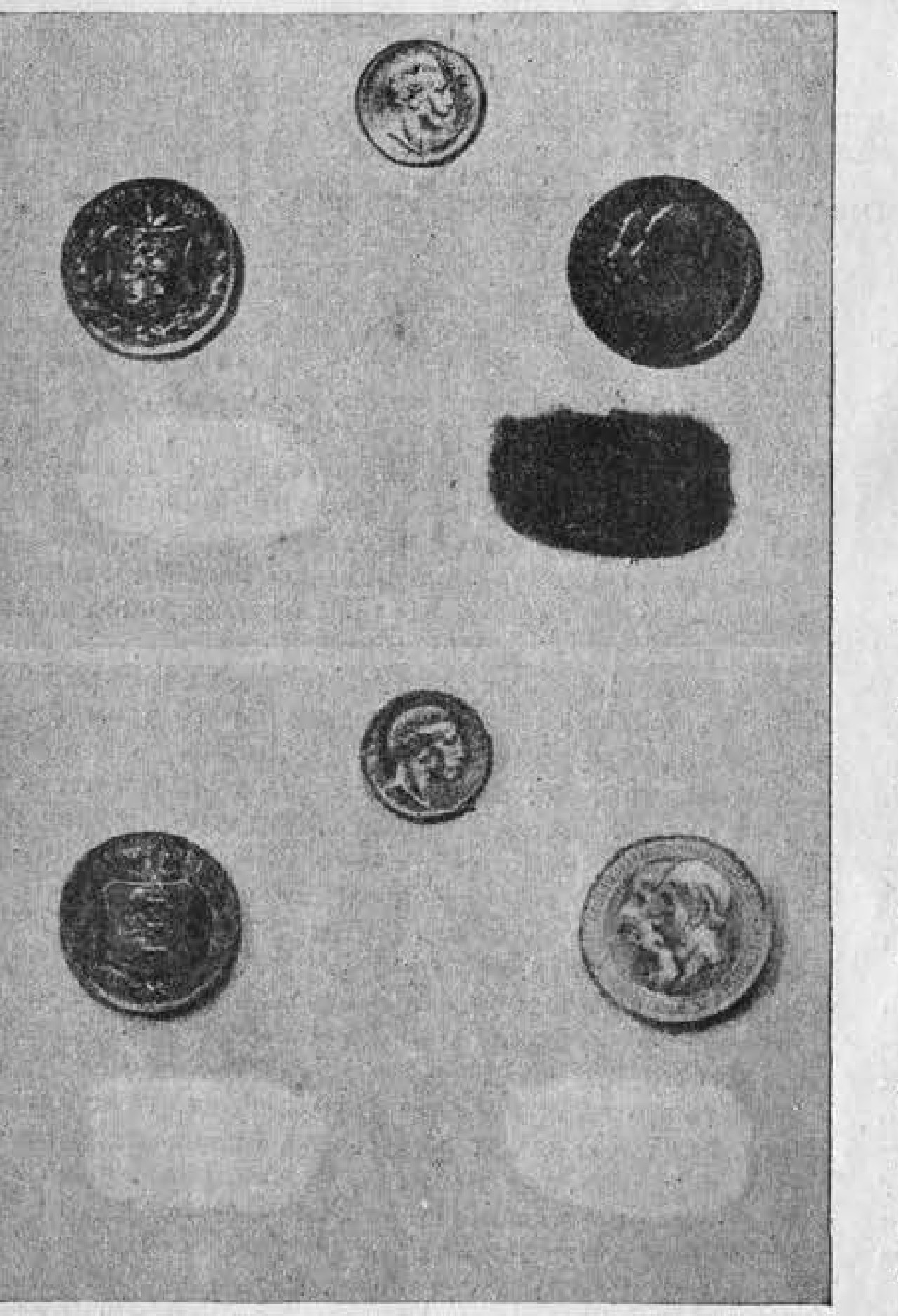
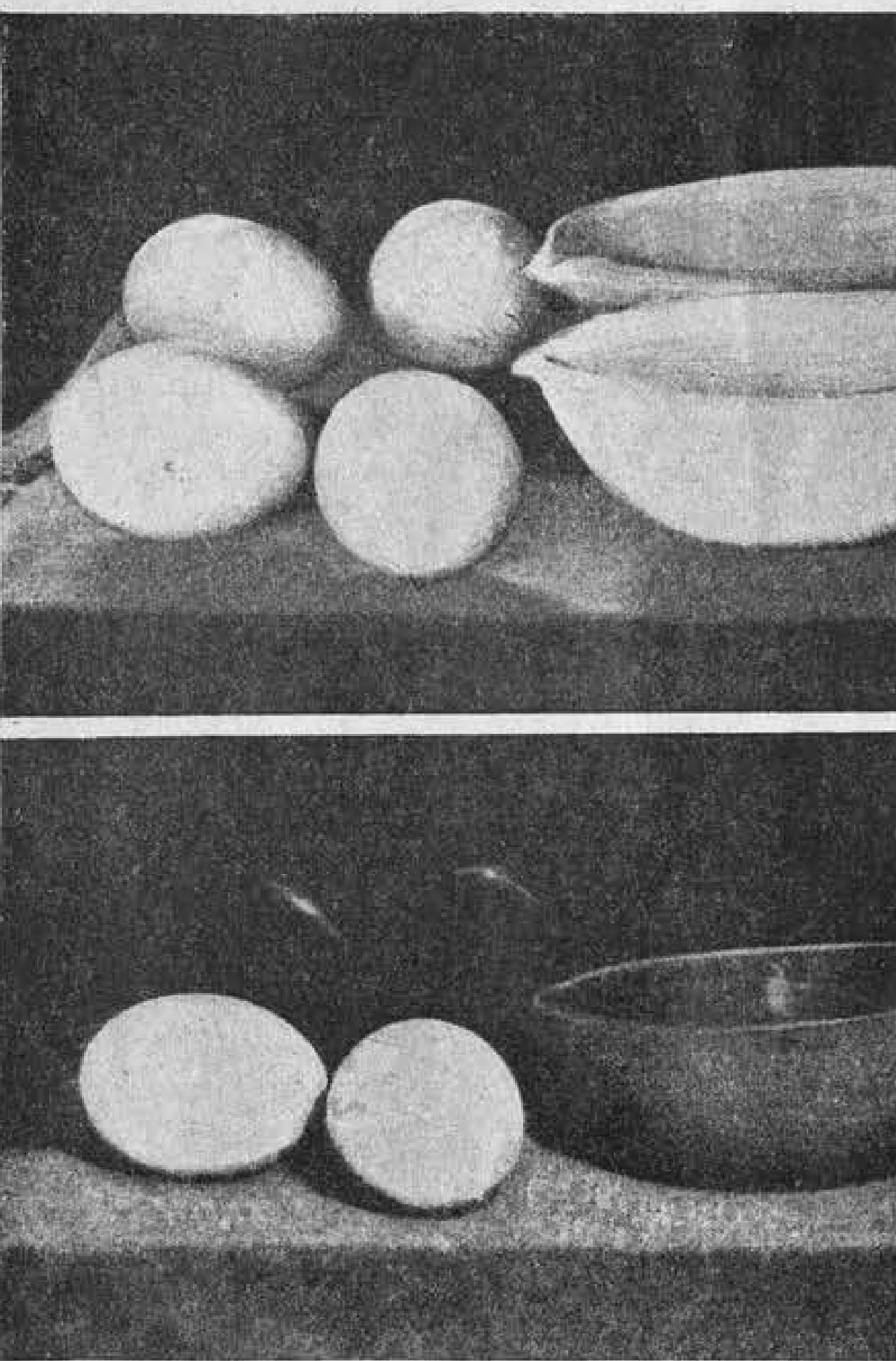
Let us begin straight with the heart of the matter. Look at the picture: it is a shot of three coins and two white dabs of powder on paper, made under red light on plates sensitive to red rays as well. Can you, without being a connoisseur of foreign coins, tell which is copper, which silver, which gold — and whether the two “dabs” below are the same substance? The shot gives no material for solving so complex a task.
Now look at the second shot: the same objects, but taken under violet light. The picture has changed substantially. One dab came out black, the other stayed the same, and the brightness of the coins is quite different. How to explain this? The first conclusion suggests itself: the coins and dabs reflected (or absorbed) red and blue rays unequally.
We know that white light is heterogeneous: it consists of the seven colors of the spectrum, which only in mixture create the impression of white. Falling on paper that reflects all colors in roughly equal proportion, they give the impression of a white surface. Paint the paper red and you see a red surface: the paint reflects mainly the red rays of the whole spectrum and absorbs the rest. Black paper absorbs decidedly all rays; blue paint reflects predominantly blue ones.
Red, white and blue paper you will of course tell apart at a glance. But the difference of paints and shades can be far subtler — a difference of tone that our eye, an instrument not perfect in all respects, cannot distinguish. And yet scarcely two objects in the world reflect the rays falling on them identically. Only wholly homogeneous bodies, with identically finished surfaces, reflect alike. Polished metals (silver, say) reflect in every case one and the same quantity of the rays that fall on them.
Here another very important property is revealed: red rays are reflected in one ratio to the incident light, blue in another, green in a third, and so on — rays of different colors are reflected differently. Gold reflects only about 20% of violet rays, 80% of yellow, 90% of red; copper — 20% of blue, 70% of yellow, 85% of red; platinum — 51% of blue, 60% of yellow, 60% of red; silver — 95% of blue, 91% of yellow, 74% of red (silver reflects light very fully, which is why mirrors are coated with silver). Polished platinum and silver are hard to tell apart by eye; but investigate how much of which rays they reflect, and you can at once tell which is which, guided by the figures above.
Let us set out the result of our coin shots as a table and compare it with the reflective properties of the metals, knowing that the coins are of silver, gold and copper:
| In blue rays | In red rays | Blue | Red | Metal | |
|---|---|---|---|---|---|
| Left coin | darker | lighter | 20% | 85% | copper |
| Middle coin | darker | lighter | 20% | 80% | gold |
| Right coin | lighter | darker | 95% | 74% | silver |
| Left powder | white | white | — | — | |
| Right powder | black | white | — | — |
Copper reflects 20% of blue rays — a fifth of those falling on it — and a full 85% of red. In which rays will a copper coin come out brighter? If the plate is sensitive to red rays (and it can be made so), then naturally it comes out brighter in red, as it did for us, since in percentage terms the plate received more red rays than blue from the coin.
Turn to the powders: one reflects both red and blue rays, the other does not reflect blue at all — in those rays it came out black. To identify it, one must run a long series of experiments reflecting rays off known powders and getting the percentages, as was done for the metals. Such experiments have been made, and it is known that chalk reflects red and blue almost equally, while zinc oxide does not reflect blue rays at all. These are the very powders in our picture; the zinc oxide came out wholly black in blue rays.
One must not conceal from the reader that our example is very simple; in practice, solving tasks by photo-analysis is complex. To identify a substance one sometimes cannot merely compare its shots in two rays — one must shoot, where possible, in a whole series of “monochromatic” (homogeneous) rays and compare them not only qualitatively but quantitatively, determining the ratios of the object's brightness in all the rays. Let the brightness in blue rays be 1; in green it is twice as pale (½); in red seven times brighter (7), and so on. Such rows of figures are then easily compared with rows obtained for known, previously photographed substances.
The American professor Wood determined in this way what substances the separate areas of the Moon consist of. On the Moon there are dark and light spots — depressions (called seas, though there is no water in them) and elevations. But even perfectly even surfaces, seen through good binoculars, show different brightness: naturally they are of different substances that reflect sunlight differently. Wood prepared “light filters” — glasses passing the rays of various parts of the spectrum — and shot parts of the Moon through each in turn, obtaining rows of figures for many lunar areas; through the same filters he shot various substances in the laboratory and compared. It turned out that the lightest parts of the lunar surface reflect the various rays exactly as crystalline sulfur does — so one could conclude that there are deposits of sulfur on the Moon. By what other analysis could one learn what lies on the surface of our satellite? You cannot run a chemical analysis up there!
Among scientists a long dispute went on over what the white spots at the poles of Mars are — ice, or carbon dioxide in a crystalline state. There were weighty arguments for both. The problem was solved by G. Tikhov, astronomer of the Pulkovo Observatory, who photographed the Martian spots through a red and a green filter, and pieces of ice and carbon dioxide through the same filters. Carbon dioxide gave almost no image through the green filter (it does not reflect green rays), whereas ice and the Martian spots, with an identical brightness ratio, gave quite clear, sharp images in those rays. All opponents of the theory of a Martian icy cover were compelled to agree with it.
So the methods of photo-analysis let us, in some cases, solve tasks insoluble without them: where the eye notes no difference of shade, the photographic plate comes to its aid as a more sensitive instrument. As the example shows, a numerical determination of brightness ratios is not always needed — so clear and striking are the results.
But there is yet another field of application: rays invisible to the eye altogether. The Sun and many luminous bodies emit rays that do not act on the retina — infra-red at one end of the spectrum and ultra-violet at the other — just as the ear catches sound only within limits: a very fine sound is inaudible to it, as the eardrum does not react to very low notes. Though our eye does not catch infra-red and ultra-violet rays, they exist in nature; bodies reflect them on a par with visible rays, and there are cases when precisely these invisible rays are reflected more, or far less, than others — and either gives us a key to discoveries unexpected to the eye.
There exist so-called “sympathetic inks”; of many kinds, but all with one property: what is written in them is invisible until the paper undergoes some chemical action — heating, treatment with a compound. A correspondent sends an ordinary letter, and between the lines writes a secret message in sympathetic ink; the recipient, knowing its composition, treats the letter and reads what was hidden. Can this concealed writing be detected without knowing how to develop it? In most cases, yes. Between the ordinary lines the letters of the secret message were laid down; the paper absorbed them, and there the fibers are impregnated with a colorless compound and so have changed their properties. For chemical analysis there is too little material, and it would destroy the order of the letters: it is inapplicable — one must not merely reveal a foreign substance but read what is written. The difference of molecular structure that chemical analysis detects will not help here; we use again the substance's reflective capacity. Almost all sympathetic inks are easily detected when photographed through a violet filter in violet rays, some also in red: on white paper where nothing is visible, the shot reveals clear lines of letters.
Old parchments, whose writing has long faded and is indistinguishable by magnifier or microscope, are read with ease on a shot in monochromatic (single-color) light: where the letters are, the parchment was scratched by the writing implement — this changed its structure and its reflective capacity; and the ink or India ink with which it was once written lost their full absorptive power (black is full absorption of all rays, as white is full reflection), but retained it partially — too slightly for the eye, enough for photo-analysis. One need only find in which rays to photograph so that the parchment becomes as readable as centuries ago, or as if freshly written.
In the St. Petersburg post office there was once a case of a tampered book: what was written in violet ink had later been flooded with black, so that it was impossible to make out what lay beneath, by light or any other means. Yet it was clear in theory that where a record lies the paper must reflect differently than where there is only a blot. Photographers tried to separate the black ink from the violet by photo-analysis, shooting through various filters — and the original record came out with full clarity, giving grounds to hold an official to account, since the result did not match the figure he had entered.
From all this it is clear that photographing in various rays, in monochromatic light, opens wide possibilities. The application of photo-analysis is enormous; one need only know how to apply it — a skill the photographer gains once he takes the trouble to master some important laws of reflection:
- The surfaces of bodies have the power to reflect rays of various colors.
- Bodies reflect not only visible rays but invisible ones too (ultra-violet and infra-red).
- The difference in bodies' reflective power is caught by the eye very crudely; in photography it is detected far more subtly.
The resourceful use of monochromatic light or a filter makes it possible to detect on a shot what can be detected by neither the eye nor any other means.
— S. Baranov