
The noise raised around modern high-aperture optics of F/2 might make one think this is a truly “new” invention. But a search in the deeper sources shows that already in 1870 there existed a lens of aperture F/2.3. And if in the years since, the striving for greater speed showed itself in nothing, there are two reasons: the improvement of shooting materials, and the demands made of the shots.
The start of the twentieth century brought the universal introduction of well-corrected anastigmats, which gave great image sharpness; naturally the public and photographers were satisfied with the edge-to-edge sharpness they gave and neither sought nor even thought necessary a greater speed.
Further development went, as in many fields, not in a straight line. High-aperture lenses were pushed aside not by the invention of a new sort of glass, nor by a wholly new type of lens, but by the lag in raising the sensitivity of materials. Just as the “Petzval” lens once gave young photography new possibilities with the then so insensitive material, so now high-aperture anastigmats must help photography move forward, until the chemists open new, still more sensitive emulsions. Such is the present situation. While the chemists think, it seems fitting to make a small retrospective survey, not pretending to completeness, of the paths by which optics developed toward greater speed.
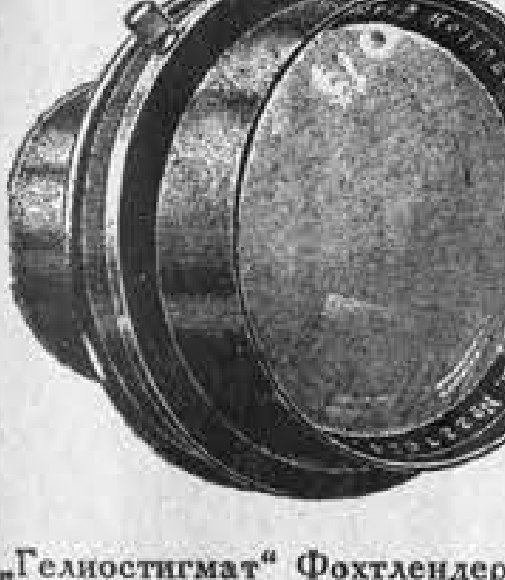
Even before the anastigmat, in 1870, the firm Voigtländer & Son of Braunschweig made, to Zincke-Sommer's computation, the “Petzval” lens of aperture F/2.3. Though a monstrous cannon — covering the image field demanded an enormous focal length — it was, for the means of the time, a supreme achievement. Compare it with today's long-focus high-aperture anastigmats, e.g. the Voigtländer “Heliostigmat” F/2.5 of 33½ cm focal length, and the progress since 1870 is plain. Both have four lenses, in both the front element is two cemented parts and the rear two uncemented — yet what a difference in performance! The Zincke-Sommer lens has an image field of barely 10 degrees, sharp only in the middle and falling off badly toward the edges, whereas the Heliostigmat has an image angle of more than 30 degrees, evenly sharp across the whole plate.
The priority in creating a high-aperture anastigmat belongs to the engineer Walter Zschokke, who computed in 1907 the so-called “Celeritar” F/2 of 90-mm focal length. This six-lens, asymmetric lens was a new type. Unfortunately, Zschokke's brilliant discovery outran its time: full sharpness from edge to edge was then demanded, and the natural shallow depth of field of so fast a lens ruined its career — it never even went on sale. By Zschokke's own account it was conceived from the start only for special purposes (autochrome shots).
The road to high-aperture anastigmats was opened by the film industry, which for interior shooting demanded ever greater speed. At the short focus used for cinema, this fast optics was readily accepted even during the reign of full sharpness. As far as I know, Dalmeyer in London released, already in 1913, a cine lens of aperture F/1.9 (with a single focal length, 75 mm). “Taylor, Taylor & Hobson” obtained in 1920 a patent on an F/2 anastigmat of six lenses, of the Gauss type, also made for experimental purposes.
Bausch & Lomb of Rochester announced in May 1922 an F/2 anastigmat for cinema needs, to Hermann Kellner's computations. This triplet was notable for an astonishing use of a parabolic surface to correct spherical aberration — it seems the parabola was applied to photographic ends here for the first time, which of course greatly raised the cost. The “Gundlach Manhattan Optical Company” released in 1923 the “Cine-Ultrastigmat” F/1.9. Also in 1923 the Rüdersdorf optical factory in Berlin (“Ryo”) released its cine-anastigmat F/2, with a focus up to 180 mm for special purposes.
In 1924 Hugo Meyer released Rudolph's “Cine-Plasmat” F/2; the same year saw Ernemann's “Ernostar” F/2, well known thanks to the firm's wide advertising, now at F/1.8. It should be noted that around 1922 Goerz built the “Dogmar” F/2 for special purposes — control shots at the races — and, to omit nothing, one must mention Zeiss's “Biotar,” built as early as 1921 for experiments (photographing shots being fired and the flight of a bullet).
The rest is before everyone's eyes. Through 1924–25 the development of speed scored ever greater successes, yielding a series of new constructions. The lineup on the market is now as follows. Lenses of the highest speed: the new (1926) “Cine-Plasmat” of Hugo Meyer F/1.5, Dalmeyer's cine-anastigmat F/1.6, the Taylor, Taylor & Hobson anastigmat F/2, Ernemann's “Ernostar” (F/1.8 to F/2.7), the Ryo anastigmats F/2, and the new cine-anastigmats Astra “Tachar” F/1.8, Rietzschel's “Prolinear” F/1.9 and Schneider's “Xenon” F/1.8. Lenses of high speed: “Tessar” F/2.7, “Ernostar” F/2.7, “Antikomar” F/2.8 and F/2.9, and the already-named Voigtländer “Heliostigmat” F/2.5, which, at a focal length up to 33½ cm, is the most long-focus high-aperture lens.
In conclusion, note that the speeds of all these instruments, even at a very small difference in opening size, differ greatly from one another, since speed is inversely proportional to the square of the lens's relative opening. Thus an F/2 lens is one and a half times faster than F/2.5 optics (2² = 4, 2.5² = 6.25); and an F/1.5 lens is nine times faster than ordinary F/4.5 optics (1.5² = 2.25, 4.5² = 20.25). Development toward speed has, of course, given us certain possibilities — but the great weight, bulk and high price of these giant instruments rule out their use in amateur practice, where aperture F/3.5 must be considered practically the highest.
— S. Yasinsky