
Satisfying our readers' many requests, we place in this department essays for comrades who have not yet taken up photography and wish to acquaint themselves with it and make their first steps. For those wishing to go deeper, the department “Fundamentals of Photography” begins in the next issue.
Essay one. The photographic apparatus
Photographic shots are the result of two processes: the negative (obtaining, by means of the camera, an image on a glass plate) and the positive (obtaining from the negative a print on paper).
The chief thing needed for photography is the photographic apparatus, or camera. In its simplest form it is a box with a matte glass at the back, in place of which, during shooting, is set the so-called “cassette” holding the light-sensitive plate or film. At the front is the apparatus's eye — the lens. It casts on the matte glass a reduced image of the object it is aimed at, and this image is imprinted by the plate.
To grasp the action of the lens, try this experiment. Stand by day in the middle of a room with a magnifying glass; hold it toward the window with one hand and, at some distance behind it, a sheet of white paper with the other. Move the paper toward and away from the lens until, at a certain distance, you see a sharp image of the window on it. That distance depends on the magnifier's focal length and differs for each lens. The image comes out upside down and not very clear, because light falls on the paper from all sides. Bring the lens nearer the window and you must move the paper farther back, and the window's image grows larger; step away and the image forms at a smaller paper-to-lens distance and comes out smaller. The lens of a camera acts exactly like the magnifier in this experiment.
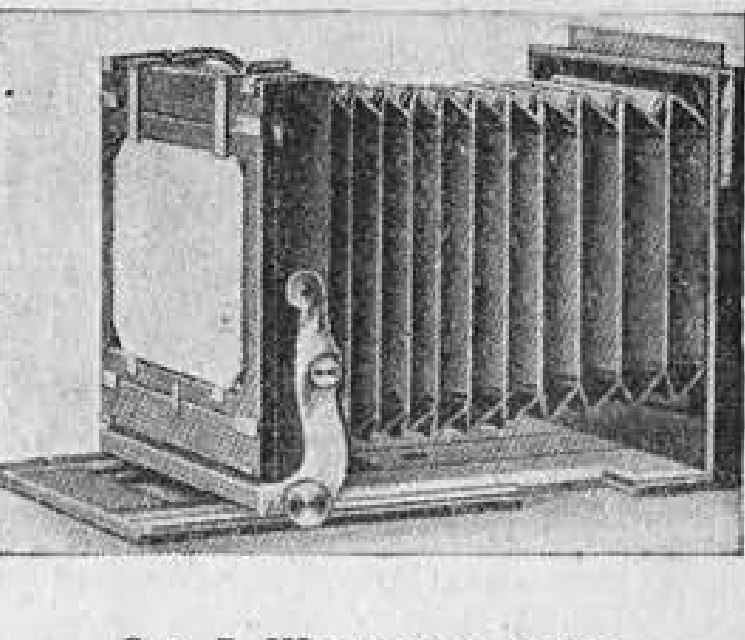
In cameras the side walls are usually replaced by an accordion-like bellows moving along a hinged board, which makes the apparatus folding and compact to carry and lets one change the camera's extension so as to get sharp images of both near and distant objects — to set the focus. Some apparatus (box cameras and strut-folding cameras) use other focusing devices, such as a sliding mount with a worm thread holding the lens.
The lens used in photography is no longer an ordinary magnifier: instead, several specially ground and assembled glasses are used, so the image comes out sharper. On the lens's merits depend the apparatus's capability and, in most cases, its price. The best and dearest lenses are anastigmats, sold by various firms under different names (e.g. the Zeiss “Tessar”). For beginners the so-called aplanats are quite enough, whereas single-glass lenses (landscape lenses, the “monocle”) are not very suitable: their image comes out either not sharp enough or, when stopped down, not bright enough — which makes the owner too dependent on good weather and sun.
A lens's focal length is a constant quantity, and on it depend the scale and sharpness of the image on the matte glass. Longer-focus lenses give, from the same point, larger images than shorter-focus ones; the shorter ones, in return, take in far more of the surroundings from the same spot — they have a wider field of view. The diameter of the glasses matters for image brightness: a larger glass passes more light. Lens mounts often bear markings like 1:7, 1:12, and so on, meaning the free opening is a seventh (in the first case) or a twelfth (in the second) of the focal length (focus is denoted by the letter F — Russian Ф). This ratio of opening to focal length determines the image's brightness on glass or plate and is called the lens's aperture (light-power). Thus a lens F = 1:7 is faster, and gives a brighter image, than F = 1:12; the faster the lens, the less time the plate needs for exposure.
The full lens opening is used only for very fast, instantaneous shots. Otherwise, to reduce the working opening through which light passes, diaphragms are used — in the simplest form, metal plates with round cut-outs fixed in the right place in the lens. The best lenses always have a so-called iris diaphragm, whose hard-rubber leaves form an opening whose size is set by turning the outer ring. Diaphragms serve to improve the image and make it sharper; but the smaller their opening, the less light passes, so even the dearest lenses work at low speed if strongly stopped down.
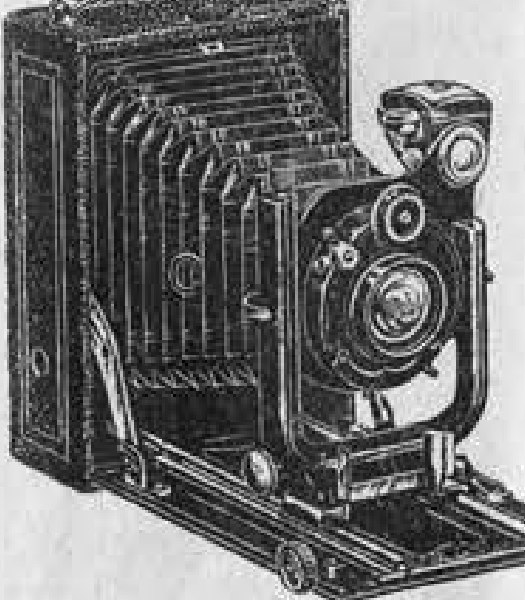
A stand camera (fig. 7) is comparatively bulky and heavy and cannot be worked by hand; so the beginner should get a hand camera, which suits him best. The most widespread hand camera for plates and flat films is shown in fig. 5. Although such cameras are quite fit for hand shooting, it is still worth acquiring a light tripod too — in some shots (indoors, say) one can hardly do without it. To the lens of such a hand camera is fixed a device that lets light pass through at the needed moment and act on the plate: the so-called instantaneous shutter, which can be set to various intervals (1/50 second and so on); on it is arranged a means of stopping down the lens.
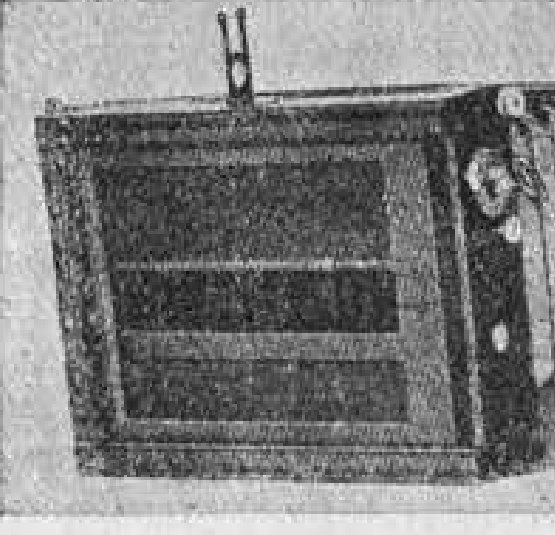
Shutters are most often placed between the lens elements and are called central, but some sit in front of or behind the lens. There are also slit or curtain (focal-plane) shutters (fig. 8): a curtain of black material with a slit running the length of the plate, the slit width adjustable. The slit passes directly in front of the plate, so that with the lens open the plate gets a brief illumination whose duration depends on the slit width and the winding speed. Whereas central shutters allow at most about 1/300 second, curtain shutters allow exposures even of 1/3000 second, sometimes needed for fast-moving subjects. In our conditions a central shutter's speed is quite sufficient.
A beginner should be advised to use an apparatus whose bellows extends on a front board, with a lens of aperture not less than F/8 and a central shutter. Central shutters are better for slow instantaneous and timed shots: they are very convenient, easily allow the most various speeds, and are simple to handle.
To fix the image on plate or film, chemical means serve. Some substances keep unchanged only in darkness but change the instant light reaches them — a property possessed to a high degree by bromide silver (a compound of metallic silver and bromine). Photographic plates are glass coated on one side with a thin layer of bromide silver held in gelatin; for films the base is thin celluloid. Films are light and unbreakable and can be carried in quantity. Place such a plate or film where the matte glass was and expose it briefly to the lens's image, and the bromide silver changes strongly where the image was bright (the sky, say), less where it was dimmer, and scarcely at all in the shadows. The change happens extremely fast, so that in good light one can shoot at 1/500 second. Naturally the plates and films must (except during the exposure) be guarded from all light but ruby-red until further processing makes them unchangeable.
To load the apparatus with plates, so-called cassettes are used, filled in a dark room. Cheap hand-camera cassettes are of black tin and hold a single plate; stand cameras and dearer hand cameras almost always have wooden cassettes holding a plate on each side (double cassettes). The plates are held fixed so that in shooting they occupy exactly the matte glass's place. The number of shots one can make in succession without entering the dark room is limited by the number of cassettes and plates. Film cameras have no such limit: roll and flat films can be loaded and unloaded in full daylight. For the amateur, films are a convenience but cost several times more than plates.
A word on the sizes of apparatus and plate formats. Especially portable are the so-called vest-pocket cameras giving 4½×6 cm shots; then come 6×9, 9×12, 10×15 and 13×18 cm. The most suitable format for amateurs is 9×12 cm, which we advise choosing: the camera is then not bulky, takes little space, and the shots are large enough not to require enlargement. Smaller cameras give interesting results on later enlargement, while larger ones come in time to feel like burdensome baggage.
Which construction you choose is a matter of taste and, to a large degree in our conditions, of chance. Good shots can be made with the cheapest apparatus, and for a beginner it is even preferable to start with simple mechanical means; we shall hardly be wrong in saying that a beginner will get better results sooner with a thirty-ruble folding apparatus than with a complex three-hundred-ruble reflex camera.