
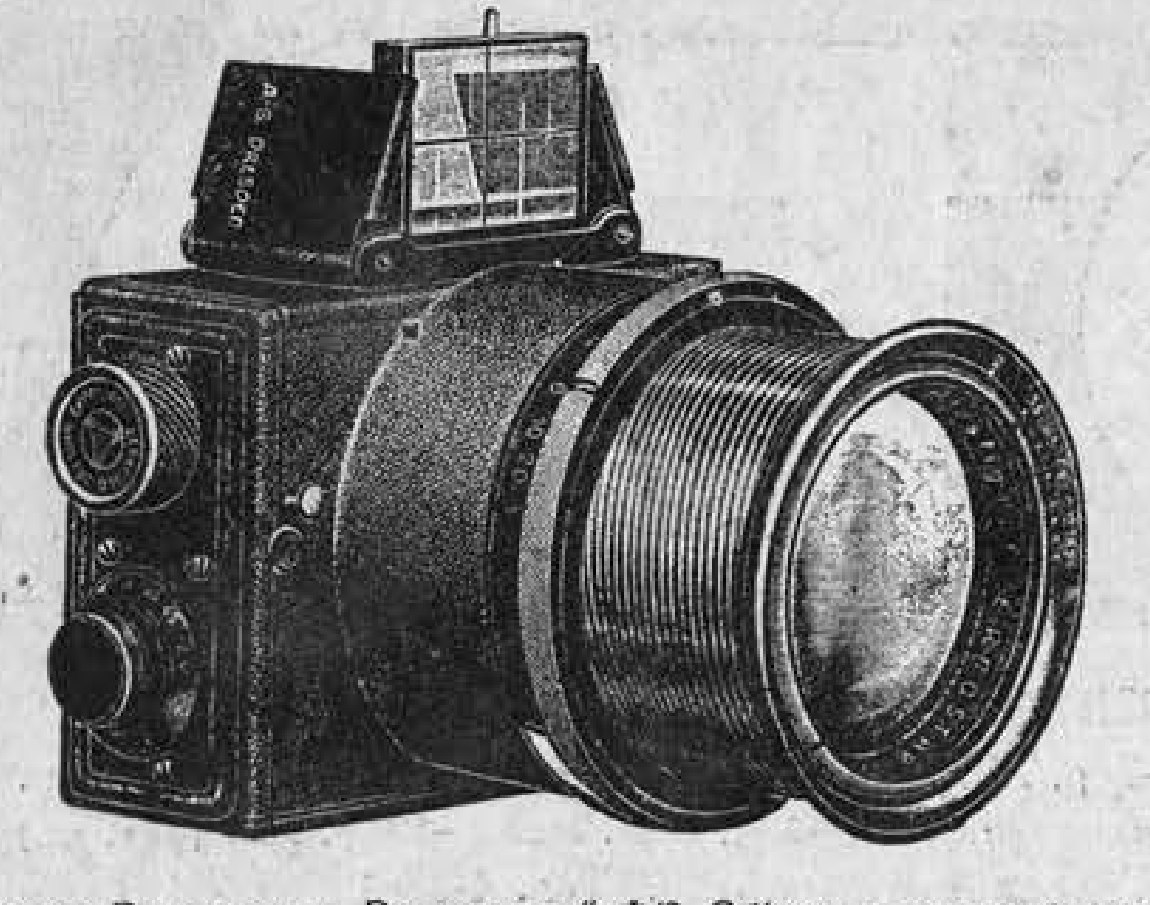
Until recently the aperture of photographic lenses usually did not exceed F/4.5, reaching F/3.5 only in exceptional cases. Lately there have appeared on sale lenses of working opening F/2.7–F/2 and even F/1.5, recommended by the makers for wide use.
All these extremely fast lenses give sharp images only at a very narrow angle of view and, undiaphragmed, have a very slight depth of field, which limits their use to quite definite bounds. The narrow angle rules out spatially wide shots, so that for amateur and professional alike only portraits, small groups and animal studies remain accessible. Such shots are shots under artificial light; evidently the building of very fast lenses was prompted mainly by the wish to shoot theatrical scenes during a performance under ordinary stage lighting — and, of course, at a fraction of a second.
It is interesting to work out the exposure time of the fastest lenses at full opening. The usual exposure tables reached, until now, a maximum of F/3.16, from which one sees that exposures at F/3.16, F/4.5 and F/6.3 stand to one another as 1:2:4. To expose, then, half as long as with an F/3.16 lens, an aperture of F/2.23 is needed — in round figures F/2.2 — and the next step should be F/1.58, in round figures F/1.6. Photographic optics has already given us a greater speed still: F/1.5.
Besides cine- and scenic shots, a lens of maximum speed is desirable for scientific ends too. In medicine, a fast lens would be needed for shots of the living eye or the oral cavity; in physics and physiology, for analysing fast movements and shooting luminescence; and, combined with a negative lens, as a fast telephoto for shooting free-living animals, or light and fire at night. Ordinary portrait photography will also gain, since more portrait shots become possible in the studio on panchromatic plates: even with a yellow filter one could make instantaneous studio shots of, say, speaking subjects, avoiding the painful rigidity of expression. Instantaneous shooting indoors is quite possible with fast optics and high-sensitivity plates.
The new, extremely fast lenses will also affect the photographic industry, especially camera construction. Already in the first camera sold with an F/2 lens one could see a characteristic difference from ordinary apparatus: it looked ugly beside what we are used to, because the lens exceeded the camera in width, and the optical part exceeded all the rest in both size and weight. So, despite the apparatus's small dimensions, the parts carrying the lens must be built very solidly, and the tripod socket moved forward. To avoid internal reflections, one should make the camera somewhat larger and set before the lens a light folding hood lined inside with red or brown velvet.
Since the depth of field in fast optics is very small, the whole instrument must work extremely precisely, and the plane of the matte glass must coincide exactly with the plate surface — there must be no “cassette difference.”* Equally important with the new lenses is the question of shutters. Since the aim of fast lenses is the maximum use of light, the shutter too must pass the maximum light at every speed. In this the curtain shutter has so far not been surpassed — yet it has many faults: rolling wheels come out as ellipses, the shutter at slow speeds is often not fully closed, the cloth grows hard and brittle with time, the speed is not always constant, and exposures of 1, ½, ⅕ and usually 1/10 second cannot be made with it at all. The central shutter, which allows precisely these very important exposures, uses light worse and suits only relatively small formats; the size that fast lenses would require for 9×12 and 13×18 cm plates could not be used, for the monstrous bulk and weight of the whole apparatus.
The possibilities and advantages that fast optics opens can be fully used only when camera construction and precise mechanics adapt to the new demands. Our photographers should by no means overrate the new optics or be carried away by it: scientific work, instantaneous indoor portraits and theatrical scenes under ordinary light are themselves the limits of its use, and are possible only with plates of the highest (Ultra-rapid) sensitivity, which do not exist in the USSR; the shallow depth of field is a serious drawback, to say nothing of the already excessive cost (a 4½×6 cm camera costs 230 rub., a 9×12 — 660 rub.). To the ordinary Soviet photographer — amateur or journalist — needing an inexpensive, reliable universal lens, all these superficially tempting high-aperture achievements will hardly be of use in practice.
— G. Hinterberger
* Ernemann's “Ermanox” 4½×6 cm model with the Ernostar F/2, tested by the editorial board of “Soviet Photo,” though precise as regards its cassettes, gave a substantial difference in the flat-film adapter, making its use impossible without correcting that difference. Filmpacks, which are not distinguished by great precision of fit — especially in small sizes — are generally not recommended with fast optics.