
Sunlight, like any beam of “white” light, is in fact complex: it consists of a whole complex of the various colours of the spectrum, which only in mixture give the impression of white. A beam of sunlight, falling on various objects, is partly absorbed and partly reflected. White paper reflects an equal percentage of all the rays falling on it; red cloth reflects only red rays, absorbing the rest; black paint absorbs all rays of the spectrum equally. The surfaces of bodies (roughly, apart from white and black) possess so-called “selective” absorption, reflecting some of the seven spectral colours more and others less, and so creating in our eye — almost equally sensitive to all colours — the impression of various colouring, the result of mixing the rays already reflected from the surface. Only white objects reflect all rays equally; black ones absorb all equally.
The photographic plate, on which the image of the photographed objects falls, is unfortunately not equally sensitive to all rays: the emulsion of ordinary plates is most sensitive to blue, violet and ultra-violet, little sensitive to yellow, and quite insensitive to red and green. So the blush of a human face always comes out on a photo-portrait as a black spot, the blue sky too white (its little clouds lost), and the accuracy of reproduction is in some cases so disturbed that one may say photography distorts reality.
Good photographers strive to combat this defect, and there are two ways. One is to make the plate equally sensitive to all rays — a task for chemists and plate makers, difficult and only partly solved: plates can be sensitized (orthochromatic, sensitive to selected parts of the spectrum; panchromatic, sensitive to almost all rays), but this makes them dear and hard to get. The other way is to weaken artificially, during the shot, the rays to which the plate is most sensitive, thereby bringing the tonal gradation closer to reality. This second way is the more desirable because sensitizing plates to the little-actinic yellow and red rays scarcely weakens their sensitivity to the most “actinic” violet and ultra-violet — and the latter, unseen by the eye, always disturb the artistic reality of the shot. Let us take an example.
A field. From the foreground into the distance runs golden rye, sparkling in the sun. Beyond — a deep blue sky with a few cumulus white clouds. On the road a peasant woman in a sarafan stands out against the golden rye as a sharp red spot. Let us take the shot.
At normal exposure the blue sky, with its rays of the greatest “actinicity,” gives a sharply black negative and, on the print, an even white background on which the white clouds vanish (scattered, like the blue rays and all the rest). The yellow rye — to which the plate is little sensitive — comes out much paler, greyer than the sky; the red sarafan is a black spot, standing out against the grey rye far less sharply than the eye perceives it. The falsity is obvious: the eye catches the landscape in a quite different ratio of brightnesses — both the rye and the sarafan are bright, the sky on a hot summer day seems deep, distant, even faded, and the white clouds brighter than the blue behind them. The shot did not convey the real shades; the gradation is wrong.
Let us set the red sarafan aside: sensitizing plates to red is the most thankless task, complex and often inconvenient — and we shall see that other manipulations will brighten the sarafan anyway. It remains to change the ratio of brightness between the rays reaching the plate from the rye (mostly yellow) and from the sky (blue, violet, ultra-violet): the first to be left unchanged or strengthened, the second weakened. We are not free to strengthen, but we can weaken the blue — and must try to lower the sky's brightness without lowering the rye's, so that the result is close to the direct impression of the landscape. This is the task of a light filter — coloured glass, gelatin or another transparent medium.
Just as bodies that reflect rays are coloured in the colour they reflect, so transparent media take the colour of the rays they pass. Look at a window through the red glass of a laboratory lantern: all seems red; look at pure green, blue or any other paint: they seem black — the red glass passes no rays but red. Put a good ruby glass together with a green one and the pair is wholly opaque: the red rays passing the first do not pass the second, which admits only green, and is opaque to the rest like wood or iron. The photographer's task is to choose filters that pass the less actinic rays and hold back, in a known proportion, the most actinic ones, so that the final tonal gradation of the shot approaches the ratio of brightnesses in nature.
Filters are made by colouring gelatin with special dyes, and the photographer's task is to match dye and intensity of colouring to the aims he sets himself. Since we shall devote a special article to the practical making of filters, let us return to our example. We need to weaken the blue, violet and ultra-violet in which the sky is so rich, without weakening the yellow, to which the plate is already little sensitive — that is, we need a yellow filter: passing yellow, it will not weaken the rye. The yellow part of the spectrum is far from the blue end, and it is not hard to find a yellow dye that strongly weakens the blue. There are many: aurantia, for instance, passes red and yellow entirely, its absorption beginning at the yellow-green border and growing — green absorbed markedly, blue and violet still more — then falling off toward the violet/ultra-violet border. Better still is the dye called “tartrazine,” whose absorption begins in the first third of the green and rises quickly (very little blue and violet pass); a filter dyed with it suits us exactly.
Shoot the landscape through this filter: the blue rays that act so strongly on the plate are much weakened, and the sky comes out “less exposed”; the clouds, reflecting all the other rays besides blue, are relatively strengthened; the rays from the rye are not weakened at all. The landscape comes out more normal, closer to reality.
One must not forget that using a filter changes the exposure — lengthens it considerably: the plate being little sensitive to yellow, to get the rye normally exposed one must lengthen the exposure, which could over-expose the sky — but the sky is so weakened by the filter that there is nothing to fear. Besides, the filter, a foreign and coloured medium before lens or plate, reduces the light reaching it, lengthening the exposure further. So, before all else, the photographer must determine by two or three trials how much a given filter lengthens the exposure, though in some cases this can be known in advance and in theory. (Filters usually lengthen the exposure 2–5–10 times.)
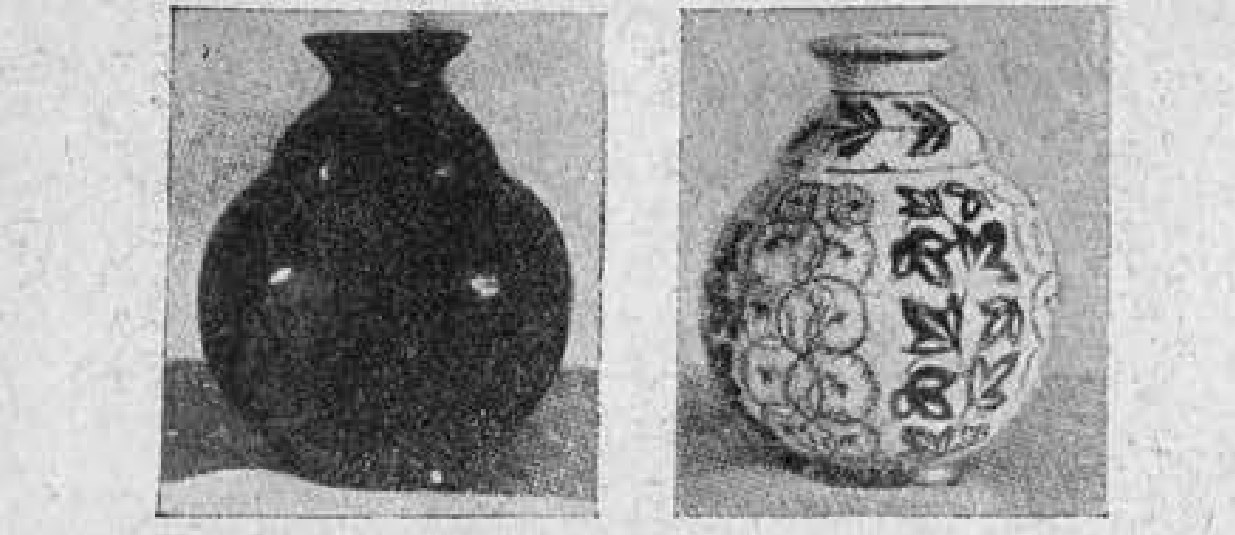
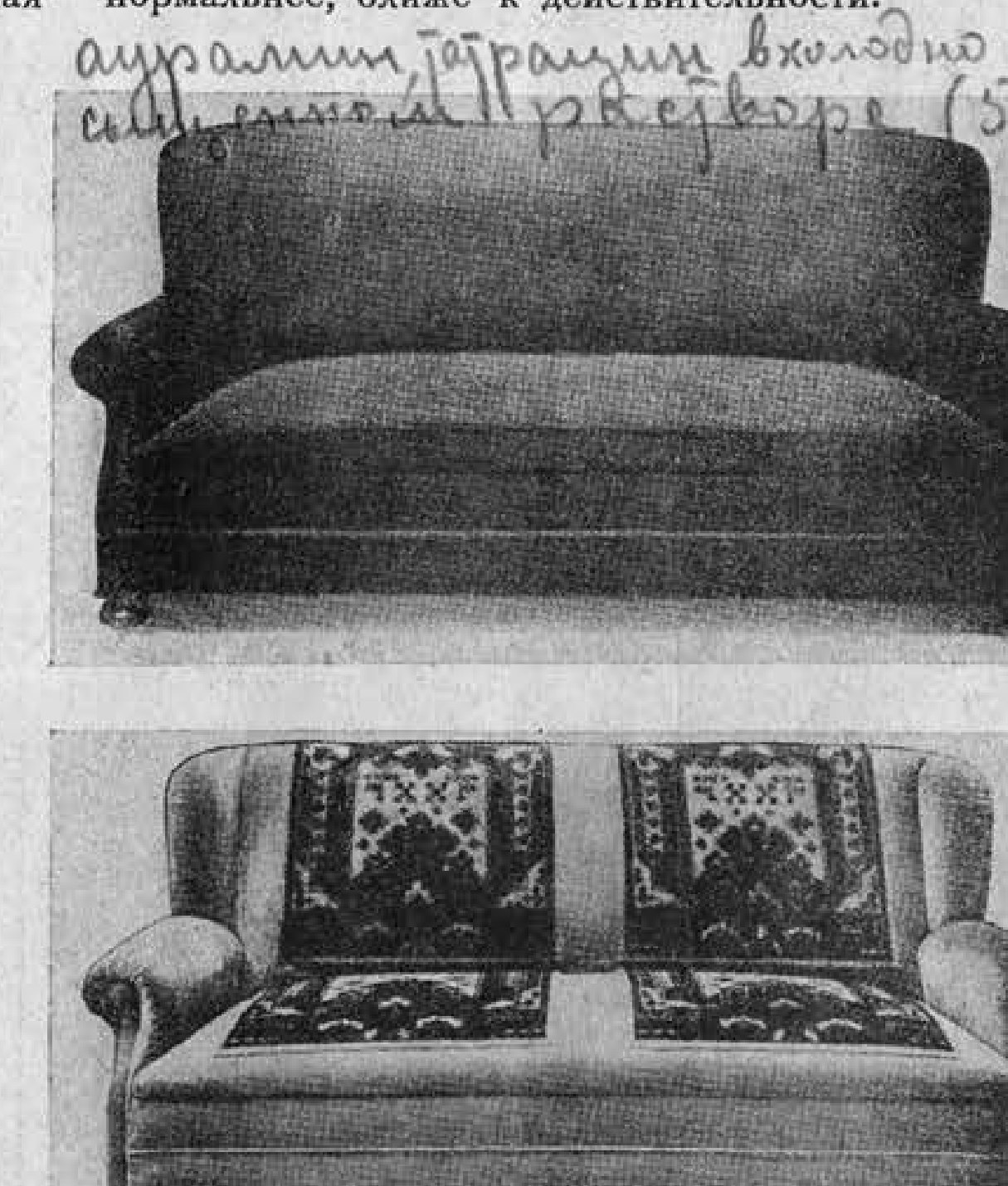
To handle filters, make them, and choose the right one for the task is one of the photographer's most important skills. In some cases a shot without a filter is worthless. Look at figure 1: a porcelain vase with a thin blue design, glazed over with a transparent red glaze. In the ordinary shot (left) only the vase's outline comes out. Sensitize the plate to red (to get the vase's outline) but weaken the red with a filter, and you get the right shot, in roughly the ratio the eye catches, the gradation correct. Brighter still is the carpet-divan example (fig. 2): the carpet's predominant tone is red, but it bears patterns of various shades; the upper and lower shots are on sensitized plates, but the lower through a chosen filter — all the detail came out by weakening the rays that had veiled the rest.
Thus the filter corrects photography's most serious defect — incorrect tonal gradation. A serious photographer, thoughtful about his results, will soon learn which rays are harmful in various typical cases and which useful; and we shall give practical directions for making filters of any absorption he needs in one of the following issues.
— S. Baranov