

Spring and summer are the best time for the amateur photographer's work. The whole setting favours it — bright sunny days with abundant light, an enormous number of varied subjects, and, above all, free time in the form of a two-week holiday.
The cameras forgotten over winter are taken out, the lenses wiped, materials urgently bought, and at last comes the long-awaited moment of shooting. The shutters click furiously, a mass of plates is used up, everything that falls into the field of view of the joyfully excited amateur is shot. But when the first wave of enthusiasm subsides and the time comes to reckon the results, it turns out that very much was shot, but of really valuable and interesting material there is almost none.
Then comes the sobering. The amateur begins to understand that all these portraits of dear relatives against dacha fences, all these deserted little rivers shaded by willow bushes — in a word, almost everything he shot — has no artistic value and holds no interest. Then, perhaps for the first time, the question arises of the need to learn the theory of composition and the ability to find and work out a good subject. To photographers going through this stage of searching for an interesting, unhackneyed subject, one may recommend taking up sport or physical-culture photography.
It seems needless to prove what broad possibilities physical culture opens, in the choice of an interesting subject, even to the beginner. To orient oneself in its boundless variety of material and to work systematically, we shall, for convenience, break the material into groups and briefly analyze each. In rough outline, four groups: (1) shooting the ordinary activities of a physical-culture circle; (2) shooting holidays, parades and performances; (3) shooting competitions; (4) shooting on the theme “Sun, water and air.”
1. The everyday work of a physical-culture circle
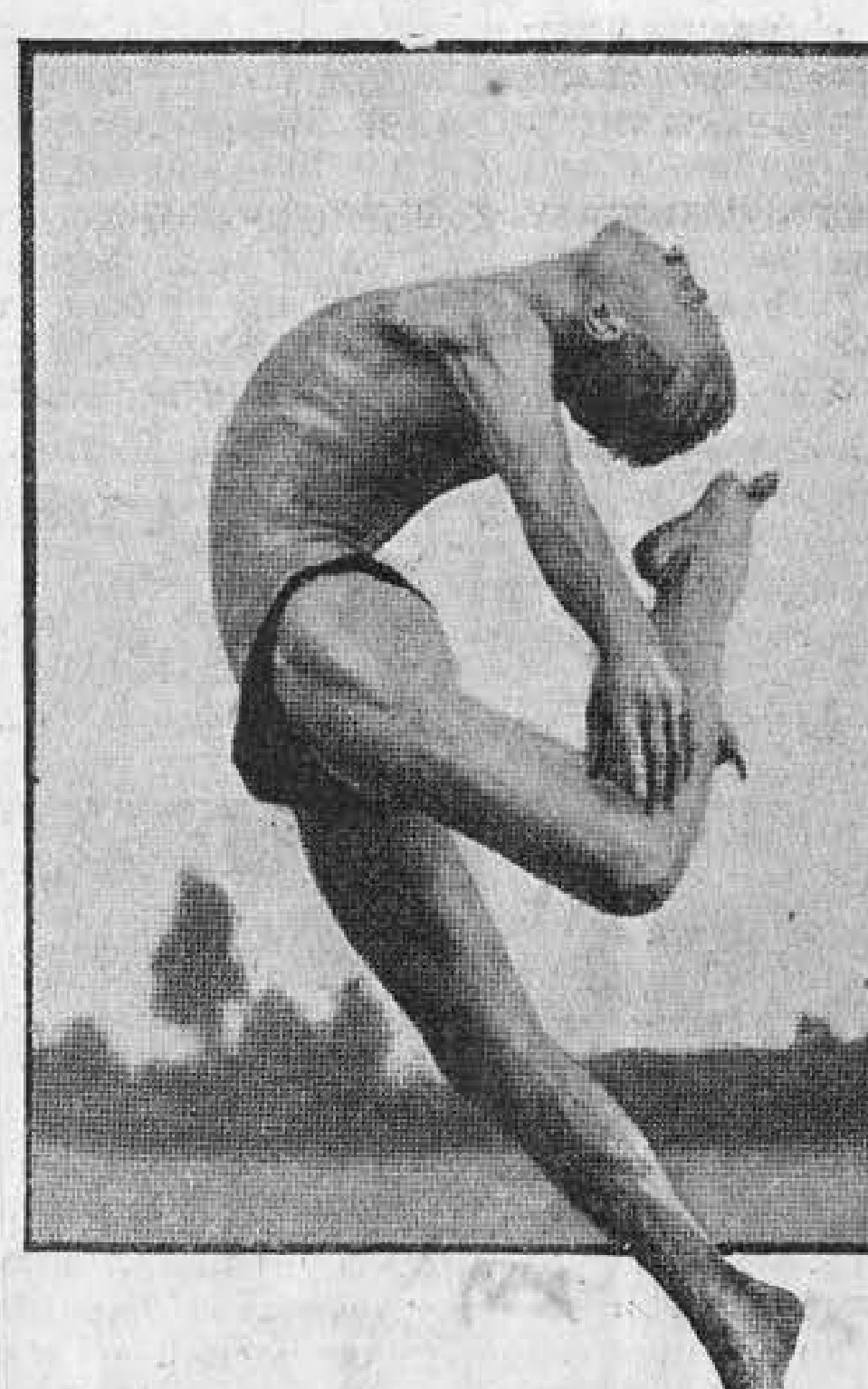
Shots on this theme are a kind of preliminary — and necessary — training, for movement, the essence of every exercise, is not so easily caught and conveyed in photography as it might seem. One is easily convinced of this by the illustrations of sport journals, where we mostly see athletes frozen in unnaturally strained poses, with no life or movement felt in their figures — they look like mannequins placed in a series of absurd positions.
What explains this? The movement of every living being is a continuous transition from one position to another, and it is precisely this transition that the artist catches: wishing to convey movement, he shows how one pose imperceptibly passes into the next, so that in his work you still make out part of what was and already guess what will be. The artist's skill lies in making the viewer feel all these moments in their order, so that their sum gives the impression of movement. It is of course very hard for the photographer to convey movement so, since he cannot merge in one image moments belonging to different instants; but the task is still solvable — if he cannot synthesize different positions, he can at least catch in each movement that “nodal” moment when one position begins to pass into another.
As an example, take the shot of comrade M. V. Frunze by M. Alpert in No. 2 of our journal (p. 46): the movement of the horse is excellently conveyed, achieved by a successful fixing of that nodal moment and a skillful choice of viewpoint, so that the rider seems to be advancing on the viewer. So we recommend shooting the ordinary work of a physical-culture circle as a school — passing through it helps the photographer develop a series of valuable qualities (coolness, quick orientation, a good eye) and acquaints him with so complex a problem as the conveying of movement.
2. Shooting holidays, parades and performances
This is the next step in physical-culture photography. The usual evil of such shots is a depressing monotony recalling factory products: we mostly see either mass free movements shot by stencil (dull rows crossing the whole length of the shot) or, worse, groups of participants arranged in tiers with furiously strained muscles and faces, or simply lined up in a row (a football team, say) — and such shots often fill the illustrated journals. Yet it is precisely at these holidays that the thoughtful photographer will find a mass of material for an interesting, artistic composition.
Take V. Savelyev's “Parade of Physical-Culture Athletes” in that same No. 2 (p. 37). How would a beginner make this shot? He would try to embrace the whole mass of the parade and shoot it against buildings — an ordinary, very motley photograph, irritating to the eye and saying nothing. Savelyev took only a small corner of the parade; his athletes are shot somewhat from below, so their figures stand out sharply against the sky, and only a small group of towers enlivens the left of the shot. The result was an artistic picture that, despite the limited means, excellently conveyed the impression of the parade.
3. Shooting competitions
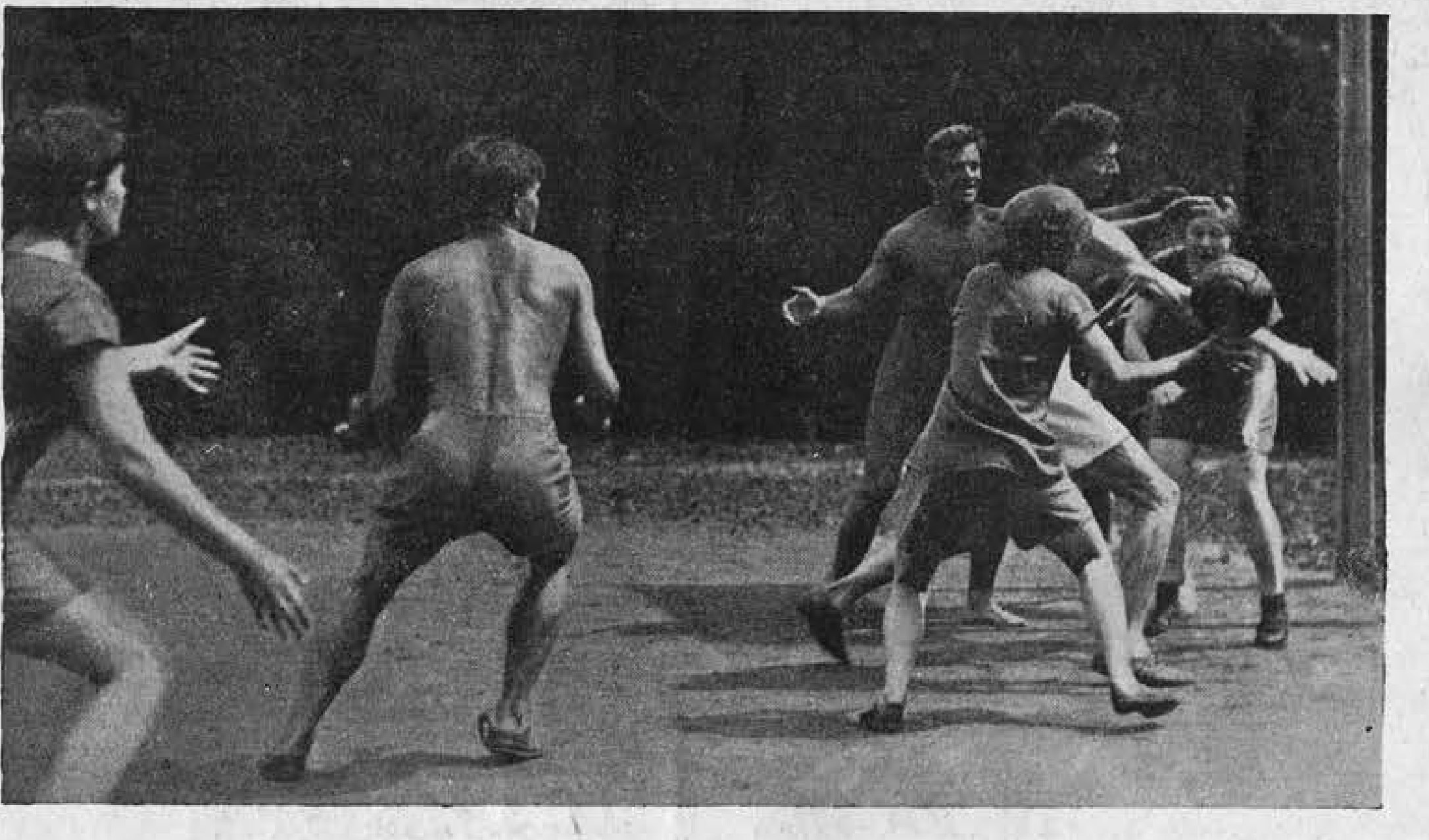
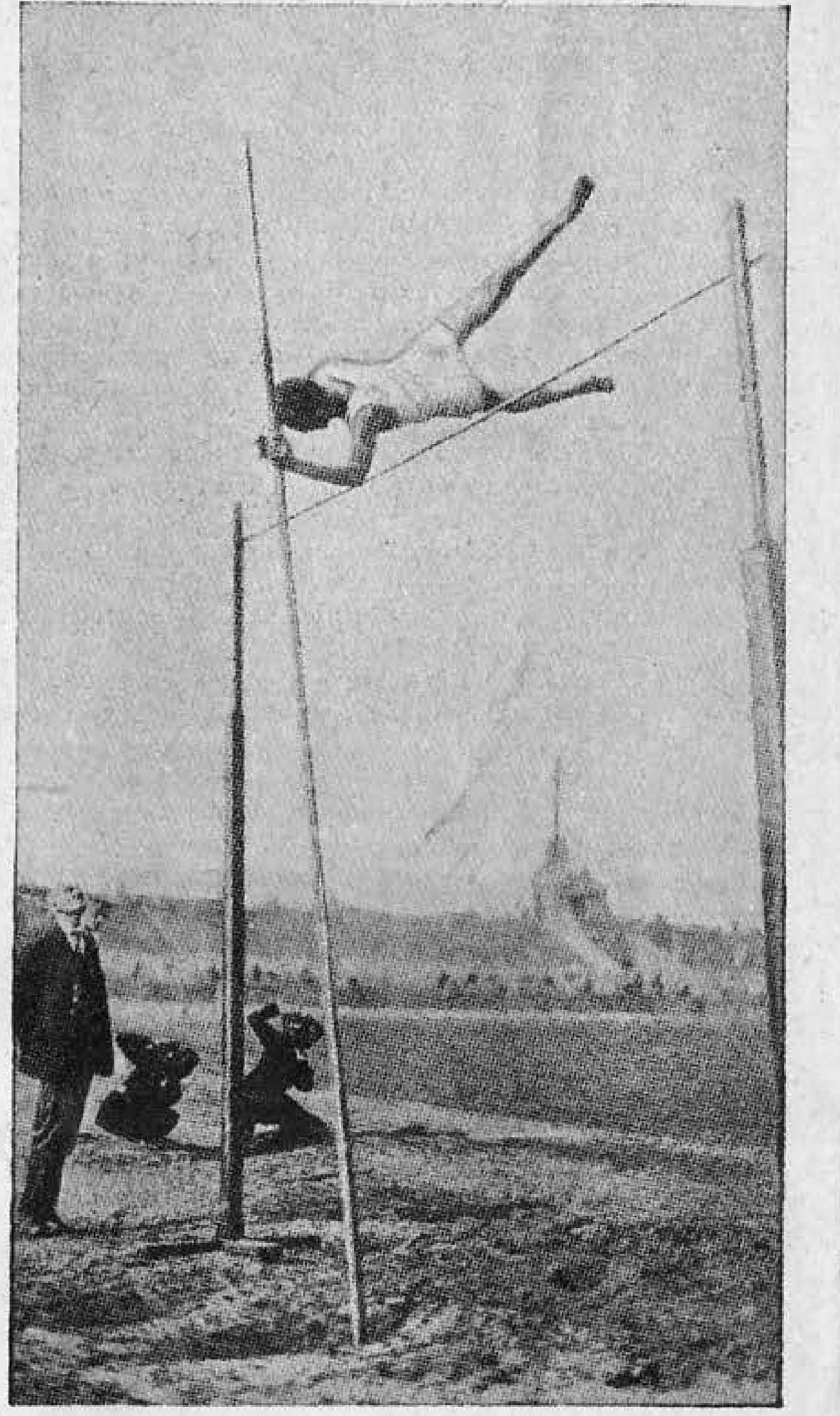
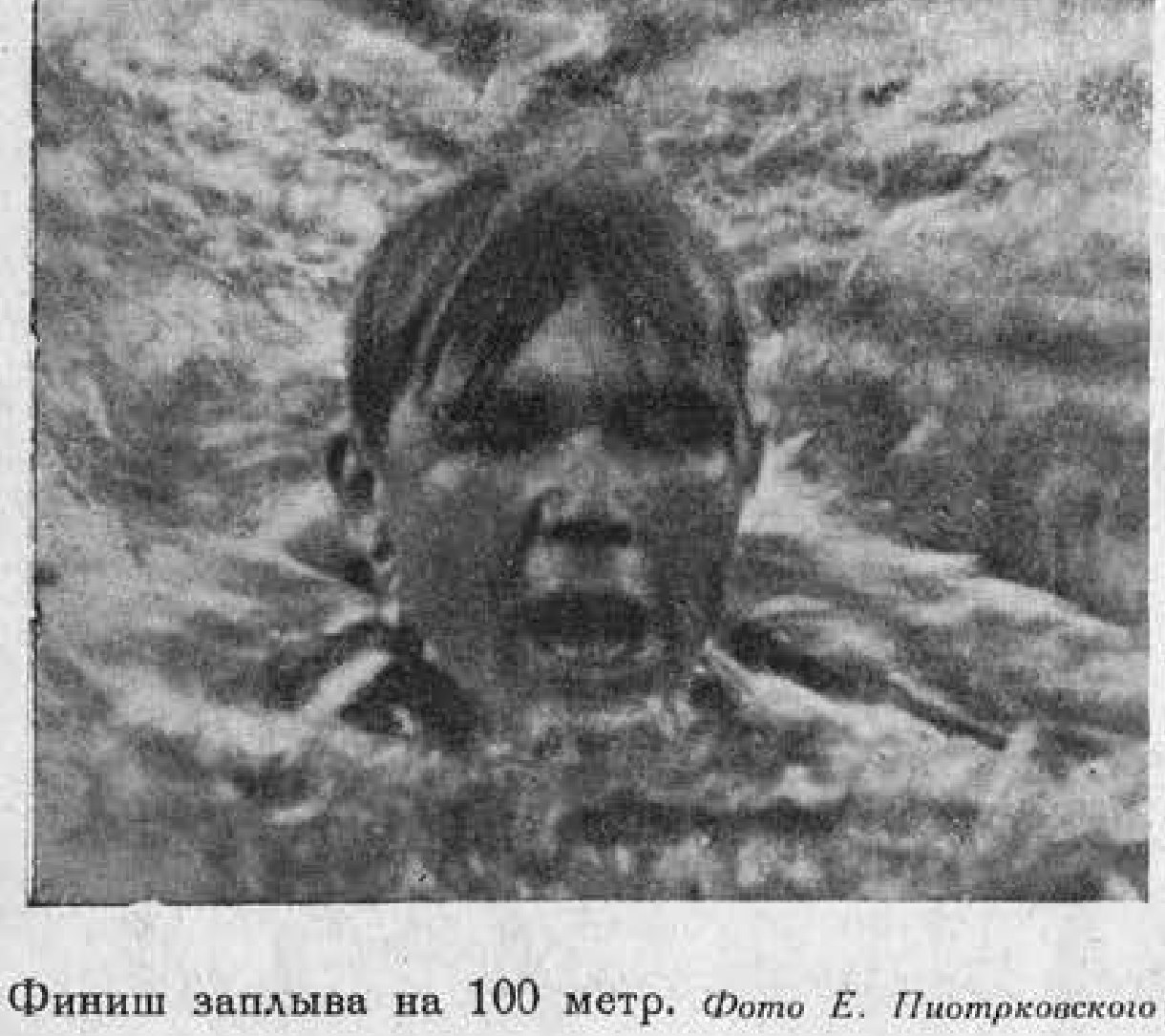
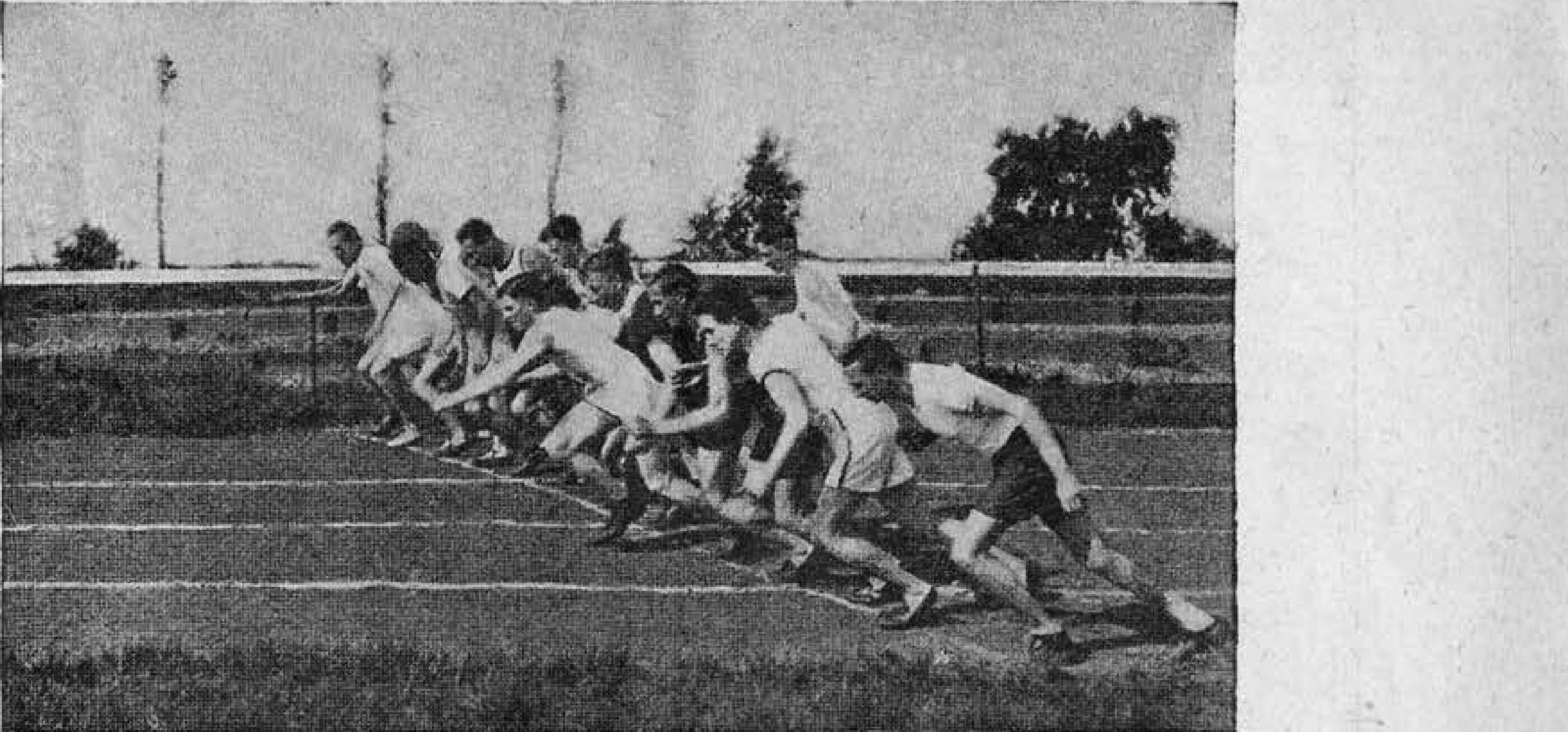
This is the highest step of achievement in sport photography. We mean shots that convey the most interesting, sharp moments of a competition, and convey them not only competently but artistically. Unfortunately the great majority of competition shots suffer from tastelessness and lack of composition, because the photographer, chasing the general view, makes crude blunders in composing the frame. The trait shows sharpest in amateur football shots: an enormous field with insignificant groups of players scattered over it, which, for want of a single unifying principle, makes an unpleasant, fragmented impression. Yet if one printed not the whole negative but singled out and enlarged the most interesting group, one might get a shot both well reflecting a moment of the game and valuable artistically. Here the paradox “the part is greater than the whole” especially applies.
To show what we mean by unity of composition, take the shot “Basketball” (p. 100). Compositionally it is built correctly: the movement begins at the left corner, is carried by the tense female figure of the foreground, and passes to the central male figure, which, by the turn of the body and the direction of its movement, makes the viewer pass on to the basic group in which the whole sharpness of the moment is concentrated. Because the three front figures are given in gradually diminishing proportions, and all are united by the unity of movement with no superfluous voids, the whole shot acquires a character of saturation and impetuosity, conveyed to the viewer.
4. Shooting on the theme “Sun, water and air”
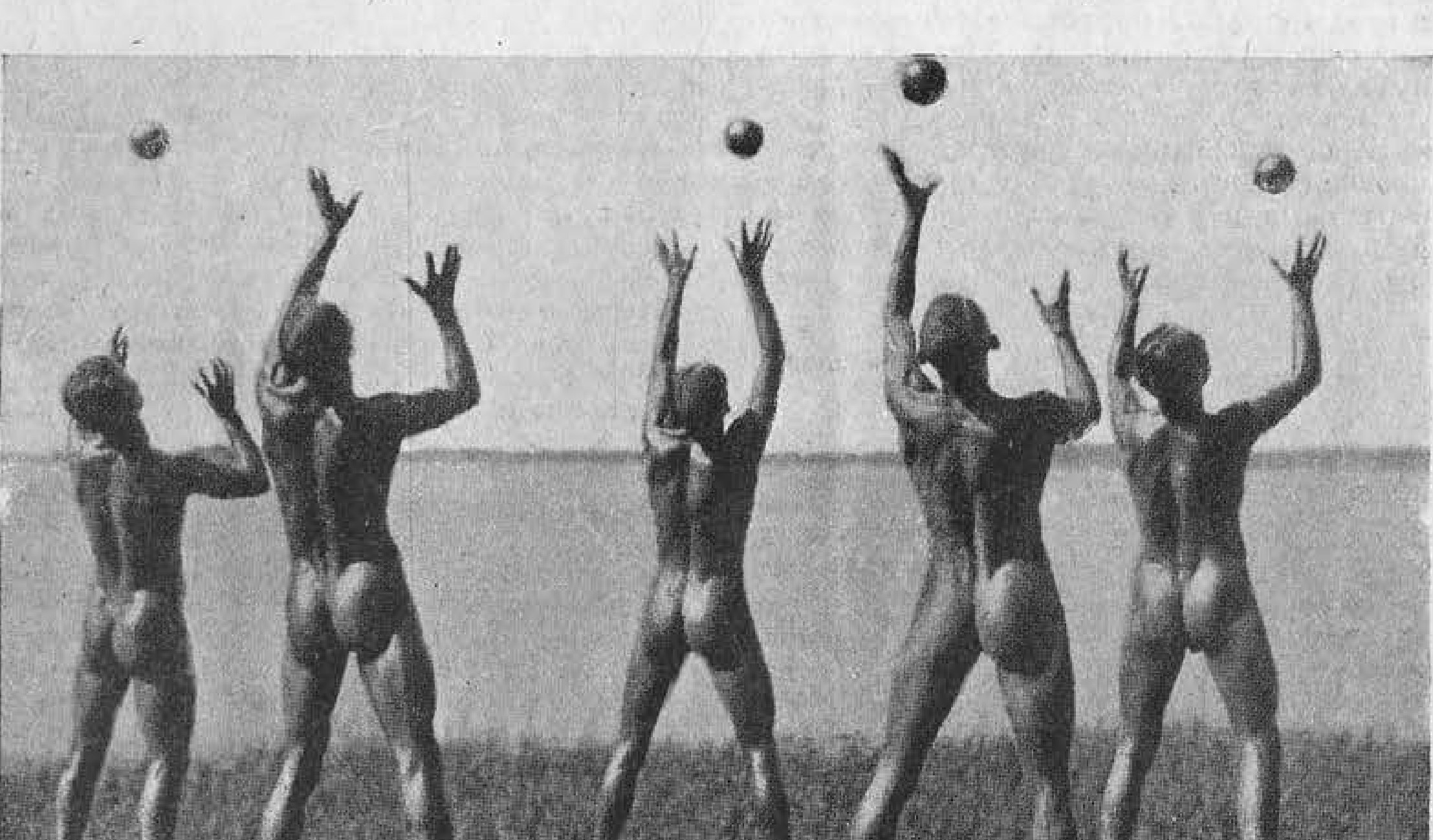
If composition matters greatly for the groups analyzed above, for works on “Sun, water and air” it is decisive. Though these natural factors would seem to give inexhaustibly rich material, we still see very few good shots on the theme. And what can be more effective than a bare muscular body shot against water and sky and generously bathed in the spring sun? Abroad, a whole series of sport and photographic journals offers amazing samples of this kind; our amateurs have no less interesting works, but, alas, only isolated ones — and the mass of photographers, even in such beautiful corners as our Crimean and Black Sea coast, are roused to no special flight of fancy, and bring back the same sugary little groups, shot not against a dacha or garden but against the sea.
Having finished our cursory analysis of what and how to photograph, we pass to the technical side of the question.
The technical side
There is a widespread opinion that work in the field of sport photography absolutely requires expensive apparatus fitted with first-class optics, and foreign plates as well. In this assumption there is a large share of exaggeration, for whatever branch of photography we touch, we always become convinced that for a good result the decisive weight falls not so much on the apparatus or the plates as on the experience and the artistic flair of the photographer.
Of course no one will deny that a good camera with first-class optics opens a wider field of activity to the one shooting than a cheap one does; but from this it by no means follows that physical-culture shooting cannot be done with an inexpensive apparatus fitted with an anastigmat of F/6.8 and a shutter working to 1/100 of a second. The amateur photographer, shooting for his own pleasure, can obtain quite satisfactory shots with an apparatus of this kind.
For serious work, however — in particular for correspondent work — the most suitable is a klapp-camera on struts, fitted with a fast anastigmat of F/4.5 and a focal-plane (blind) shutter working to 1/1000 of a second. Such a camera is portable, light, and can quickly be brought to battle readiness. Yet, in spite of all its merits, some photographers give preference to so universal an apparatus as the reflex camera.
Since in sport photography one has mostly to shoot rapidly moving objects, the determining of the exposure under these conditions presents no little difficulty, because, on the one hand, the exposure must be short enough for the moving object to come out sharp, and, on the other, it has to be coordinated with a whole series of other, no less important factors — such as the time of day, the strength of the light, the sensitivity of the plate, and so on.
A common mistake of many photographers is their urge to shoot a moving object at maximum speed, the result being a very sharp negative but one so underexposed that it is impossible to print. The question of fixing the exposure time can therefore be fully resolved only on the basis of mathematical calculations, whose aim must be to establish the limit to which the normal exposure may be shortened for the subject to come out sufficiently sharp. Unfortunately these formulas are rather complex, which is why in practice the question of exposure has to be settled by purely empirical means.
However, despite the complexity of the question raised, we still think it useful to give some pointers:
- For a moving object to come out sharp, the exposure must be the shorter the closer the subject is to the apparatus.
- The shortest exposure is required when the subject moves in a plane perpendicular to the axis of the lens.
- The exposure may be doubled (that is, made slower) in the case where the subject moves in a plane coinciding with, or parallel to, the axis of the lens.
The frame of a journal article does not allow us to touch here on the questions bound up with the technique of developing and printing sport photographs. Referring those interested, therefore, to the articles of a general character printed in our journal, we nevertheless cannot refrain from giving a few indications bearing directly on sport photography. The shooting of rapidly moving objects demands a very short exposure, which, as is known, is possible only under certain conditions — such as sufficient strength of light, high sensitivity of the plates, a large aperture of the lens, and so on. There are, however, moments when the shooting has to be done under very unfavourable conditions. Clearly we then obtain a very heavy underexposure, which will be hard to correct.
Since cases of this kind occur rather often, it is not surprising that the question of developing underexposed plates is a live one in sport photography. For the developing of heavily underexposed plates we can recommend the following method, proposed by the late V. L. Rusetsky.
The underexposed plate is lowered into the solution:
| Water | 100 cu. cm |
| Sodium sulphide | 15 g |
| Pyrogallic acid | ½ g |
| (or glycin | ¾ g) |
In this solution the plate is kept for several minutes so that the light-sensitive layer soaks the bath well through. After this one adds, drop by drop, a solution of caustic soda, 10 g to 100 cu. cm of water.
The caustic soda must be added by drops; and, having added the first 4–5 drops, one must wait patiently to see whether the image appears; if it does not, one may add another 4–5 drops, until the first traces of the image begin to be drawn out. From that moment the developing is carried on in the bath without any further pouring-in of alkali.
This process sometimes drags on very long, and for full success one must, besides accuracy, lay in a stock of patience as well; sometimes it seems that everything is already finished, that the plate can develop no further — but if the image is not fully worked out, the developing must be continued until at last the developing bath itself refuses to work altogether.
Concluding this essay, we think it necessary to underline once more the broad possibilities that physical culture opens before photography. We do not hide the fact that the first steps of the beginner working in the field of shooting rapid movement may not always be successful; but the more persistence and tenacity he shows in reaching the goal he has set himself, the higher the results he will obtain, and the greater the experience he will acquire.
Life is movement, and therefore photography, being one of the means of the artistic reflection of life, neither should nor can ignore that which is its very essence.
— E. Piotrkovsky