
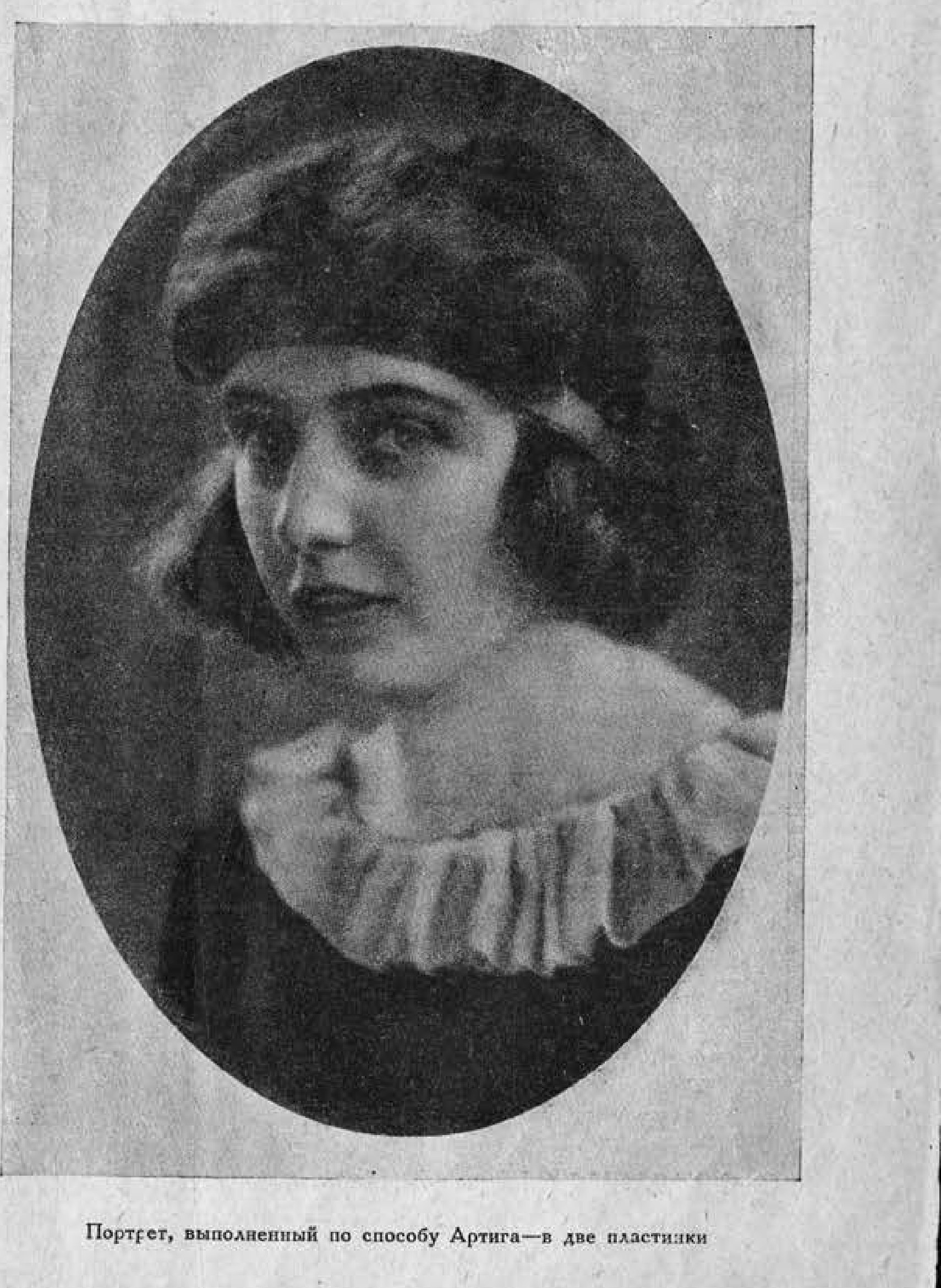
There exist several paths for obtaining the “softness” of image so beloved in portrait shooting: the placing of an extraneous transparent medium between the apparatus and the subject, or the same device applied at the stage of subsequent enlargement; the use of soft-drawing optics; printing from two “conjugate” negatives, and so on.
In the use of this last device (the so-called “Artigue method”) the French have attained great mastery. Although it is marked by a certain complexity, we think it not useless to acquaint our readers with it — stipulating, however, that this method is intended, of course, not for beginner photo-amateurs but rather for the seasoned masters of the photo-craft, and that before resorting to it one must have mastered the art of ordinary portrait shooting.
The Artigue method consists in this, that the shooting is done simultaneously on two plates, inserted together into one and the same cassette, both of them emulsion toward the lens.
The first, front, plate stands thus in its usual place — in the plane of the ground glass, in focus, and gives the ordinary sharp image. The second, rear, plate stands at a distance from the plane of the ground glass equal to the thickness of the first plate, and for this reason alone must give a blurred, unsharp image; moreover, the light rays reach it not directly but through the milky emulsion of the front plate — the result being very diffuse, vague outlines on the rear plate.
Each plate is developed separately, and in printing both negatives are folded together into the same position they held at the moment of shooting — that is, emulsion to one side, the sharp negative touching the sensitized paper and the blurred negative lying over it — and the printing is done as though from a single negative.
Here, in general outline, is the method, as a result of which: (1) a peculiar, effective soft image is obtained, with superb relief and airiness; (2) retouching for the removal of facial defects becomes wholly unnecessary; (3) the likeness is fully preserved, since the method is a mechanical one, without the hand of the photographer-retoucher.
From conjugate negatives one can, of course, not only make contact prints but also enlarge, as from the most ordinary negative.
Since each negative is developed separately, the photographer has great scope for achieving this or that desired effect, for each of the negatives may at will be developed more or less, intensified or weakened.
Among the minuses of the method are: (1) a double consumption of plates, and (2) the need for a longer-than-usual exposure, since the rear plate must be sufficiently worked through, while the front one is a little overexposed, so that on developing it yields a light, non-contrasty image, not worked out in its details.
There is nothing here to fear from gray tones; on the contrary, contrasty negatives should be avoided. It is therefore better to use very soft plates.
The second (rear) plate should be as sensitive and orthochromatic as possible, so that the yellow rays which penetrate to it through the yellowish milky layer of the front plate may act upon it in sufficient degree. The front plate is better taken less sensitive; but it must on no account be anti-halation (backed), for in that case the light rays, passing through its tinted layer, would not be able to act on the rear plate.
With a certain skill, by the way, it is quite possible to use the same plates for both negatives, which of course eases the work.
And how is one to fit two plates into a single cassette? the readers will ask. Into the ordinary metal cassette of amateur apparatus two plates will not go at once, but they will go into certain book-form cassettes. One may also specially adapt a single double cassette for this purpose by removing its partition.
Plates are seldom cut absolutely true. Therefore, so as not to get a shifted image in printing, before laying both plates into the cassette one should align one edge of them evenly — standing the plates on edge on the table — and glue two opposite (diagonal) corners with the insulating tape used in electrical wiring, or with sticking-plaster. Afterwards, in printing, it will be just as easy to fold the two plates together in exactly the same way, and the possibility of a shift and of wrong superimposition will be removed.
If two plates can in no way be got into your cassette, then in place of the second plate one may take a flat film (drawing it out of a film-pack, for instance) — such a combination will already fit into any cassette. If for some reason it is desirable to use two films — for the first and the second negative — then between the films, at the moment of printing, a clean glass must without fail be placed, so that between their emulsions there is obtained the gap, of a plate-glass thickness, necessary for this method. With films the result is of course the same as with plates.
As we have already indicated, in order the more easily to compare the two negatives, and to have the chance of varying in one way or another the processing of the one or the other, they are developed simultaneously — but, it is understood, in different trays.
The ratio of the tones of the two negatives is of great importance for obtaining the final result — the positive. The front negative should possess a medium intensity, the rear one be somewhat weaker. If the rear negative is worked out more, one gets more half-tones in the print; if the front is developed more strongly, the positive comes out sharper. Guided by this, each photographer can within known limits vary the processing of the negatives, developing them with this or that developer, more strongly or more weakly, intensifying or weakening them. One should only bear in mind that the hardness of the rear negative reduces the general effect of the lighting.
It must also be remembered that the shadows and the lights on the two negatives mutually reinforce one another on the positive. Those who apply the Artigue method are, the first time, fairly struck by the unexpected effect and power obtained from printing with a double negative.
From conjugate negatives one can, of course, not only make contact prints but also do enlargements, arranging both negatives in the same order as in printing.
The described method does not, naturally, exclude the possibility of obtaining from the same negatives an ordinary sharp print — for this one uses the single front negative. And in the case too where the second negative has not come off or does not give the needed results, the shot is not lost, since the front negative is an ordinary negative, from which positives can be obtained by all the usual methods.
— A. Kamenshchikov
The editors ask those comrade-photographers who have tried the method described to report to them on the results obtained and to send in the prints they have made.