
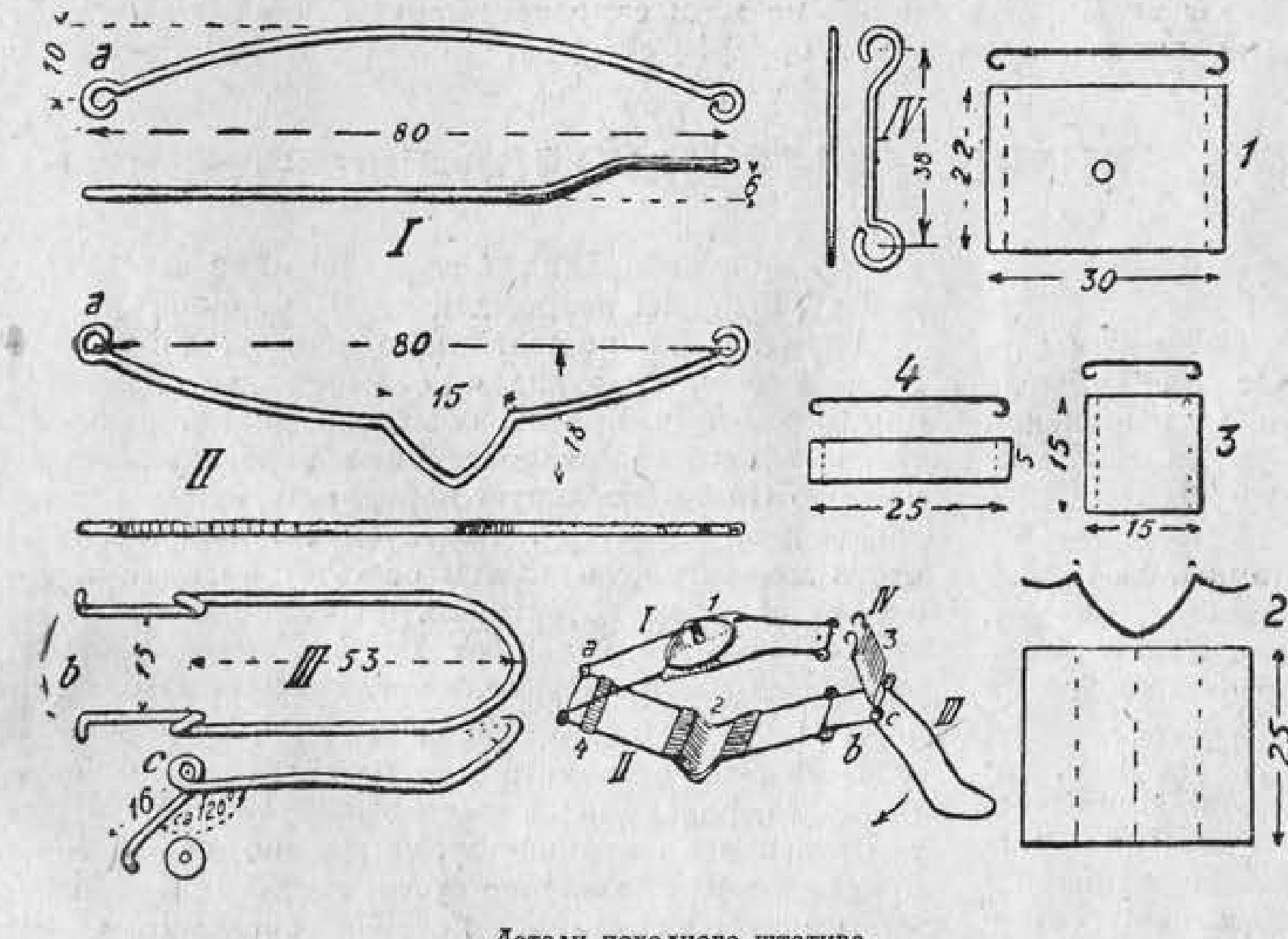
Probably many of those who set out into the lap of nature take a photographic apparatus with them. The lighting, however, is not always favourable enough to allow an instantaneous shot, and for a time-exposure shot one must have a tripod. But the traveller usually strives to lighten his baggage as far as he can, and so does not wish to burden himself with a cumbersome tripod. There exists a countless multitude of devices for fastening the apparatus to a stick, a bough and so forth. A device of this kind caught my eye in the window of a shop, but its price was so high that I was in no position to buy it. On the other hand, since its usefulness attracted me, I resolved to make a similar thing myself. I have an apparatus of the firm Goerz-Tenax, 4½×6, with a very small screw thread. From my stock of screws I chose one to suit it. Besides this, I needed a little stout iron wire 2 mm thick, a little tin, and a small piece of leather. From this material I made parts I, II, III and IV.
Part I was made in two wholly identical copies; in just the same way I did for parts II and IV; part III was made in a single example. Besides this, I needed three more straight pieces of wire, 30, 21 and 25 mm long. From the tin I bent the pieces 1, 2, 3 and 4.
In bending piece 2 one must see to it that the folds marked with a little cross are made very sharp. In general piece 2 should correspond fully, in the shape of its bend, to part II. When these parts are ready, one must also take two small disks of 6 mm diameter, with an opening of 2 mm; through the opening of these disks, in part I, passes the screw of the apparatus. From the leather I cut a disk 25 mm in diameter with an opening in the middle; this disk is put on the screw and so lies between piece 1 and the apparatus.
The separate parts are assembled as follows. Piece 1 joins together, in the middle, two pieces of wire I, the short bent ends of I falling inside. In the same way the two parts II are joined by means of piece 2, and the parts IV by means of piece 3. Piece 4 is joined to the longer end of II. Then parts I and II are fastened to each other by their ends: for this one lays the parts II between the parts I, pushes between their eyes a piece of wire 30 mm long and solders it to I; another piece, 21 mm long, is soldered to the two other eyes of I. Both parts IV, joined by means of 3, enter with their eyes into part III, where they are held by a wire 25 mm long, soldered to C. The hooks of part IV that remain free are laid into the eyes of part I. On the outside, small tin disks are soldered on so that the wire cannot slip out. Then the screw is soldered to part I, and on it is put the leather disk. The “tripod” is ready!
The manner of handling it is this: having screwed on the apparatus, one clasps with parts I and II a wooden bough or something of the sort, then lays part IV into I and draws part III in the direction of the arrow. The device then acts after the fashion of the well-known method of corking beer bottles — by tension. In doing so, the sharp edges 2 cut into the wood of the bough, or whatever else, and do not let the apparatus slip off. It is self-evident that the separate parts must have spring; one must therefore use very hard iron wire, preferably even steel. Moreover, I would advise doing the soldering with a soldering-iron, because in using a lamp too large a piece of wire is heated, which thereby loses its firmness. For larger apparatus the dimensions of the device must be correspondingly increased.
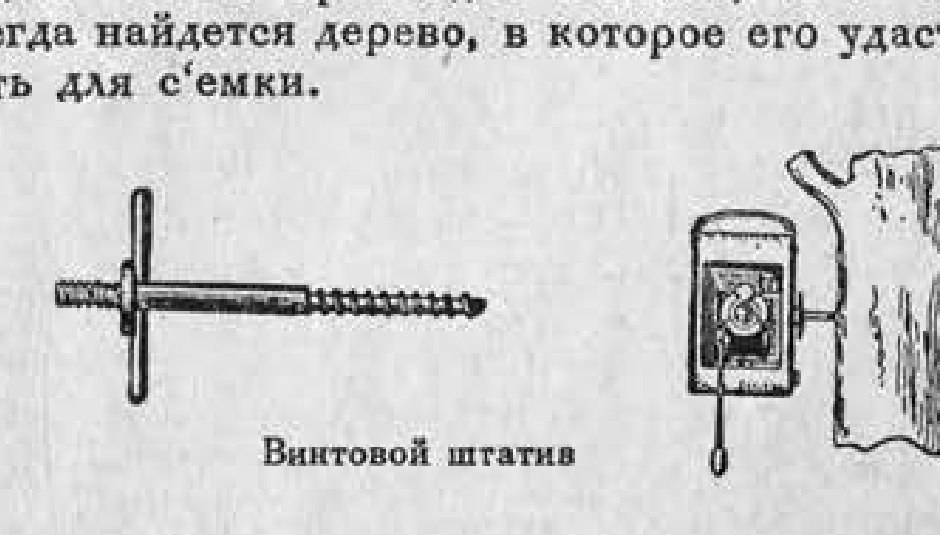
Another tripod — the corkscrew — is still more convenient, but to make it without a locksmith's help is harder. I went about it thus: I found a bolt long enough, with a well and sharply cut thread (such a one is not hard to find on the market) and, having knocked off its head with a chisel, I turned to a locksmith for a thread on the other end of the screw, answering to the thread in the head of an ordinary tripod. If the locksmith has a suitable threading tool, he will do this cheaply; he will also drill, perpendicular to the axis, a hole for a nail, which serves the corkscrew as a handle for screwing in. The convenience of this “tripod” is evident: it is not bulky and is light, and on an excursion there will always be found a tree into which it can be screwed in for shooting.
— S. B.