
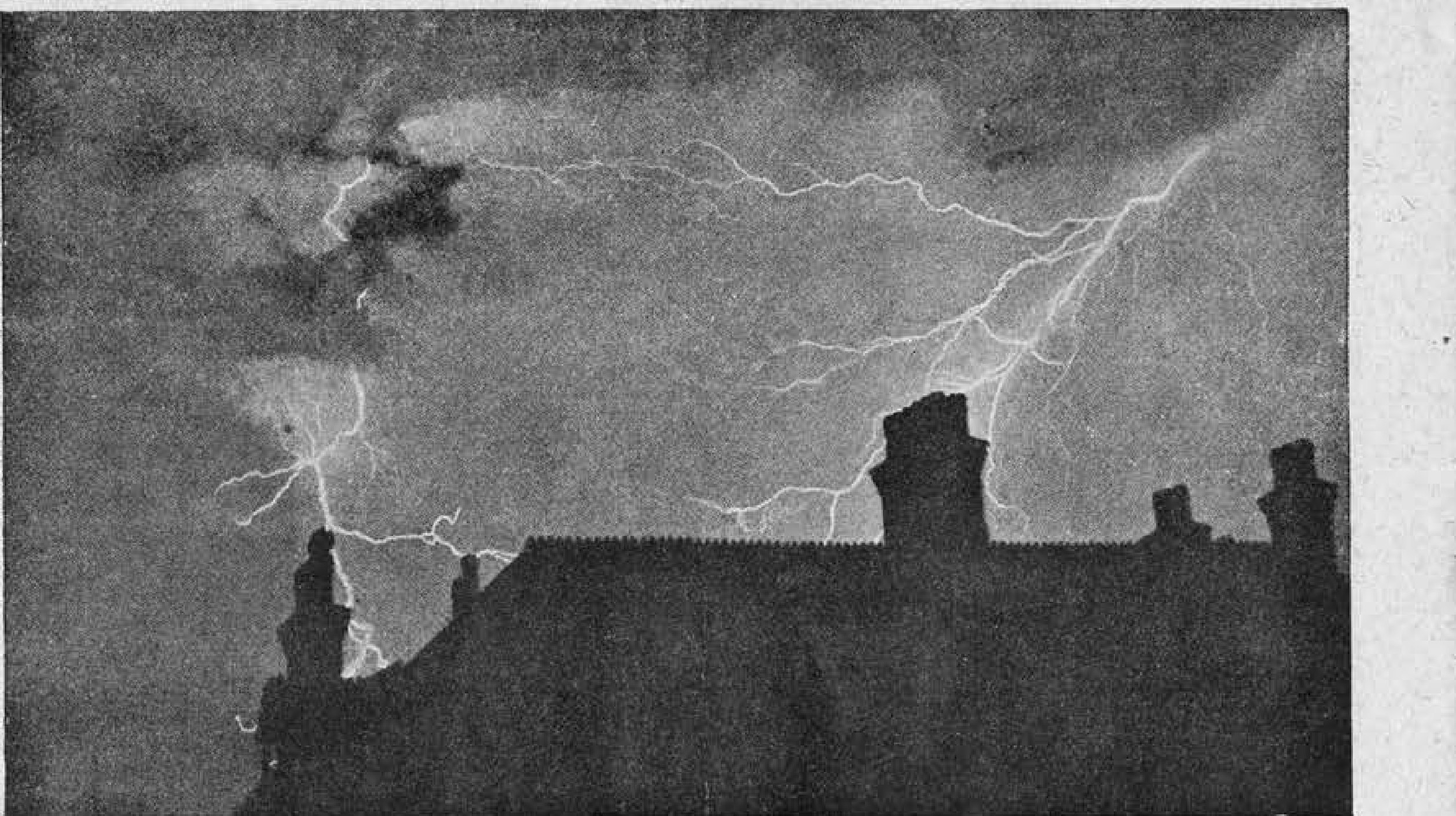
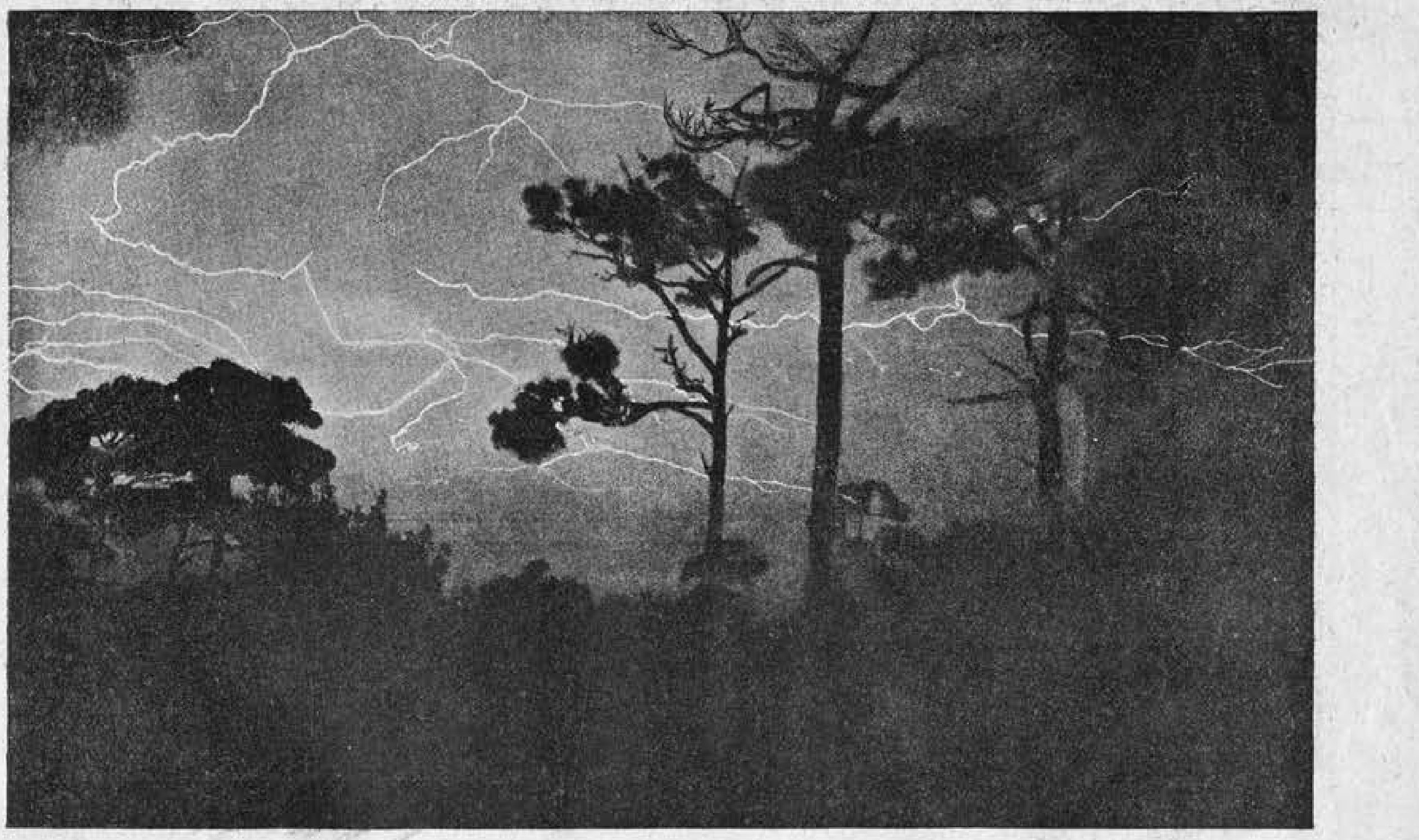
You think this is a difficult task? On the contrary — it is one of the very simplest: it demands of the photographer patience, the one thing that must be laid in in sufficient measure.
Two further conditions are needed for photographing lightning: a thunderstorm (or storm clouds) and a sufficiently dark night. If to these you add a photographic apparatus and a couple of plates, the lightning shots may be considered as good as obtained.
The technique of the matter, in two words, is this. On the approach of the storm, a heavily diaphragmed camera, with the lens set at infinity, is pointed at the storm cloud, and the cassette is opened. The wider the angle of the lens, the more chances of getting lightning on the shot. A dark night is needed so that, during the wait for the discharge, the plate does not veil too much — though this is not very terrible, since a bright flash of lightning will always give a sharp image even upon a veil; only the fine branches of the discharge may be lost.
Best of all is to shoot lightning with an apparatus without a lens, with a small needle-prick in its place*: its light-power is very small and the plate veils slowly; the width of angle of such an apparatus may be arbitrarily great (even 100°), and the image in it is always in focus. It is very good to use a dense yellow filter, which destroys the influence of the sky — the veil — upon the plate.
So, when you have aimed the apparatus at the cloud and opened the cassette, keep glancing to see whether lightning flashes within the field of the lens's work. The moment it flashes, close the cassette and put in another. If the lightning flashes outside the field of the apparatus, the plate is either spoiled, or there will appear on it some branches of the lightning, often observed very far from the main one. But if one leaves the apparatus open during several discharges of lightning, one may get a fanciful interweaving of different lightnings on one and the same plate. The shot will be very beautiful, though it will lose its scientific value.
In photographing lightning one has especially often to observe the phenomenon called “solarization.” The brighter the photographed source of light, the blacker the negative comes out at the same exposure. But if the source is excessively bright, brighter than a certain limit, or the exposure is too far prolonged, then the reverse phenomenon is obtained on the negative: the black turns white. This phenomenon is periodic; with further exposure a “reversal” of the image is obtained once more.
Lightning is a source of light so bright that neither dense filters nor diaphragming hinder, but on the contrary aid the shot, making the negatives sharp and distinct.
What, then, is the aim of the portraitist of lightning? It is an occupation far from senseless; on the contrary, it is quite important. To this day there is in science no established classification of lightnings; all the diversity of their outward forms has not been brought into a system; the causes that produce arrow lightning (with a single branch), branched and ribbon lightning, and so on, have not been cleared up; there are as yet no sufficient materials for this. There are not, for instance, exhaustive works on the change in the appearance of lightning as the cloud's charge diminishes (successive shots of the discharges of a single cloud), on the coloring of lightning (shots through monochromatic filters are very important), and so forth. Therefore every accumulation of material in this direction (with a note of the date, the place and the meteorological conditions — temperature, and so on) is highly important for geophysics — a young science that needs many and many materials.
— S. Galbar
* See the book “How to Make a Photographic Apparatus Yourself” (Library of Sovetskoe Foto, issue 3).