
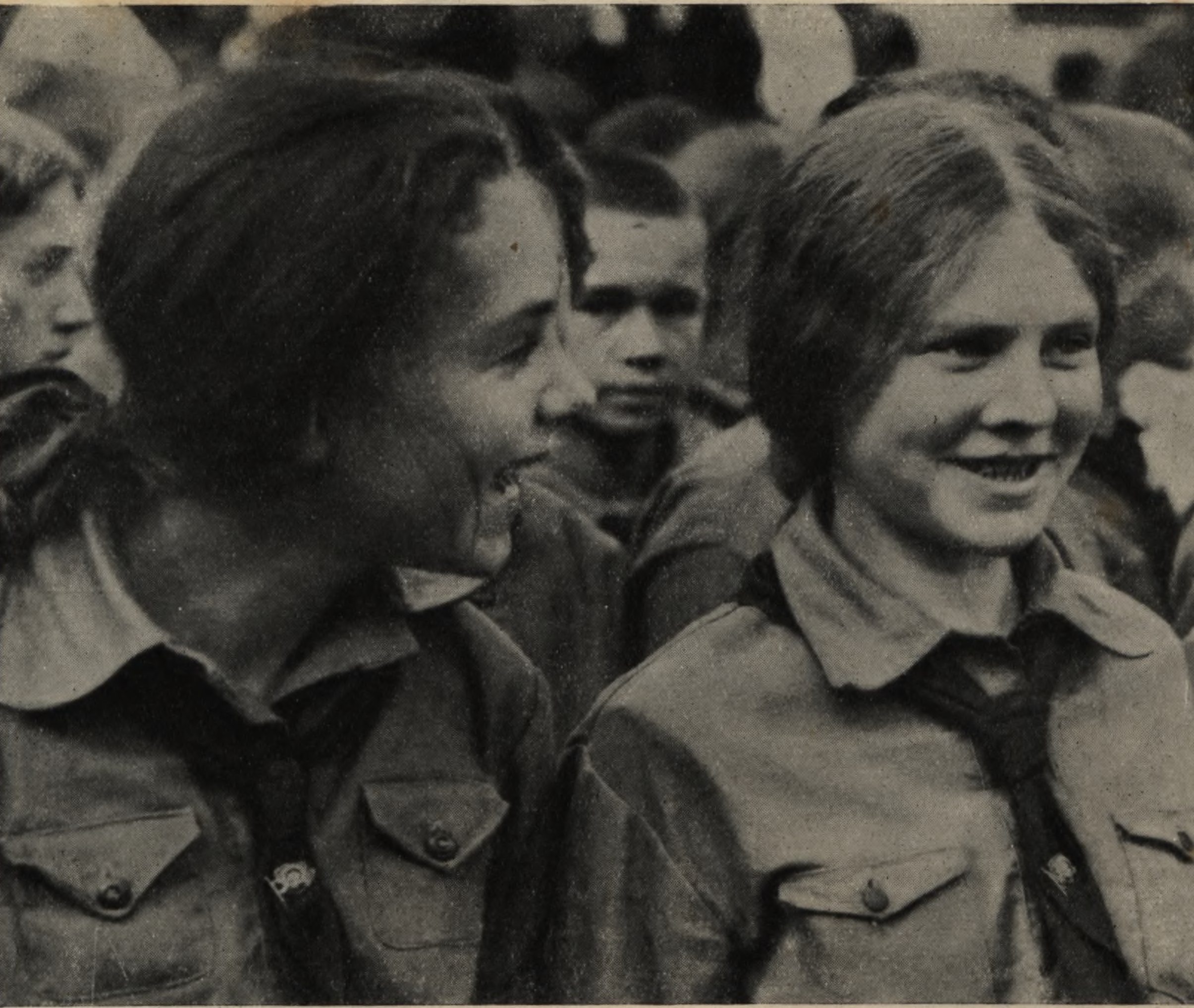
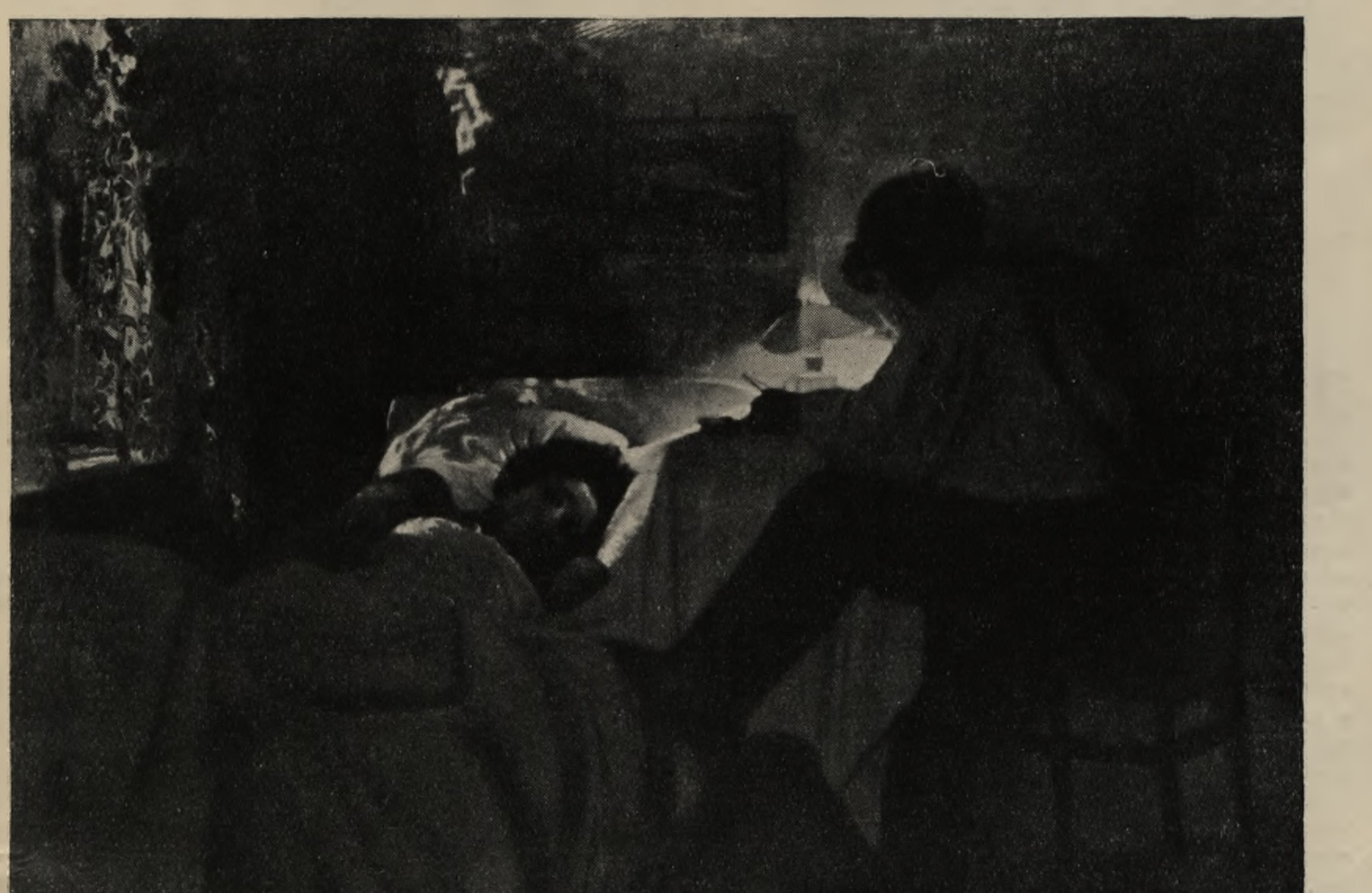
No — there isn't. But there should be.
The beginning. — The beginner clicks away. He has no notion of composition, and so he clicks everything that comes to hand. Indiscriminately, unconsciously, unsystematically, and not in the least in an organized way. Nine-tenths of his negatives perish in the developing. This is the primordial chaos, the initial stage.
The amateur — this one already “can” develop, but still shoots by inspiration — whatever takes his fancy. And at this step the amateur usually freezes fast. True, he is now and then puzzled why a thing that looked well in nature came out in the print, though lifelike, quite uninteresting; but his reasonings go no further. Beyond there is only the one thing: photography is a machine, an automaton, where no intervention is possible — what you shot is what you got. And photography is set up against painting, against freedom of action in art.
The specialists — they know everything, can do everything, but from case to case; even they rarely stop to think of the possibility of some scientific approach, of a scientific working-out of the questions of composition, raised to the rank of art.
When photo-production ceases to be only a craft — “the more, the merrier” — and, overstepping certain bounds, suddenly, by a single leap into quality, turns out to stand at the level of a recognized work of art — is it not interesting, not useful, not necessary to establish, if not the laws, then at least the regularities of the essence of this transition?
What is it? Perhaps it is a matter of sharpness, of definition? But even blurred, “impressionist” sheets, such as those worked with a monocle, are often very convincing. Perhaps it is the retouching, the surface of the paper, the coloring, a good focusing, the mounting on a background, bromoil, and so on — in a word, the technique of the thing? Yes, of course it is that. But only that? No, not only.
Why? — Because the mass of “beginners,” who have more or less mastered the primitive technique of the thing, and who know not only about underexposed and overexposed negatives but already about the means of saving them, both at developing and at the further processing, keenly feel the lack — not of recipes, but of guides on the general questions of photography.
At the present moment, when the photo-apparatus is gaining so enormous a spread through the amateur circles and the workers' clubs that it is justly set on a level with the pocket watch, when scientific thought, along the rails of the Scientific Organization of Labour, makes its way into the most secret corners of human activity, to leave photographing even without an attempt at a scientific footing is impossible — it would be irrational.
The signal. — Let the first experiment be reworked, supplemented, even refuted, but it is time to raise the semaphore.
Chance. — If photography is an art, then there is no place in it for chance. And every qualification thereby presupposes the absurdity of any kind of chance.
The main thing — is the full, free and deliberate command of the technique of photography.
With a scientific setting of the question there can be no accidentally successful composition, no accidentally correct exposure. First of all one must be able to shoot. And only then may one set about so-called “artistic photography.”
But may not accidentally good shots, by the very fact of their unintendedness, be recognized as genuinely artistic sheets? Of course they may; but they enter the circle of scientific interest not before, but after. To them, as to a product of that same anarchy of photo-production, the principles of the theory of photographing will be applied ready-made, whereas the organized production of artistic sheets will demand the most painstaking, the roughest, but the correct preliminary calculation.
The three pillars. — Passing now to the process of production itself, one may mark out three basic moments in it:
- One must see with the human eye the subject of the shot — choose it, delimit it, outline it in nature, where everything changes with the point of view and the mutual placing of the parts — the future frame. One must picture to oneself, in the mind, the thing desired precisely so, and not otherwise, inscribed into this frame.
- One must grasp with the photo-eye the resolved patch of nature and carry it home, imprinted on the photo-plate.
- One must show the catch — to the eye of the viewer — show it so that the action is the strongest, the simplest and the most intelligible. One must be able to show, as they say, “the goods face on,” having removed all that is superfluous, all that is inessential, having left and brought out the “main line.”
From this it is seen that the first two points relate to the place of the shot, where a sharp eye and quickness of decision are needed; the third point — the processing in the laboratory — requires experience and a knowledge of the photo-chemical processes.
Classification. — When there is no chaos, that is, order. It is clear that the principles of one kind of photo-shooting cannot be used in full for all the others; a classification is needed. Let us outline it now, without laying claim to any completeness or exactness:
- View and landscape shots;
- Production shots (machines, the interiors of buildings, exhibitions);
- Portrait;
- Group;
- Genre (chronicle);
- Movement;
- Scientific;
- Reproduction.
Let us now dwell briefly on some of the particulars.
The theme of the shot — is it not the same as the title in a book? It matters for an immediate and sure orientation, not only in what exactly is shot and what is the main thing, but also in that the position taken is the best of all possible ones, and that the cut-out is self-sufficient and quite complete.
Before the shot one must always give oneself an account of what will be the main thing and what the secondary. Sometimes the main thing is everything in general; sometimes a part; to the one or the other will then be subordinated the choice of focus, of diaphragm, and of the lens itself. Here too belongs the ability to find the viewpoint (full-face, from the side, from below, from above), the tilt of the board and the setting of the tripod. The norm demands the parallelism of planes, to avoid foreshortenings, which are necessarily bad — but are really all foreshortenings bad?
And once there are exceptions, then, that means, there must be a law.
The character of the lighting in photography almost always plays the decisive part (“light-writing”), but the “rules” are so home-made and unworked-out that they come down almost to immediate flair. And yet one question — the lighting of architecture on a sunny day, with its sculptural modelling, and the painterliness of a cloudy day — deserves serious attention. Still more so the question of light, and chiefly of artificial light, with its endless combinations, in the portrait.
Composition — is the most essential condition of artistry in photography. A face, a place, a group, wholly indifferent in themselves to the majority of viewers, acquire artistic value precisely through the successful mutual arrangement of the separate parts, the masses, the lights and shadows, and their subordination to the common task. Nothing superfluous, nothing unjustified.
Here opens a new chapter of inquiry: and if at the shot one cannot avoid something extraneous? How is one to be rid of it, not only without spoiling, but, on the contrary, improving nature by the intervention of processing the negative or the print?
The background — is a quite separate, important problem, which splits into two parts: the background within the shot, and the background as the backing beneath the print. Where is it laid down how large the sheet of background should be in relation to the print? What are the numerical relations of the upper margins to the side ones, and of them together to the lower? What are the most harmonious relations of the tone of the cards to the coloring of the print — when to take it darker, when lighter, and by what means is this attained in each separate case?
Why can all this be resolved only in a handicraft way, when a mere few special works in this field would give at once the richest material for further invention, and would lead the art of photography out at last from the dense forests of dilettantism onto the economical and rational ferro-concrete of science?
It is a pity that the size of the article allows one only to dwell cursorily now on a more detailed working-out of the basic three moments.
One would wish that all that has been said might serve as a challenge to those comrade specialist-photographers who possess an enormous experience — which they could so easily, by giving their practical material but a little literary shape, bring out in the following issues of Sovetskoe Foto — with those exceedingly rich and valuable factual data that they own, like an unused archive.
— An. Te