
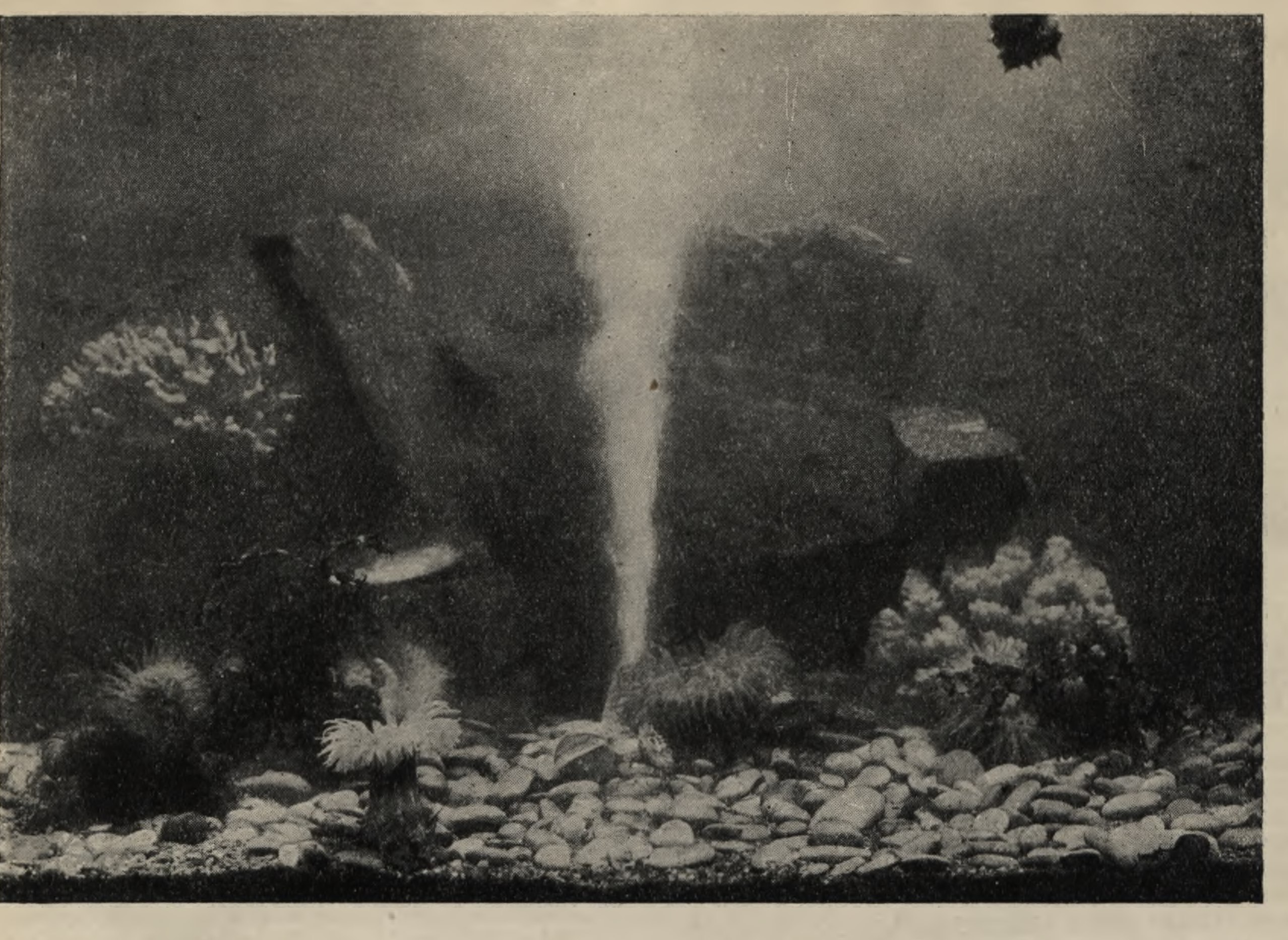
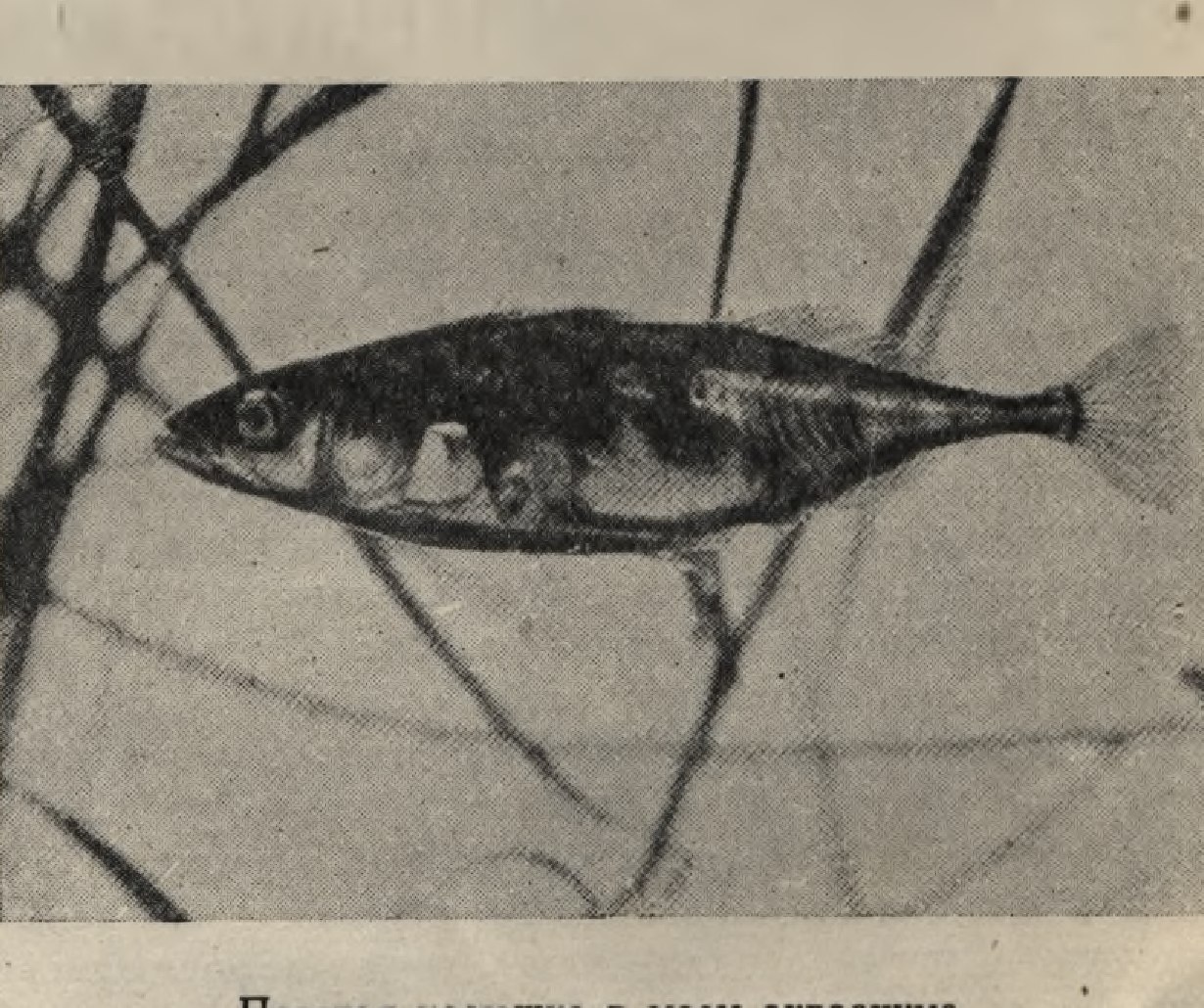
Accessories: an aquarium, a camera with a long bellows, and a high-aperture lens.
The photographing of fish and other dwellers of the waters in their natural setting rarely succeeds, since water is a considerable obstacle, and fish only seldom appear so close to the surface, and in such a setting, that they can be photographed. Therefore the chief work of collecting shots of the water population must be transferred to a room, to a special fish pavilion, into which single specimens or groups will be invited for the shot from the jars and aquariums where they live and are bred in expectation of it.
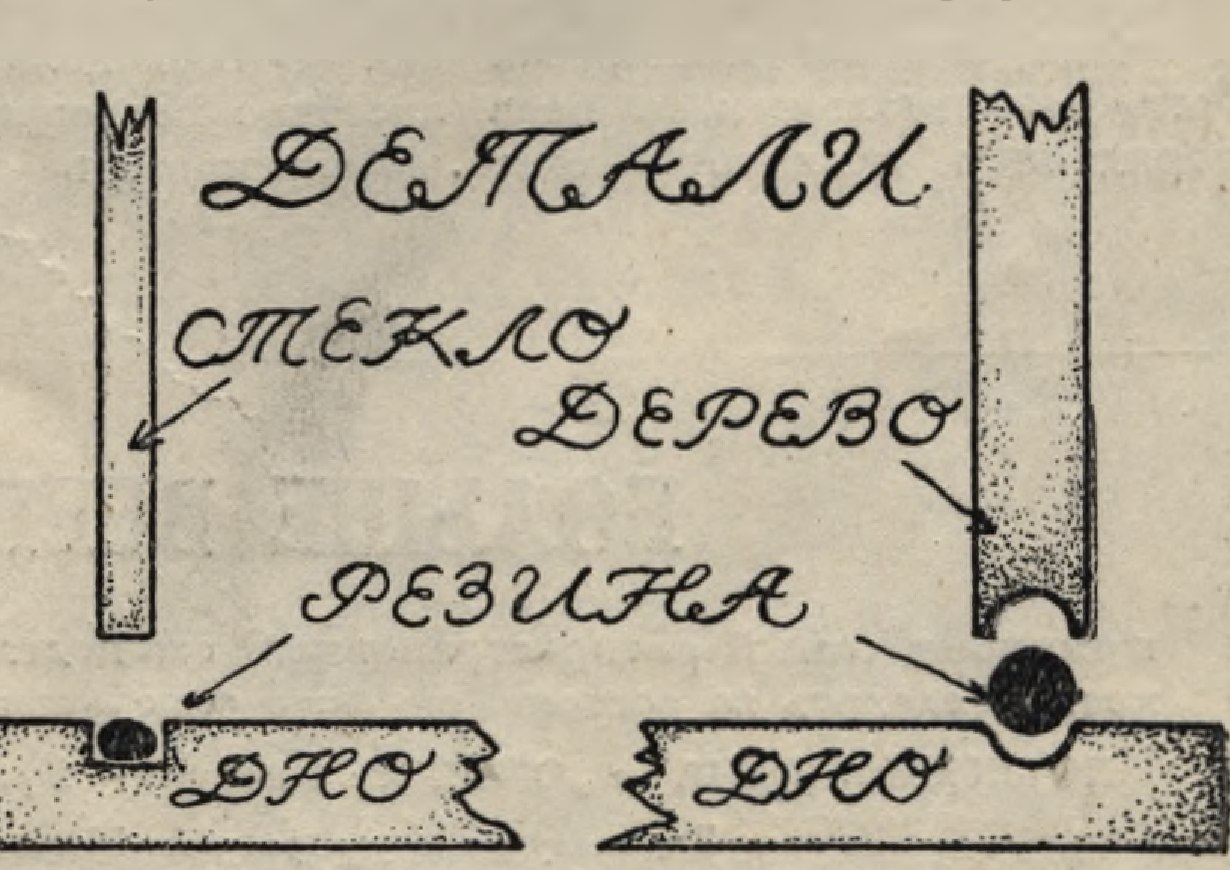
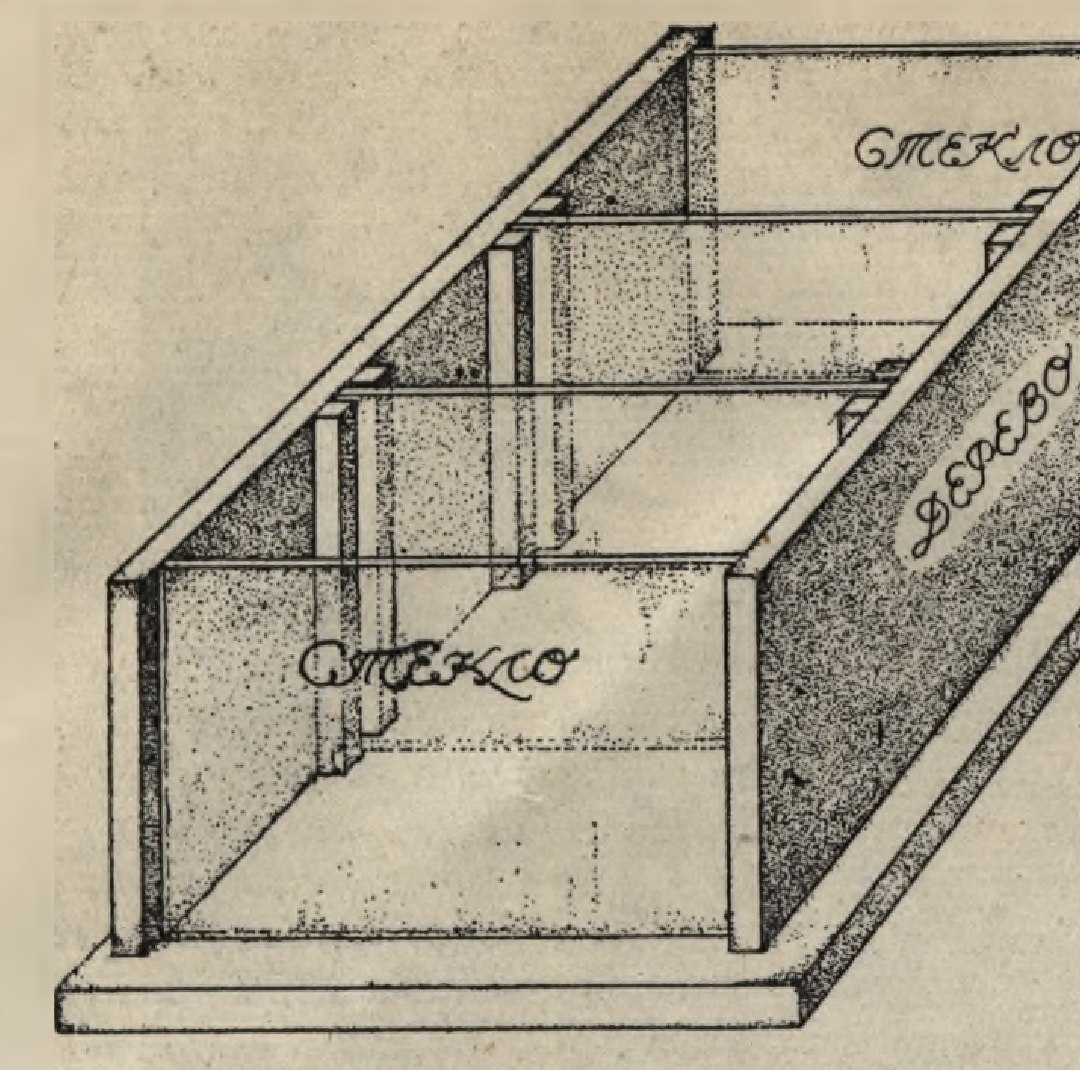
The fish pavilion is an aquarium with two glass walls, two wooden walls, and a thick wooden bottom. The fastening of the wooden walls to the bottom should not be done directly: beneath the wall one must make a groove, and in the lower edge of the wall another like it, to the dimensions of the rubber tube at hand, which must be laid in before the wall is nailed on (see the figure at right). In exactly the same way the glass must be pressed not straight against the wood, but also through a rubber tube or strip of rubber, as shown in the same drawing (left). On the inner side of the side wooden boards one must nail strips, so arranged that glass can be inserted across the pavilion, parallel to the glass walls, at various distances. The wooden walls should not be fastened with strips that would throw a shadow inside; better to draw them together at the front and rear glass with strong wire twisted double.
When the pavilion is knocked together, all the corners are smeared with a very thin layer of putty and painted inside with a durable — best of all “boat” (marine) — varnish, waterproof and insoluble in water. Inside the aquarium, in the usual way, water plants are set out and pebbles laid — but not close to the front edge — and water is poured in. The aquarium, together with the camera, is set on a table of suitable length, namely: the length of the aquarium, plus a quadruple focal length of the lens used, will give the length of the table. The table should be sturdy, and not shake under the steps of the one shooting.
The fish to be photographed is let into an enclosure between the front glass and an inserted one (which, to let the water circulate, should not reach the very bottom — below, parallel to the wooden walls, strips must be laid to prop the inserted glasses). According to the fish, the width of this space is varied: the fish should feel no considerable constraint, yet should not be able to turn round in it. The planting of the aquarium requires attention: it should answer to the setting in which the fish being shot lives in nature; and so, according to the object, the planting has to be changed. A second rule: the water must be absolutely transparent — this plays a great part in the shot.
The shot may be made in daylight or with magnesium. By day it is best to shoot not from the side lit by the sun, but against the light, and moreover so that the light falls on the surface of the water behind the object photographed; for which a white screen or mirror is set over the aquarium, tilted back (toward the rays). From lighting from above the images of the fish gain much in distinctness and relief. With this method of shooting one must see that no stray light, passing by the aquarium, gets into the lens; it is therefore desirable to surround the aquarium with a shield of cardboard or cloth, so that a dense shadow falls on the apparatus, or simply to set it in the shade. The shot itself should be made not in a room but out of doors, in a garden, in a very bright spot, since the shot must be instantaneous, and water and glass absorb a fair amount of light. To focus, one focuses on some object placed between the glasses (a stuck-in stick, a plant branch, or a stone on the bottom), watching carefully at the same time that there are no glares — reflections from the glass and water. When all is ready, one waits for the fish to swim up to the focused object, and shoots on the instant.
One may shoot with lighting from the side of the apparatus as well, setting behind, at some distance from the aquarium, a screen of white or faintly yellow cardboard; in this case one must watch even more attentively that there are no reflections on the ground glass, and it is better when the aquarium is very narrow — an accumulator jar, for example, will be very suitable for the purposes of photographing. With this method too the light should be, so far as possible, from above, reflected inward by a screen or mirror, and diffused, without shadows.
To photograph with magnesium, a box is set on the aquarium, open at the top and the rear — toward the rear glass — and closing the aquarium by ½–⅔ in front, toward the rear wall. The flash is produced right at the water, and in such a way that the light does not fall into the lens, from whose side the flash should be screened off. One can shoot with magnesium only once, since after it the fish dart about in fright for a long time, and to shoot them a second time is possible only after they have fully calmed down.
Some fish, freshwater and others, should be photographed from above. In this case one should choose a flat glass jar; fix the photographic apparatus in a vertical position on a board or wall, set a side screen, and watch carefully that there are no glares.
It goes without saying that the ideal apparatus for such shots is the reflex camera.
— S. Galbar