
Photography is one of the most vivid examples of the development of a branch of pure science into a field of technique, widely applied in everyday life. Two sciences — physics and chemistry — happily combined their efforts to work out, hand in hand, the methods of obtaining images first on metal, on glass, then on paper too. The first steps were hard and complex, but soon the horizon cleared, the paths of research were marked out for both sciences, and the perfecting of the methods went on by giant strides; and ever since it goes forward all the time: the chemists unfailingly perfect the plates, the paper and the process; the physicists — the optics and the apparatus, not counting the borderline questions into which it is not known whether physics or chemistry contributes the more. For every consciously working photographer it is not useless to know the laws that lie at the base of the photographic processes, since only an understanding of the essence of the matter gives the possibility of perfecting oneself. The section “Fundamentals of Photography” has for its aim, in several essays, to give our readers an idea of the physico-chemical foundations of photography, for the editorial board holds the conviction that only a knowledge of the theoretical side can produce a true and knowing practitioner of photography.
The Photographic Plate
The most important element of photography is the photographic plate. The lens only throws onto it the image of the photographed object, with the needed degree of sharpness and in the needed scale; but the plate takes up this image, first in latent form, then — by developing — in manifest form, and thus it remains for use: the final aim of photography.
The action of light on the photographic plate belongs to “photo-chemical reactions.” Chemical changes of a substance — its combinations and decompositions — may occur under the most varied circumstances: in the mixing of substances, in the presence of third substances (catalysts), in the passage of a current, and so on; but we know that every chemical change of a substance requires an expenditure of energy, taken either from within or from without — thermal, electrical or light energy.
All chemical reactions that occur under the influence of light, or are accelerated under its action, bear the name photo-chemical. Examples of such reactions in life are very many: the combination of chlorine with hydrogen, the processes in the chlorophyll of plants — all this occurs under the influence of light. But not in all cases does light produce chemical actions; most often bodies only absorb rays, turning the light energy into heat energy, without accompanying this absorption by any chemical changes. On the other hand, there are no rays, out of the seven colours of the spectrum, that are not capable of chemical reactions: the blue and violet rays influence the combination of chlorine with hydrogen; mercury suboxide passes into the oxide under the influence of red rays; and so on.
A photo-chemical process occurs only when there is present the capacity of the substance to absorb the energy of light. If chlorine and hydrogen combine under the influence of blue and violet rays, that means these rays are absorbed by the mixture of the two gases: every reaction requires energy, and in this case it is borrowed from the blue and violet rays — otherwise the process would not have occurred, or would have occurred (as in certain cases it does) with the absorption of energy of some other kind. That absorption is necessary for the reaction, photographers may see from such a professional example: to sensitize a plate to red, green or yellow rays, it is saturated with a paint that absorbs those rays; then they produce the photo-chemical reaction, and the plate becomes sensitive to them, whereas before sensitizing neither red, nor yellow, nor green rays acted on it or produced any chemical change in it. Light not only promotes the combination of substances, but also their decomposition; and it happens that the decomposed compounds, on the cessation of the action of light, combine again. Sometimes, in photographic practice for instance, this capacity of the compounds already decomposed by light to combine again slows the action of light, and one has to see to it that one of the decomposed substances combines with some added third one and does not return to its former state, so that the process of light-decomposition acts not endlessly but comes to an end when all the substance is decomposed.
The brighter the light, the faster the chemical process flows; and the longer the light acts, the more substance combines or decomposes — that is, the photo-chemical reaction is proportional to the time and to the quantity of absorbed energy.
In photographic processes the substance on which the light acts is the salts of silver: chloride, bromide, iodide and nitrate of silver, introduced into the gelatin that covers the glass of the plates. Our usual plates contain silver bromide. Gelatin of good quality is dissolved in a solution of potassium bromide (chemically KBr) and treated with silver nitrate (AgNO₃) — a chemical (not photo-chemical) reaction results, in which silver and bromine combine into one molecule (KBr + AgNO₃ = KNO₃ + AgBr), filling the gelatin with a mixture of silver bromide and potassium nitrate. Such an “emulsion,” however, is very little sensitive; to increase the sensitivity, it is given time to “ripen,” by heating. The higher the temperature of the heating, the faster the emulsion ripens, the grains increasing in volume, roughly from 0.008 mm to 0.03 mm. The sensitivity of the plates depends also on the size of the grains, that is, on the moment at which the process of ripening is stopped. After ripening, the emulsion is washed free of KNO₃ and the glass is coated with it. This process varies somewhat at different factories, but in general outline it is just such.
The finished plate, containing in the gelatin layer silver bromide (the emulsion), possesses one remarkable property — in essence still unriddled to this day, but one on which all photography is based. Only in the places that have undergone the action of light (and are outwardly in no way changed) does the silver bromide, under a certain chemical action, pass into metallic silver; the places not previously lit do not possess such a property, or possess it in a very small degree. At the same time the quantity of metallic (non-transparent) silver forming in the gelatin is the greater, the longer the light acted in that place, or the brighter the illumination was — that is, the formation of the “latent image,” which then “develops,” obeys those laws of the photo-chemical processes spoken of above.
Thus, in developing — the essence of which we shall consider — the silver bromide in the places of the plate that have not undergone illumination will not turn into metal, and the plate will remain transparent there. The illuminated places will prove filled with metal and will be non-transparent; but since the quantity of metallic silver is proportional to the brightness of the light, we get intermediate degrees of transparency — the gradations of the negative; and all this, in printing on paper, gives, as is known, the reverse relation, by virtue of the purely mechanical retention of light in the least transparent places of the negative and its free passage in the transparent parts.
So, let us suppose that onto the plate, through the lens of the camera, light has fallen — the image of the photographed object, reduced by the optical system. Taking the plate out in red light, you will see no changes on it; and yet light has produced a chemical action: those rays which were absorbed (chiefly the blue and violet) have produced some change in the silver bromide, and in the subsequent process its molecules (those which underwent illumination) will possess the capacity to decompose into pure silver and bromine — a capacity which before illumination they did not possess; until developing, the plate jealously guards the “latent image.”
We lower the plate into the developer. In what, then, does its role consist? The solutions we call developers help the silver which is in combination with bromine to “reduce” into metal; the silver untouched by light is partly dissolved, saturating the developer. And here occurs the second part of the process of developing, little investigated and very remarkable: the silver from the solution begins to deposit around the reduced silver of the emulsion. This question is in the highest degree important: the silver reduced under the influence of light is insufficient for working out the negative — it would remain too transparent (as in ferrotype); and the developer solution, supersaturated with respect to silver, makes good this deficiency, so that the negative comes out sufficiently dense. At the same time the alkalis, always present in the developer, neutralize the acid reactions that arise, which would otherwise hinder the process; the bromine that is set free also combines with the alkali, forming potassium bromide or sodium bromide, according to which alkali is used in the developer. With too prolonged an action of the developer, the unexposed silver too may begin to be reduced into metal, and then a veil forms. As it works, the developer weakens, owing to the increase in it of the products of acid reaction and of soluble bromine salts. An increase of the alkali leads to its strengthening, since the oxidation products that slow the process are then removed faster.
Fixing follows developing. Its aim is to remove the unreduced silver bromide from the emulsion. One must find such a reaction as would give, in combination with AgBr, an easily soluble, removable salt. In this respect hyposulphite (sodium thiosulphate, Na₂S₂O₃) is an ideal reagent. It gives the following reaction:
2 AgBr + 3 Na₂S₂O₃ = Ag₂S₂O₃·2Na₂S₂O₃ + 2NaBr,
that is, silver bromide plus a solution of hyposulphite form salts easily soluble in water, which are removed by the subsequent washing. But for this it is necessary, first, that the hyposulphite in the solution be sufficient (up to 30%), and that the plates lie in it no less than 10–15 minutes: then these soluble salts will have time to form completely.
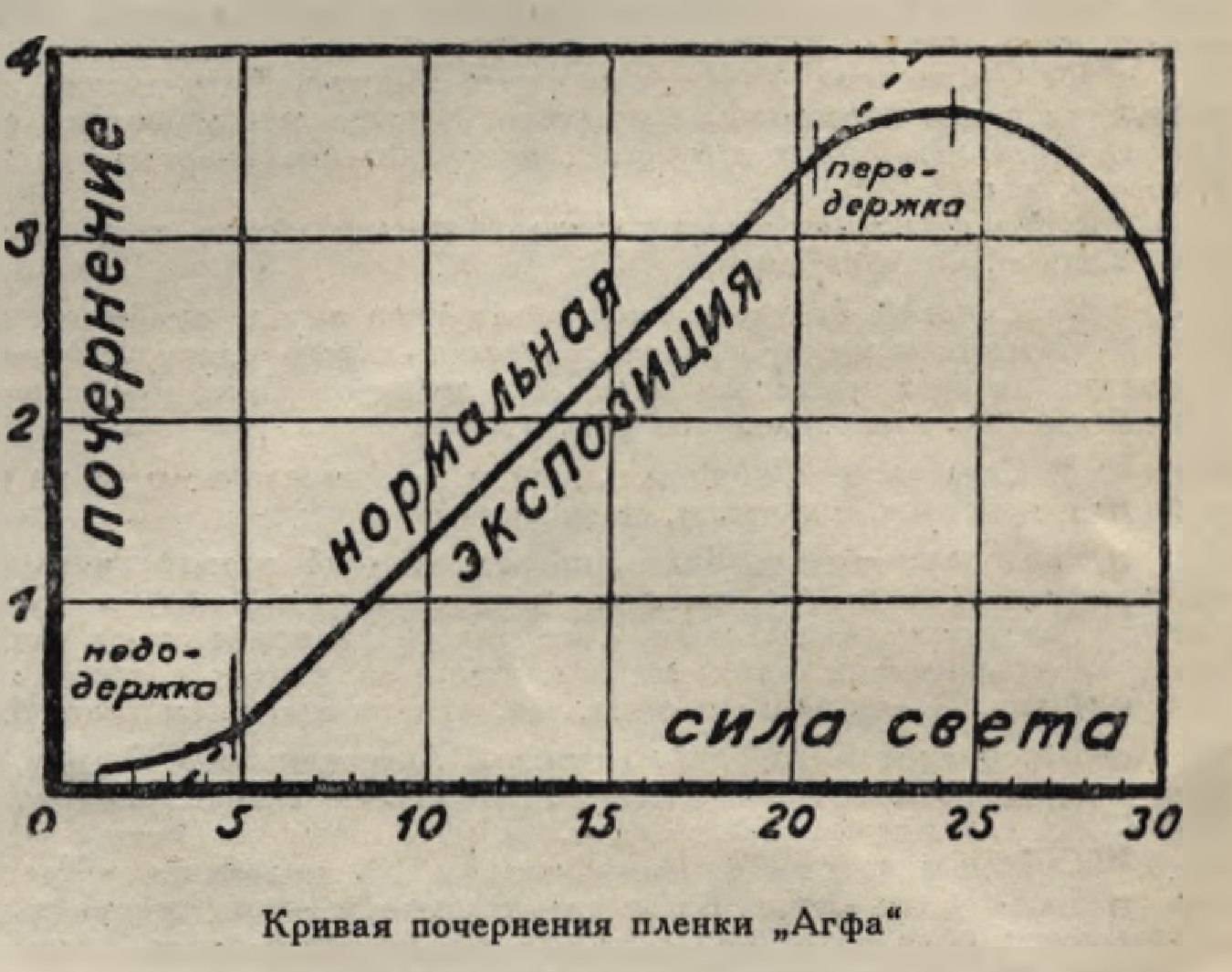
A very important characteristic of the plate is its sensitivity. If we illuminate the plate with a source of light of ever-increasing brightness, we notice that at first — at minimal brightness — the plate does not react at all, does not blacken. From a certain moment the blackening begins, and will grow very slowly at first, then faster, and at last a regime sets in at which the blackening will go almost in proportion to the increase of brightness.
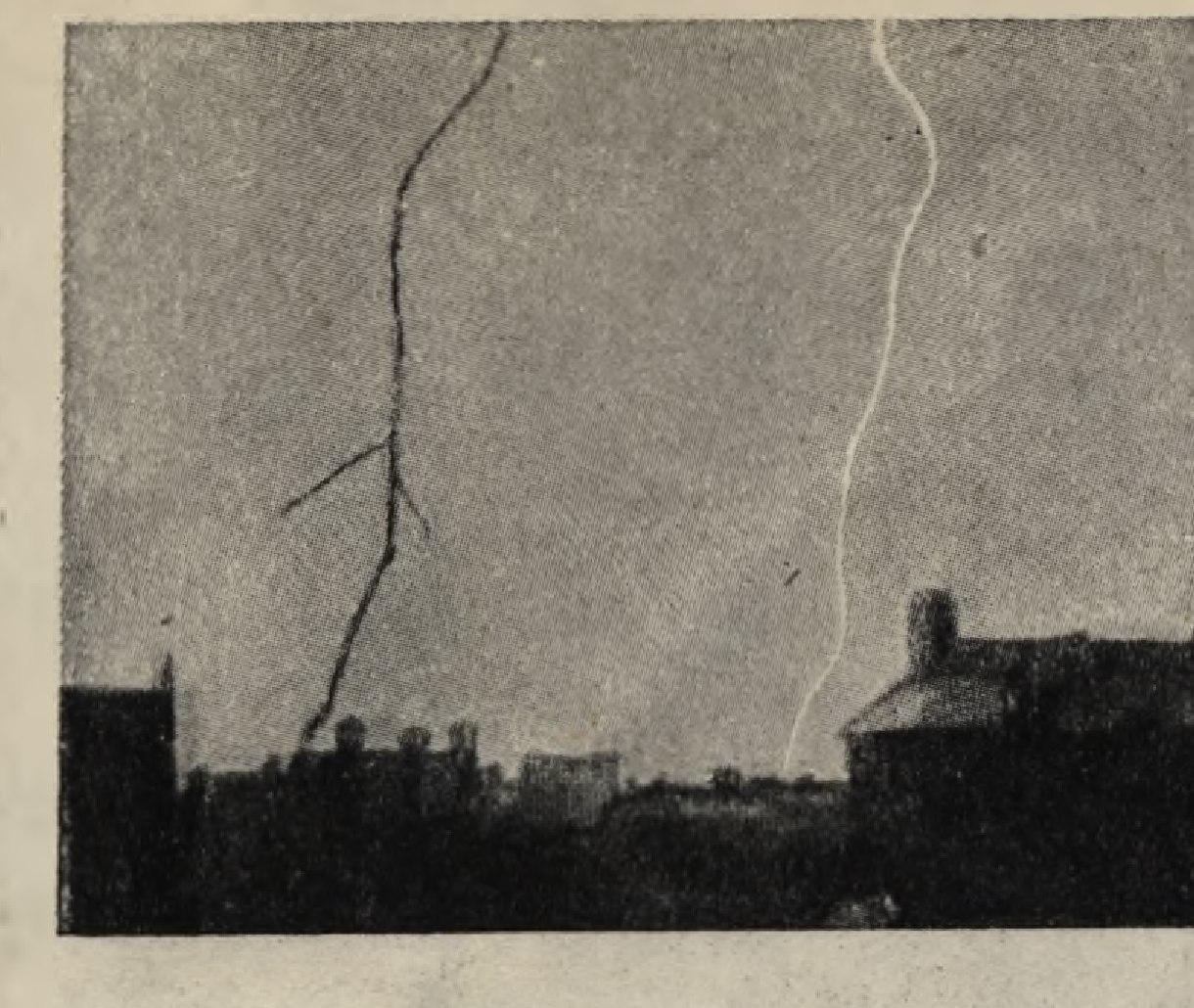
The first period is called the “threshold of sensitivity”: at a certain weak (or brief) illumination, up to a certain limit, the plate is quite insensitive. After the acting illumination passes this threshold, the second period begins — the period of “underexposures.” Then comes the period of “normal exposure,” when the blackening curve goes correctly upward. Then sets in the period of “overexposures,” when an increase in the quantity of light (or of exposure) causes no considerable change of blackening. After this period comes the critical point, when further illumination not only ceases to entail an increase of the negative's blackening but, on the contrary, causes its decrease — causes the phenomenon of “solarization”: the negative weakens with increasing illumination more and more, the blackening reaches a minimum, the plate almost frees itself of blackening, and then, if the illumination continues, it again begins to blacken and to restore the image. Thus, with considerable overexposures, one may obtain an underexposed negative. To the author of these lines it happened to get a solarized negative in shots of lightning: one branch of the lightning came out normally white on the dark sky, while another, whose brightness for the given plate proved above the limit, came out blacker than the sky (see the figure).
Roughly speaking, the sensitivity of a plate can be characterized by its threshold of sensitivity: the sooner the image begins, the lower the “threshold,” the more sensitive the plate. But this — with a reservation, since the “threshold” depends not only on the properties of the emulsion but also on the conditions of developing, fixing and illumination. We shall therefore say thus: all other conditions being equal, that plate is the more sensitive whose threshold of sensitivity is the lower.
— S. Galbar