
Whether you come upon the Volga in its middle, upper or lower reaches, everywhere the long ribbon with which the great Russian river winds along its whole length makes on you an impression of mighty beauty. Curious are the sources of the Volga. They lie near the town of Ostashkov, on the shore of Lake Seliger — the largest in the group of Upper-Volga lakes. To reach the bank of the Volga one must make for the village of Svapushcha, 40 km from Ostashkov. From there you go another 18 km by a wonderful forest road through the hilly country of the main Valdai ridge, and come to the sources of the river. You will see a little chapel at the edge of the forest, in a damp, boggy place, where there is the spring Iordan, held to be the beginning of the Volga. Here, at a height of 228 metres above sea level, lies the village Volgino-Verkhovye. Near the chapel is a small pool, out of which the Volga flows as a thin little stream, slowly making its way among the boggy banks.
This little feeble stream, hardly to be told from a thousand like it, then stretches on without a break for about 4,000 km. From it is born the greatest river in Europe — the Soviet Volga. This enormous waterway, the greatest river route, Soviet photographers know well enough. The river has inspired them to many thousands of shots, spread over the whole republic. The Zhiguli hills have been shot along their whole length. Each of the towns that stand on the Volga has thousands of photographic representations.
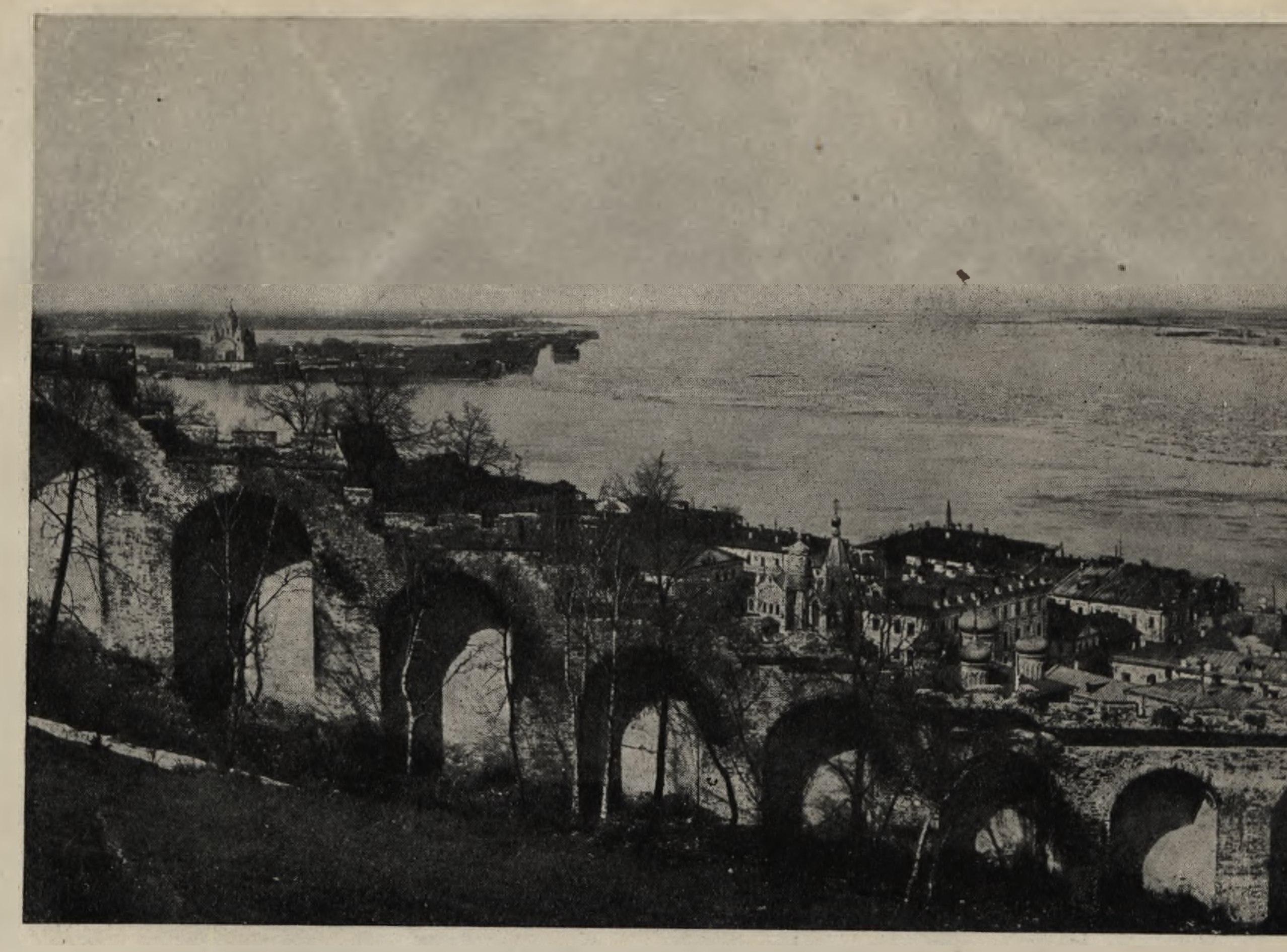
Take, for example, Nizhny-Novgorod, reckoned one of the most beautiful of Volga towns. Here there is scope for the photographer's creativity. The town was built in 1221. A curious legend has survived of the town's origin, telling of a starling, friend of the Nightingale-Robber, who is bound up with Ilya Muromets.
The history of Nizhny-Novgorod is peculiarly interesting and significant. It submitted to Moscow only in the 15th century. Then, too, there was sent to Nizhny from Moscow the Italian architect Francesco, or Pyotr Fryazin as the chronicles call him, to build the Kremlin, which he finished in 1511. Peter the Great thought to set up a shipbuilding wharf in Nizhny, and Catherine II spoke of Nizhny-Novgorod thus: “This town is beautiful in its situation, but ugly in its building.”
Nizhny-Novgorod is famed for its Nizhny-Novgorod Fair. The town divides into two parts: the upper, set on the hills, and the lower. In the upper part are the Kremlin, the theatre, the museum, and the administrative and cultural institutions. The lower lies along the low embankments of the Volga and the Oka; in it are concentrated all the trading houses, banks and offices. Photographers may be drawn to the town's monuments of antiquity: the most ancient Archangel Cathedral in the Kremlin, the Spaso-Preobrazhensky (Transfiguration) Cathedral with its underground church, the tombs of the Nizhny-Novgorod princes and of Minin, the Krestovozdvizhensky (Exaltation of the Cross) Monastery, and other artistic and historical monuments of daily life. From Nizhny hundreds of thousands of travellers set off along the Great Volga Way to Astrakhan.
From Nizhny-Novgorod the Volga grows fuller of water. From here the basic features of the Volga, with its differing banks, stand out more vividly. The right bank is almost all the way high — mountainous; the left is meadowy, leading the observer's gaze into the depth of the forests.
Past Vasilsursk, Kozmodemyansk and Cheboksary, the steamer Kovlov, an American three-decker, brings you to Kazan, set on high hills. In the town the Kremlin is beautiful, with its towers and many-coloured churches. Fine is the mass of houses with bell-towers and minarets. In the environs of Kazan there is a superb monument of antiquity — the Raifa hermitage. Raifa stands on the shore of a small lake ringed with magnificent pine forest; its mighty walls with loopholes, fortified by elegant yet imposing towers, are a splendid specimen of the fortress architecture of the 17th century.
Beyond Kazan — Ulyanovsk, the town where Lenin was born. The little town is especially lovely in spring, when all the hills that descend from the town to the landing-stages are flooded with the white of apple-blossom. The town reigns over the surrounding country and is washed by two rivers flowing in directly opposite directions. Further on — the towns Samara, Saratov, Tsaritsyn, places where Razin once roamed. Ulyanovsk itself once withstood an attack by Razin; here he was beaten, and from here he fled on a dark night, leaving his comrades to the mercy of fate.
From Stavropol begin the famous Zhiguli. The Zhiguli hills caress the gaze with their wonderful green slopes and ravines running off into the distance, with little paths and tracks mysteriously outlined in the shade of the trees. Only here and there peep out bare cliffs and knolls with the fanciful outlines of limestone. The hills bring peace. The steamer passes close by the very bank. With the Zhiguli hills are bound up thousands of legends, songs and tales. In the Zhiguli hills there once lived Ermak Timofeyevich, Ivan Koltso, Stepan Razin.
Beyond Samara the Volga, turning sharply west, skirts the Samara Bend, after which it keeps on to the south. We pass Saratov, which disputes the glory of Nizhny-Novgorod. The town is spread over the slopes of the lower chalk deposits along the right bank of the Volga. West of Saratov rises Lysaya Gora (Bald Mountain). The town itself is animated, and lives the full, tense life of an industrial centre.
Beyond Saratov — Tsaritsyn, and at last Astrakhan, one of the largest ports of the republic. In an endless string stretch the fishing wharves, the steamers, the sailing vessels. Here is the Kutum — an arm of the Volga cutting through the town. Here, above the forest of masts, looms and darkens the original tower of the exchange. In the fish trade Astrakhan holds first place in the Union of republics. Almost the whole fish catch from the lower Volga and the Caspian seaboard is brought here first, and from here is sent on to various parts of the Union. Very considerable, too, is Astrakhan's trade in grapes, fruit, watermelons and melons. On leaving the steamer you fall into a many-voiced, many-tribed, moving southern crowd. At once it strikes the eye that you stand on the boundary of Europe and Asia.
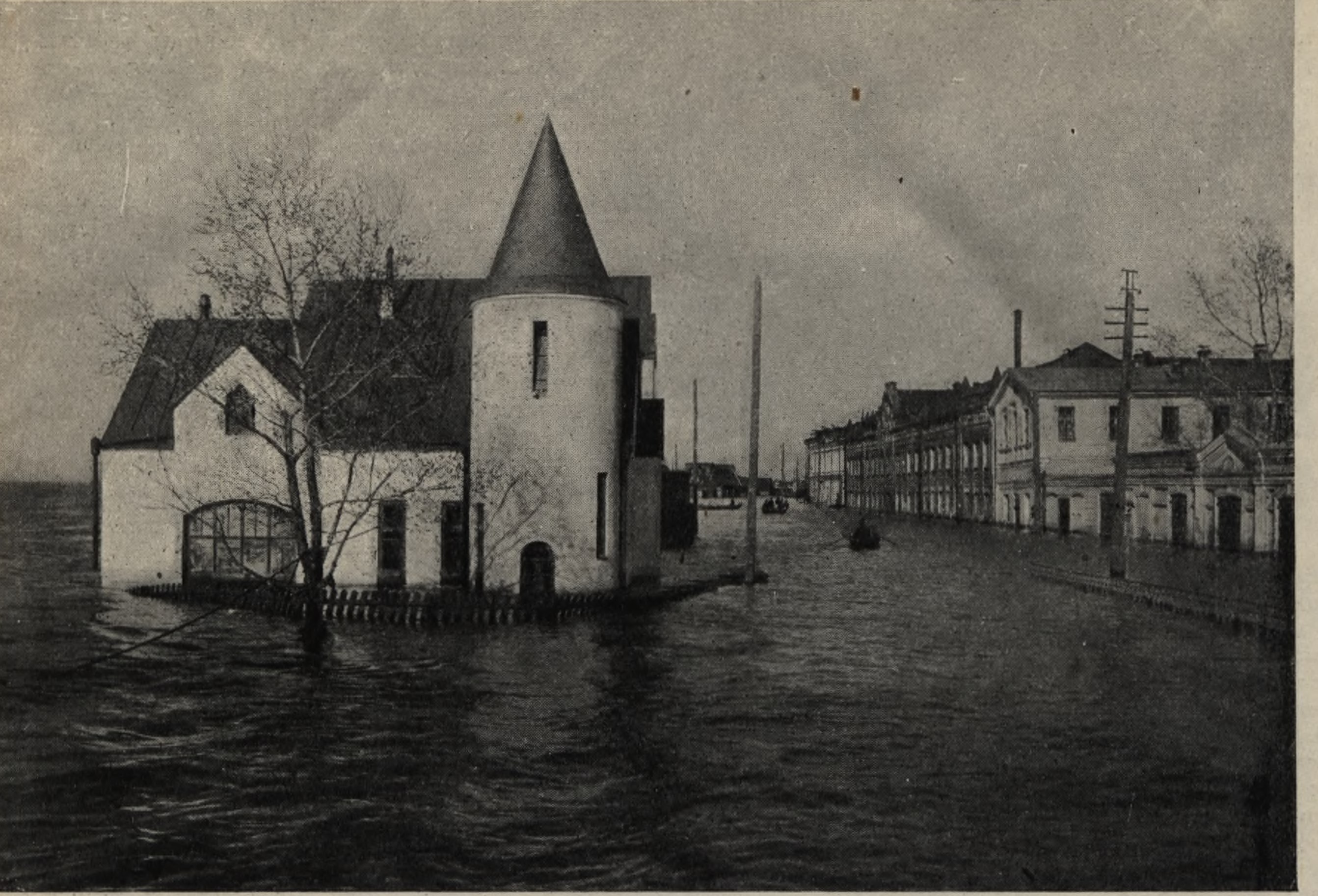
The Venetian Contarini, who saw Astrakhan in 1473, describes it as a poor, insignificant town. A pity the author of that account cannot look at Astrakhan now. Only lately the town withstood the furious onslaught of the Volga — more like a sea than a river — in the days of the flood at Astrakhan.
Quite near Astrakhan, 100 km off, is the Caspian Sea. Special steamers, half of the sea type, go there. At its mouth the Volga seems a sea, so wide and boundless is it; and on the sea roadstead there is room for a whole little floating town of vessels standing at dead anchor. Here are customs, and telegraph, and militia, and a whole series of barge-wharves, through which the transfer from sea steamers to Volga ones, and back, takes place.
As you see, even a cursory list of the beauties on the Great River gives scope wide enough for the photographer's creativity. A journey along the Volga provides enormous possibilities for shots as well. The Volga basin is the chief life-giving nerve of the whole Caspian reservoir. With the Volga river system are bound the river Kama — the full, free, deep and enormous Kama — the Moskva river, the Vyatka, the Belaya, the Vetluga, the Sura, the Ural. On all these rivers stand towns; all are rich in landscapes amazing in their beauty; on them stand towns with a great historical past, full of the most precious monuments of antiquity.
In the Volga basin live hundreds of tribes. Their way of life, their life, awaits yet a million representations. The Volga should lure and draw to itself every photographer. And even now, on the river, you will meet, for every ten travellers, one with a photographic apparatus in his hands.
— Esbe