
The photographer is like a hunter. One can find many traits in common. And there is, by the way, one which the photographer has to reckon with oftener than the hunter.
What a vexation when you have fired off all your charges, and just then the hunt grows ever more interesting, the game, as they say, comes pouring in as if tipped out of a sack. There remains only to recall with anger the shots wasted in vain, as you head for home. The same thing happens to the photographer, especially on an excursion, when he has used up everything, there is nowhere to reload the cassettes, and the subjects grow more and more interesting. This, of course, relates to the photographer who works on plates. Films deliver one from this trouble, but they cannot always be used with plate cameras, for various reasons: one must have an adapter for flat films; films are, compared with plates, very dear; and to find them with us is often impossible. The latter applies especially to the provinces.
To reload plates the photographer needs a dark place. Where will you get one on an excursion, when even at home it is often to be had only at night? Of course, one can climb into a cellar, suffocate under blankets, or sit hunched up in some wardrobe, reloading cassettes in the most awkward conditions. But even these “conveniences” are not always to be had: in the forest, in the field, you will find no wardrobe. And besides, work in such conditions often leads to the spoiling of plates: either you fail to notice, and somewhere white light breaks in, or, in haste, languishing from the stuffiness, you muddle them up or stain the plates with sweaty fingers.
Meanwhile, one may very easily, once and for all, provide oneself with a dark space for reloading plates — which is, of course, especially important during excursions, far from one's “base.” One must make oneself a light-proof bag; its making is extremely simple and cheap, and all its advantages it will show on the very first excursion, and even at home, if the photographer has no permanent dark room.
The material for such a bag should be a dense and light black cloth. Silk, of course, would be ideal here, but there is no point in speaking of it. Let us take rather a good sateen, black demicoton, so-called “devil's skin” (moleskin), or something of the sort. If the material, folded double, does not show through against the sun, then it is fit for our purpose — of which one must make sure thoroughly. One must take about 2 metres of it, if its width equals one metre.
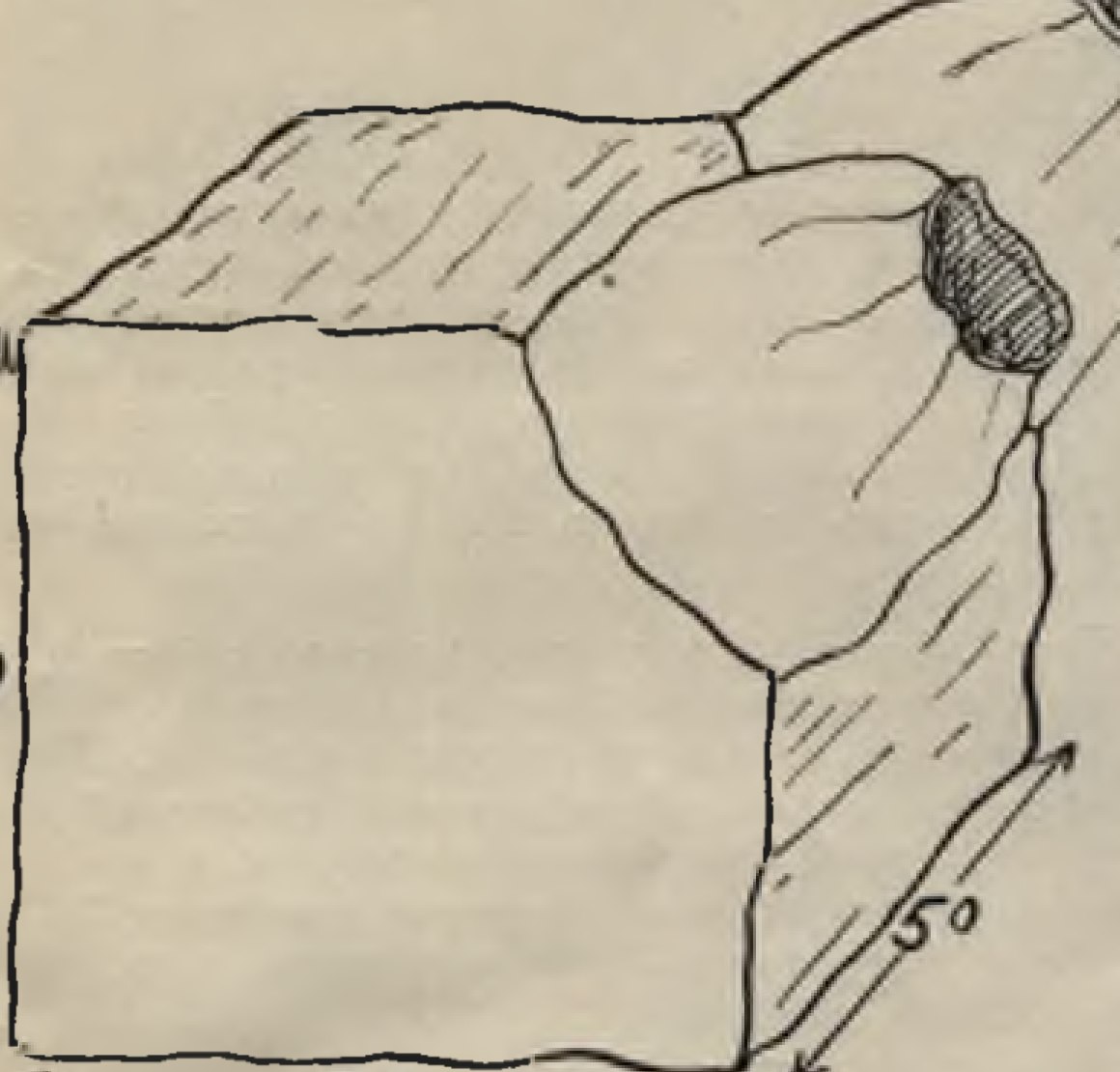
Best of all is to sew the bag in the form of a four-cornered box, with sleeves set into its corners, as shown in the drawing. Its (approximate) dimensions are: 50 cm in length and 30 cm each in height and width. Smaller sizes should not be made, remembering that a reserve may come in handy here too. The sleeves it is enough to make 30 cm long, with a width of 20–25 cm. Into the free end of the sleeve an elastic is threaded, so that the hand, passing into the bag, is tightly clasped by it. The walls of the bag and the sleeves are made necessarily double, and all the seams stitched twice. After this they must be rubbed over with a brush, because at the places of the needle-pricks there may remain holes.
One may also sew the bag in the ordinary way, not as a four-cornered box; but in that case one should not economize on the bag's dimensions. It is necessary that one can work in it quite freely with the hands. A rectangular bag is somewhat more convenient, since its walls do not stretch during the work and there is more free space. If desired, one can set into it a folding wire frame, to give the bag's form rigidity.
Such a movable dark camera, with its cheapness of manufacture and its small weight and volume, gives the photographer — especially the excursionist — many conveniences in reloading cassettes, freeing him entirely from the need to carry a superfluous number of cassettes: at any moment he can load them again somewhere in a pleasant setting, under a tree and so on.
Of course, this operation is done by touch; but very often photographers, even in the dark room, prefer to load plates by touch, without red light. The sensitive layer is easily recognized by the touch of a finger on the corner of the plate.
Into the bag one must, before loading, place: an empty box with black wrapping paper for the exposed plates, a box of fresh plates, and all the cassettes to be loaded. After this one pushes one's hands into the bag, pulling the sleeves well up. To avoid show-through, it is of course better to be placed not in direct sunlight but in the shade. Now and then it is useful to wipe the bag inside with a damp rag, to remove moist dust.
From my own practice I can say that the conveniences of such a device are very real, especially on excursions and with a large number of shots made. I even sometimes cut plates in such a bag, and in general have had no failures with it.
— P. Leontyev
(In the drawing — a camping dark box.)