
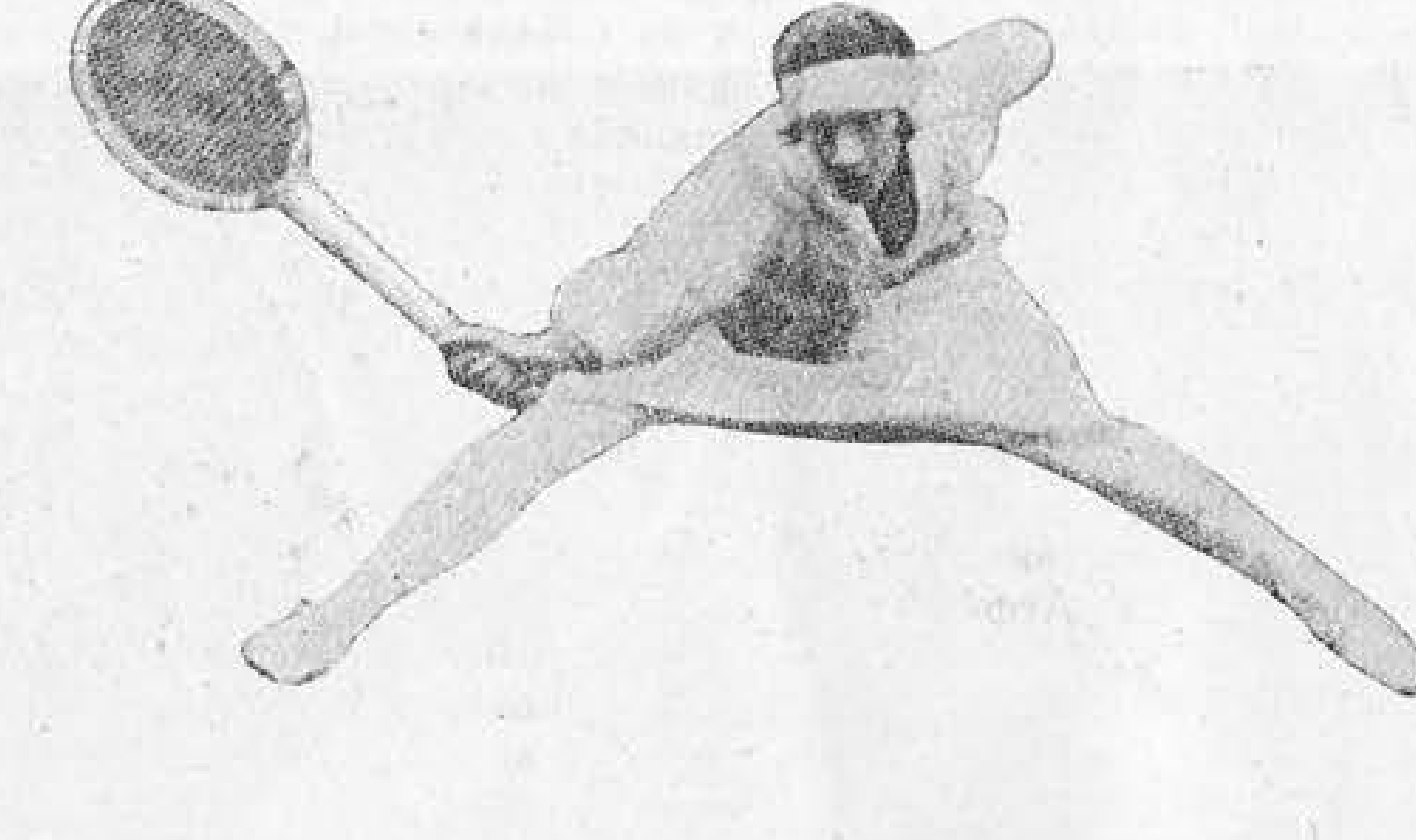
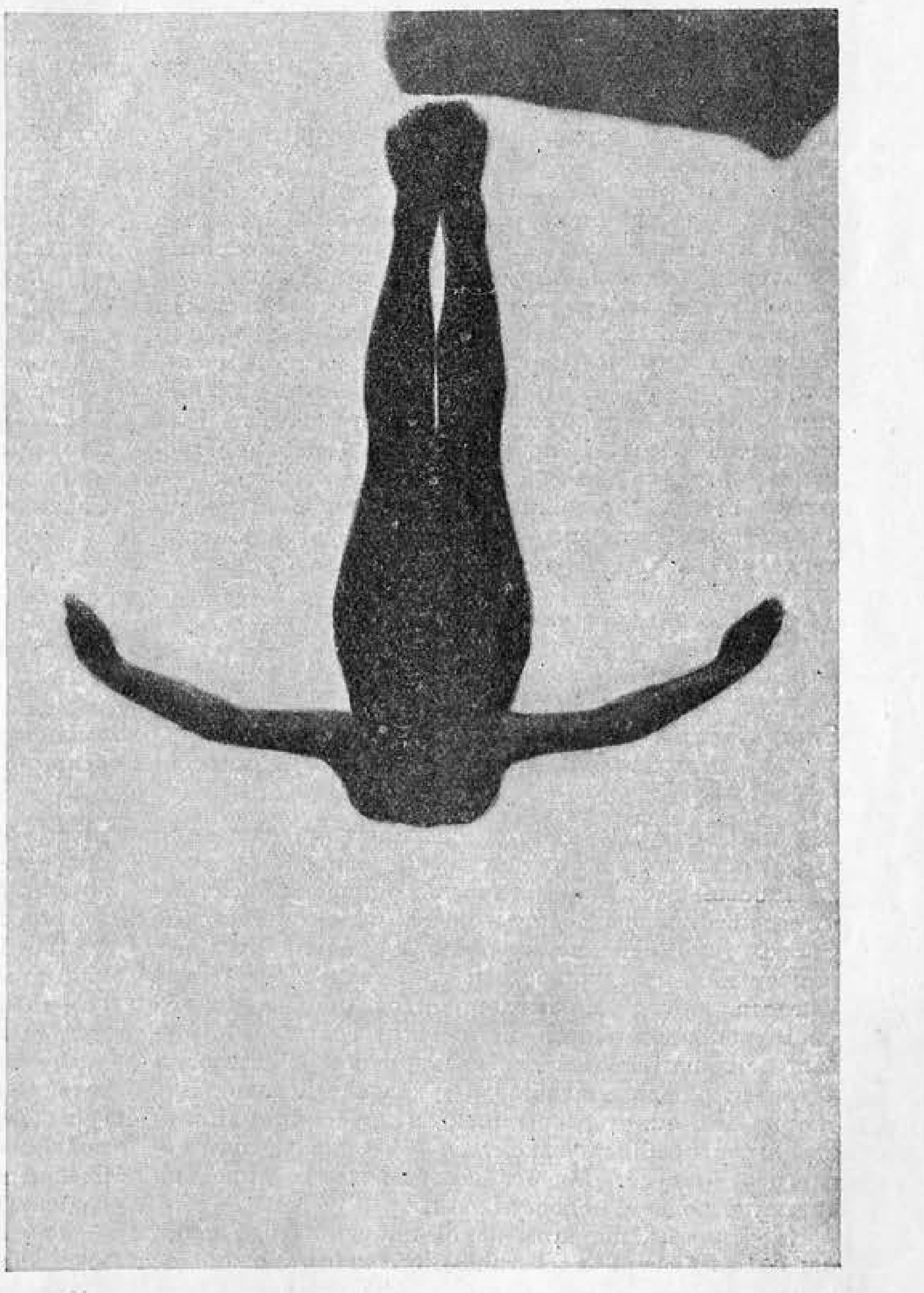
[See An. Te's article in No. 5: “Is There a Science of Photo-Shooting Among Us?”]
Let this article be the first modest response to the call of comrade An. Te in No. 5 of Sovetskoe Foto. I hasten to share with comrades those small data which I have acquired in shooting various kinds of sport.
Among young photographers there exists a conviction, supported by the professionals, that sport shots without a reflex camera and a focal-plane (blind) shutter are almost impossible. This conviction is incorrect: the experiments I have made, and also the work of some Moscow photo-reporters (V. I. Savelyev, for example), show the opposite, which gives the right to draw the comrades' attention to this circumstance.
In sport shooting, as is known, the chief task is the shortest possible exposure, so that from rapidly moving objects one may get a sharp, unblurred image. The maximum permissible time of exposure depends on the speed of movement of the object shot, on its distance from the apparatus, and on the focal length of the lens, and can consequently be in some way calculated.
Foreign theorists worked out such a formula, in which e = the distance of the object from the apparatus, v = the speed of its movement along the perpendicular to the axis of the apparatus, in metres, f = the focal length of the lens, b = the permissible unsharpness of the image on the negative, in centimetres, and t = the highest permissible speed of exposure:
t = (e / v) · (b / f)
True, only an experienced mathematician will be able to use such a formula at the moment of the shot; but it serves for preliminary home calculations, and by it are reckoned special tables that can be used already at the time of the shot. We give it both for practical application and in order to show comrade An. Te that the matter of a scientific setting of the question of photo-shooting is not at all hopeless, and that some data on the subject do exist.
The greatest exposure speeds thus obtained prove sometimes still too short to allow shooting with them. For example, to shoot a jumper moving at a distance of 5 metres from the apparatus at a speed of 5 metres per second, with a 9×12 cm camera of 15 cm focal length and a permissible unsharpness of 0.01 cm, the needed speed proves to be 1/1500 second. Such a real speed is not given even by focal-plane shutters, though this and even greater speeds are sometimes marked on them. We do not even mention that, by the light conditions, such an exposure will hardly prove possible either.
If we allow an unsharpness of 0.03 cm, then an exposure of 1/500 second will be required — such a speed is given by a decent focal-plane shutter, and it often suits by the lighting. A greater sharpness than 0.03 cm = 0.3 mm is not needed for illustration purposes, since it is in any case lost in the making of the screened cliché, even in journals — not to speak of newspapers, which, because of the coarse paper, use a screen of 0.3 and 0.5 mm.
If the lighting is not quite favourable, there is the simplest way of lengthening the exposure without loss of sharpness: one need only step back a little farther with the apparatus. With the same other data as in the previous example, increasing the distance of the object from the lens to 8 metres — at which a standing man still comes out 4 cm high on the plate — gives the possibility of attaining the same sharpness already at a shutter speed of 1/300 second.
This example with the increase of distance is essential for us, because thanks to it we fall into the circle of speeds given by central shutters. True, a fast speed of 1/300 second is so far given only by the small models of central shutter in 4.5×6 cm apparatus; the larger sizes of central shutter, mounted on high-aperture lenses F/4.5 of 15 cm focal length, allow a maximum speed of only 1/150 second.
Consequently, to make sport shots freely with a central shutter, it is better to use a 4.5×6 cm camera and enlarge the prints. Usually the lens of such a camera has a focal length of 7.5 cm, and on enlarging the shot twofold — to 9×12 cm — the scale of enlargement will correspond to a focal length of 15 cm; the conditions of unsharpness remain the same. In reality the circumstances become even more favourable, because, firstly, one usually does not demand absolute sharpness of an enlargement, as of a contact print, and, secondly, thanks to the short focal length, all the secondary parts of the shot come out incomparably sharper.
On the basis of the above theoretical premises, this summer I made a fair number of sport shots with a 4.5×6 cm camera, with F/4.5 optics and a Compur shutter; and, having no reserve of cassettes, I used film-packs, whose sensitivity (not more than 17° by Scheiner) is, as is known, considerably below that of plates (the films I had were Agfa and Goerz — they proved the same). In shooting with a small apparatus (4.5×6 cm) the economic factor also plays a part — the cheapness of the photo-material.
Once I made shots on a cloudy day. The sun was covered with dense clouds, peeping out from behind them only now and then; from time to time it rained. Since, by the conditions of movement, almost all the time I had to shoot at 1/300 second, I was convinced that a tedious and long developing awaited me and, probably, almost complete failure.
The photo-reporters were shooting at the same time as I, with focal-plane shutters at a speed of 1/500 second, and in most cases got a barely correctable underexposure. But as a result of my work it proved that a speed of 1/300 second is quite sufficient, if not for all, then for most sport shots; and, on the other hand, almost all my negatives in the end proved worked-out and gave good prints.
By the experience of several months I found that one must see to it that, in the above formula, the ratio e/v is not less than 2 — that is, that the distance from the lens to the subject of the shot be at least twice as great as the speed of its movement along the perpendicular to the axis of the apparatus.
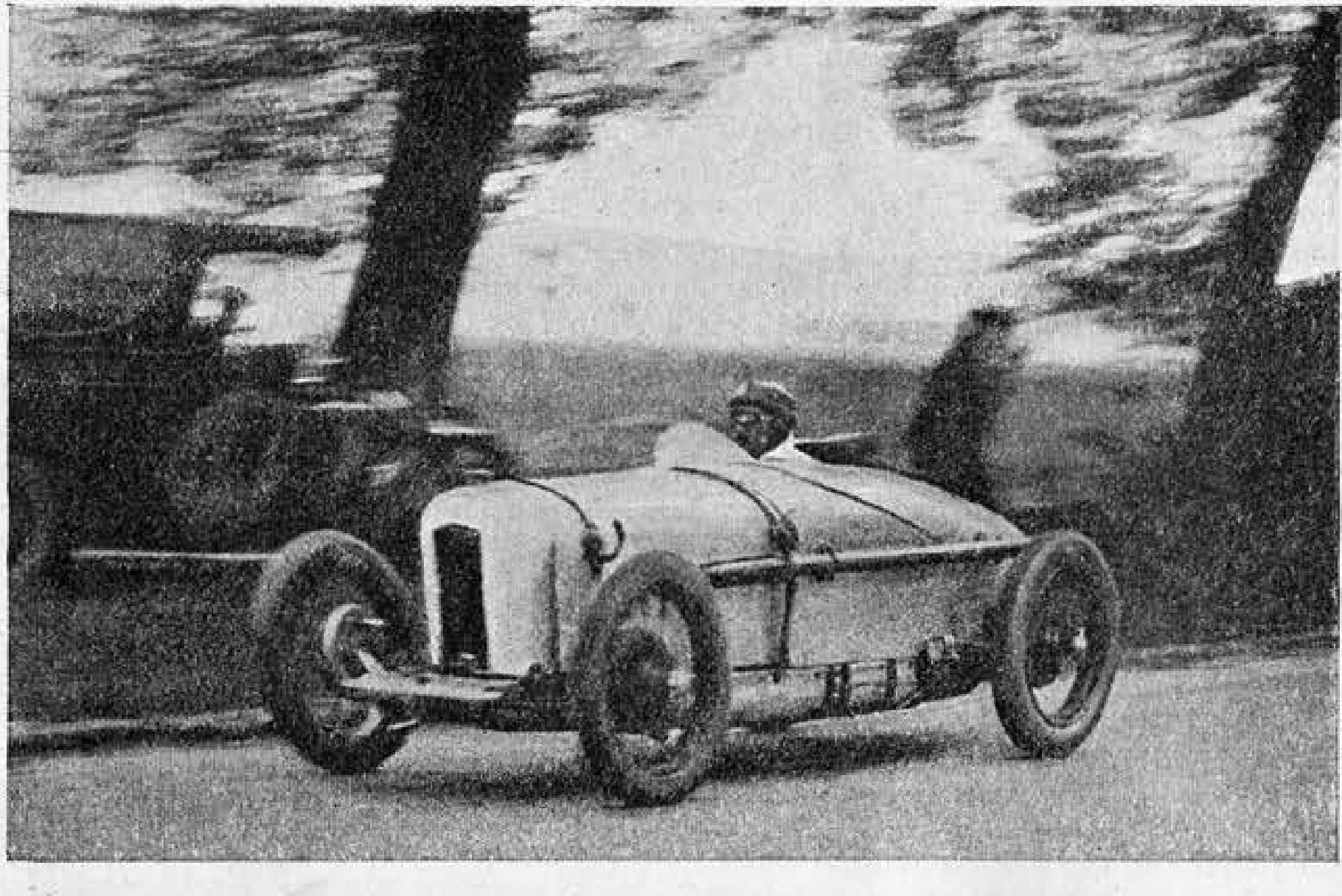
This relative speed of movement can be reduced by three means. The first, as already noted, is to step back farther with the apparatus, thus increasing the magnitude e. The second is to choose such a position for the apparatus that the object moves straight at the apparatus, or at a sharp angle of 45° to the axis of the lens; this old device often helps our photo-reporters. The third means consists in turning the camera after the moving object of the shot in such a way that the object remains all the time in the same place in the viewfinder; the shutter is released at the needed moment, without stopping the movement — the turning — of the camera. True, with this the rear, motionless background is smeared; but on the other hand the device gives the possibility of avoiding great unsharpness, especially in shooting rapid movement (the shot of an automobile at the races, given on the following page, was made precisely in this way, by turning the apparatus). For this device a reflex camera is convenient: in it the object is easily held in one and the same place on the ground glass, and it does not waver up or down, since it is held by straps.
With all my 4.5×6 cm shots, enlargements to 9×12 cm and even 13×18 cm came out excellent; the unsharpness did not noticeably increase.
In my little camera there was an ordinary tiny reflex viewfinder, in which it was hard to catch moving objects. Several shots were therefore lost because of too early or too late a release of the shutter. But now I have fitted a through-finder to the apparatus — it has become considerably more convenient.
Some German firms advise holding a special magnifier over the viewfinder, by which the image seems larger. I tried this and found it feasible, though it is rather awkward to hold at once both the camera and the magnifier, and to release the shutter.
I very much regret, all the same, that my camera has no wire iconometer, in which the image is seen in natural size, and with which most folding cameras are now equipped, even the cheap ones. The iconometer is a really perfect viewfinder.
The central shutter has, over the focal-plane, also the advantage that it is brought into action much faster, and the object does not manage to leave the field of view of the lens. In some reflex cameras (especially German), so much time goes to the release of the focal-plane shutter that a special knack is required — to begin the release in advance, when the object has not yet appeared in the mirror.
As a result of my work on sport shots with a 4.5×6 cm camera with central shutter in cloudy weather, there were some underexposures; about half the negatives even had to be intensified (with uranium); but on the other hand, from all the negatives, enlargements succeeded on high-sensitivity contrasty paper (gaslight), and not one shot proved unfit by reason of underexposure or blurring. In this respect I proved luckier than my colleagues, who worked with 9×12 cm cameras and focal-plane shutters.
Here are all my observations. Maybe not smooth, but on the other hand from a pure heart.
For my part, I should like to hear the comrades who have worked with the newest high-aperture optics — up to F/1.8 inclusive. There, of course, the approach must be quite different, since in the most overcast weather shots with a short exposure are possible (F/1.8, after all, is 6 times more light-powerful than F/4.5!). It still seems to me, however, that the small depth of sharpness will hardly allow working with an aperture larger than F/3.5. Some Moscow comrades use the Ernostar F/2, the Dallmeyer F/2.9 and the Tessar F/2.7 — perhaps they will share their experience? It would be all the more welcome, as of the practical application of high-aperture optics we have so far, unfortunately, heard almost nothing.
— G. Nauman