
Not long ago a group of comrades — workers of education — was examining the old works of one of the photo-amateurs. The works were all very good. But the best and most interesting were recognized to be not the gaslight prints, not the bromoil, but the colour shots. People did not believe that this was photographic work, and moreover done in the course of 15 minutes.
It turned out that the majority of those present were quite unacquainted with this kind of photographing, and the wish was unanimously expressed — to acquaint the broad masses of photographers, especially amateurs, in popular form with this process.
The future of photography depends on a successful combination, as simple as possible for practical use, of the rendering of natural colours, the rendering of movement (the principle of cinema), and of relief and perspective (the principle of the stereoscope). In Russian literature there is at present no popular and at the same time exhaustive work on the question of colour photography. In foreign literature, especially in the special journals, there is an enormous material in this field. We shall not here set out the course of the shooting process and the practice of developing, but shall make clear only the very essence of the process.
There are several ways of obtaining a colour image by a photographic path. One can obtain shots only on glass; one can obtain colour print-shots on paper too. Some ways require an ordinary single shot on special plates; others require a threefold shooting of one and the same subject through three different colours of glass — light-filters. We shall speak of the most perfect, in our opinion, and practically the closest to the usual way of photographing — we mean shooting on plates of the “Autochrome” type (Lumière), “Omnicolor” (Jougla), “Dioptichrom” (Dufay) and others. This way is based on the principle of a three-colour underlying light-filter.
Why three-colour? you will ask. Because, as you probably know from physiology, all the variety of colour shades and impressions of the eye can be obtained from the mixing of just three basic colours of the spectrum: yellow, red and blue. One need only be able to mix these basic colours in a known, needed proportion, and we shall get any shade we need, any colour.
Let us recall one more law. If you look at various colours through red glass, you will see brightly only the red colours. The other colours will not pass through this glass. Green tones pass through green glass; blue — through blue. On this is based the method of colour photography, applied for the first time in 1869 for photographing through three different colours of light-filter.
In 1907 the brothers Lumière put out the famous “Autochrome” plates, in the very layer of which the needed light-filters were already contained, by which the work on these plates was considerably simplified. In external appearance, and in the practice of processing, it differed in essence almost in nothing from ordinary shooting on simple plates.
Let us now look at what is the “secret” of such colour shooting. We take an “autochrome” plate. In appearance it in no way differs from an ordinary one. The glass is coated on one side with a sensitive layer (emulsion). But try carefully to gather off this layer: it is extremely thin and separates easily. When you remove it, you will see beneath it yet another layer, another film, lying directly on the glass. This last especially interests us. Only thanks to it do we get a colour image. The first, upper one, in essence in no way differs from ordinary photographic emulsion: it is not coloured, but gives an image in ordinary photographic tones.
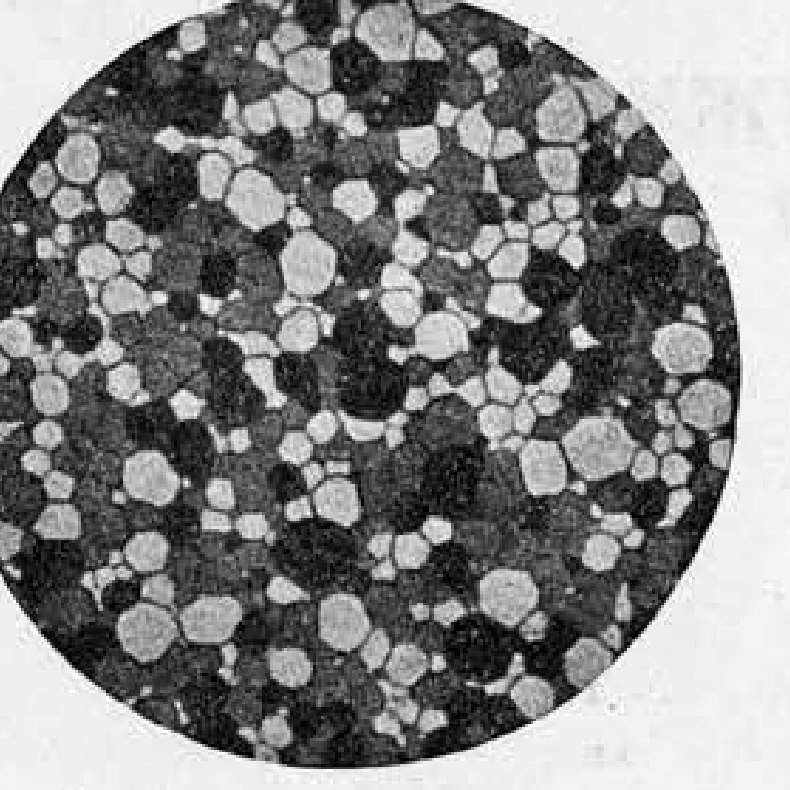
Why, then, that second underlayer? It plays for us the role of three-colour light-filters. Against the light this underlayer is almost colourless. But it is, as it were, strewn with some tiniest multicoloured points, which are so small that the eye cannot separate them one from another. Take a magnifying glass or, still better, a microscope. You will see before you a mosaic of red-orange, green and blue-violet colours (let us agree, for simplicity, to say here — red, green and blue). Each cell, each grain does not merge with another, but is separated from its neighbours by a black border — this is the finest coal dust. And these cells are starch grains, each coloured its own colour, carefully and evenly intermixed.
These grains play the role of light-filters of the three basic colours. They are so small that about 150 million of them are placed on a plate of 13×18 cm size. I shall not here speak of how these microscopic grains are made and coloured, how they are applied and evenly distributed over the glass, how they are separated one from another by coal dust, flattened, levelled, poured over with waterproof lacquer and coated on top with photographic emulsion. All this will be done for us at the factory. And let us, you and I, load our apparatus and make a shot on this plate.
A little peculiarity: the plate is put into the cassette “back to front.” Not with the layer to the lens but, on the contrary, with the layer to the ground glass. This is very important, and in this is the whole secret of the shot! Thus the image falls from the lens not directly onto the sensitive layer, but first passes through the glass of the negative and through the net of coloured grains of three colours.
Now let us look at what we get in shooting. Suppose we are shooting on Red Square the May Day holiday. Here is a sea of colours, a variety of paints, and all of them you and I will get natural. Let us take the red flags, the big red placards, and stop at one of them. It will occupy on the negative, say, one square centimetre. On this section of our plate, in the underlayer, several thousand colour grains are placed. We already noted at the start that red glass passes only red rays and holds back the rest. So the red rays from our filter will pass through the red grains of the underlayer, and the emulsion under these grains will receive the image; the green and blue ones lying beside them will not pass these rays, and there the emulsion will remain unchanged.
Now let us develop our plate with any developer we are used to working with. What do we get? Since the sensitive layer of our plate in essence in no way differs from the ordinary layer of plates, then, obviously, the process too will be the same. From the action of the developer those places of the negative on which light acted will darken — the more strongly where the light acted more strongly (therefore usually the sky, faces, white paper come out black on the negative, while black earth and dark buildings come out transparent). Therefore, too, under our colour grains the darkening of the layer will be far from identical. The plate under the red points will darken only where the red image passed through the net. The blue colour passed only through the blue points and was held back on the red: on the section of our flag which here interests us, the image will darken only under the red grains. Why? Because the image was red, the flag was red. And a green or blue inscription on a red placard? There the green inscription will pass through the green points, and the layer in the developer will blacken only under them. In mixed tones all three kinds of colour grain work: for the rendering of violet, for example, blue grains will work, about as many red, and very few green. The eye will get the general image of the object, in the final result, precisely as violet, although under the microscope we shall see only three kinds, three shades, of colour.
Let us try now to stop our work at this point and fix the plate in ordinary hyposulphite, and look at it against the light. Suppose the sharpness of focus is good, and all that is needed is in focus. But what about the colours? Some nonsense! Here the flags and placards are clearly seen, one can read all the inscriptions, but they are in some “wild,” unusual colours! All that was red in nature here came out green-blue; all that was blue came out red-yellow, and so on — that is, it all came out the reverse. Do not be frightened! All goes well. So it must be! For before you is a negative, where usually “all is reverse.” In place of the colours you need, therefore, are others, because the very grains you need are not seen against the light: they are closed, darkened in precisely those places by the developed emulsion. Therefore you see the red flag as blue-green.
One must now obtain the so-called “reversed image.” On the section of the red flag one must clear and open all the red points and close and darken the green and blue. This is done very simply. Usually all the developing (the first) is conducted either in complete darkness by the clock, or in a special greenish light. The plate is never fixed. After developing it is lowered into a solution of potassium permanganate with sulphuric acid. This solution has the property of destroying, “etching out,” all the places of the negative darkened by the developer, but it does not touch those places on which light did not act. Now the trays can already be brought out into the light.
Let us place the plate, after a brief washing, again into that same first developer, and bring it out into the brightest possible (sunny) light. What do we get here? Will the whole plate darken solidly? No! Why? Because in some places we have just now “etched out,” just now destroyed with the potassium permanganate, the decomposed silver. There now there is nothing to darken; there a transparent, empty place will remain. But those places where the permanganate could do nothing, which after the first developing remained untouched and white — those places will now blacken. With this the process of developing is finished. Let us wash the plate 3–4 minutes, dry it (they dry, by the way, very fast), and look against the light.
You will involuntarily come to delight. Nothing of the sort had you supposed! Before you is living reality! The very best artist will never manage to colour your shot so precisely and so finely. And this is clear! Here it was not the human eye, which can err, that worked, but mechanical automata — of you it was required only not to hinder them in their work, and precisely, by the clock, to conduct the whole process.
Thus you see there is nothing cunning here. A little it is difficult and confusing in words and on paper, but in fact it is considerably simpler. Suffice it to say that only two baths are required here, and 17–20 minutes of time for a fully finished shot. And can one shoot instantaneously, from the hands? you will ask. One can! True, the exposure here requires as many minutes as seconds are usually required for the exposure in shooting on simple plates. But take our high-aperture optics into account — we work at 1/500–1/1000 second! There is also another way — there is a recipe for “sensitizing” these plates. You can do it yourself, and then there will be no difference in the work between the sensitivity of these and of ordinary plates.
The advantages of this way over the usual are self-evident. We shall not speak of the artistic value of such works. No gaslight-bromides and bromoils, no gum-arabic ways of printing (which, by the way, are incomparably more complex and difficult than this way), will ever manage to convey to you all the tenderest yellow shades of our golden autumn. And the evening sunset? And the azure of the tender sky and sea? And the colours and colouring of animals?
Therefore it is clear what significance this way has for science, when it is important to fix quite precisely various colour shades. It is clear what significance it has also for reproduction from oil paintings, how valuable it is in their restoration. There is also one more interesting application of colour photography — forensic expertise, medicine and archaeology.
We have tried to be brief and, as far as possible, to set out this question popularly. In this essay we wished only to acquaint the comrades with work on colour photography and to interest them in it, and, on the basis of experience, to say to them: do not be afraid of this work — it is not more complex, but even simpler and far more interesting than the usual way. The whole misfortune, however, is that in the shops with us there are now no plates for colour photography. Let us hope that they will not be slow to appear!
— N. Lebedev