
The Soviet photographer has to endure much in the way of various inconveniences: now there is no paper, now no chemicals, and so on. One such inconvenience is that, under present conditions, there often may not be on the market plates of the required format. Many, I think, have had to come up against this. But any difficulties and obstacles always give rise to the desire to overcome them; so let us see how to manage, if there are no plates of the needed size for sale — how to cut plates oneself.
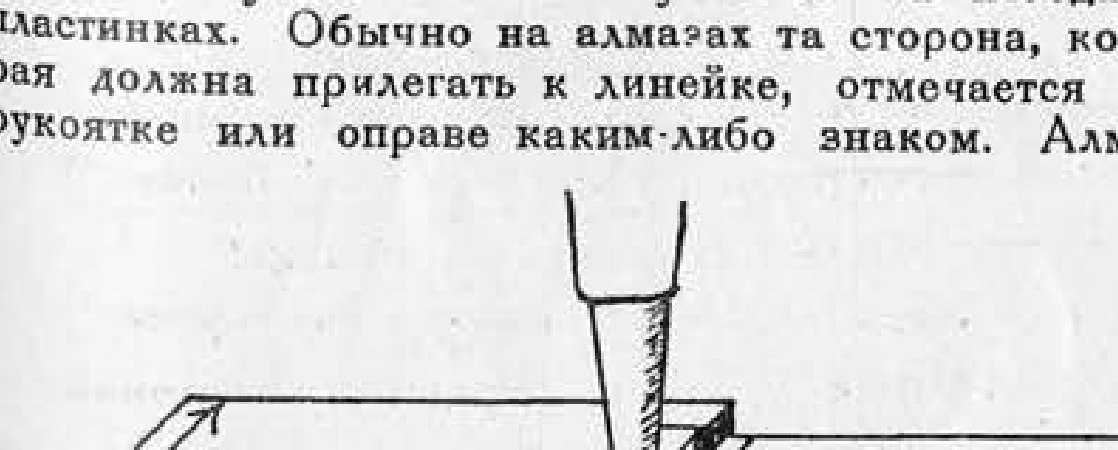
Of course, for this a diamond is needed. It will cost a rouble and a half, taking into account that the glass on plates is usually thin, so that one can get by with a small, inexpensive diamond. Having got the diamond, one must still make templates by which we shall cut the plates. The templates are cut with a sharp knife from thick cardboard, 3 mm. Their sizes should be smaller than the required plate size by as much as the cutting edge of the diamond stands away from the edge of its mount. Usually this distance is 4–5 mm. Thus, if we align one side of our template with the edge of the plate being cut, and along the other side, as along a ruler, draw with the diamond, we shall cut off a piece of just the required size.
It is better to use two templates, and sometimes even several, especially where there is a great difference between the size of plate that is available and the size into which the plate must be cut. For example, we need to cut plates 13×18 into 4.5×6 cm. The cutting edge of our diamond stands 5 mm from the edge of the mount. Then one template we cut of size 13×4, and, using it, cut the plate first into strips of size 13×4.5; there will be four of them. The second template should be of size 4.5×5.5; with this template we cut each strip 13×4.5 into 2 plates 4.5×6, getting an offcut of 1×4.5 (see the drawing).
It is understood that one who in general does not know how to work with a diamond had better first practise on unfit plates. Usually on diamonds the side which should lie against the ruler is marked on the handle or mount with some sign. The diamond must be held straight, pressing it slightly on the glass. It should not scratch the glass; with correct cutting its movement over the glass is unhindered and takes place without an unpleasant grating. One must stop the diamond a little before reaching the edge of the glass, otherwise, slipping off that edge, the diamond may crumble out of its mount. Having drawn a line with the diamond, small pieces of glass are broken off by holding them between the fingers, larger ones by laying the cut on the even edge of the table or a ruler and pressing with the hand on the other half of the glass. Small offcuts are broken off by pressing from below with the handle of the diamond, or by using the notches in the mount.
Only having fully mastered this art does one set about cutting plates. Of course, this operation should be done in complete darkness under a weak red light — or still better, if it is farther from the source of light. With some skill one can very easily cut plates even in a completely dark room. One must be especially careful in resorting to red light when working with high-sensitivity and orthochromatic plates.
The hands of the one working should be clean and dry. Having opened the plates, we take two at once, folding them layer inside — usually they are already so packed. Aligning the template with the edge of the plates, we draw a line with the diamond. Then we turn the plates over and draw a line on the other plate. After this we take the plates and break them one by one in the hands, holding them with the fingers so that the layer is not touched. Having broken along the cut, we bend the plate; then again layer lies on layer, remaining all the while protected from touch.
In cutting large plates one can break them either by the usual glaziers' way, on the edge of a ruler — observing with this, of course, every care not to scratch the layer — or by carefully shifting the plates between themselves so that the cut of the one comes onto the edge of the other; with a light press the first plate breaks on this edge. It is very useful to fan the cut plates with a soft brush, so that there do not remain on them the small splinters and glass dust produced by the diamond.
— P. Leontyev