
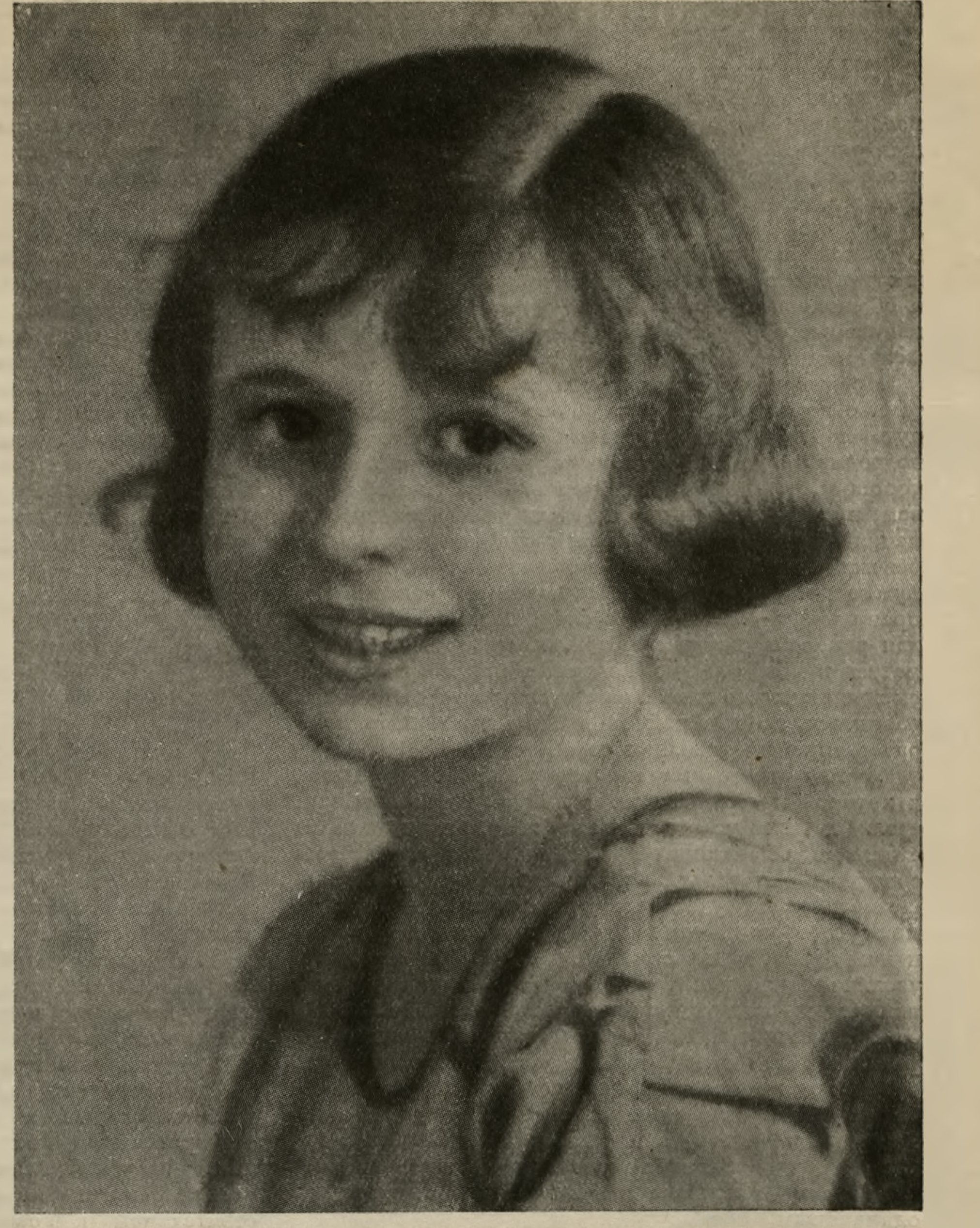
The Artigue method, with two plates, described by A. Kamenshchikov in No. 4 of Sovetskoe Foto, called forth a flood of responses from our readers who tried the method. We think that comrades wishing to attain softness in portraits will find it useful and pleasant to acquaint themselves also with the method described below — exceptionally simple, but giving full satisfaction.
The bulkiness of the Artigue method
As the readers of Sovetskoe Foto know, in the Artigue method the shooting of a portrait is done simultaneously on two plates, inserted together into one cassette, emulsion to the lens, the first plate giving the ordinary sharp image, the second an unsharp, blurred one; the printing too is done simultaneously from both plates, and in the result the print acquires an artistic softness.
The application of this excellent method requires, however, very great skill, and is bound up with a number of difficulties, thanks to which successful results become possible only after a long series of trials and failures: (1) for the sufficient working-out of the rear plate, the front one has to be strongly overexposed, whence the need to develop the plates in different developers; (2) the need to catch exactly the correct mutual relation of the negatives, so that the print is neither too sharp nor too blurred — the negatives often have to be now weakened, now intensified; (3) over and above all, a double expenditure of plates.
Buret's method
Meanwhile, there exists a method of “double printing,” worked out also by a Frenchman — G. Buret — a method considerably simplifying the Artigue process, not diminishing its merits, and leading to the same results. This method is widely applied by French photographers.
Buret's device consists in this: that the printing from a most ordinary sharp negative is divided into two parts. First they print directly from the negative onto the light-sensitive paper and get an underexposed sharp image; then they insert between the negative and the paper a ground glass, with the smooth side to the paper, and finish the printing. The second part of the exposure gives a blurred image, and in the general result a soft print is obtained, the same as in the Artigue process.
Buret's method in enlargement
This device is especially convenient in using an enlarging apparatus. The paper is fastened to the board with drawing-pins. If, for example, an ordinary enlargement required an exposure of 20 seconds, then first one prints on the paper half this time — 10 seconds; then puts out the light in the enlarger, covers the light-sensitive paper with ground glass (matte side to the lens) and exposes the remaining 10 seconds. It remains only to develop the print, to get a portrait with excellent artistic softness, which completely excludes the need to retouch the negative or positive — the stumbling-block for amateurs and the waste of a mass of time for professionals.
At the first exposure on the paper an underexposed sharp image was obtained; at the second, onto the paper fell only the scattered shadow of the sharp image, held back by the matte surface of the glass. The sum of these two images is a pleasant soft print. The ground glass is better taken thicker than a plate, and one must see that with its smooth side it presses the paper tightly to the board on which it is fastened.
For the simplicity of our example we divided the exposure into two equal parts, but they can be varied according to the desired degree of sharpness or softness: for example, give 12 seconds of the sharp part of the exposure and 8 seconds of the soft, or the reverse — but so that the sum of both exposures gives the exposure normal in the given conditions (in our example, 20 seconds). After a few experiments the needed skill is easily acquired.
Advantages of the proposed method
By comparison with the Artigue method, the advantages of double printing are these: (1) economy — only one plate is used instead of two; (2) more economy — in view of enlargement, plates of small sizes (up to 9×12 cm) are used even for large portraits; (3) since here the most ordinary negative is needed, the failures bound up with the complexity of obtaining Artigue's two conjugate negatives are excluded; (4) the negative can be used both for ordinary printing and, conversely, one can get soft prints from already existing, previously shot normal negatives; (5) one can use even a crudely retouched negative, since the scattering makes the pencil invisible, just as it does spots on the skin and the like; (6) one can mutually vary the parts of the exposure of the sharp or soft image, one at the expense of the other, to shift the desired effect one way or the other.
Buret's method in contact printing
Especially tempting for the owner of an enlarger, Buret's method is quite accessible also to one who has none. In contact printing one must take a completely even and smooth board (better a drawing board), lay it on a table, over which, at a distance of not less than 1½ metres, hangs an electric lamp (better matte, or of milk-glass), which will serve for the printing and must on no account swing.
By laboratory light the sensitive paper is fastened to the board with three strong pins, the ends of which are driven firmly into the wood, a little inside the sheet of paper: one pin in the middle of the short side, the two others at the first and third quarter of the long side of the sheet. Then on the paper, by the pins, is laid, matte side up, a ground glass of the needed format, and on it the negative, emulsion down (so that the matte side of the glass touches the emulsion of the negative), and both are carefully fitted by the three pins. The lamp is lit and the first part of the printing is done (the soft image). Then the light is put out, the negative and the ground glass are removed, the negative alone is laid again on the paper, exactly by the pins, and the remaining part of the printing is done (the sharp image). One must see to it carefully that both times the negative is laid in exactly one and the same position.
General remarks on portrait shooting
Beginning portraitists must not think that the device described above possesses a miraculous property — of itself automatically giving an artistic portrait, whatever the negative. If on the negative, through incorrect lighting, one side of the face came out quite white and the other completely black, without any half-tones — then, of course, Buret's method will not help here either. If, for example, a ¾ bust is shot with strong diaphragming, so that both shoulders came out very sharp and the general sharpness of the negative is such that one can almost count the eyelashes and the hairs down to the last plane, then a simple print would come out flat, with an unpleasant excess of detail. Double printing will soften the dryness of the contours, give them a certain softness — but the portrait will all the same remain mediocre.
To obtain the maximum artistic effect one must start from a good normal portrait negative. In this article there is no room to expatiate on portrait shooting in general — this will be done in the nearest numbers of the journal by other comrades; I shall give only a few of the most important indications. If possible, it is better to use a long-focus lens (24–30 cm); with a small camera, if its extension allows, shoot with the one rear lens. In general one cannot shoot closer than 2½ metres, to avoid distortion.
The setting to focus on the ground glass must be done so that the eyes are seen completely sharp; but one must try to attain this result with the greatest possible extension of the camera — that is, the eyes should be at the last boundary of the field of sharpness, which should decrease from the eyes toward the back of the head. With high-aperture lenses (F/4.5) it is always useful to use the full aperture — this gives a good gradation of shadows between the foreground and background. Lenses of a light-power greater than F/4.5 (F/3, F/1.8), however, or with a very long focal length, must be diaphragmed, to moderate the blurring of the background.
The eyes should be clear, and the back part of the head less distinct. Such a negative, enlarged by double printing, will give a shot in which the eyes, having lost the dryness of the negative's features, retain sufficient distinctness and clarity; the small insignificant details of the face will be invisible; the hair, receding from the foreground, will pass into the general drawing; and a portrait of the most pleasant outline and relief will result. The method of double printing softens contrasts — therefore the negatives should not be too weak, but should approach the normal type. With very weak negatives one must use contrastily working paper.
In conclusion I must warn comrades that this method, excellent for portraits, should not be used for landscapes. So, arm yourselves with ground glass and — to work! Report the results to the editorial office of Sovetskoe Foto.
— A. Mironov