
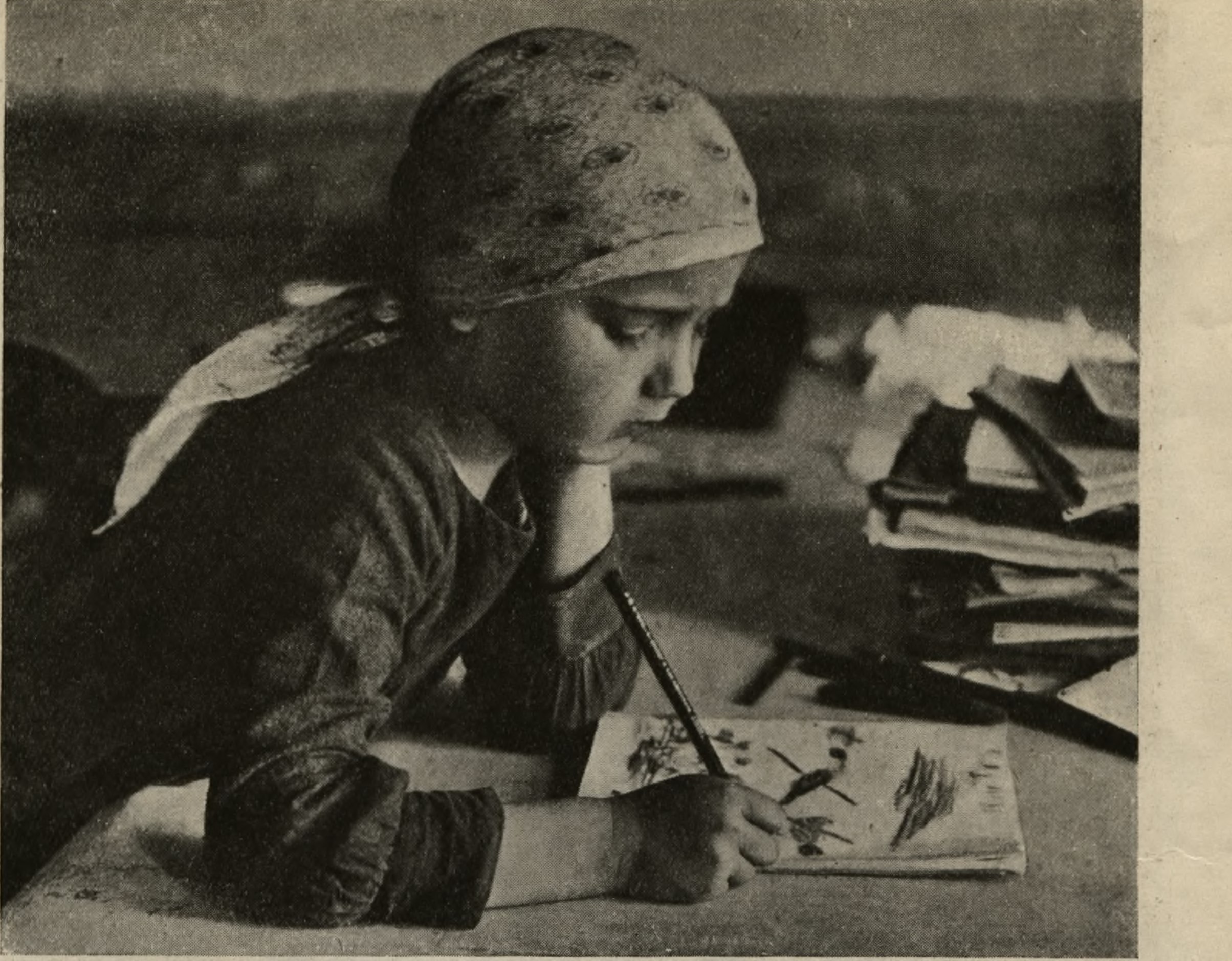
How is one to get a print with a background “artistically” hatched with careless strokes? This question has probably more than once arisen before the photo-amateur.
Such a background is best of all for portraits; and, indeed, very often precisely in amateur practice portraits can come out that are, on the whole, not bad, but with an ugly background that quite destroys the favourable impression. Suddenly out of the head grows a bunch of flowers that stood behind the sitter at the shot, or the portrait is adorned, like a hat, with a frame that hung opposite. Such mishaps happen. Sometimes one even gets by without them, but the background of the portrait is, as they say, “restless”: on it are many objects, spots and the like. Everyone, probably, has tried to avoid this by shooting against a background of a blanket, a large grandmother's shawl and so forth.
There are also cases where one simply needs to single out one face from a group, covering all the rest. This may especially often present itself in enlargement. In all these cases one must close those places which should not come out on the print. This is done with so-called “covering” paints — that is, opaque ones (black), or ones that do not let the acting rays through onto the paper (red).
But one can also soot the glass side of the negative and then wipe clear on it the needed places. This method is very good, uncomplicated, and gives excellent results. One must have a small lamp-smoker, which can be prepared oneself very simply, recalling the experience of past years. As fuel serves kerosene, and still better kerosene together with lean (vegetable) oil — such a mixture gives more soot. The flame is set so that the soot goes in a thin and round stream, a little cord of it. One must try that there are no draughts in the room, and oneself not to move sharply or breathe on the flame, so that the stream of soot does not waver.
The negative is wiped on the glass side, to remove various spots, as is always done in printing; and, holding it between the fingers, one carefully leads it over the flame at a height of 15–20 centimetres. This must be done not at once but gradually, so that the negative does not crack from fast heating. In the same way, having finished the sooting, the negative is gradually cooled. Despite the gradualness, however, these are very fast operations. One must only not lay the negative, after sooting, straight onto the surface of a table or some other plane — in that case it will almost inevitably crack, losing much heat at once. One can set it on a drying rack, or on edge, leaning it against something.
The sooted negative requires care also in not scratching the soot. Holding it between the fingers, against the light, with a cotton, slightly damp tampon on a match one wipes the glass in those places which should print — they are usually sooted the more weakly and are well seen against the light.
When the needed place (the face) is cleaned of soot, the most varied hatching can be made with a tampon, a little brush, simply a match or a stick. The drawing of the hatching itself, this or that background, depends of course entirely on the tastes and skill of the photographer. Whoever can draw even a little quickly grasps all this wisdom; and if something is not right, one can very easily correct it — again onto the smoker, and draw anew.
One can make also a very good softly-shaded background, or a weakened hatching, if the already finished negative is sooted again, but not strongly, and one cleans off those places which should be completely transparent (the faces). With a stream of soot one can work as with the softest stump, moving the negative away from it or bringing it closer — and, moreover, much more simply than with paint or stump. Only, when all is ready, one must remember that the lightest touch leaves a trace on the soot. Therefore in printing or enlargement the negative should be held either on trestles or in a frame, but so that nothing can spoil the work.
If one wishes to preserve the finished soot for a long time, one can spray the sooted side from a pulverizer with fixative, as is done with pencil or charcoal drawings. The fixative is a not-dense solution of some transparent resin in alcohol, turpentine, benzine or benzene. Therefore, if ready fixative is not to be found for sale, one can use ordinary white spirit-lacquer, only it should be diluted with alcohol at least twofold, so that it is not so thick and sprays well from the pulverizer. One can also dissolve oneself, in any of the solvents named above, some light resin — for example, at least good colophony (rosin), or, still better, dammar resin, gum dammar.
The method of sooting can be successfully applied not only in portrait shots. In printing landscapes with masks of this or that form (masks of the “Fantasi” kind), the mask can be successfully replaced by sooting the negative; needed is only a little experience and, of course, a certain artistic taste. And in all those cases where one must completely close off what is unneeded on the shot and single out that for the sake of which the shot was made (for example, in many scientific shots), sooting with subsequent processing is an extremely simple and convenient device.
— P. Leontyev