
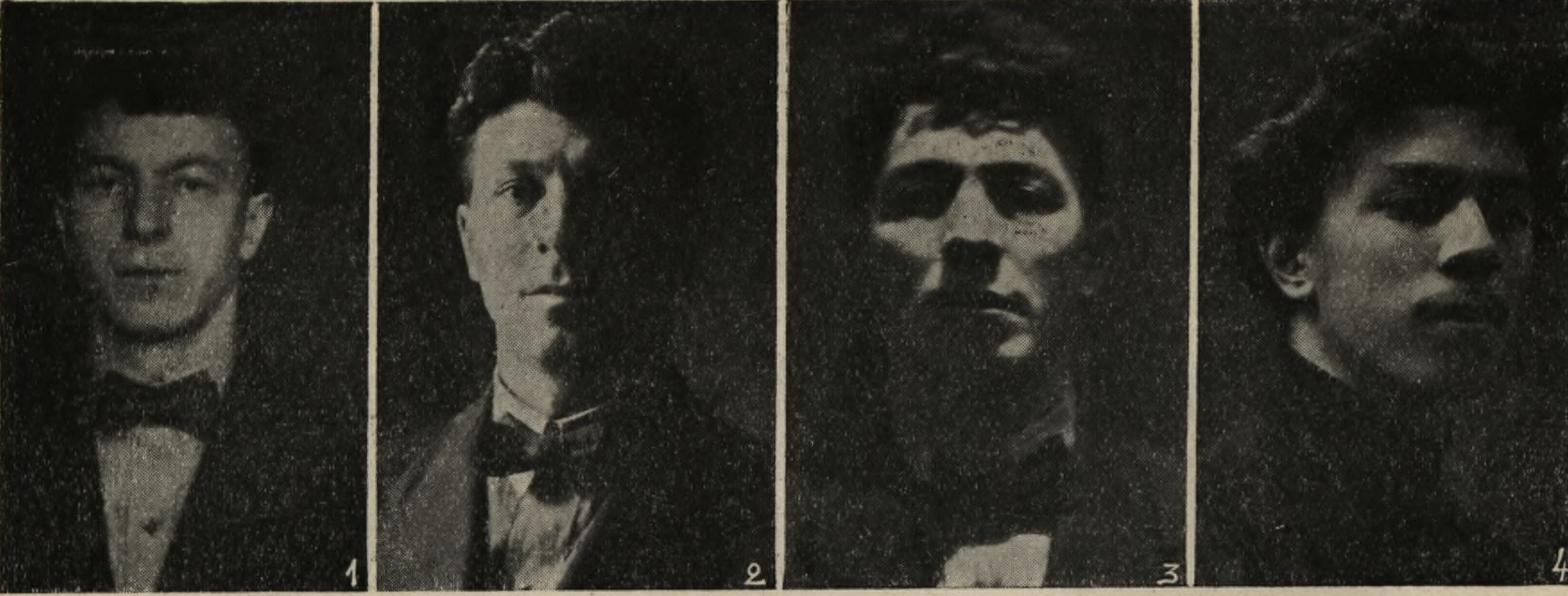
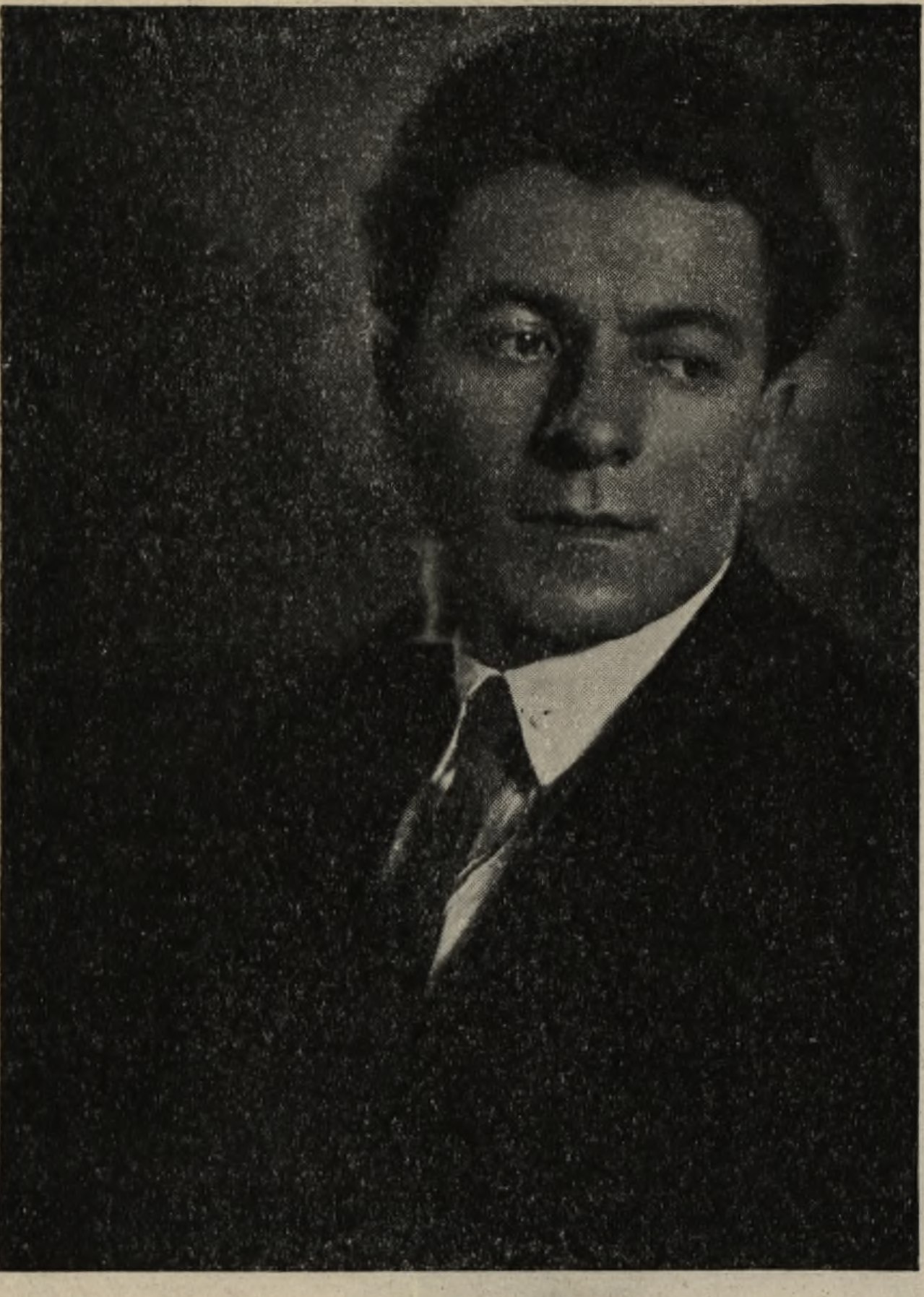
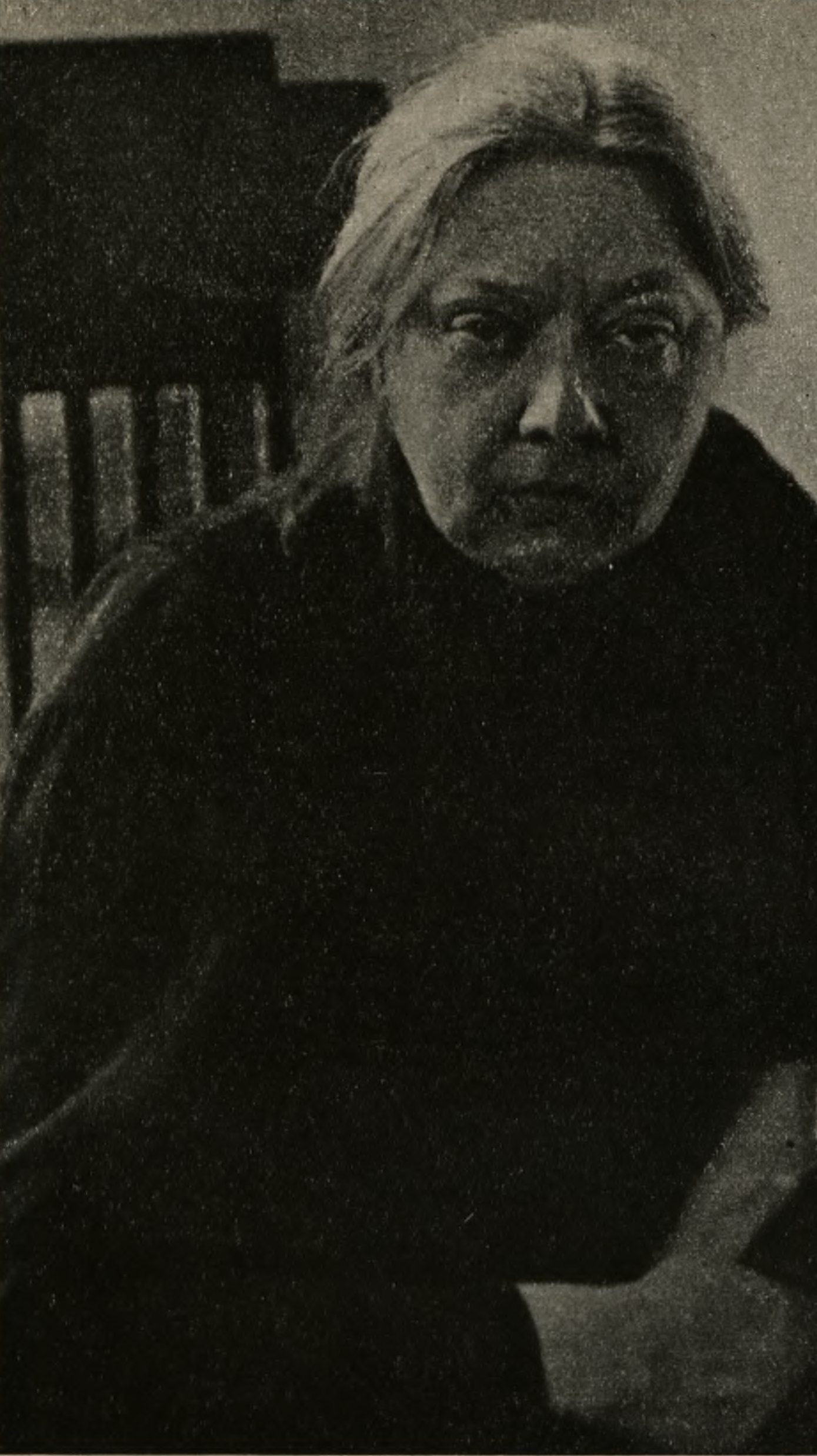
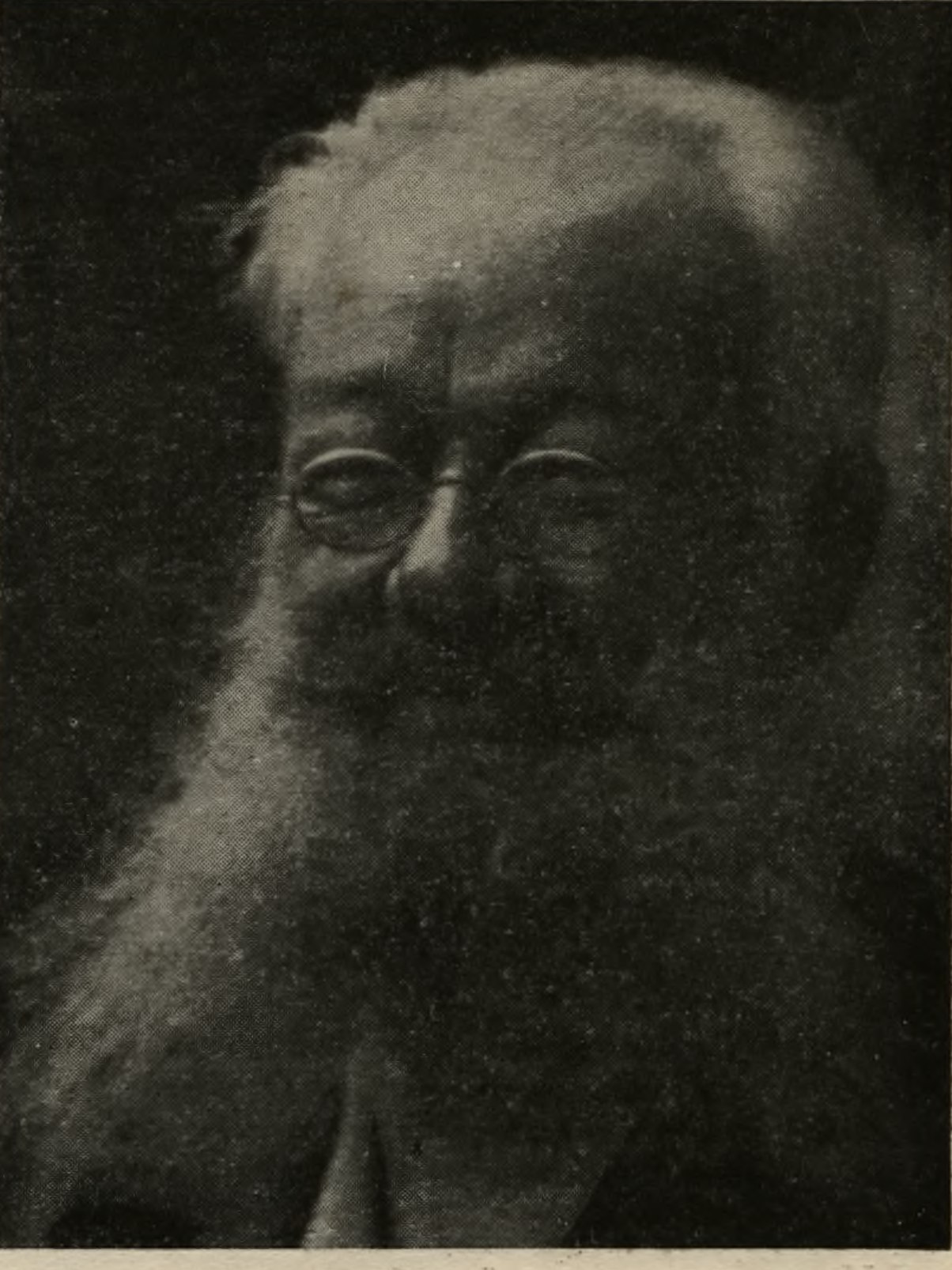
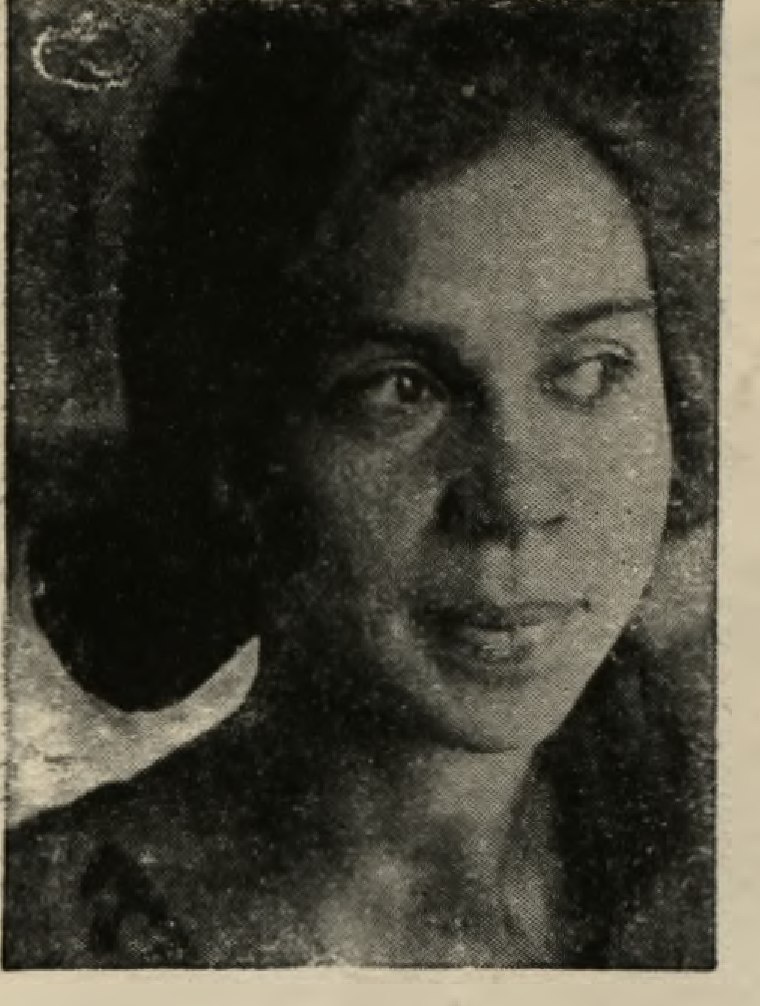
Portrait shooting is one of the most interesting, but at the same time one of the most difficult, departments of the photographic art.
This difficulty consists in the limited means by which the photographer-artist can get a portrait that is artistic, and that presents a certain interest not only for the model or persons closely connected with it, but also for outsiders.
What, then, should be the qualities of a portrait, for it to possess this objective artistic value? Besides the compositional requirements — that is, unity of theme, beauty and plasticity of lines, a correct distribution of light and shadow — an artistically executed portrait must also reveal the characteristic features of the face shot, express sufficiently fully its inner essence, and thereby emphasize the given individuality. Besides, like any artistic work, a portrait must sufficiently brightly reveal the creative personality of the artist himself.
Among the enumerated conditions, the most difficult to fulfil is the question of likeness. If, with the help of a successfully chosen lighting and pose, the photographer can achieve a correct conveying of the external and, possibly, the characteristic features of the shot model, this may have only an external, formal likeness, and in the obtained portrait the main thing may, perhaps, be lacking — namely, vitality. Life is movement; therefore the expression of a living human face is not a frozen form, but is a whole gamut of states alternating one after another. To catch the most characteristic of these states, and to be able to convey the whole sum of impressions from the model — that is one of the basic tasks of the photographer-portraitist. A portrait can be valued as an artistic work only where it is vitally truthful, which is possible only on the condition of both an external and an inner likeness of it with the depicted face. It is precisely in the conveying of this inner essence that the chief difficulty of portrait shooting consists.
1. Instantaneous shot, or shot with exposure?
In resolving the questions of the vitality and likeness of a photographic portrait, perhaps the decisive role is played by the question of the duration of the exposure. On this question the opinions of photographers have divided, and two diametrically opposite points of view have emerged.
A considerable majority, to which belong a number of very large and talented photographer-artists, warns against too short an exposure. From their point of view, with a prolonged exposure it is easier to catch the characteristic features of the model, since in these conditions on the shot are formed, as it were, layerings of various, fast-following expressions, thanks to which are revealed the characteristic features proper to the shot face.
In opposition to this opinion, a minority of photographers, to which the author of the present article belongs, considers that only a very short-lived — more correctly, even an instantaneous — exposure is capable of conveying those inner features which create the main likeness of the portrait with the model. From their point of view, a prolonged exposure does not attain its aim, since, instead of the supposed gamut of various expressions, it calls forth in the model only an expression of strained attention and fatigue. On the contrary, with a skilful approach to the shot model, with its attentive study, and, chiefly, with the creation of such a setting as would distract the thoughts of the one shot from the forthcoming photographing, one can always catch such a “nodal” moment as could sufficiently fully and brightly characterize the shot face.
From our point of view, the main defect of a prolonged exposure is precisely the realization, by the one being shot, of the very moment of photographing, thanks to which his face at once takes on a petrified, strained expression. To avoid this is possible only with the suddenness of the shooting — that is, with an instantaneous exposure. However, despite all the positive qualities which the instantaneous shot possesses, it should be applied only where we are sure that we shall not make an underexposure. Beginners should therefore hold to that basic rule which says that a small overexposure, corrected by subsequent developing, gives the best results, whereas an underexposure in a portrait is much harder to correct than in any other field of photography. With underexposure disappears all the modelling of the face, and with it disappear those tender half-tones and transitions from light to shadow which constitute its main charm; for with their disappearance disappears both the likeness and the vitality of the portrait, which, by its contrastiness and coarseness of tones, gives what among photographers bears the name “soot with chalk.”
2. On the lens in portrait photography, on the camera, plates and developer
From the experience of everyday life we know what distortions of perspective short-focus lenses give; therefore the first thing a specially portrait lens should possess (besides, of course, a good light-power) is a long focal length. The most suitable focal length for a shot of size 13×18 cm should be recognized as 40–50 cm, and for 9×12 cm — 25–35 cm. Among the various systems of lens applied in the field of portrait photography, especial distribution has been gained by the high-aperture anastigmats.
Possessing a considerable light-power, these lenses still could not fully satisfy the requirements made of them, since they emphasized and conveyed, with excessive obtrusiveness, a whole series of unnoticeable and insignificant defects of the shot face. To avoid this murderous sharpness and to soften the contours, photographers resort to a whole series of artificial devices. One of them, the so-called Artigue method, or the method of printing from two “conjugate” negatives, is described in No. 4 of Sovetskoe Foto for this year; another, simpler method — Buret's — is described in No. 7 of the journal. Let us mention one further device: in the cassette, before the plate, is placed a completely even and absolutely clean matte glass with a fine mat, a millimetre thick, its matte side turned to the lens; the setting to focus is done as usual, without paying attention to the matte glass, and the exposure should be normal. The thicker the matte glass, the greater the softness that can be attained.
Unfortunately, the most beloved corrective to the work of the anastigmat is retouching. It is precisely the combination of a short-focus anastigmat with tasteless and illiterate retouching that gave birth to that horrifying type of portrait which has received a spontaneous distribution and is not eradicated even to this day.
A turning point in the history of portrait photography was the appearance of soft-working lenses — monocles. The images obtained with the help of these lenses were distinguished by an unusual softness and plasticity. This effect was attained by the fact that in the lenses the spherical and chromatic aberrations were only somewhat reduced and regulated, but not destroyed completely. Thanks to these qualities, the soft-working lenses gave a splendid modelling of the face, relief, and — possessing a large focal length — conveyed perspective correctly. If one still has to work with a comparatively short-focus lens (for example, 15 cm for plates 9×12 cm), then, to avoid distortion, one should not bring the apparatus closer to the one shot than a distance of 2 metres.
The best camera for portrait photography should be recognized as the pavilion camera, provided with a special tripod. Since these cameras are extremely bulky and dear, the amateur can use any camera possessing a movement of the lens-board, tilts of the ground glass, and a large extension of the bellows. From the author's point of view, the reflex camera, possessing a double extension and giving the possibility of a fast change of lenses, is especially fit for the purposes of portrait photography. In shooting portraits one should use orthochromatic plates, and in some cases — as, for example, in shots contre jour — anti-halation plates as well. As for developers, the best results are given by soft-working developers, such as glycin, rodinal or pyrogallol. It would be a mistake, however, to suppose that only the developers named can give the best results: of course that is incorrect, and the best developer will always be the one to which you are most accustomed.
3. Photographing portraits in a room
The photographing of portraits in a room possesses the valuable quality that the one shot, being among the usual and familiar setting, feels more calm and balanced than at shots in the pavilion, which is why the portraits obtained in these conditions are distinguished by an unusual naturalness and vitality of pose.
In view of the fact that the variants of room lighting are extremely various, we, having no possibility to examine them all, will limit ourselves to acquaintance with the most characteristic and frequently met. To the photographer wishing to acquaint himself as fully as possible with those effects of lighting which can be obtained in a room, we advise doing the initial experiments with a plaster bust. This kind of training will be especially useful for the beginner, since he, without excessive nervous fussiness, can trace on the bust a whole series of light effects and master the technique of obtaining them; besides, on plaster the play of light and shadow can be traced especially clearly.
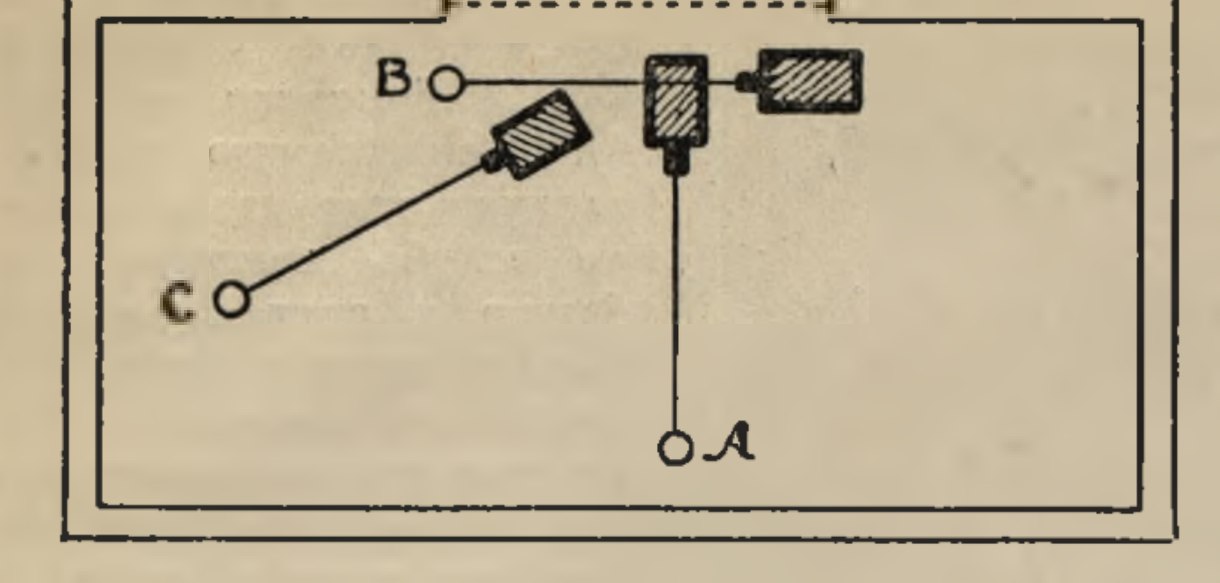
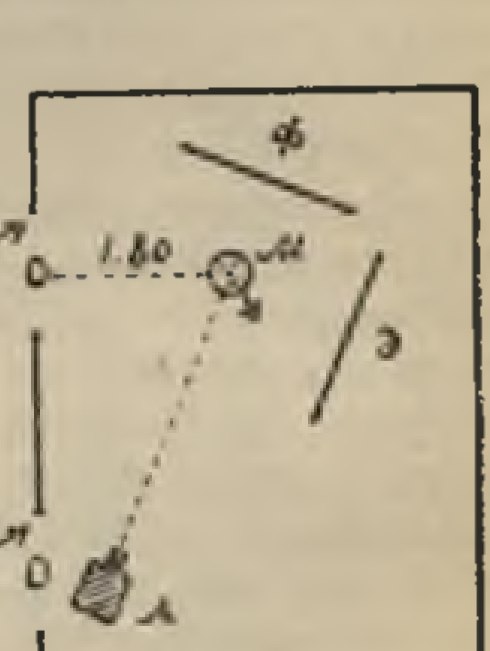
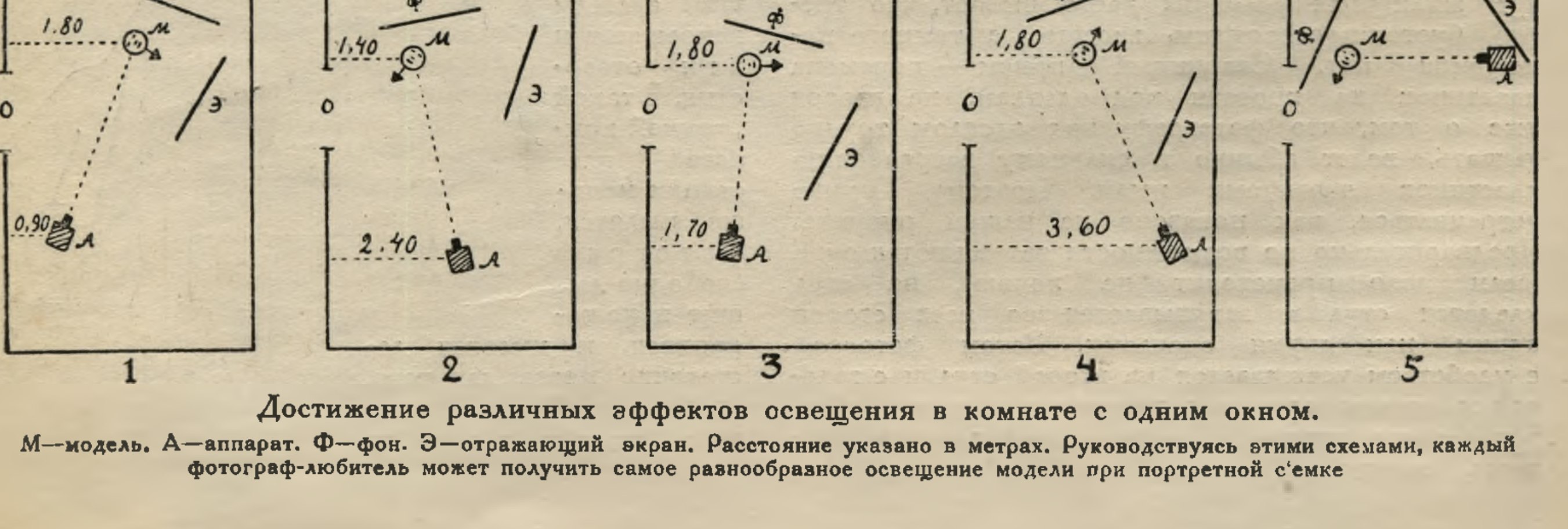
Light, for the photographer, replaces the paints and brushes of the artist; it is, perhaps, one of the few fields in which he can reveal his creative conceptions — which is why the question of the possibility of regulating light is one of the most essential conditions for obtaining a good portrait. Some notion of the various kinds and peculiarities of lighting which it is possible to obtain in a room with one window we may have from the examination of the drawing given.
If we place our model at point A, we get the so-called front lighting. With this lighting all the deep shadows on the face disappear, and the forms are marked by barely noticeable contours, thanks to which a whole series of characteristic features disappears, and we get a little-expressive portrait with “flat” lighting. The overwhelming number of photographers avoid this kind of portrait, resorting to direct lighting only where the model has some defects — such as sharply expressed wrinkles (which, as is known, are still more emphasized by the lens, forcing one to resort to retouching), or too deeply set eyes, and so on.
On moving the model to point B, we get the so-called side lighting, with which the part of the face turned to the window will be quite illuminated, while the shadow part will almost completely vanish in darkness. Attempts of the inexperienced amateur to call forth more details on the shadow part during developing will lead only to the illuminated part being hopelessly overdeveloped, while the shadow part remains almost without change. It is needless to say that as a result a very contrasty portrait with sharply emphasized features and wrinkles will be obtained, which, of course, completely distorts the likeness. To get a more harmonious distribution of light and shadow, the shadow side is usually illuminated with the help of a screen. The screen is a light wooden frame covered with cloth or pasted over with white paper. One should resort to the screen with great caution, however, since with too bright a reflected light (which happens when the screen is at a very close distance from the shot face) the modelling of the face is lost, the nose merges with the cheek, and on the eye near the screen appear unnatural, ugly highlights.
To avoid the defects of both front and side lighting, the shot model should be moved somewhat deeper into the room, closer to the wall opposite the window. Turning the model in various directions, moving it forward or back, we can achieve that the main part of the light from the window passes by the model, whereby the excess of contrastiness is destroyed and the face gets a good harmonious lighting. A similar effect can be achieved by placing the model at point C: in these conditions the light falls from the front and the side onto the face, turned somewhat more to the window, whereby a sufficient lighting of the shadow side is achieved.
Although all recipes and exact prescriptions about how to shoot in a room lead only to routine and stencil, we still consider it necessary to give the beginner a series of concrete indications. Much more possibility, in the sense of good lighting, is given by a room provided with two windows situated on one side (the approximate arrangement of the apparatus and model is indicated on the second drawing). In these conditions, onto the model, besides the strong side light from window “x,” falls also the front scattered light from window “y,” which, falling on the shadow side, softens the contrasts and gives a calm, even lighting. But still better and almost impeccable results can be obtained in a room with several windows situated at an angle. In these conditions the photographer disposes of a considerable quantity of light, which facilitates the possibility of regulating it by means of a partial or full darkening of the windows. The various effects of lighting here are so diverse and numerous that there is no possibility of systematizing them in any way. The only practical advice we can give, therefore, is to achieve the needed lighting by experience, moving the model in various directions until a suitable lighting is found. As already indicated, such experiments are best of all done at first with a plaster bust, which allows, firstly, calmly to study the peculiarities and effects of various lightings, and, secondly, to avoid an excessive fatigue of the model, which, as is known, always tells catastrophically on the likeness.
In a room with several windows one can, as mentioned, regulate the lighting not only by moving the model, but also by partial or full darkening of the windows. For this, sliding curtains are put on them, made of white or light-gray light material. These curtains should not be lowered from above but, on the contrary, raised from below by means of a cord, in order to facilitate the use of the upper light. A still greater differentiation of light is given by little curtains arranged in two rows on each window. Sliding these curtains together or apart, and varying their combinations, the photographer can always achieve the intended effect of lighting.
A known influence on the result is exerted also by the background against which the shot object is placed. Best of all, if the room itself serves as the background, with its natural setting; but this is admissible only on the condition that the setting will not be too motley and will not distract and fragment the attention from the portrait itself. Looking through the works of large photographer-portraitists, we may see how skilfully they tone down the obtrusive details of the room setting; thanks to this toning-down, an intimate and eye-caressing natural setting is obtained, against the background of which the shot face stands out.
A few more pieces of advice concerning the arrangement of the lens in relation to the shot. As a general principle, one should hold to the rule that in shooting a bust portrait the lens should be somewhat below the line of the mouth, and in a knee portrait at the height of the chest of the one shot. Deviations from this rule are, of course, not only admissible but sometimes even necessary, since faces possessing incorrect features — a long or turned-up nose, too long a chin, and so on — should be shot so as to soften these natural defects as far as possible (not overstepping, of course, the bounds of common sense, and not falling into the field of crude flattery).
Although the main element of a portrait is the face of the model, and the hands only supplement the characterization, the photographer should still devote some share of attention to their suitable arrangement, fully answering to the position of the figure of the one shot. In view of their secondary role, the hands should be lit more weakly than the face. To convey the character of the hands, one need give only a general impression of their form; an excessive sharpness of conveying may, in the artistic respect, spoil the whole portrait. One should never cut off the hands — not only at the very wrist, but even up to the elbow; too ugly come out the results of such “amputation.”
4. Photographing portraits in the open air
It remains for us now to acquaint ourselves with the shooting of portraits in the open air. This kind of portrait photography, possessing many positive qualities, is, unfortunately, not devoid of some defects, of which one should mention first of all the difficulty of regulating the lighting. This circumstance creates for the beginner a whole series of difficulties, since the enormous mass of light, with the predominance of the upper, gives, in the hands of an inexperienced photographer, a flat lighting with absence of modelling, and therefore does not allow a sufficient emphasis of the individual peculiarities of the model. To avoid these defects, it is usually recommended to do portrait shooting either early in the morning or closer to evening (in summer at 5–6 o'clock) — that is, at such a time when the scattered light gives a soft, harmonious lighting.
But if the inexperienced amateur will not at first fully manage with shooting portraits in the open air, the photographer-artist will find in this field an inexhaustible source for resolving a whole series of bold and interesting tasks. The skilful use of daylight, the combination of the portrait with the surrounding landscape or environment, and, finally, the possibility of instantaneous photographing — all this opens before the photographer a whole field of interesting themes and achievements. Of all these possibilities the greatest interest, from our point of view, is presented by the possibility of instantaneous photographing. Contrary to the established traditional opinion, the author considers that only the instantaneous shooting of portraits allows achieving their greatest expressiveness and likeness. All indications about the necessity of a long exposure do not correspond to the actual state of things, for the movements of the soul, the complex of which determines the inner likeness of the one shot, are instantaneous and fast-passing; and so attempts to fix them by the method of layering, with the help of a long exposure, must be recognized as attempts with unfit means. When a photographer wants to convey movement, he always applies an instantaneous exposure; and so any attempt to convey movement with a stationary pose produces a false impression.
Thus we consider that instantaneous shooting in the open air serves as the best means for achieving the vitality and likeness of portraits, and that in its name one may sometimes even neglect some effects of lighting. Let us now say a few words about regulating light when photographing portraits in the open air, which presents, as we have already had occasion to note, the greatest difficulty in this kind of portrait photography, in view of the mass of light — chiefly the upper — falling on the shot object. Most convenient of all is to make such shots in the space between two walls situated at an angle; in this case it remains for us to regulate only the light falling from the front and from one side. Too strong an upper light is weakened with a screen of some light cloth — thin muslin, for example — placed over the head of the model; with a similar screen one can in the needed way change the side light. To reduce the action of the upper light one may also use the placing of the model under a balcony, a porch, a canopy, a projecting part of the roof, or trees. The photo-amateur may be rendered a similar service even by an umbrella, a large hat, or some cloth stretched between trees or on special stands. All that we have said about the pose and arrangement of the shot object when photographing a portrait in a room can, of course, be referred also to the case of photographing in the open air.
Concluding the present article, we consider it necessary to point out that all the technical data given by us should by no means be regarded as mathematical formulas, a knowledge of which will automatically lead to obtaining an artistic portrait. All these indications should be regarded only as starting points for the work of the beginning photographer.
— E. Piotrkovsky