
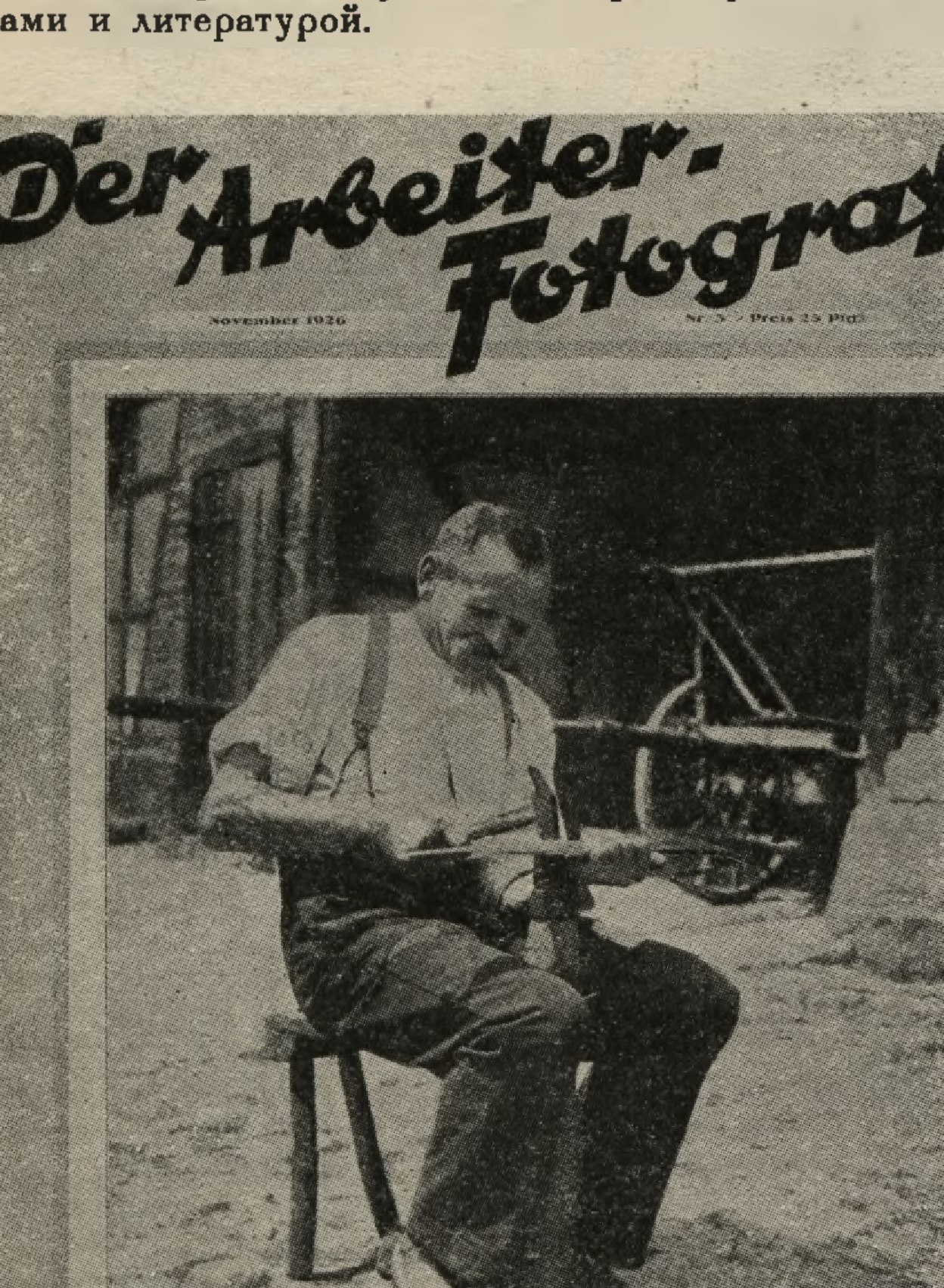
In Berlin, as was already reported in No. 7 of Sovetskoe Foto, in the edition of the “Union of Worker-Photographers” there has begun to appear a monthly journal in German — Der Arbeiter-Fotograf (The Worker-Photographer). This new, interesting undertaking belongs not to professional photographers but to workers, photo-amateurs and worker photo-correspondents, and should serve as a new form of communication between photo-worker-correspondents and a new weapon of struggle in the hands of the working class.
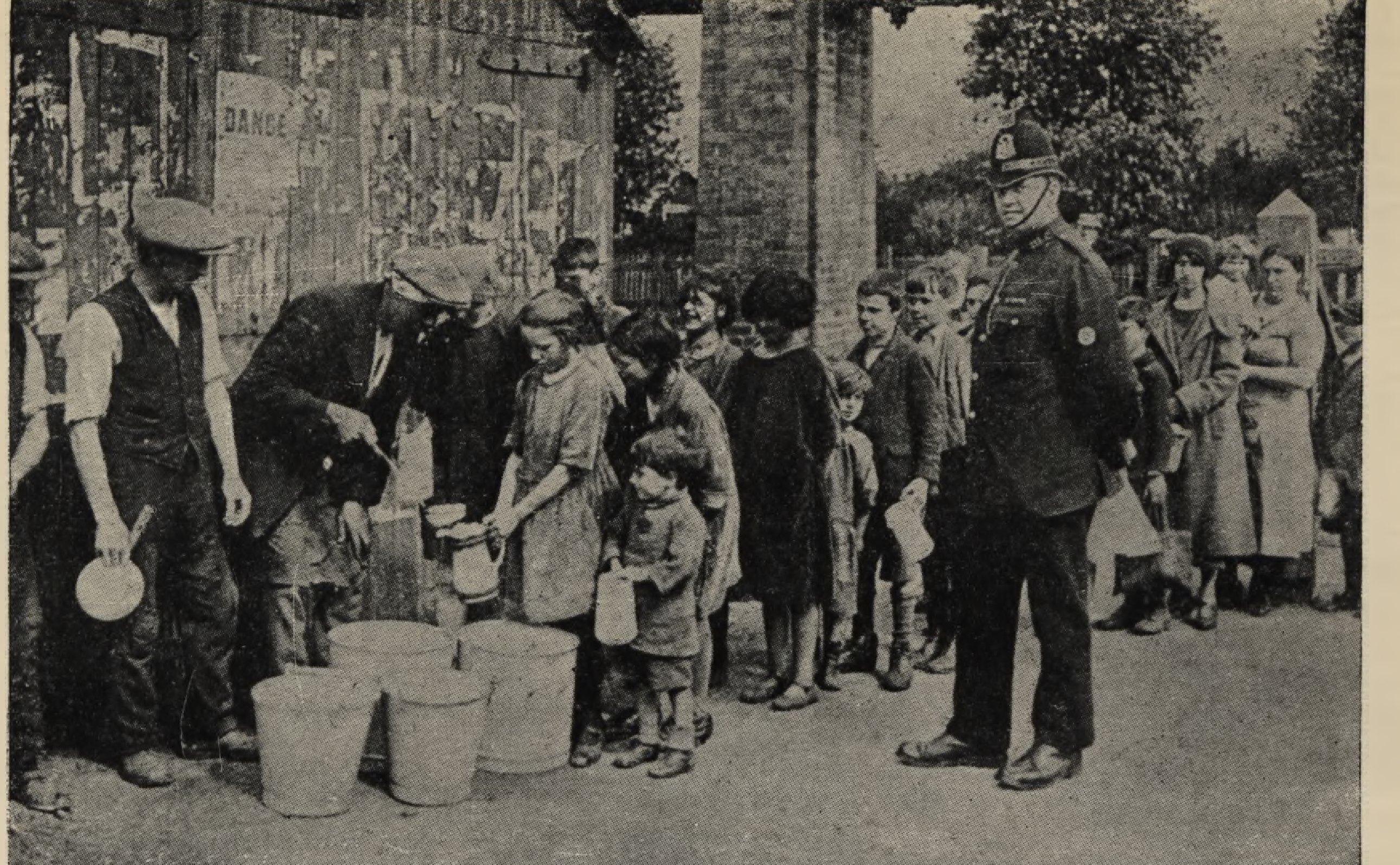
As the journal's editorial board rightly reminds us, illustrations in printed editions serve, in the hands of the bourgeoisie, as a mighty weapon for clogging the brains and plastering over the eyes of the workers. During the imperialist and civil wars the bourgeois press skilfully used retouched and montaged photographs in order to depict the “cruelties” of the enemy, the “atrocities” of the Spartacists or the communists. No less valuable a weapon photography proves in the hands of the bourgeoisie during strikes as well. The Worker-Photographer cites, for characterization, a shot depicting the distribution of milk among children during the general English strike in May 1926. Both the caption under the picture and the picture itself are meant to show how “humane” the bourgeoisie is, and what a “philanthropic” role is played by the policeman present at the scene, hands folded behind his back, smiling, as though he were a chance onlooker (see the shot).
The bourgeois press has at its service a whole network of illustration bureaus, an army of photographers and retouchers, and thousands of illustrated journals and newspapers, which poison the mind and soul of the worker with tendentiously selected illustrated material. One should not, of course, look in these journals for a truthful depiction of the worker's life in the family or at the factory. On the contrary, the bourgeois press distributes in millions of copies cheap, accessible illustrated journals, on the pages of which you may find a photograph of a famous operetta actress taking a bath in milk, or photographs of elegantly dressed ladies at the latest ball in the palace of the English king, or a shot of the most beautiful and elegant little leg that received the first prize at a competition of Parisian beauties. In vain will you seek material from workers' life — for the main task of the bourgeois press is to distract the worker from reflection on his fate, to hinder the awakening of his class self-consciousness, and in every way to brake his striving to study his needs, to understand their cause, and, having understood, to destroy the source of his grief and suffering — capitalism.
To oppose to the bourgeois illustrated press one's own workers' press is a matter of first-rate importance. In the first place, the worker-correspondent must occupy himself with photographing various moments of workers' life. Photography will help him not a little; in very many cases it can do even more than the pen.
The number of photo-worker-correspondents in Germany grows; there is already an urge to unite, to exchange experience. The expression of this need is the “Union of Worker-Photographers” and its journal The Worker-Photographer. As is seen from its statute, the “Union” sets itself the following basic tasks: to give advice to worker-photographers, to supply them with photo-literature, to help them replenish their knowledge, and to place their forces at the disposal of the workers' illustrated journals.
The Worker-Photographer is closely connected with the illustrated supplements of the communist newspapers and with the special Illustrated Workers' Gazette, existing already 5 years in Germany, splendidly set up, competing with the bourgeois Illustrated Gazette.
The main, basic task of the worker-photographer is to serve his class with the photo-apparatus, as the worker-correspondent serves it with his pen. To the force of the capitalist pocket we must oppose the might of an army of thousands of our collaborators, penetrating into all the corners of the life of the working class.
The editorial board emphasizes that a conscious worker, armed with a photo-apparatus, can do very much for the general enlightenment and organization of the working masses. The worker-photographer looks on everything with different eyes than the amusing bourgeois-traveller, clicking his kodak for his own pleasure. The board warns that the worker-photographer must not degenerate into a simple amateur — the worker-photographer must always be a devoted member of his class, everywhere and always (on the street, in the family, at the workbench, in the port and in the forest) faithful to the Marxist task of organizing his class and covering the needs of the proletariat.
The journal indicates that the worker-photographer must most of all beware of the sweetening of his shots: “For the worker-photographer there is only one kind of beauty — truthfulness. One photographing, by itself, is not enough. Whoever is not inwardly connected with the toiling masses, who does not live and struggle together with them, will never be imbued with their life and will not find the suitable moment and theme for shooting.”
The conditions of work of the photographer-worker are quite special. The sun, in the journal's expression, relates like a stepmother to the worker's flat; the light conditions for shooting in the worker's flat are extremely unfavourable, and the apparatus of the worker-correspondent is for the most part far from perfect. The journal The Worker-Photographer sets itself the task of technical help to the photo-worker-correspondent as well.
On the question of what to shoot, the editorial board indicates that one should not be carried away by shooting parade events, but strive to give real photo-correspondences from the enterprise, covering the most burning questions and the most pressing needs of workers' life, revealing and scourging the hard living conditions of the working class in capitalist Germany, illustrating the absence of labour protection, and so on. In the journal a competition has been announced for the best photo-correspondence. The announcement states: “It is necessary to give a picture of the whole enterprise, beginning with the general view of the factory and ending with the pitiful devices for washing; from the magnificent flat of the entrepreneur to the pitiful hovel of the worker and his refuge in a railway wagon; from a session of the factory committee to the board from which the entrepreneur orders the committee's announcements to be torn down.” Systematic photographic information about life at the factories is the subject of the first competition of The Worker-Photographer. For the best series of photographs which, in 5–10 shots, can acquaint one, in the most essential features, with the social essence of an industrial or agricultural enterprise, a series of prizes in money and literature will be given.
The journal The Worker-Photographer, having put out only three numbers, has already attracted the attention of German workers; separate enterprises order it by the hundreds, and the number of letters to the editorial board from workers grows. But the most curious and characteristic thing is the “interest” in this journal on the part of the entrepreneurs. The attitude of the capitalists toward this young journal best of all justifies the journal's designation and the correctness of the tasks it has set. A large, influential capitalist organization, the “Union of Entrepreneurs of the Chemical Industry of Germany,” became interested in the journal. Immediately after the appearance (1 October) of No. 2 of The Worker-Photographer, this organization addressed its members with a long circular. A happy chance brought this document into our hands. It well reflects the fear of the entrepreneurs before the organization of photo-worker-correspondents, and it is worth reproducing:
UNION OF EMPLOYERS OF THE CHEMICAL INDUSTRY OF GERMANY. Section 1a. Berlin, Eichhornstrasse 4. No. 120/26. 5 October 1926.
To our members. General questions — IV. Factory espionage — 26. Concerning photographic espionage at the factories.
We have received from our general association (of entrepreneurs — D. I.) the following letter of the central association of German unions and organizations of photographers:
“Dear Sirs! We allow ourselves to touch in the present letter upon one phenomenon which deserves the greatest attention, both on the part of the employers and on the part of us, photographers. As you know, the publishing house ‘Neuer Deutscher Verlag,’ Berlin, Schadowstrasse 1b, publishes the sheet ‘Arbeiter Illustrierte’ (‘Workers' Illustrated Sheet’). From August this publishing house, whose responsible director is the member of the Reichstag, the communist Willi Münzenberg, began to put out a new little journal, ‘Arbeiter-Fotograf.’ The reasonings published in this new journal are the occasion for our letter. Let us first cite a few phrases from the first number:
‘We must first of all make shots at the factories and plants, shots that would acquaint one with the life of the workers…’
‘We must, with the help of our art, improve the agitational methods of the workers' movement.’
‘Of the many tasks standing before us, we choose today a special task which, in our opinion, is the most important for worker-photographers, namely: the acquaintance of the masses, by means of photographs, with the life at the enterprise. Every worker-reader is most keenly interested in learning in what conditions his colleagues work in other districts and countries; and the whole revolutionary working class wishes that the outrages of the capitalist order and the methods of rationalization now applied everywhere in Germany, as well as all the defects in the protection of workers from accidents at the factories, and the most unfortunate accidents themselves, should be imprinted on shots and subjected to the strictest criticism…’
If this programme is realized, then trade espionage will receive free access to the factory. We ask you to take into consideration that in this case all organizational measures, and all attempts at rationalization at any plant, will in no case be able to be kept secret. If every communist-worker will secretly make photographic shots, then the novelties which, in the interests of the enterprise, should not be made public will become the property of the broad masses: and since this matter is in the hands of the communist Münzenberg, then, given the international orientation of these people, the shots may get abroad, where they will be used to the harm of German industry. We therefore ask you to relate to this question in the most attentive manner, and await with interest your reply.”
That the journal The Worker-Photographer does not set itself the task of “economic espionage” in favour of competitors, we need not prove. The open, public printing of shots in a journal accessible to everyone cannot be called espionage! And the matter, of course, is not in espionage. The capitalists fear the exposure of their “speed-ups,” of the medieval forms of exploitation at their factories, and of the horrible conditions of life and work of their workers.
The attack of the entrepreneurs, and their readiness to put into action the most serious measures in order to strangle the young organization of photo-worker-correspondents, best of all show the necessity, the timeliness and the expediency of this organization. The journal The Worker-Photographer will undoubtedly do much in the cause of consolidating the German worker-photo-correspondents and of their mutual enrichment with experience; it will play no small role in the cause of organizing the forces of the German proletariat and in its struggle for its liberation. This journal deserves attention not from German workers alone — it is worth getting acquainted with beyond the borders of Germany too.
— D. Ikhok