

There exists an opinion that on any good-quality plates or films one can get a good shot, guided only by the general sensitivity — and sometimes also the colour-sensitivity — of the chosen material. What a disappointment and bewilderment of the photographer, then, when after developing he gets a thin, grayish negative, monotonous and devoid of contrasts (so that even contrasty paper will not help). It happens that both density and contrast are good, but the finest details are blurred; and in shooting forest subjects in autumn the yellow colouring of the deciduous species is not always easy to distinguish from the green of the coniferous woods. The photographer usually blames the emulsion, the developer, the lens, the unsuitable conditions of lighting, and so on. But in the majority of cases he is himself to blame, in incorrectly selecting the light-sensitive material.
Not knowing the basic properties of the emulsion of the plates and films we are going to work on, we thereby reduce the possibilities which can be attained with a skilful and rational use of the light-sensitive material. And these possibilities are indeed great. The few “experienced” photographers who have a “diamond eye” will make a shot of a sport jump in overcast weather, or will not repaint a blond with blue eyes into a brunet with white eyes, or, finally, will get, with all the finest details, a perspective shot in the presence of a blue haze. Of course, the determination of all the properties of the emulsion of plates and films is a rather troublesome matter, and sometimes impossible, in view of the absence on the market of suitable cheap devices. The complex and expensive equipment for testing light-sensitive material is inaccessible not only to the amateur with his “bathroom” laboratory, but also to the qualified professional.
The most important factors in determining the properties of light-sensitive emulsions are:
- General sensitivity, H;
- Contrast (the factor of development), γ;
- Veil (fog), D₀;
- Colour-sensitivity;
- The ability to convey fine details (resolving power);
- Various physical properties: durability, sliding of the layer, and so on.
1. General sensitivity
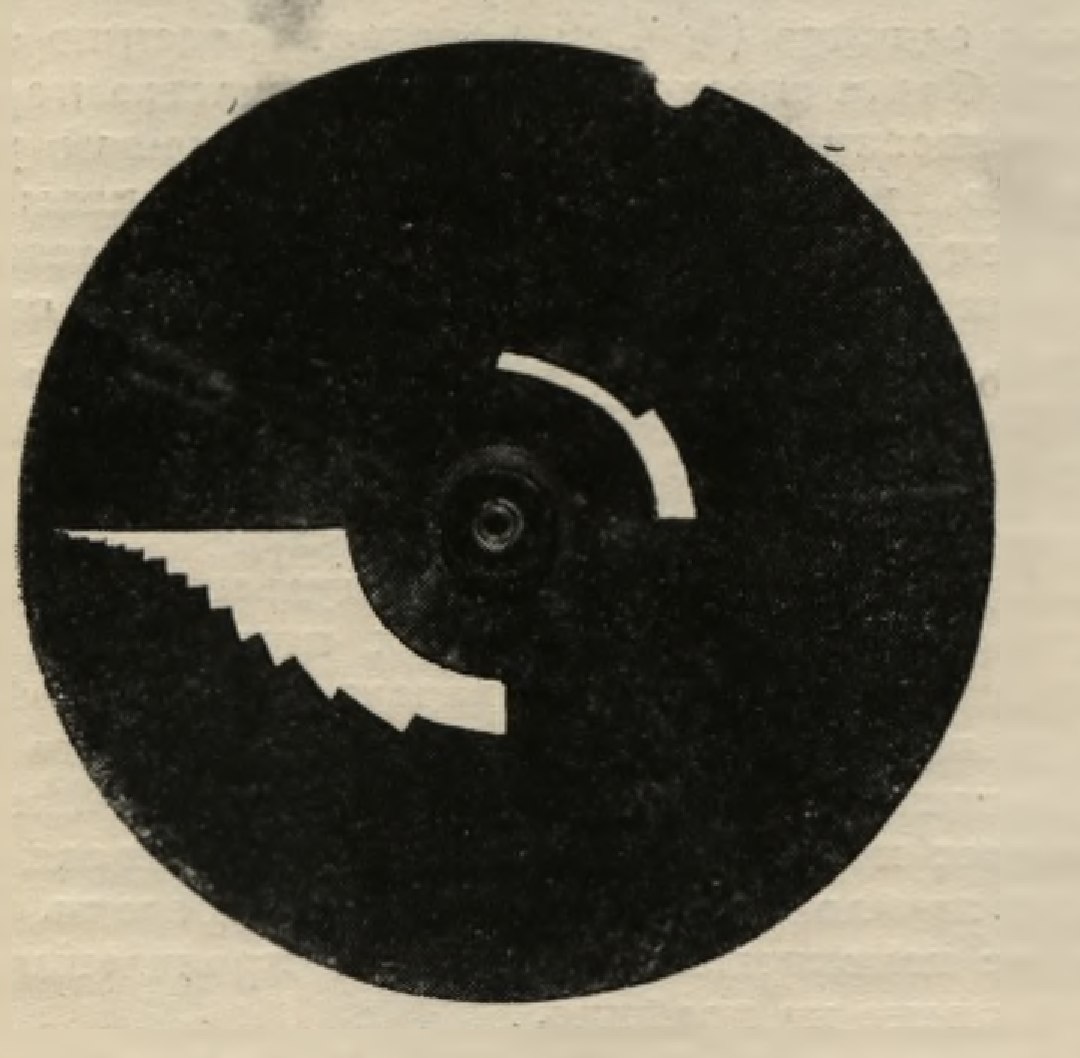
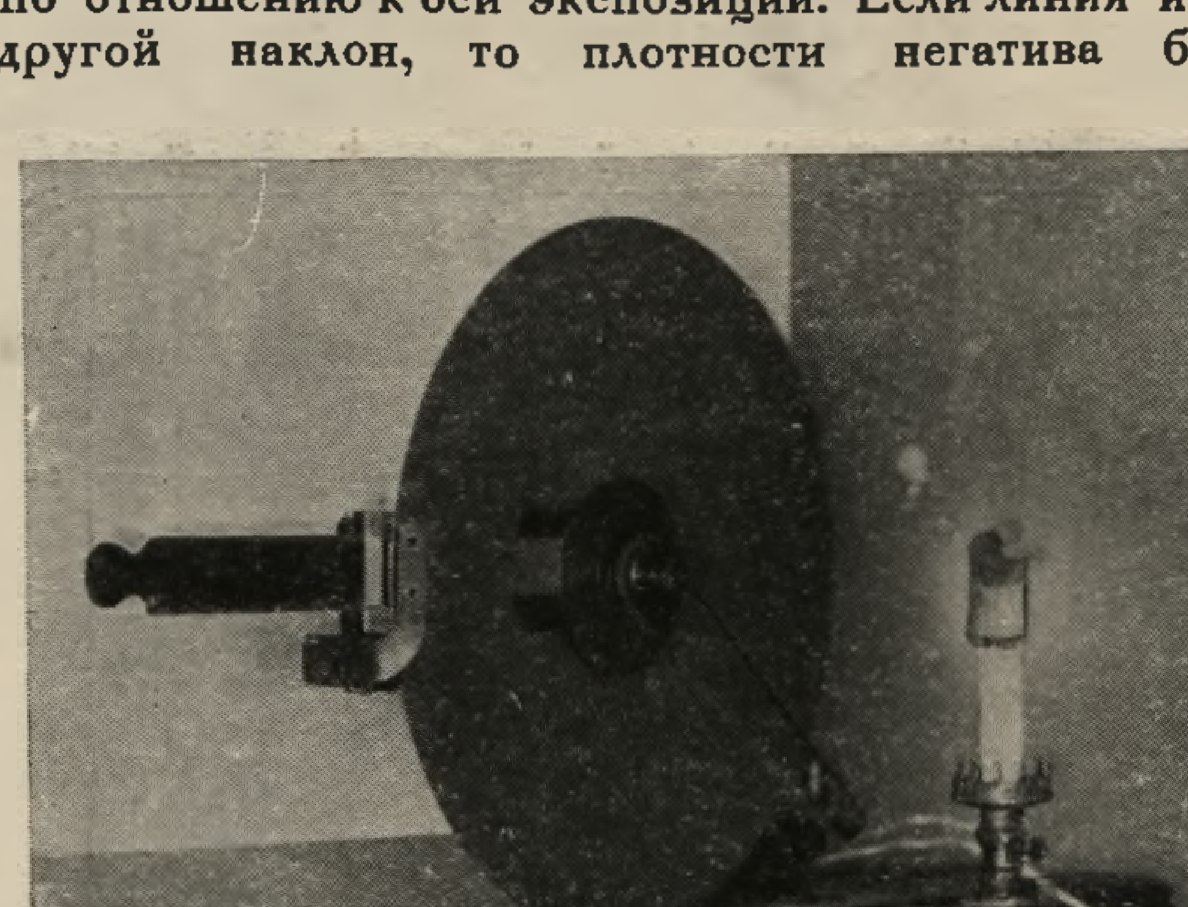
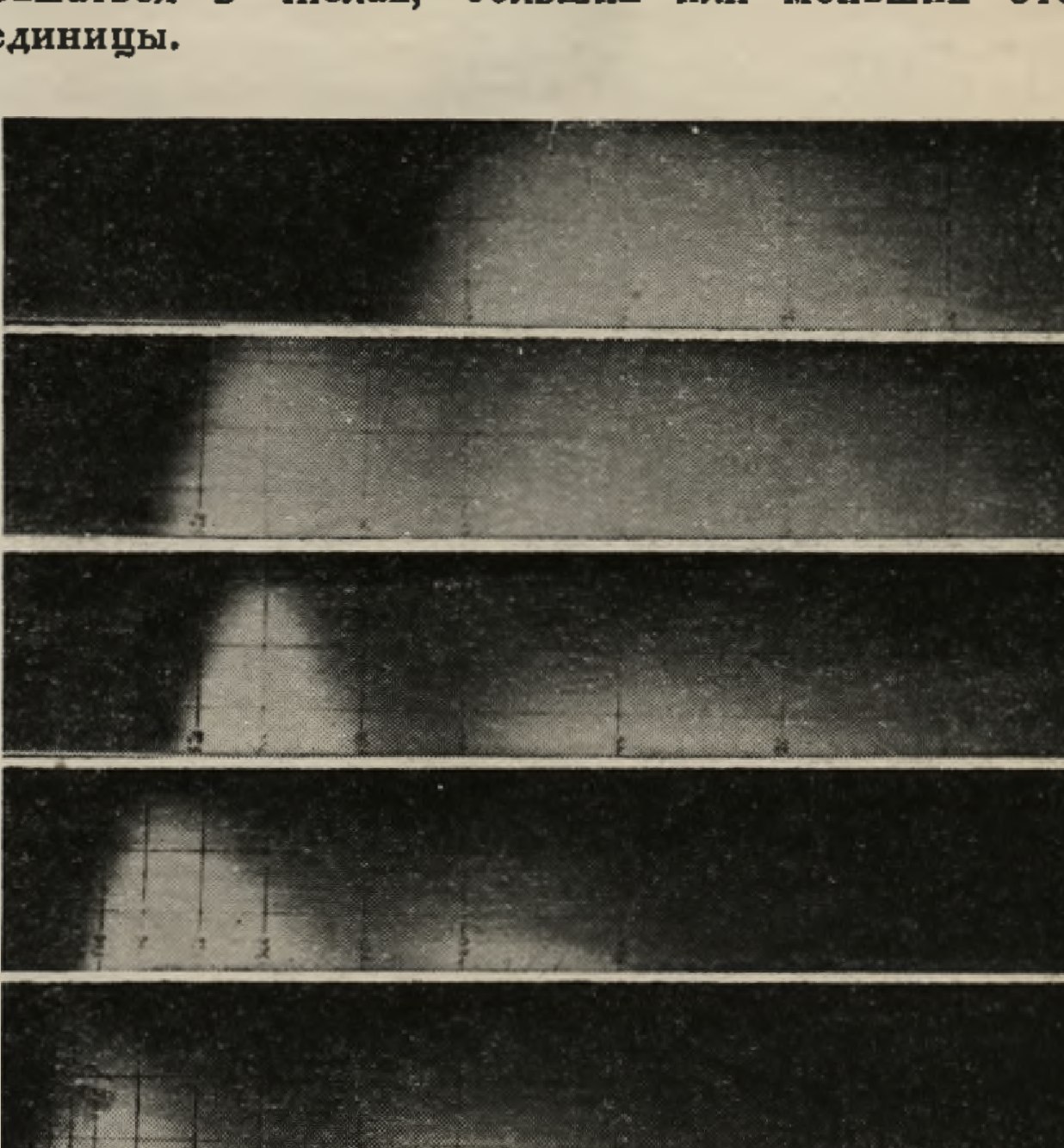
The most exact, and now also the most widespread, system of sensitometry (the determination of the sensitivity of plates) is the system of Hurter and Driffield (X and D), (H & D). To determine the basic properties of the emulsion one must use a series of exposures, in large laboratories usually obtained with the help of a rotating disk with exactly calculated stepped slots (fig. 1). On one side of the rotating disk is placed a cassette with the test plate, and on the other a normal light source (fig. 2). Thus the plate, in places where the slot is longer, receives per unit of time a greater quantity of light than in the area where the slot is shorter. The illuminated plate is developed with a developer specially worked out for this purpose, for a definite time and at a definite temperature (18°C). Then on the obtained negative, called a sensitogram (fig. 5), the densities are measured with the help of a photometer, and from the obtained numbers a curve is built, called the characteristic curve.
To depict the results of photometering a given emulsion by the graphic method, the following terms were introduced:
| 1) Transparency | T = (intensity of light passed) / (intensity of light fallen) = J / J₀ |
| 2) Opacity | O = (intensity of light fallen) / (intensity of light passed) = J₀ / J = 1 / T |
| 3) Density | D = −lg₁₀ T = lg₁₀ O |
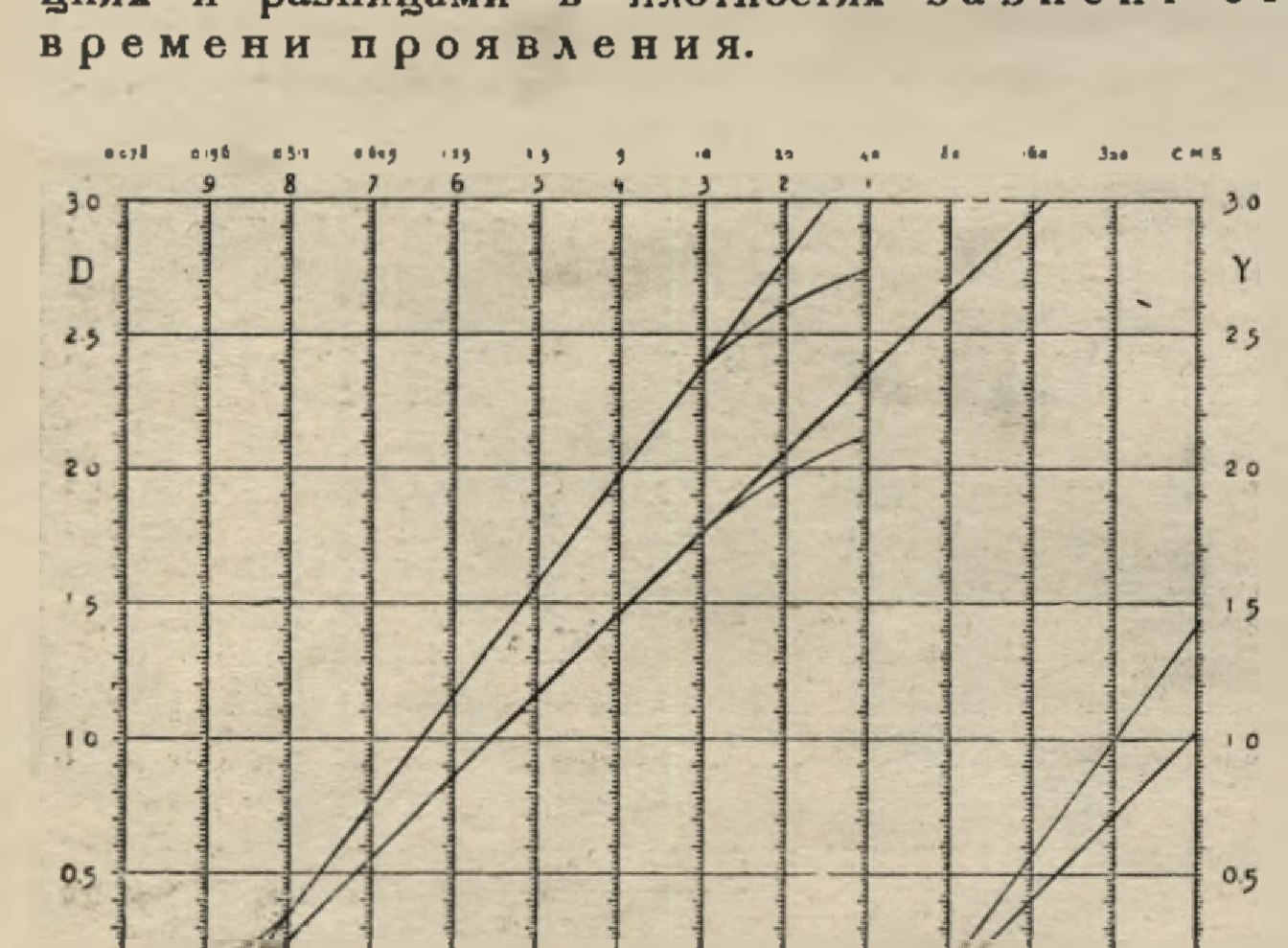
X and D indicate that the negative must give a correct conveying of the distribution of light and shadow of objects in the case where it reproduces these differences (of light and shadow) in correspondence with equivalent differences of opacity. This means that if all the densities are depicted against the corresponding exposures, then the straight line should have an inclination of 45° (normal contrast) in relation to the axis of exposures. If the line has a different inclination, then the densities of the negative will be proportional to the illumination of the photographed object, but the contrast will be different.
A typical graph of X and D we see on drawing 3, on which are depicted two curves, obtained at different times of development. These curves show that the contrastiness, or proportionality between the differences in exposures and the differences in densities, depends on the time of development. Each of these curves gives known characteristics common to all tests made by this method.
The rectilinear part of the curve shows the proportionality between densities and illumination. This part is most often called the region of normal exposures. The inclination of this rectilinear part is the ratio of density to the lg of exposures, and this ratio is called the factor of development, usually designated by the letter γ (gamma). A gamma equal to unity (tg 45°) conveys the gradation of the shot object quite exactly. Below the part of normal exposures is a segment of the curve of reduced contrast — the region of underexposures. Above the region of normal exposures is another segment of the curve, where the density, reaching a maximum, is reduced — the region of overexposures, or the region of solarization.
The general sensitivity of the emulsion (speed) on the X and D graph is obtained by continuing the rectilinear part of the characteristic curve until it intersects the axis of exposures. This point of intersection is called the inertia. The inertia expresses the smallest exposure which determines the beginning of the period of correct conveying. The inertia does not change with the time of development, as is seen on the graph. The numerical value of the general sensitivity by X and D is obtained as the quotient from the division of the empirical number 34 by the inertia, on condition that the exposure was expressed in C.M.S. (candle-metre-seconds).
If the plate is developed until the maximum density and contrast for the given emulsion are obtained, then the factor of its development is called γ∞ (gamma-infinity), and this magnitude shows the greatest contrast which the given emulsion can give on development. If with such development a veil is obtained in the unexposed places, it is measured in units of density and noted in the certificate in the column “veil at γ∞.”
The length of the rectilinear part of the characteristic curve determines the latitude (gradation) of the emulsion, or the limits of admissible exposures for getting good negatives. Thus, if we suppose that an object has limits of illumination from 1 to 30, and our plate has a latitude of 120, then 120 / 30 = 4. This means that the exposure for the given sort of emulsion can be increased or reduced against the normal by four times without change of the correctness of conveying in the light-and-shadow. If the limits of exposure are too small, then the shadows will fall into the region of underexposures and the strongly lit places into the region of overexposures, and contrasts will be absent.
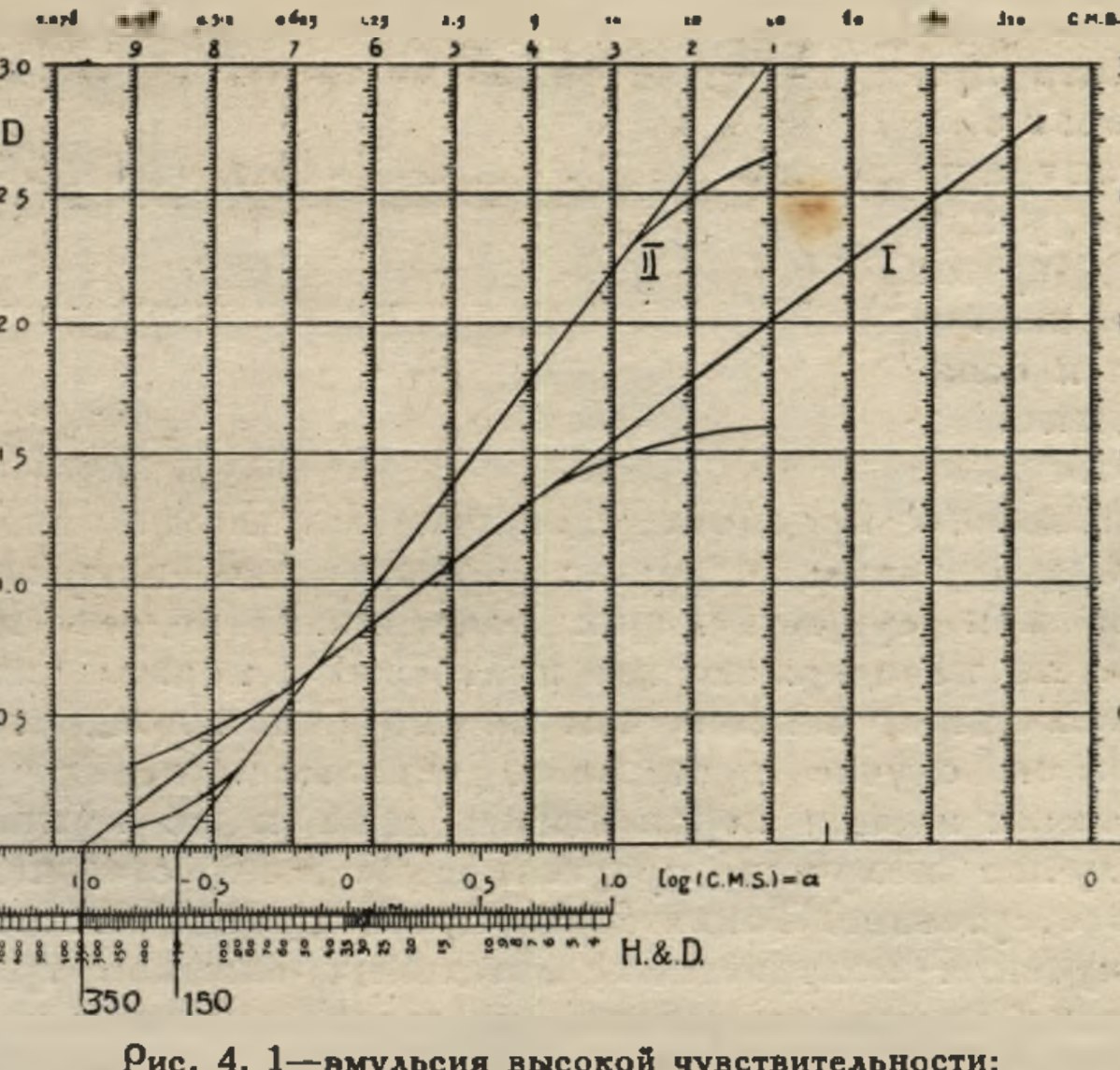
In sport and reportage shooting the sensitivity of plates is a matter of first-rate importance. In choosing the sort of emulsion one must take into account all the factors able to impart expressiveness to the photographic image at small exposures — the only ones possible in shooting moving objects. But, as shown on the graph (fig. 4), curve I, corresponding to the high-sensitivity emulsion, has a region of normal exposures (a latitude) and a contrast much smaller than those of curve II, corresponding to the emulsion of medium sensitivity. Both curves are obtained at maximum development. Therefore, with good lighting it is more rational to use plates having a curve of the second type, that is, slower ones.
What, then, to do in shooting in overcast weather, or during fog, when the lighting and the contrast of the photographed object also decrease? One can reason thus: the majority of exposures with the existing plates fall into the region of underexposures, where the contrasts with normal development are smaller than on the photographed object. In this case a correct tonal conveying, from the point of view of perspective, is even not needed, and it is better to get an exaggeration of contrast than its absence. Thus it turns out that for getting contrasty, detailed shots, plates of medium sensitivity are required; and that in overcast weather, with underexposures, on them, with a rational development, we get a more contrasty and relief negative than on a plate of high sensitivity. True, the contrast in the region of normal exposures may be excessively great, but this is in some cases even desirable. Besides, a plate of medium sensitivity has the ability to thicken on development more than a plate of higher sensitivity, which gives the possibility, to some extent, of regulating the obtained densities and contrasts.
2. Colour-sensitivity
The investigation of plates does not stop at the determination of the general sensitivity, contrast, gradation and other sensitometric data, which reveal the force and distribution of the light that acted on the plate. All this is important for simple shooting in good weather, when colour-separation is not pursued. In cases of colour-separation (landscape shots in autumn, the shooting of children with blue eyes and light hair), or when a perspective landscape shot is made, and the interference of the air haze reduces the already imperfect contrast — the plate requires the use of light-filters, absorbing the rays unnecessary to us. Using light-filters, we consequently make the shot in that part of the spectrum which is not absorbed by the light-filter. For the absorption of the blue and violet rays predominant in the haze, and for raising the colour contrast, a yellow light-filter is required; consequently, the plates should be sensitized to yellow, since their natural sensitivity lies in the blue-violet rays.
The sensitizing of plates is done either by introducing a dyeing substance into the emulsion at its manufacture, or by bathing the ready plates in dyeing solutions. The latter method gives a great colour-sensitivity, but the smaller preservation and the trouble involved limit the use of plates prepared by it. In general outline, colour-sensitive plates divide into two kinds: (1) orthochromatic, sensitive to yellow and yellow-green rays, and (2) panchromatic — sensitive to a certain degree to the whole spectrum. The most exact determination of colour-sensitivity will of course be the spectrographic. Spectrograms, showing the distribution of sensitivity along the length of the spectrum, for some sample plates are presented in fig. 7.
Orthochromatic plates are used most often with yellow light-filters of various shades, and have a great practical advantage in that they can be developed in ordinary laboratory red light. Panchromatic plates, used with orange or red light-filters, are processed in complete darkness or in a weak green light. A less exact determination of colour-sensitivity is done with the help of a special cassette with three light-filters: yellow-green, red-orange, and blue-violet; these light-filters are identical in transparency for the rays corresponding to each of them. If the plates are sensitive to the whole spectrum, then behind all the light-filters, in one and the same time, we get one and the same blackening. If the plates are sensitive only to definite rays, then the maximum blackening will be behind the light-filter passing those rays. Taking the sensitivity to blue-violet rays as unity, the sensitivity to other rays will be expressed in numbers greater or smaller than this unity. Such an expression of colour-sensitivity will, of course, be relative.
3. Resolving power (the sharpness factor)
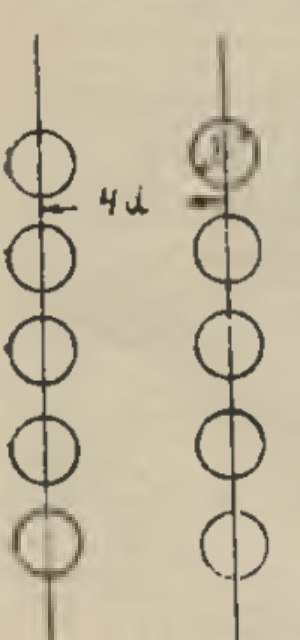
The question that arises in connection with any detailed photo-shot is the size of the grains of the photographic emulsion. The ability of the emulsion to separate the image of details located close to one another is called the resolving power, or the sharpness factor. Resolving power, besides the size of the grains, depends also on the graininess of the emulsion — that is, the joining of separate grains into groups, and the scattering of light between the grains in the emulsion. The size of the grains may change according to the sensitivity of the emulsion (fast plates usually have larger grains) and according to the method and time of development. Practically speaking, the image of two lines can be distinctly separated where the grains of silver bromide lying along the axes of these lines have such a diameter that the distance between the axes of the lines is a fourfold diameter of one grain (fig. 6).
4. Requirements made of the light-sensitive emulsion
In relation to the sensitometric data, the following requirements are made of the emulsion:
- Sensitivity. Generally speaking, a high sensitivity with a suitable contrast would be desirable. But ordinarily plates of high sensitivity give a small density and contrast. For the purposes of reportage and sport shooting, plates with a sensitivity of on average 150 by X and D are quite suitable.
- Contrast. The contrast of non-orthochromatic plates with normal development, without veil, should be γ = 1.5–2. Orthochromatic plates, used with light-filters, should have, at maximum development, a contrast γ = 2.5.
- Speed of development. A gamma (γ) of approximately 2 should be obtained with development for 2.5 minutes at 20°C.
- Veil should not be more than 0.25 for normal development, and not more than 0.40 for maximum development.
- Colour-sensitivity should be as high as possible.
The investigation of all the properties of photographic light-sensitive material is a rather complex and painstaking matter, requiring, as was indicated, special, expensive equipment. But the determination and comparison of at least the basic properties of the light-sensitive material is necessary for the productivity of the work and the rational selection of materials in various conditions. These tests are quite accessible only when there are on the market suitable cheap devices for practical purposes.
— K. Kolosov