
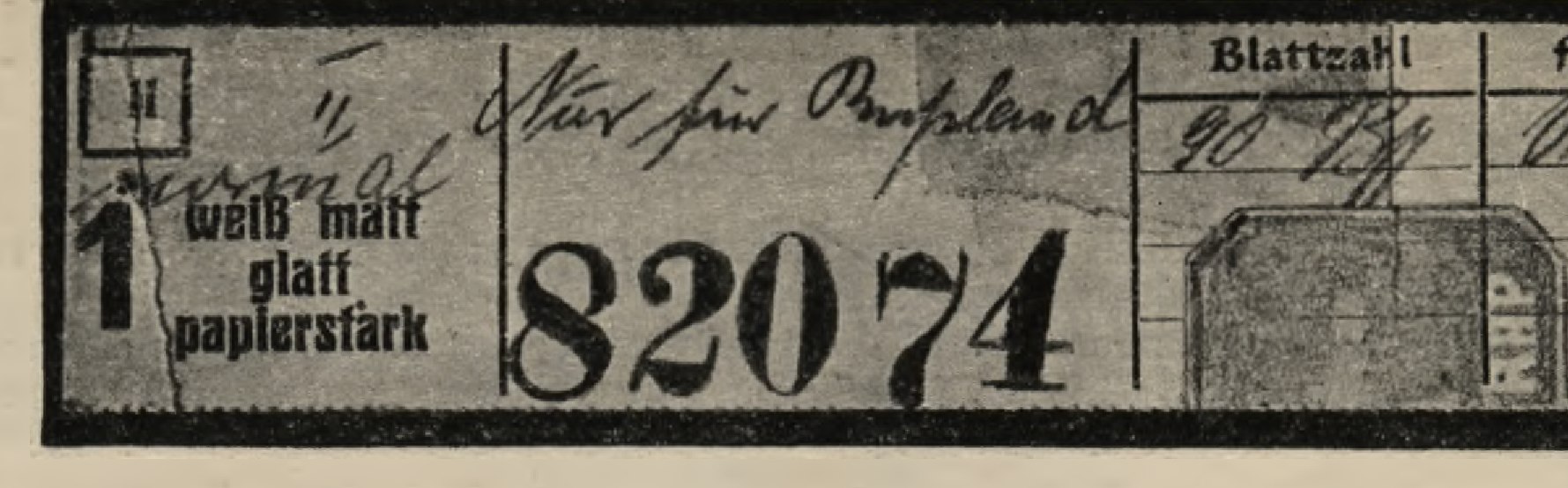
“Nur für Russland” — “Only for Russians.”
The wails of photo-amateurs and professionals over the low quality of photo-materials should draw special attention to themselves. The amateurs are disappointed; the professionals convince their clients of the impossibility of fulfilling the order better.
To domestic production, as still very young, one cannot make too great demands; but still, excluding “accidents” of the kind that happened recently at the “Iris” factory, one can state that the plates of our production are, in general, of sufficiently satisfactory quality. I personally have had to perform on Soviet plates the most varied works and shots — landscape, portrait, group, reproduction, as well as X-rays, microphotograms, instantaneous shots with a reflex camera — and I got quite satisfactory results, differing little from shots made on foreign plates.
What is interesting is that a batch of German plates of Hauff, in consequence of complete unfitness, has already a year been lying on the shelves of one of the Kiev photo-warehouses. The “Imperial” plates also. Some of the best German orthochromatic plates, “Agfa-Chromo,” with the stamp of the Kharkov Customs of 1926, proved to be even unsensitized… X-ray films of Ilford, bought, it seems, by Gosmedtorgprom in 1924–25, on which the X-ray cabinets of the Union worked for almost a year, were distinguished by a special defect: a comparatively good emulsion had been poured onto defective, warped celluloid, which as a result gave spots.
As for photo-papers, they periodically withstand no criticism whatever. Everyone knows that earlier the papers of NPG were distinguished by sufficiently decent quality; but I have a rough NPG paper, acquired about a year ago and lying until now almost entirely without use, thanks to some of its peculiarities. With the complete absence of veil (after developing, the places of the pin-marks and the stencil remain white), the drawing has absolutely no juiciness. On drying, portraits produce such an impression as if they had been abundantly rubbed with pumice. The picture is supplemented with gloomy lights and the complete absence of details in the shadows. The character of the print does not depend on the density of the negative. Still worse is the rough “shamois”-paper of the factory “Mimoza.”
In short, I have a whole collection of papers, acquired in recent time (and all of first-class firms), on which it is almost impossible to work. And who, finally, does not know certain sorts of the papers “Satrap,” “Bik,” “Slon” and so on for 1924–25, for the use of which one had to make extremely hard negatives? There are, true, exceptions: thus the NPG paper that was on sale this past spring is good; good is the “Kodak” paper for 1925 and a number of others.
From abroad they never used to send us unfit goods before, but now they send 50% defective. It is hard to think that over the years of war and revolution the quality of production fell so strongly that the best German factories get 50% failures. The matter, evidently, is in something else: in any production there are failures, there is also defect, which usually earlier either went into reprocessing or was destroyed. And now it is done otherwise: the defect is exported to Russia, and the quantity lacking for the full order is supplemented already with good sorts.
If a defect has resulted, the firm is little embarrassed — it glues to the whole batch a label with the inscription “Nur für Russland” (“Only for Russia”) and sells it to us. Our foreign “friends” sort their production, evidently, into 2 categories — “For Europeans” and “Only for Russians.” The shot given in the heading — material evidence — is made from a little label, probably forgotten by mistake (at the factory of the former Schering, “Satrap”) in a packing of 100 sheets of paper 50×60 cm.
A special commission on the quality of photo-cine-production should see to it that the corresponding organs, in purchasing photo-materials abroad, test the purchased goods in the most careful manner.
— S. Kovalevsky