
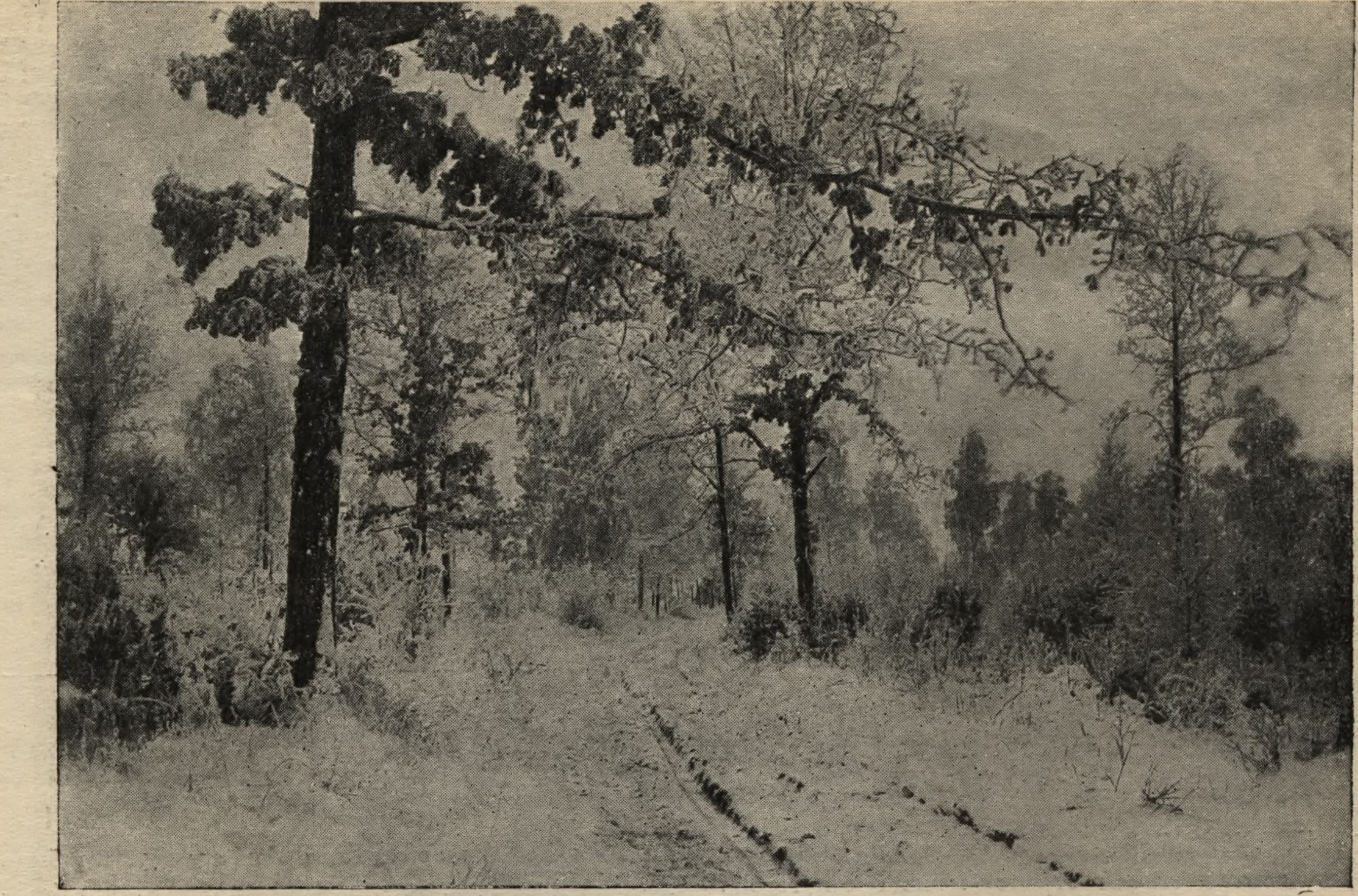
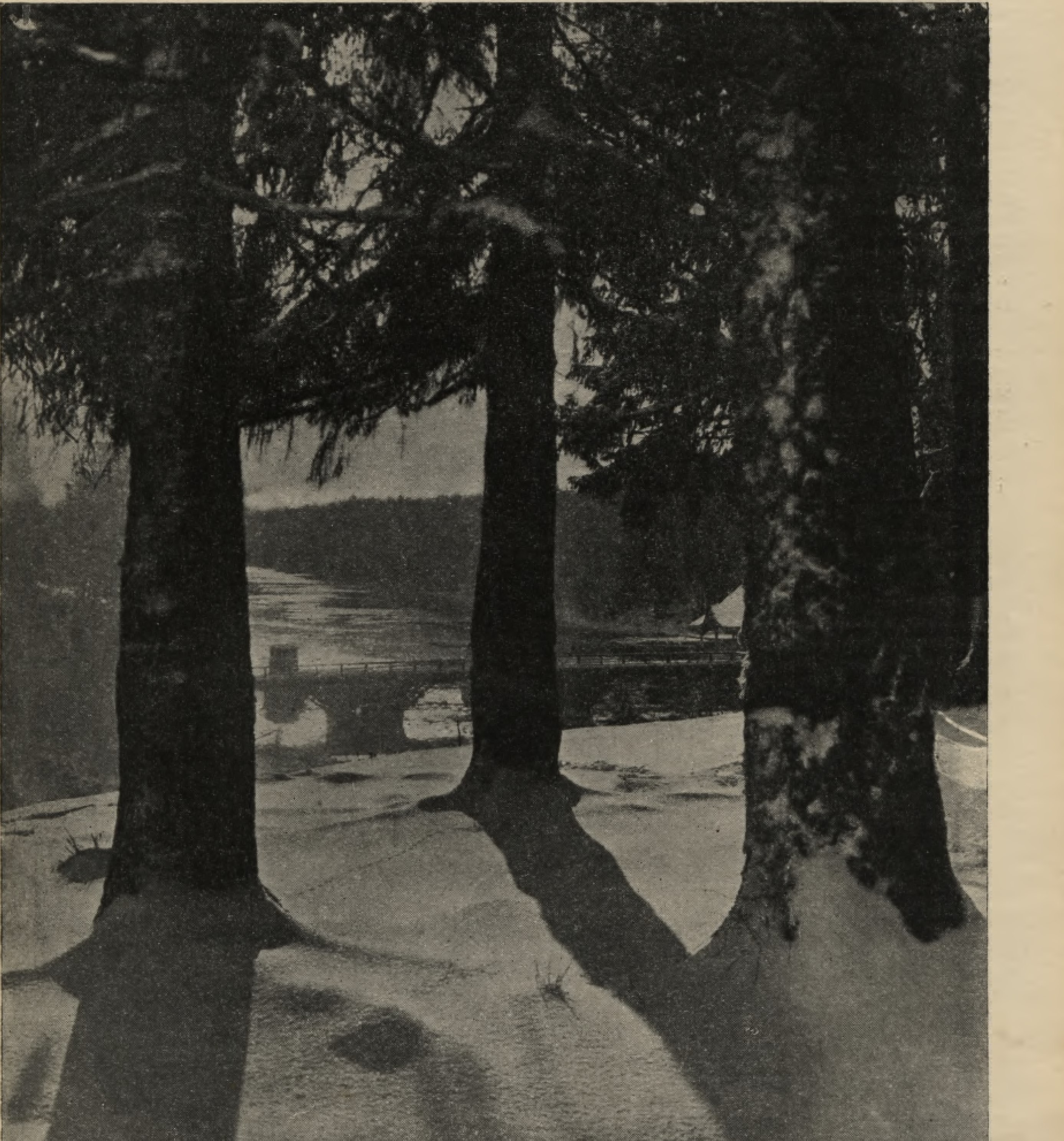
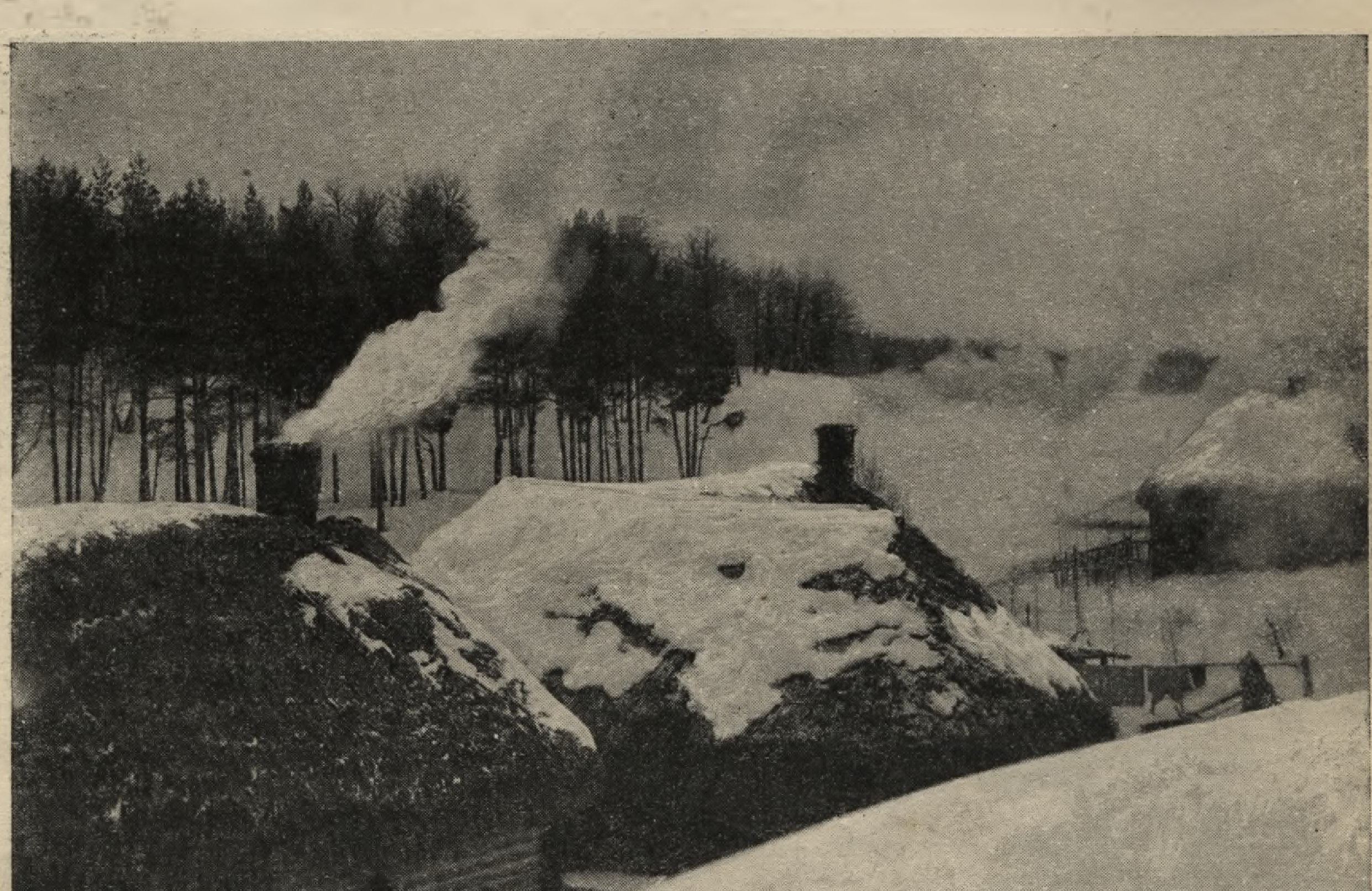
It is accepted with us to consider as the photographic season only the warm time of year. Photographer-portraitists in winter, of course, do not stop their work; nor can the photo-reporters abandon it; but the majority of amateurs consider autumn and winter a dead season. And yet winter subjects are peculiar and beautiful. True, there is usually little life in them, little movement, and all the beauty consists in the striking shades, the highlights, the light shadows, the fineness and elegance of the fluffy snow. For winter landscapes no special richness and variety of forms are needed; here the centre of gravity is in the correct conveying of the play of light and of the light bluish shadows. The question of technique in winter shooting is therefore much more significant than in any other landscape work.
As is known, the rays of various colours — that is, of various wavelengths — act on the photographic emulsion quite differently than on the eye. Those coloured rays which seem bright to the eye (green, yellow) act very little on the ordinary photographic emulsion; and conversely, the rays that are little bright (blue, violet), or even quite invisible to the eye (ultraviolet), act most strongly on the photographic emulsion. Therefore, in shooting on ordinary plates one cannot convey the relation of the brightnesses of colours such as it appears to our eye. For example, in shooting a landscape on an ordinary plate, on the print the bright-green grass comes out dark, and the blue sky with white clouds comes out all solidly, monotonously white.
Of late photographers have ceased to put up with such a conventional photographic conveying of brightnesses. In order to make the photo-emulsions sensitive to the rays to which they are little sensitive — that is, to yellow and green — they began to treat them with solutions of special aniline dyes (optical sensitizers). Plates thus treated, sensitive to yellow and green rays, are called orthochromatic; and those sensitive more or less to all rays — panchromatic. The use of panchromatic plates is bound up with a specially equipped dark laboratory and a special processing; therefore in practice in the majority of cases one has to use orthochromatic plates — and besides, panchromatic plates are so far not even made with us. But still, in shooting on orthochromatic plates, the most actinic (strongly acting on the emulsion) blue-violet rays continue to act on the emulsion more strongly than the others; so, in order to absorb the excess of these rays, a yellow light-filter is placed before the lens. True, in shooting with a filter one has to lengthen the exposure; but on the other hand the conveying of the brightnesses of the tones then corresponds to their perception by the eye.
In winter shooting it is especially important to take into account the incorrectness of the colour conveying by an ordinary plate. The beauty of winter landscapes consists in the play of the bright whiteness of the snow and the light blue shadows. But if one shoots on an ordinary plate, then the beauty and fluffiness of the crystalline structure of the snow will be completely lost; the blue sky with clouds will merge with the snow, and a white image will be formed, devoid of half-tones and details, on which only the black trunks and branches of the trees will stand out sharply. Winter landscapes must be executed on orthochromatic plates with the use of a light yellow filter, or on orthochromatic plates with a “filter in the layer.”
As for the sensitivity of plates for winter shooting, photographers do not agree: some prefer ordinary plates, others high-sensitivity, and still others low-sensitivity plates. This, of course, depends on the individual methods of shooting. It is important only to determine, in any case, the correct exposure. For little-experienced photographers, plates of medium sensitivity are recommended. One must not forget that the sensitivity of plates in frost is considerably lowered: in a frost of 40°C, for example, the sensitivity falls by half.
Generally speaking, winter landscapes are especially interesting and beautiful only when they are lit by the sun. Sunny lighting emphasizes the dazzling brightness of the sparkling snow and the beauty of the sky and shadows. In shooting without sun the shots come out flatter. But even with sunny lighting the structure of the snow is not conveyed correctly if in shooting one does not take into account the angle of view and the angle of lighting. It is usually good to choose for the camera a low point of view, while the sun should light the landscape from the side or a little from behind. Of course, the photographer-artist chooses the subject and lighting by his own taste; but still, for shooting winter landscapes, one must reckon with the indicated basic positions.
Surprisingly decorative are the trees and bushes covered with hoarfrost, but to shoot them does not always succeed, since hoarfrost usually does not hold long. Such landscapes are best of all shot early in the morning.
In shooting contrasty landscapes one must carefully establish the exposure and especially fear underexposures, since on the negative the beauty of the shades and of the snow's structure will then be lost. One must also pay attention to the correctness of developing: overdevelopment smooths the bright lights and therefore very much worsens the conveying of the snow; underdevelopment gives the negative limpness. The developer should not be too cold — which can easily happen in winter time — as this very badly affects the quality of the negative: a correctly exposed plate does not reach normal density, and a “thin” negative results, since many developers lose their developing ability at low temperature. The normal temperature, on average, should be considered 18°–20°C. In shooting contrasty landscapes lit by the sun, it is better to develop with a diluted developer, so that the details manage to appear before the negative becomes too contrasty.
In winter it is better to work with lenses consisting only of two cemented halves, since such a lens, in case of need, can easily and quickly be wiped even if your hands have frozen. In frost it often happens that shutters — central, and especially blind — begin to be capricious. In central shutters having an air brake (“Compound,” “Koilos,” “Bausch and Lomb” and others), the piston freezes to the cylinder, and the shutter either stops working altogether, or gives an exposure greater than is wanted. In blind shutters the blind of rubberized material loses its elasticity, and so its movement slows. In case of freezing of a central shutter one should, having warmed the cylinder with the fingers, make 5–7 idle releases of the shutter. With a blind shutter nothing can be done; and in general it is desirable, in strong frosts, not to work with apparatus having a blind shutter, since the blind may crack all over. Best of all to use central shutters without an air brake (“Compur,” “Ibso” and others).
After finishing work, on returning home, the misted-over camera should be well wiped and left open for some time. Prints of winter landscapes are very beautifully executed on coarse-grained black or blue paper; brownish tones and sepia do not suit this genre at all.
— A. K.