
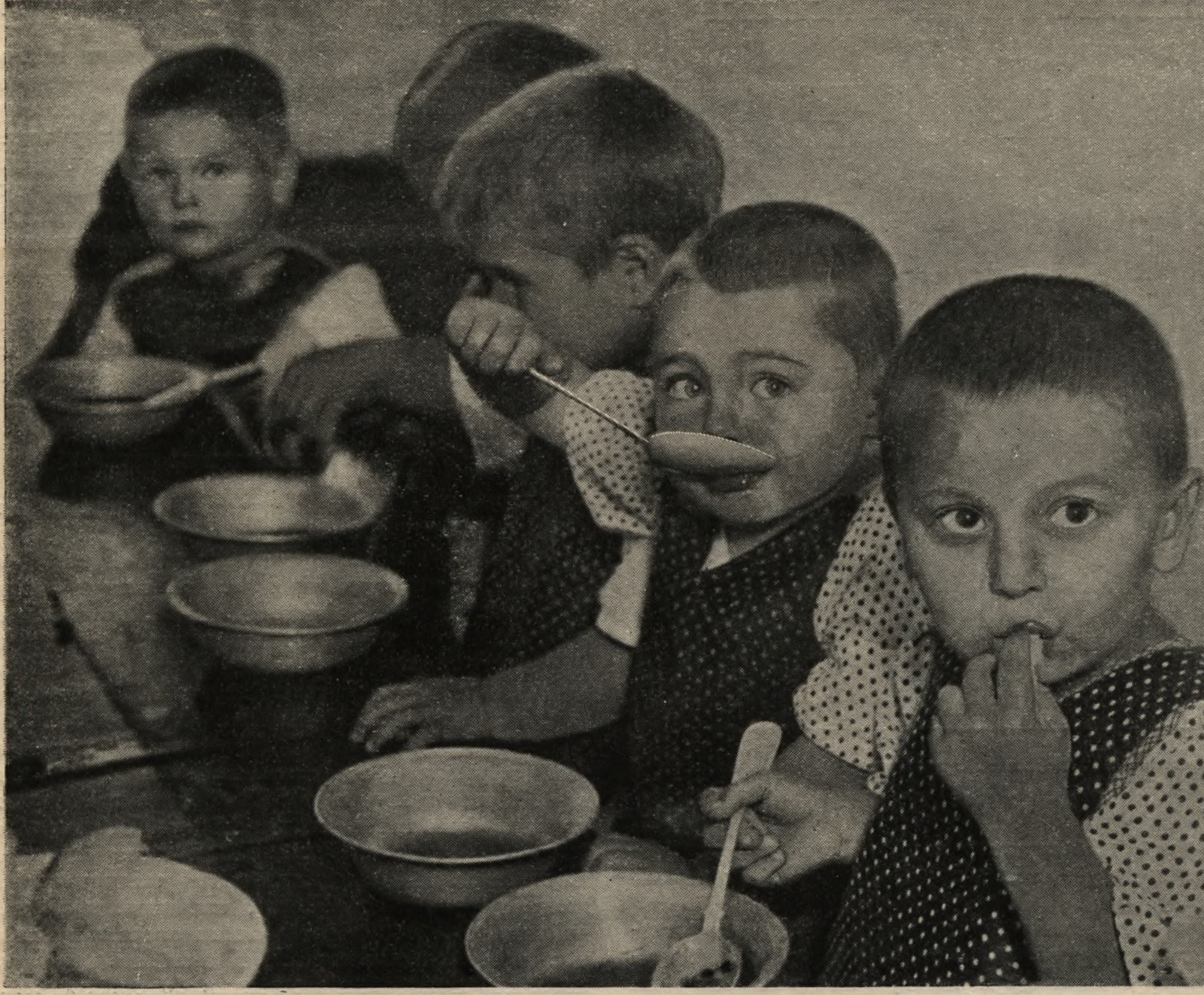
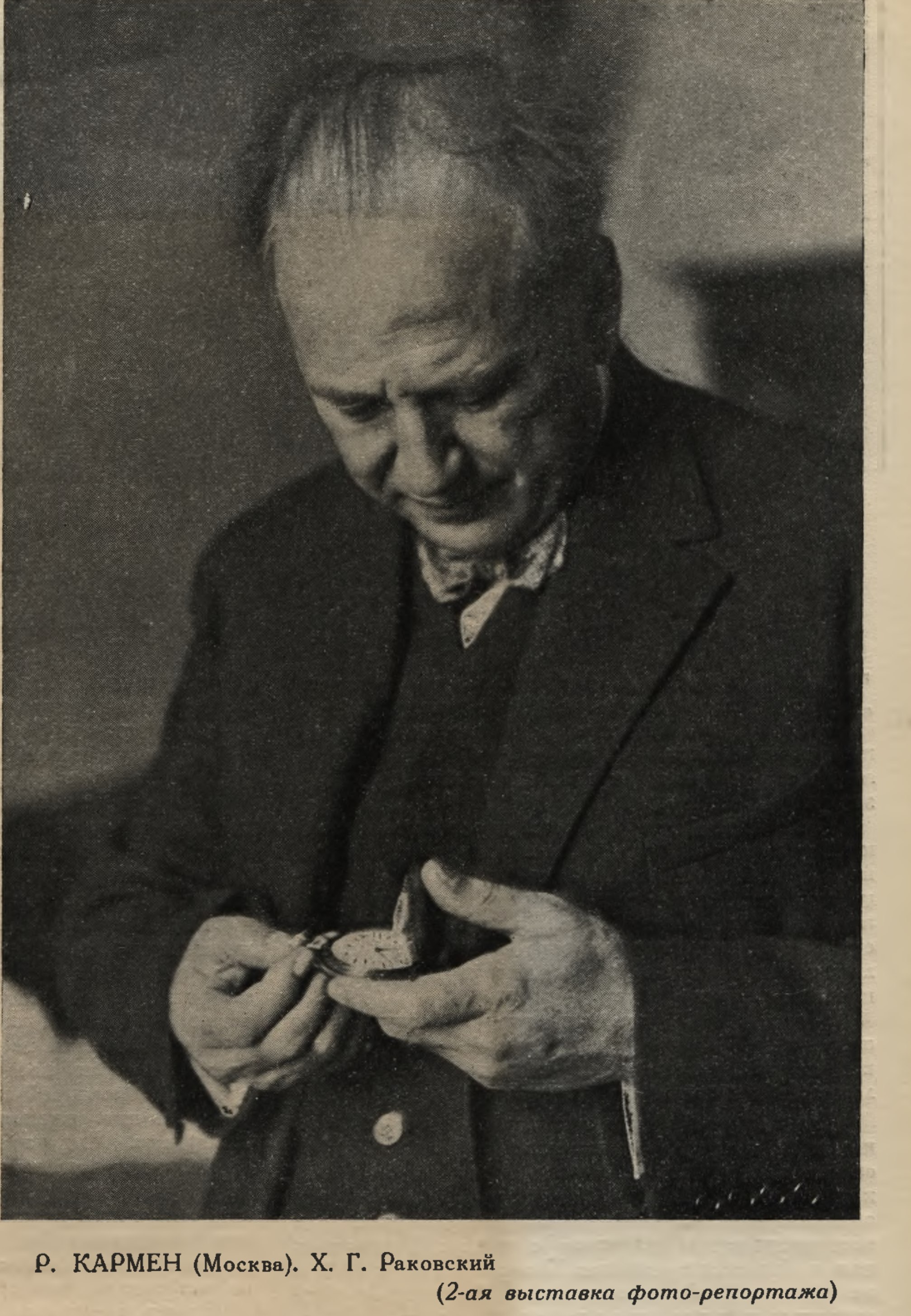
At the present time the shooting of portraits under the lighting of half-watt lamps has gained wide distribution. All the former methods — such as shooting with a magnesium flash, under spirit-incandescent or kerosene lamps — go off into the region of legend; and even the professionals who earlier worked with jupiters supplied with a voltaic arc are passing gradually to half-watt lamps. The conditions of contemporary life insistently dictate to us precisely this method of photographing. Indeed, the housing crisis, work, and the lack of free time deprive the majority of photographers of the possibility of doing portrait shooting by daylight even in a room. Half-watt lamps remove all these obstacles. The photographer becomes independent both of daylight and of the time of shooting; and, besides, the constancy of the light source allows him to take the exposure exactly into account, and to study to perfection all the possibilities that open before him.
The arrangement of half-watt lighting
For photographing, two half-watt lamps are needed, of 400–600 candles each (200–300 watts). These lamps can be plugged into any socket without the risk of burning out the fuse or damaging the meter. Besides, it is recommended to make reflectors with light-proof side walls. Usually these reflectors are made of tin or plywood and have the form of a truncated four-sided pyramid, into the upper base of which is set a socket with a cord; the inner part of the reflector is painted with white oil paint. With the help of two half-watt lamps one can achieve the most varied effects of lighting. The most widespread method of photographing is such an arrangement in which one lamp is placed at a height of about 2 metres near the shot model, giving upper side lighting, while the other is placed before the model (behind the lens, of course), giving the front lighting that evens out the too great contrasts caused by the light of the first lamp. Moving the lamps away and up, placing on the path of the rays screens with various coefficients of absorption (muslin, cigarette paper, cloth and so on), one can get the most varied effects and splendidly regulate the light.
However, despite the ease of applying half-watt lamps, work with them requires a certain skill. The usual stumbling-block for all beginners is the inability to use the combined light of two lamps, thanks to which on the face of the shot model crossing shadows are clearly traced, reaching in some places an excessive density. This error occurs because the dazzlingly bright light of the half-watt lamps does not allow the beginner correctly to evaluate the relation between light and shadow; and if one takes into account that the chemical force of the lamps' rays is far from corresponding to their visible brightness, then it becomes clear why the shots of beginners are distinguished by excessive contrastiness and unpleasant, eye-cutting shadows. To avoid these defects, one should achieve a soft, harmonious lighting by covering the lamps with muslin or paper of various density. Although the use of these screens increases the exposure, on the other hand it allows one to attain a soft, easily controlled lighting. If for some reason the lengthening of the exposure is undesirable, one can resort to the following method: one of the lamps is fixed immovably so as to give upper side lighting; the other is taken by the one shooting into his hands and, during the exposure, led in various directions — the speed of movement of the lamp being determined by the duration of the exposure, and the direction of movement depending on the effect one wishes to get.
To avoid the excessive brightness inherent in the light of half-watt lamps, some photographers use lamps with so-called opal (milk) glass. We consider it necessary to point out that these lamps are little suited to photographing, since opal glass strongly absorbs the ultraviolet rays, which, of course, considerably lengthens the exposure. Another error, into which fall not only beginners but experienced photographers too, is the excessive chase after glares. Of course, in some cases a skilful use of glares contributes to enlivening the portrait, emphasizing the modelling of the face and strengthening the gamut of lights; but if these glares are applied without a feeling of measure, and if their appearance is dictated not by compositional requirements but by the desire to flash the virtuosity of technique, then the artistic value of such a portrait becomes very doubtful, since the human face loses the texture proper to it and recalls in its external look a shot made from porcelain or majolica.
Shooting with reflected light
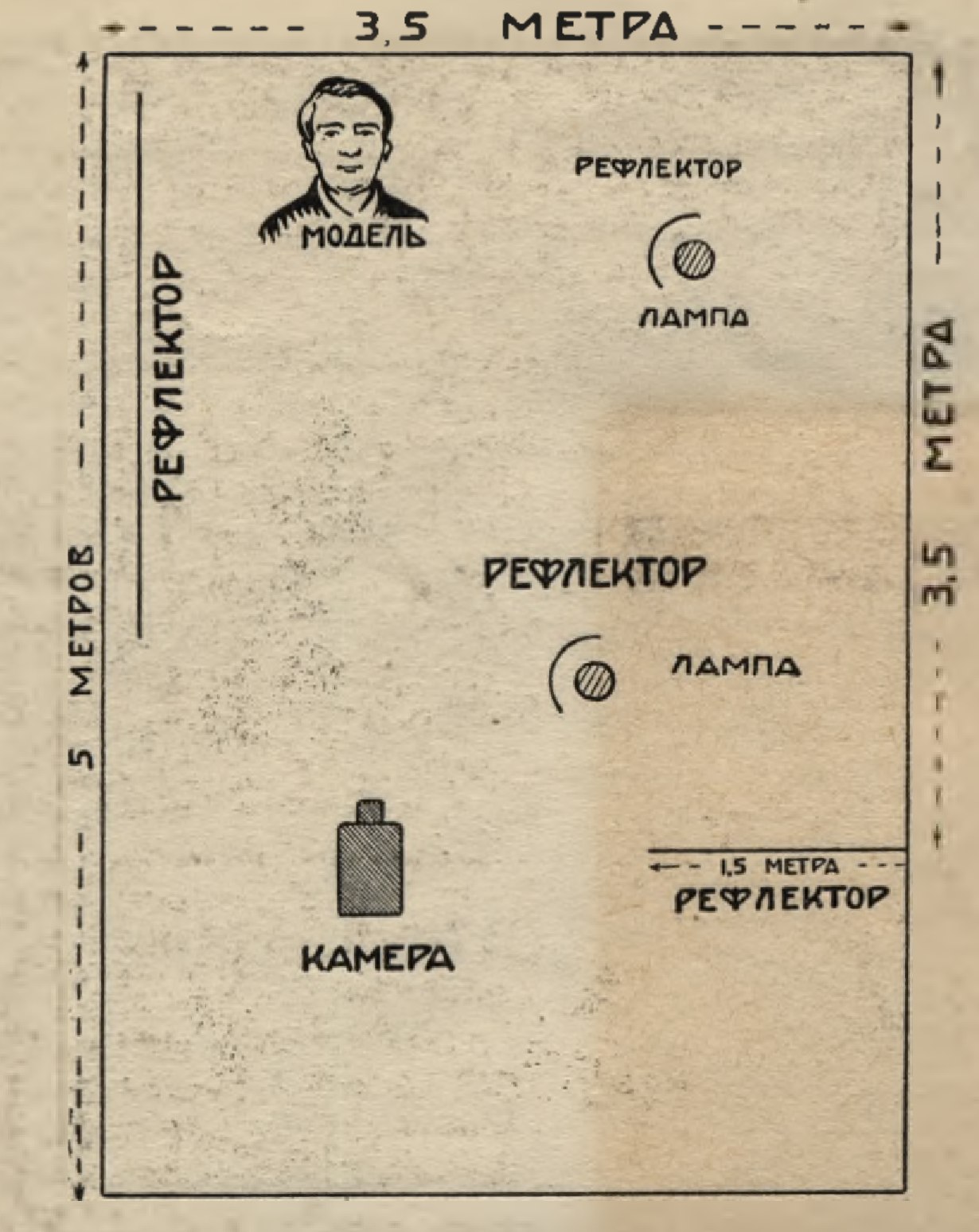
Very interesting results can be obtained using the reflected light of lamps; but the exposure then considerably increases, and depends both on the coefficient of reflection of the screen and on the mutual arrangement of the light sources, the model and the screen. The best arrangement of the model and lamps when using reflected light is indicated on drawing 1. In view of using reflected light, one should take lamps of not less than 1,000 candles (500 watts). At each lamp there is a concave reflector, throwing the light at an angle of 45° onto the wall and the white ceiling. The reflectors should be so large that they can protect the lens from the lamps' light getting into it. Light effects are achieved by a partial darkening of the reflected light, by changing its direction, by placing small reflecting screens, or by using one lamp. It is necessary to avoid the getting of side rays into the lens, for which one should put on it a hollow cylinder made of cardboard or dense black paper.
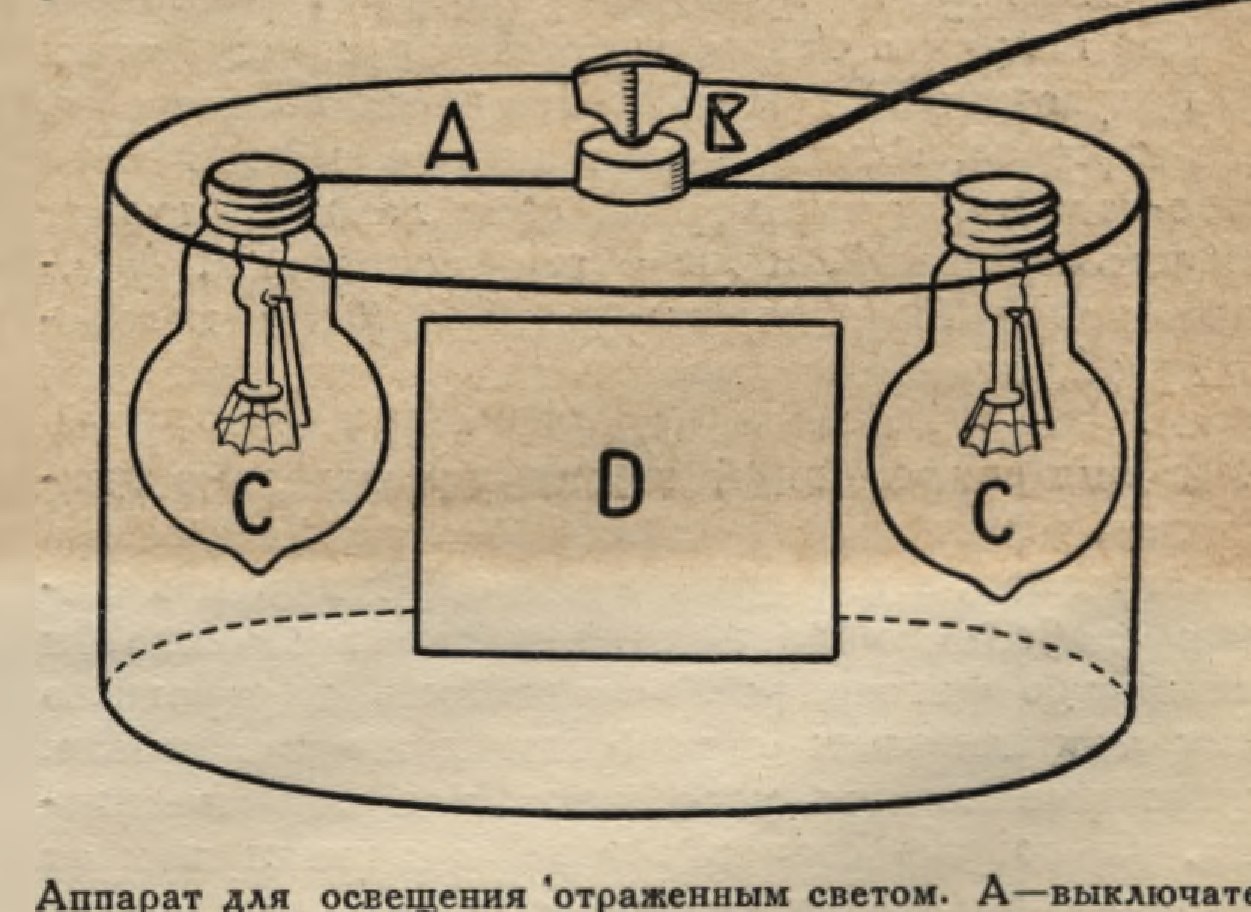
The described method of photographing with the help of reflected light, despite all its positive qualities, possesses also some very essential defects, of which one should first of all point to the bulkiness and dearness of its equipment, which is not always within the powers of the modest amateur. Therefore in his practice the author applies the following simplified method: the light source is a home-made enlarging apparatus working with reflected light. The general view of this apparatus is shown on drawing 2. This apparatus is comparatively portable, light, and can very quickly be brought into action. Its great merit is the possibility of close placing to the shot model, which considerably shortens the time of exposure. It is used for getting upper or lower-side lighting, evened out by the light of another lamp of 600 candles (shaded by a screen or giving reflected light), which gives an unusually rich gamut of soft light effects.
Combined lighting
When the beginner has well mastered the characteristic peculiarities of photographing with the help of half-watt lamps, he can pass to works with so-called combined lighting, in which the light source is daylight in combination with the light of half-watt lamps. This method, which has gained wide distribution in the field of cine-shooting, is for some reason little applied in artistic photography. And yet, using combined light, one can get any effects of lighting one likes, and considerably shorten the exposure, which, even with weak room lighting and a lens light-power of F/4.5, can be brought to 1/10 second. The main difficulty of this method consists in the ability correctly to evaluate the relation between daylight and the light of half-watt lamps, which is not always successful for beginners. Everyone should therefore, in his first works, work out a definite system of using combined lighting, and only, having well mastered this system, gradually pass to resolving other, more complex tasks.
In photographing with the help of half-watt lamps, as in other fields of the photographic art, a methodical training is needed for achieving good results. It is better at the start to spend time and spoil a dozen or two plates, but on the other hand work out in oneself the necessary skills, than to content oneself with accidental successes and never have a firm confidence in the final result. The use of half-watt lamps in photographing portraits requires the observance of the same rules as in ordinary portrait shooting. As for the exposure, in determining it one should take into account the following factors: (a) the light-power of the lens; (b) the sensitivity of the plates; (c) the size of the portrait (the closer the lens to the shot model, the greater the exposure); (d) the number of candles in the lamps; (e) the distance of the shot model from the lamps. One must not forget that with an increase of the distance from the lamps to the model by twice, the exposure should be increased 4 times; with an increase by three times — 9 times, and so on — since the exposure is proportional to the square of the distance from the model to the light source.
— E. Piotrkovsky