
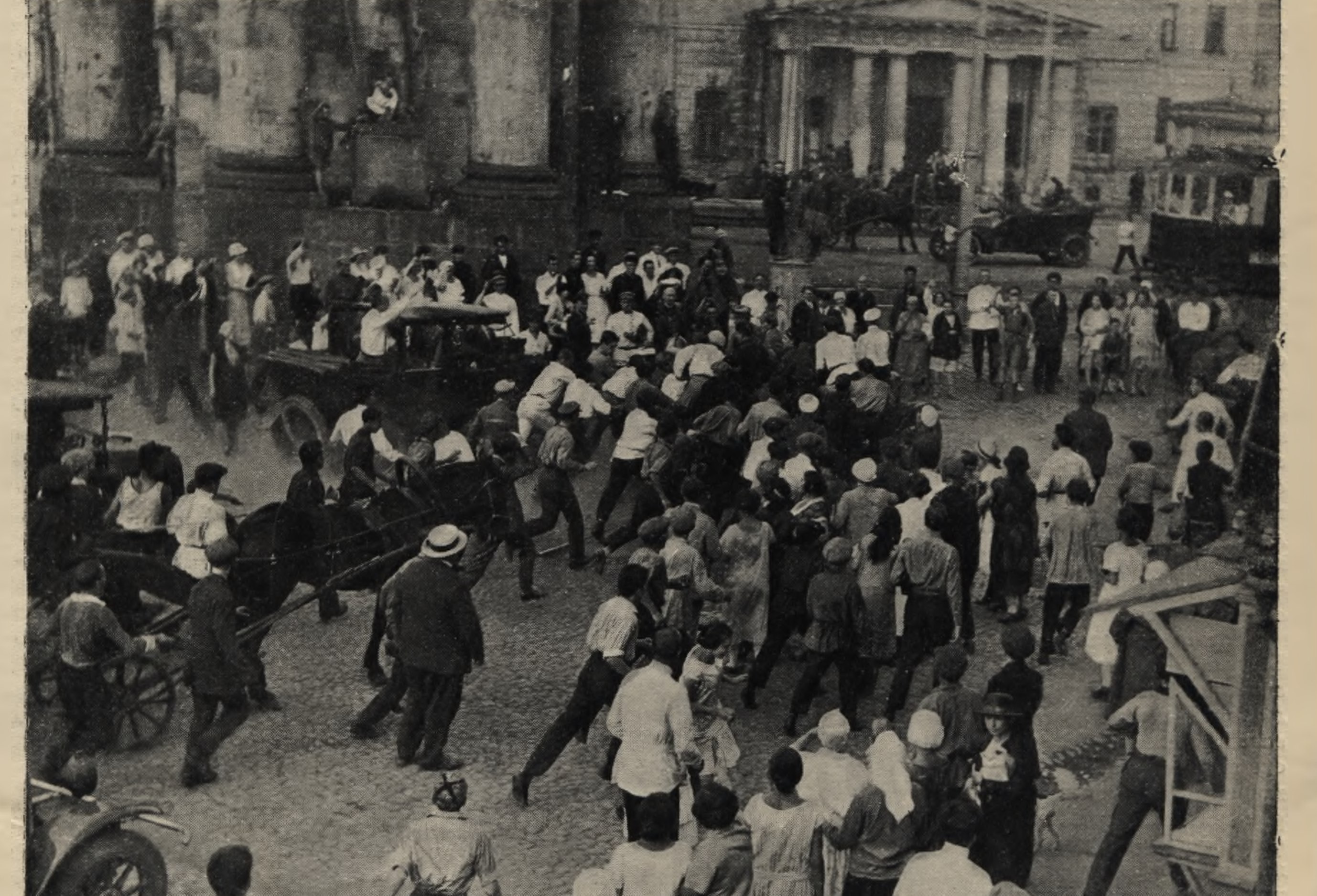
The second reporting exhibition (for 6 months) of the works of the Moscow photo-reporters took place in the House of the Press from 10 to 25 November. In the exhibition participated 16 photo-reporters and 5 beginners, who gave in all about 600 works. Unfortunately, part of the photo-reporters strong in the past — such as Savelyev, Usov, Shaikhet — avoided participation.
The second exhibition is poorer than the first. The works are insufficiently sustained and made often in haste. Very weakly is represented the chronicle of our days, there is no daily life, and the construction of 1926 is completely absent. In the statute of the exhibition the department “Children” is also mentioned, but this department we did not find at the exhibition.
The thematic poverty is accompanied by compositional and textural poverty. It would seem that, going away from living life into the region of the photo-study, the master should reveal himself precisely in the ability to make the frame and to resolve textural tasks. However, the ability to make a thing is apparently still very slight, and the texture is hindered by some false striving to give at the exhibition a shot just as it is transmitted to the editorial office. The showcase “Technique of Printing” (Grokhovsky's) shows that however strongly the print may be made, it still, for contemporary methods of printing, needs very great retouching. Photo-technique has not yet given such a positive material on which one could give a shot not requiring technical retouching. Besides, the exhibition of photo-shots, and not of prints in printing, sets the obligatory, in our view, requirement: to refuse the manner of giving to the exhibition shots turned into glossy oilcloths. If the photo-shot itself is exhibited, then it is necessary to give it in a texture acceptable to the viewer's eye. Work on texture will accustom the photo-reporter to work also on singling out the main thing in his shot — and this is one of the sorest spots in the exhibited works.
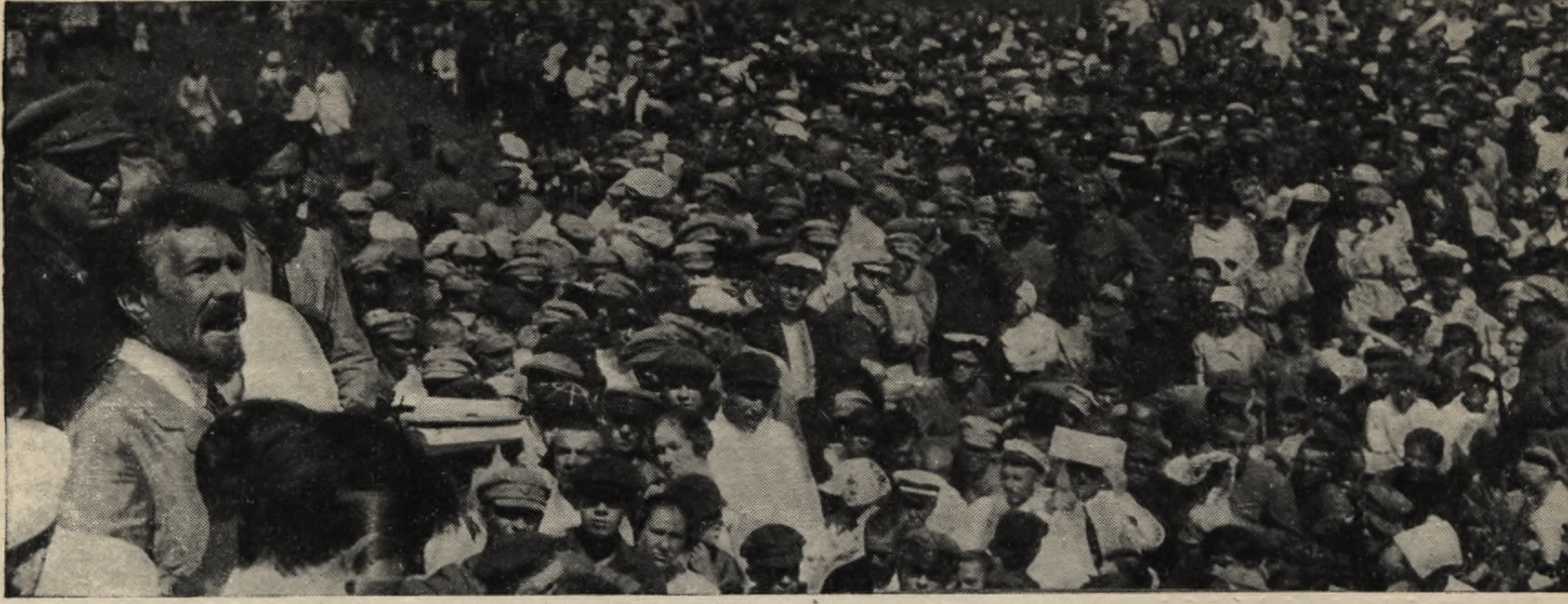
A gratifying phenomenon at the exhibition is the presence of beginners and the showcase of the photo-amateurs' circle of the House of the Press. It is pleasant to note that the association of photo-reporters has ceased to close itself into narrow professional frames and draws beginners into its ranks. And one must do justice to the beginners — their works to a considerable degree enliven the exhibition and bring into it something of their own, new. Among the beginners we note the best work of Petrkas — “Budyonny at a factory meeting.” A well-made thing, requiring no caption. In his other things Petrkas shows himself a pupil of a good school. Unfortunately, in some works he lapses into themelessness, into the cloudy study, and so on. Devlet gave good shots, deeply looking into the daily life of Karakalpakia (Turkestan). His work “The Old Man” is a most difficult shot with a backlit background; this Karakalpak, however, is excellently lit, correctly inscribed into the frame, and very providently the hands and knees thrust forward are removed. “The Mountebank” gives a maximum of expression, an excellent moment is caught — unfortunately, the format is not sustained and the legs are cut off. Chumikin — a photo-amateur, not bound by a definite thematic task, free — does not work out deep themes; he seeks a theme with the kodak on the street. Fresh impressions give fresh shots. Good is his “Chinaman” — a seller of fans and of little balls trembling on elastic. The moving human figure is taken in a noble pose (there are none of the usual, in such cases, shouting torn-up legs and waving hands). In the showcase of the photo-circle good is the shot of the beginner N. Levenshtein — “The wheel of the steamer”; well conveyed by contrasts is the struggle of the active machine with the inert water.
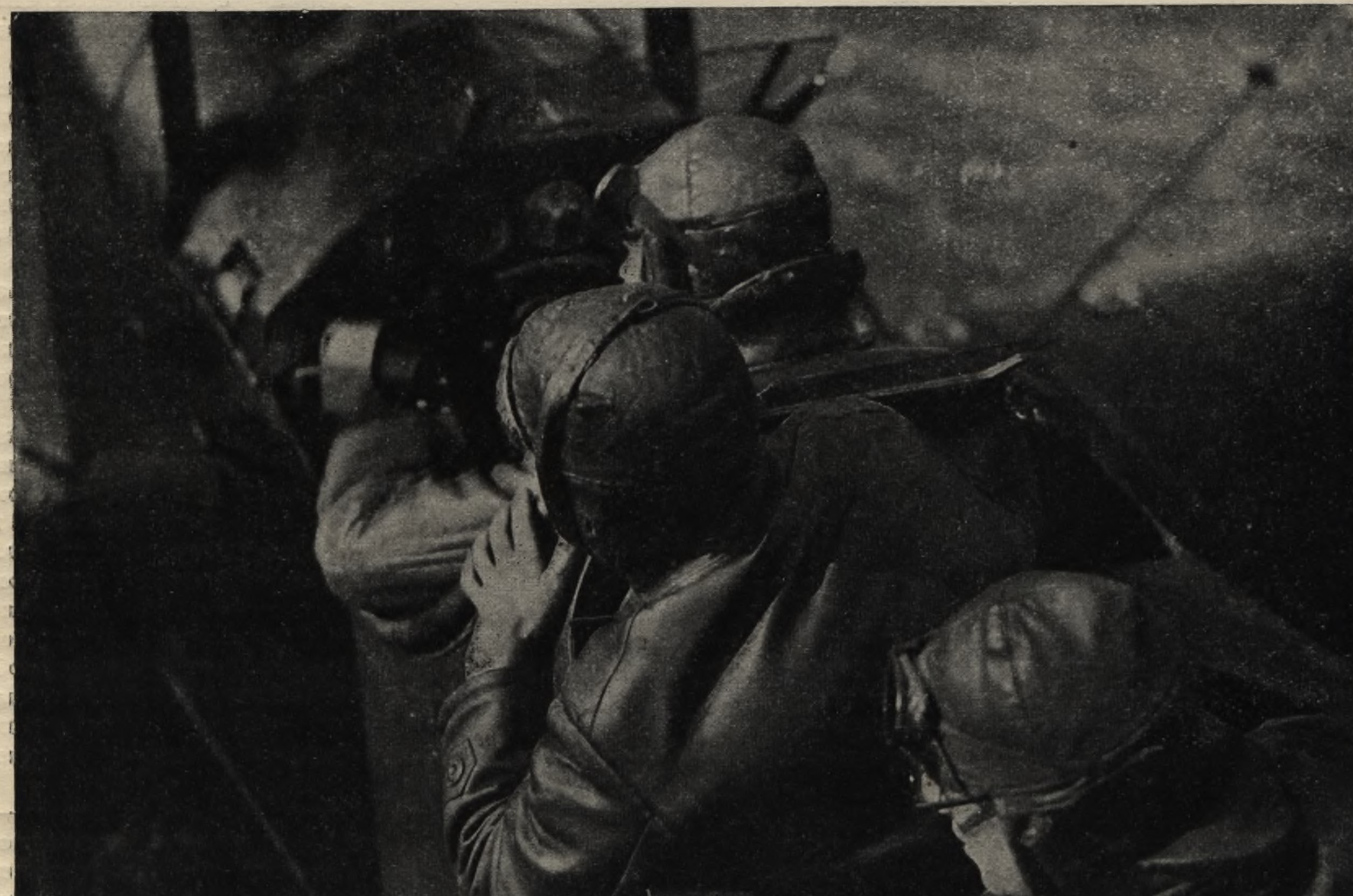
Passing to the works of the photo-reporters, it is necessary especially to dwell on the original works of Fridlyand (“Ogonyok”). Fridlyand has his own face. Fridlyand works at maximum limiting speeds. We think that Fridlyand translates neither the slits nor the springs in his blind shutter: he took the speed — and the end. This gives a special style to his works, reaching at times to silhouettes. His shot is a low-detail shot of masses. The masses dominate. The depth and might of these masses Fridlyand emphasizes also in the positive process, carrying out the intensification of the prints. In general the printing with Fridlyand is excellent — he takes from the paper all that it can give. However, having stood on this especially responsible and dangerous path, Fridlyand has not yet finally coped with the main thing — composition; and the style of his works is especially demanding of a conscious distribution, within the frame, of the heavy masses. The path of Fridlyand is very interesting and promises much in the future. His best works: “Aeroplane” (p. 255), where the people merged with the machine, “Sea guns” and “Battleship.” A bad work is “The Tower,” an attempt to give height by the tilting of the camera and the cutting of the foundation. Bad is “The Sleep of the Sailors,” given on the diagonal: repose requires other compositional methods.
As the best chronicler of our political events showed himself Alpert (“Rabochaya Gazeta”). His shots “Tomsky listening to the debates,” “Stalin and Kalinin” reveal Alpert's especially sharpened sensitivity to the choice of the most interesting, often very fleeting instants. Alpert works as they play, as the players play “va-banque.” A little more — and all will break loose: either an underexposure, which now nothing will save, or the horses rushing madly straight at the photographer will crush both the apparatus and the photographer. This sharpened perception of life often leads Alpert beyond the limits of acceptable frames: a good work, “Spectators,” tires by the length of the frame, the same with the rushing horses.
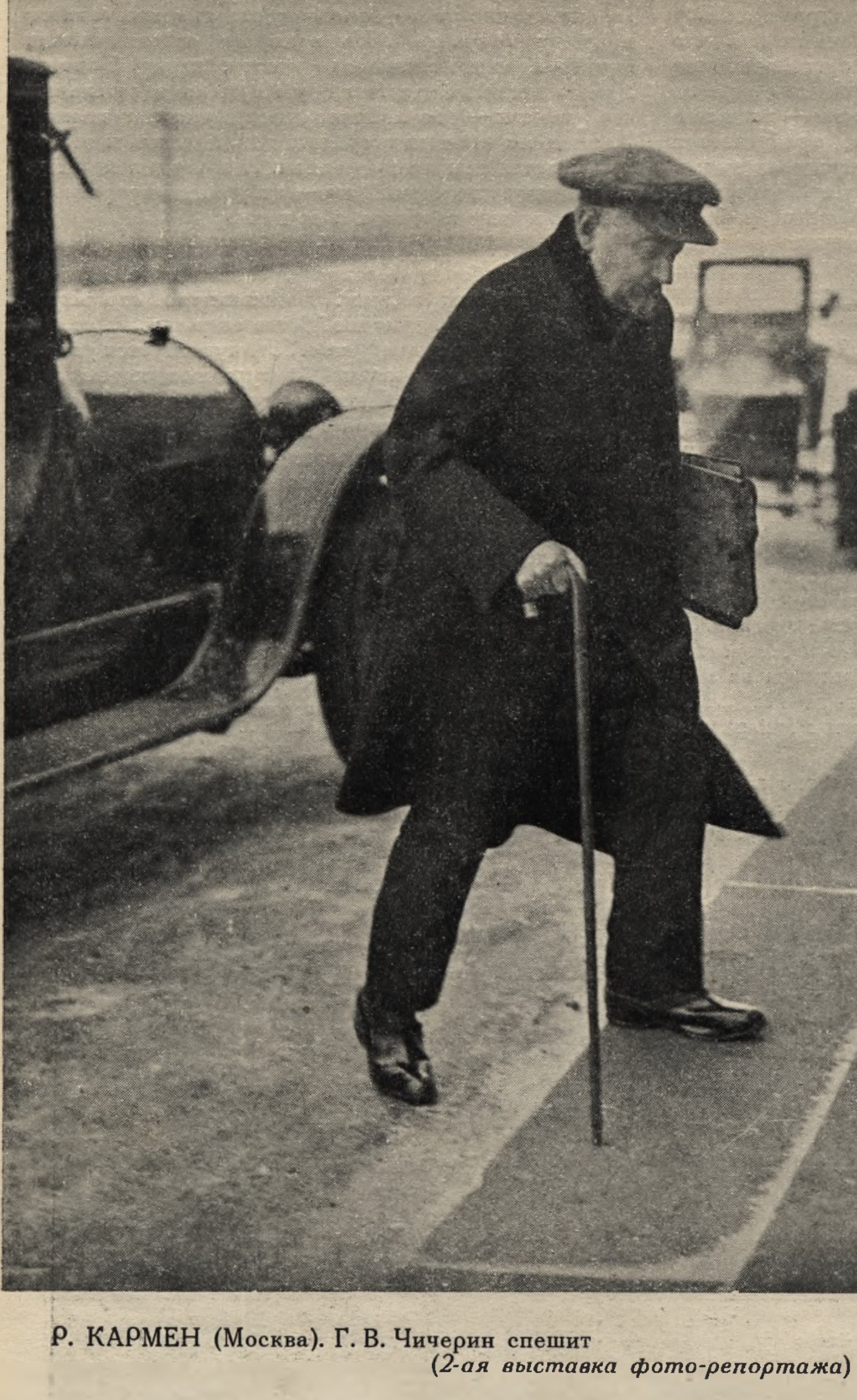
Well, and somehow unusually easily, conveys life Karmen (“Nasha Gazeta”). His hurrying “Chicherin” (p. 256) and the by-the-clock-living “Rakovsky” (p. 249) are full of life and dynamics. Just as dynamic is the yearning of the white bear, shut in a cage (p. 251). On all his works lies the stamp of a young cheerfulness, seeking its refraction. The defects of Karmen in his other works are an excess of unjustified planes: Karmen does not economize the means of influence, and from that the viewer's attention scatters. And one more defect, purely technical — the absence of working-out of the negative: no depth and juiciness.
As a serious worker at the exhibition revealed himself Chemko (“Rabochaya Moskva”), consciously relating to his frames. The majority of his things are made very thoughtfully. In his shot “Rykov at the Aviakhim festival” (p. 254) one feels the work of singling out the central figure of the leader and emphasizing the masses. His “Football” strikes with the caught moment and the splendid working-out of details.
Finishing the review of positive works, it is necessary to note also separate satisfactory works of N. Petrov (“Krasnaya Niva”). In “A locomotive at the factory” the rays of sun passing through the dusty windows are well conveyed; in the most dangerous place of the picture — the bend of the locomotive's boiler — the bent figure of the worker is well placed. Not bad is the study “The Kremlin at night” (p. 261), made at dusk with the lights already lit. With Samsonov (“Pravda”): “Washing nets” (p. 252) — the excellent conveying of water and foam reconciles one with a certain heaviness of the fisherman's figure. With Tules (“Rus. Foto”) an outstanding one for the moment is “The psychosis of the Pickfordists” (p. 258); “After the fishing-net” is an example of a good use of reflected light. With Zubkov (“Komsomolskaya Pravda”) good is the shot “Oxen” — well and correctly conveyed is the climb uphill, good is the background in the haze. Originally conceived is “At rest” — two heads under one hat: child-like merrily do these bearded ones laugh from the photographer's lucky invention.
Properly speaking, that is all on which one could stop attention at the exhibition. By the statute of the exhibition a special showcase was also envisaged: “How not to shoot.” However, the participants here too remained faithful to the principle of individual boards, and samples of how not to shoot each gave on his own board.
One can use in one's work the best cameras and the best materials. One can enjoy the conditions of the greatest favour in the sense of getting all kinds of passes and permissions. One can, finally, be a magnificent, sensitive-to-events theme-finder, be able to use the best information — and yet all this will be reduced to nothing if there is no mastery, if there is no ability to embody the thought, to materialize the conception. Unfortunately, the views of some persons — that the photo-reporter should be above all a pushy reporter, and the photo-apparatus will itself do all the rest, and one needs only conscientiously to expose, firmly develop and still more firmly print, and the work of illustrative art is ready — these views with us are still strong. The strivings toward real photo-mastery are still very few. The searches for artistic resolutions are in the best case resolved simply by searches for subjects in themselves photogenic, in themselves, without the master's participation, impressive.
At the exhibition there are very many things with a heaping-up of clouds, smoke screens, shots against the sun which should depict real night, of frost-covered trees with little sparrows on the twigs, of poor portraits of big people, and so on, and so forth. Sometimes such a subject is seasoned with coloring in sepia by “sulphurous stinker.” And that is all. And yet the illustrations in newspapers and journals, born by the photo-reporter, spread about the country in enormous print runs reaching half a million copies. Badly or well, documentarily or not documentarily, these illustrations serve above all as an element educating the eye, an element forming the artistic consciousness of the mass. The illustration in the prevailing case is a picture which they examine, and through the prism of which they gradually get accustomed to look at life. Here is that basic thing which is fundamentally forgotten. In the chase after quantity and earnings on the part of the photo-reporter, and in the chase after economy on the part of the publishing house, are born hack-work and workers not knowing the elements of their mastery.
Let us pass from general reasonings to concrete examples. The photo-reporter Otsup, the work “Com. Kalinin and Yenukidze ascending the stairs”: the photographer tilts the camera down and destroys the impression of ascent. The viewer is puzzled — why do the walking people step so badly on level ground? Otsup does not know the basic rule that, by tilting the camera down in shooting a downward-sloping surface, one gets the impression of level ground, since the directions of the sliding plane and the objective axis become close to parallel. His too — “Rest.” The resting ones are seated along a hillock, and the shot is made in profile: a frame on the diagonal resulted, sliding from the upper right corner to the lower left — so one shoots sledging from the hills, a figure running from left to right. A frame on the diagonal is dynamics, and this is very stubbornly confirmed by the table, set on two legs and also sliding down. His too — “An automobile at the Kremlin wall,” with the cut-off nose and the bored passengers examining Otsup and his apparatus. What is this? Where is the subject? What an amateurishly helpless thing! “The Government on the tribune” — good. Ten times a year, for nine years already, the government is on this very tribune; 90 times this was shot by tens, if not hundreds, of photographers. What does the old reporter want to say with this shot? Is it not that he too was there, and he too shot? Also — “A train running across the plain”: the shot is made from the roof of the rear wagon of a moving train, and instead of a mighty system devouring space, before us is a helpless tortoise. It is very good that the reporter does not sit in the train and, with danger to life, climbs on the roof of the wagon during the movement; but what business is it of the viewer's, what “the old woman thinks when she cannot sleep”?
Also the old master Kapustyansky: “A peasant in bast shoes on Red Square in Moscow.” On the right, left and above the figure — helpless space. A gray little simple peasant, and behind him GUM and Red Army men on parade. Is it not time to drop the fairy-tales about the gray little peasant, about the white bull-calf, and so on? “A patrol in the steppe” is shot in profile; and the camel, and the rider on it, and the watchful leader in front have bitten into space — and this space is diligently cut off right at the nose. There is no restless patrol scheme, but a stable mass, inscribed into an Egyptian pyramid-grave. Heavily looks “The Wrestling,” where the monotonous loaded foreground killed the basic theme. Krasinsky caught a splendid moment — “Rykov gives his hand to a pioneer, and the pioneer knows the statute and does not give his hand” — and here is the confusion in the child's consciousness and the fear of not falling into a trap. Two faces act in the frame — why are the faces behind com. Rykov left in, what do they add to the picture? The right lower end of the negative is fogged, and the master lacks the ability to put it in order. Slavishly is conveyed all that the plate caught.
“The speech of com. Dogadov”: some space is filled by this speech, but what space is not to be seen. Right under the mouth the photographer cut off the space in front, and generously left it behind; behind looms some out-of-focus figure, and fills the frame with yearning and boredom. “The Cabman” (p. 263), with certain persons who are to depict drunken hooligans — however the fellows try, the likeness is slight; and in addition half the horse is cut off clean — simply the whole horse did not fit in the showcase. “Little birds on twigs,” “Snow on roofs” (p. 246)… The photo-reporter walks along the little street, spits right and left, clicks right and left. It works well when 40 double cassettes are loaded in the case.
N. Petrov — “Sheaves with clouds,” “Little horses with clouds,” “A copse with clouds.” All this is flat, without perspective, without introductory lines and planes; all this is lifeless, grayly printed, and no one needs it. Neither is it “The Obelisk of Freedom,” nor the Lenin Institute, nor the intermediate colonnade between them: there is no stroke, no main thing, the eye and attention scatter. S. Petrov — an example of a little steamer entangled, like a jackdaw, in the branches of a big tree. Peterson — the mighty “Cliffs” squeezed the sea into a narrow crack, good; but here up the left cliff climbs helplessly, in a bathing costume, a “resort young lady” — bad. The thing is quite spoiled, and yet it could have been not bad, had Peterson not chased two hares at once.
More than others works on the frame Samsonov: his “Washing nets” and “Recruits” — with faults, but they look easy and are well remembered. Unsuccessful is “The Kivach waterfall” (p. 245), where two large, blackly-made pines of the foreground ate up the Kivach: this is a study with pines, and the Kivach in the quality of a “backdrop,” a piece of scenery. Only under the cover of night and the glints of the moon on the sea could one give “The Swallow's Nest in the Crimea” — the ruins of an amusement restaurant of the old bourgeoisie; this thing, however, is made with taste — unfortunately, only it is very much fogged. If one adds to this collection the shot of Tules — “Musicians,” with the listeners cut off to the belly — Galperin's “A little dog with kittens,” and his little simple-peasant in a prayerful pose, named for some reason academician Oldenburg — the collection can be considered finished, and the attempt to organize at the exhibition a showcase “How not to shoot” — realized.
— P. G.
(The photos mentioned in the article and not included in the present number will be placed in the following numbers of Sovetskoe Foto.)