
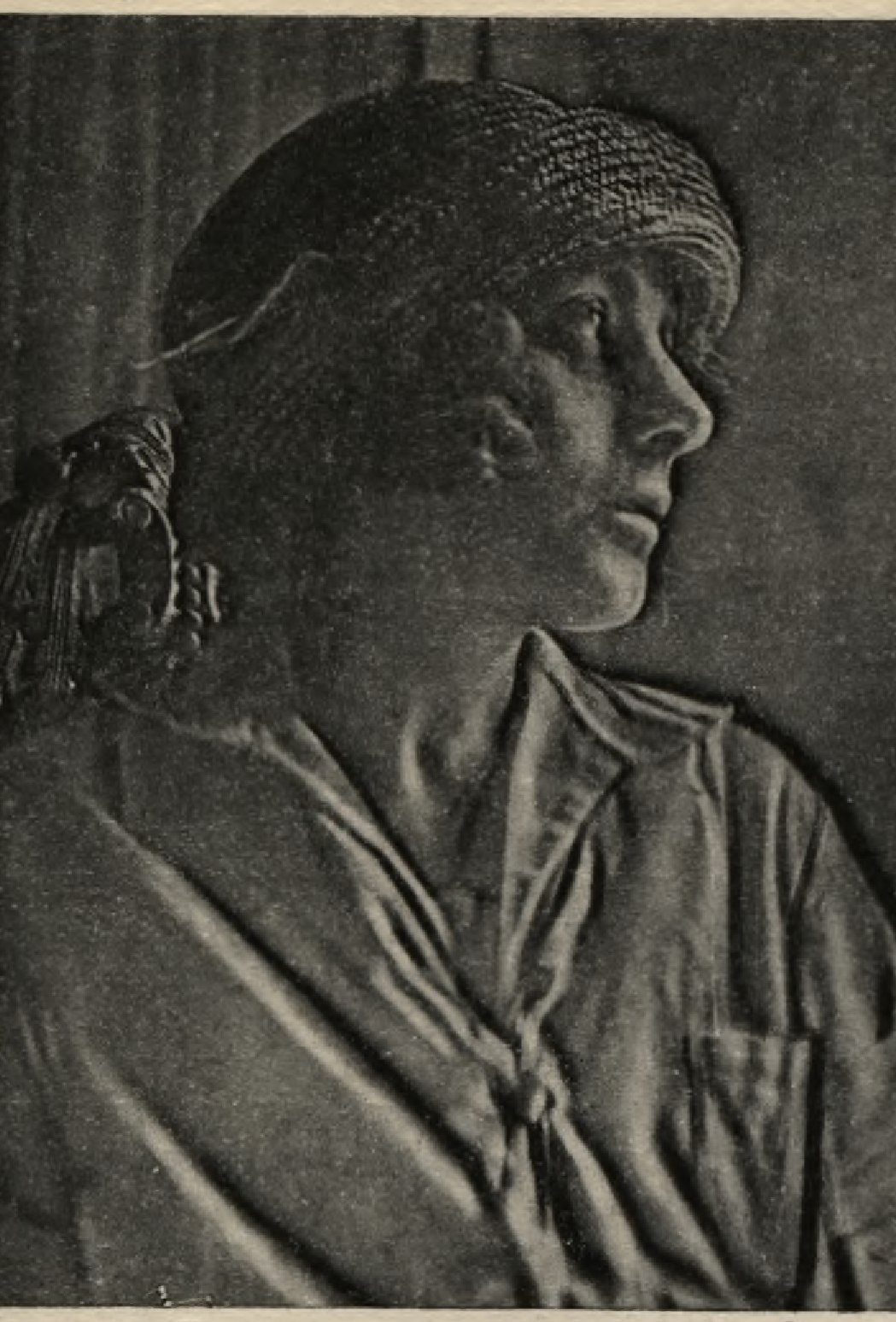
The method of getting a photo-bas-relief is extremely simple and accessible to every amateur (we have here in mind getting not a convex, plastic image, but a flat image that gives the illusion of relief). First of all a shot is made in the most ordinary way; no special devices are required for this. It is desirable to get a contrasty negative, for which one conducts the developing with a slowly-acting developer (glycin, for example). Then from the obtained negative one should print a diapositive, as far as possible also contrasty. On getting the diapositive, one proceeds to making the bas-relief itself.
For this the diapositive is placed in a copying frame, emulsion side to the glass of the frame. To the glass side of the diapositive one applies the negative, also with its glass side; thus the emulsion side of the negative will be turned, as usual, to the emulsion side of the paper. Now it is important to align the contours of the drawings of the negative and the diapositive. The alignment attained by examination against the light can be fixed by gluing the corners of the plates with adhesive paper or pieces of insulating tape. It remains for us only to place the aligned plates, with the paper, into a copying frame and make the print — on which, in essence, the quality of the bas-relief will depend.
Printing is done under artificial light (we have in mind bromide paper) so that the light from the lamp falls on the frame not perpendicularly, but obliquely, at some angle. We do not indicate the exact angle of incidence, but should note that the bas-relief comes out the deeper, the stronger the deviation of the lamp; however, too sharp an angle of incidence can strongly distort the image, so that it is best to take an angle of approximately 35–40°. A correct bas-relief is obtained when the shadow (see the photograph) falls on the lit part of the shot. The lamp should therefore be moved to the side opposite the shadow — that is, to the side of the unlit part of the drawing (simpler, of course, to move not the lamp but the frame relative to the lamp). Thus, in the case of lighting from above in shooting, one must, in printing, light from below (everywhere we have in mind positive lighting, as it was at the shot).
One should remember also that, in view of the extreme density of the double plate obtained from combining the negative and the diapositive, the exposure in printing must be increased 3–4 times. After the exposure follows the usual developing. For making photo-bas-reliefs the most grateful subject is portraits made in profile; good too are architectural shots, if there are no distant planes. Photo-bas-reliefs are very effective on a black velvet background. Getting them is uncomplicated, requires no special knowledge or instruments, and, we think, will interest many photo-amateurs.
— D. Bunimovich