
According to the established tradition, the majority of photographers use the winter period for processing the material shot in summer or autumn, and only an insignificant part continue to work in winter as energetically as in other times of year. Therefore, despite the fact that in our middle belt winter lasts about half a year, we comparatively rarely have to see good shots of winter landscapes. Why does this happen?
The causes, of course, are many; but, probably, the chief one is our inertia and unwillingness to acquaint ourselves with those peculiarities which are met in winter shooting. And yet, knowledge of these peculiarities guarantees us success; and even the ordinary amateur, who usually abandons his work after the first unsuccessful attempts, even he will be able, with a known skill, to get fully satisfactory results.
What, then, are the peculiarities met in shooting in winter? First of all, in the winter landscape there is not that richness of colours and shades met in other times of year. Thanks to the snow cover, the landscape is simplified and reduced to three or four planes, of which the basic ones are white and black. This circumstance considerably eases the composition of the shot, since the richness and variety of colours usually distracts our attention, and we, carried away by this colourful gamut, often shoot landscapes that are completely uninteresting in their composition. Although the winter landscape does not abound in richness of colours, still the basic white tone that dominates in it possesses a whole gamut of tender half-tones and shades. In the skilful conveying of these barely perceptible nuances of the snow cover, and in the correct distribution of masses, light and shadow, consists, perhaps, the main difficulty of winter shooting.
However, the mere technical overcoming of these difficulties does not yet create an artistic work: the shot obtained will satisfy our aesthetic feeling only when it is compositionally correctly constructed. Questions of composition, which play a decisive role in all the representational arts, are almost not touched upon in the field of photography. True, on the pages of journals we often meet the expressions “arrangement of the shot,” “composition of the frame” and the like; but all this is still too little for the amateur to form for himself a clear idea of what composition is. Thanks to the incomplete illumination of this question, such theories get into circulation as, applied in practice, can lead only to mechanicalness and stencil — which usually happens when people try to replace the complex theory of composition with several superficial “laws,” completely losing sight of the fact that in the life of art there are not, and cannot be, unshakable laws.
The study of the works of the great masters of painting and graphics shows us, with special persuasiveness, that the forms of composition are as various as various is the individuality of the artists who embody in this or that form their creative fantasy. Therefore, speaking of composition, we cannot indicate any laws of it, but can only, in general outline, sketch those requirements it should satisfy; for composition is nothing other than “the ability of the artist to bring all the elements entering into the given work to a known unity, to arrange them in mutual subordination to one another in such a way that the very placing of these elements should promote the clarification of the basic aim or task of the work” (V. Nikolsky).
The composition of an artistic shot should satisfy the above requirements, for which it is necessary that it be: (1) simple, since the cluttering of the shot with superfluous details irritates the viewer's attention and distracts him from the basic idea of the composition; (2) whole — that is, constructed so that all the elements entering into it are so organically welded with one another, and in such equilibrium, that nothing could be added to or taken from them; (3) clear — distinctly expressing the basic idea, for which the photographer will have to emphasize or advance some forms, move away or weaken others, and, finally, completely remove the third; (4) natural, since every far-fetchedness and artificiality, especially in photography, produce an unpleasant, repellent impression; (5) beautiful both in its basic lines and in the placing of masses, light and shadow; (6) rhythmic, since “the rhythm of the compositional construction should correspond to the artist's conception: emphasize movement, or, on the contrary, give calm to the depicted; balance the ardour of some personages with the calm of others, or, on the contrary, if only this corresponds to the artist's conception, set off and emphasize the swiftness of others by the calm of the poses of some” (V. Nikolsky). Besides, for the successful resolution of compositional tasks, the photographer-artist should “well use the frame” — that is, so fill the area of the shot that there be in it no empty places, and that each centimetre of this area be really needed.
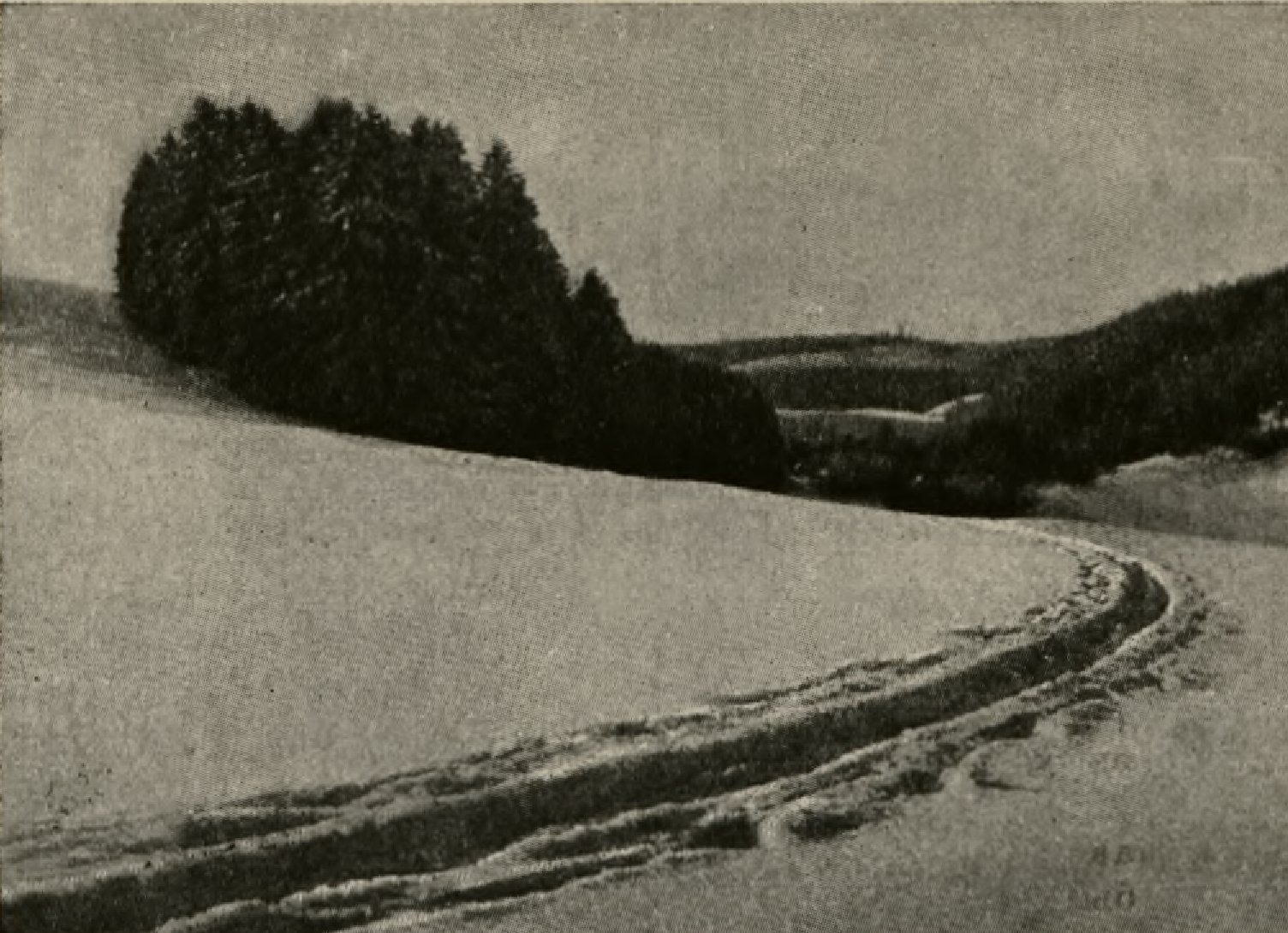
For the clarification of all that has been said, let us briefly analyze the shot placed on p. 10. Compositionally this shot is constructed quite correctly and satisfies almost all the above-enumerated requirements. Its subject is unusually simple and is made up of three planes: the foreground, corresponding to the snow space, with a beautifully rounding road; the middle plane, consisting of a group of fir-trees on the left and a knoll covered with forest on the right; and, finally, the background in the form of a hill. The absence of superfluous details, the beautiful arrangement of lines, and the correct relation between light and shadow give the shot a special distinctness and expressiveness. One should point also to the wholeness of the composition, thanks to which all the elements of the shot are, as it were, organically welded one with another. It is worth removing the line of snow tracks of the foreground, and the whole shot will become dull, monotonous, and will lose its depth; destroy the group of fir-trees of the middle plane, and the equilibrium of masses will be sharply violated.
Already one cursory analysis of the just-adduced shot allows us to make a series of practical indications. We became convinced that the dull and monotonous foreground, thanks to the skilful use of snow tracks, got depth and expressiveness. Consequently, if in the shot landscape there is a snow space in the foreground, it should be enlivened with something. Although in the creation of an artistic shot the main role is played by the creative fantasy of the photographer, we still consider it possible to adduce several technical devices applied for enlivening the foreground. Besides the skilful use of snow tracks, a figure placed in the foreground can serve the intended aim: the contrast of this figure with the white background surrounding it can give the shot the needed depth and expressiveness. If, however, the photographer, having set as his aim the conveying of the virginal purity of the snow cover, wishes at the same time to enliven the foreground, then he can use as shadows both the shadows from various unevennesses met on the snow and the shadows of trees or bushes.
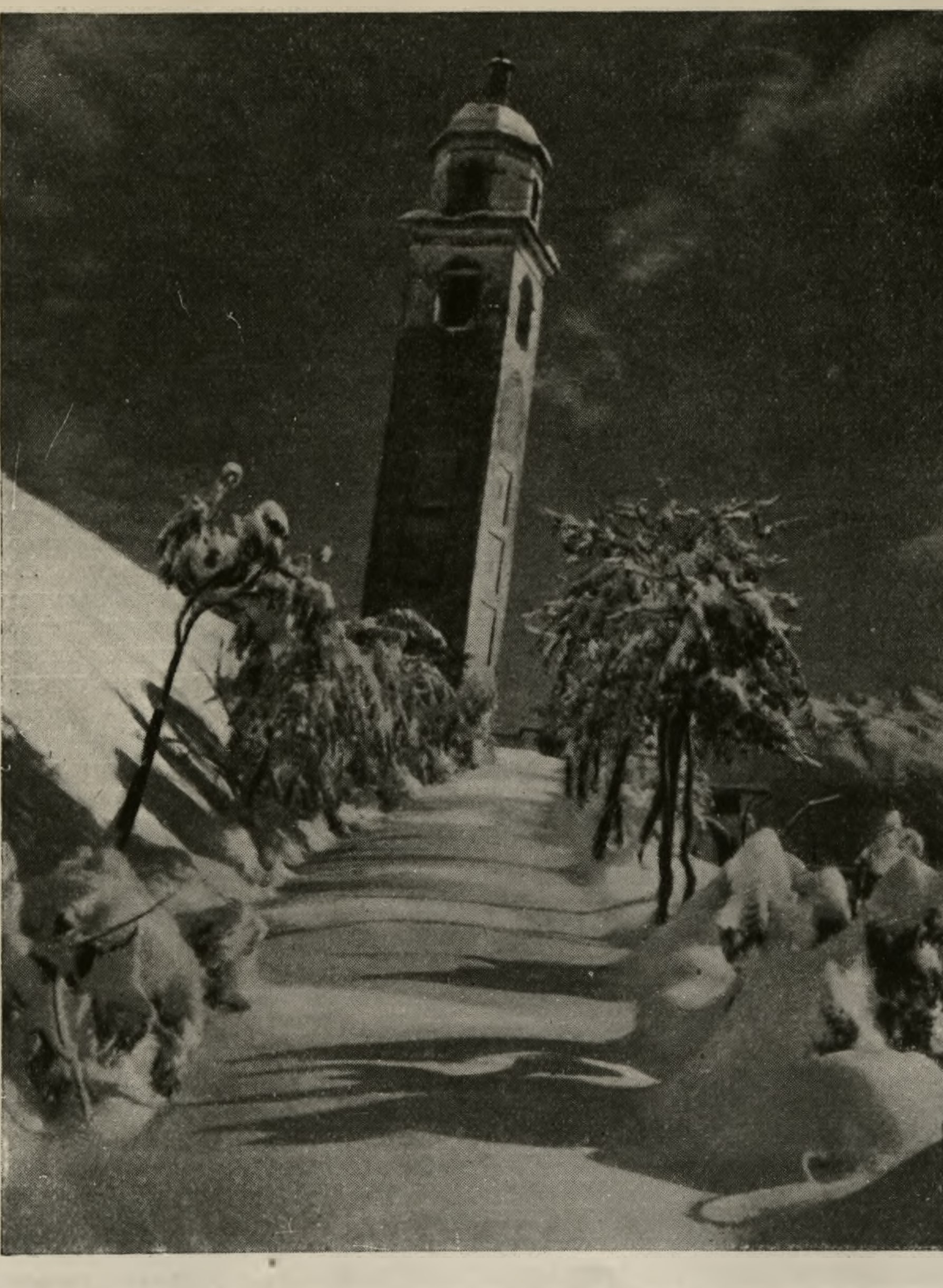
We have already mentioned that one of the main charms of the winter landscape is that symphony of half-tones and tender shades which are on the snow. For the conveying of these nuances it is best of all to shoot in the morning or shortly before sunset: at this time the smallest unevennesses on the surface give off long shadows, which gives the shot an unusual beauty and relief. As for the artistic conception of the shot, this field is so various that it is not subject to any account; in general outline one can only indicate that in his works the photographer-artist strives to convey either the charm of the snow space lit by the bright rays of the sun, or the mood of a gray winter day, or, finally, the charm of the winter attire of the trees, with branches weighed down by snow and beautifully adorned with hoarfrost.
Passing to the technique of winter shooting, we must first of all dwell on the question of the choice of lens. From the author's point of view, the best lens is an uncorrected lens (monocle) of a light-power not less than F/6.8 and with a focal length of 25 to 35 cm for a plate size 9×12 cm. Thanks to the uncorrected spherical and chromatic aberration, the lens conveys only the general impression of the landscape, completely muting the obtrusive and eye-irritating details; therefore the shots obtained are distinguished by a great plasticity, correctly convey perspective, and, mainly, create that air haze which is so hard to convey with an anastigmat. It goes without saying that with the help of an anastigmat too a talented photographer will manage to achieve the intended result, but for this he will have to observe certain rules of precaution. First of all, one should avoid strong diaphragming of the lens, and not bring its light-power below F/9, since with the decrease of the diameter of the diaphragm the sharpness of the various planes increases — which, however, goes at the expense of the loss of air perspective and of the plasticity of the shot. Since snow strongly reflects light, then, to avoid the getting into the lens of the lower and side reflected rays, which, as is known, strongly veil the plate, one should put on its front mount a hollow cylinder made of black paper or cardboard. In view of the fact that at low temperature blind shutters sometimes refuse to work, metal sector shutters of the Compur type, or of other systems, should be recognized as more suitable.
We have already repeatedly had to emphasize that the main charm of the winter landscape is made up by the tender, sometimes barely perceptible shades of the snow cover, for the conveying of which the application of orthochromatic plates and a light-filter is obligatory. Only with the observance of these conditions shall we be able correctly to convey the whole scale of light and shadow, and, mainly, to achieve that the sky on the shot comes out darker than the snow. Orthochromatic plates should possess a lowered sensitivity to the perception of blue rays. The orthochromatization is better done oneself, which, firstly, creates confidence in getting a good result, and, secondly, strongly lowers the sensitivity of the ordinary plate being treated — which is also a valuable quality, since the best results can be obtained precisely on plates of medium sensitivity. As for light-filters, their choice depends both on the sort of plates and on their colour-sensitivity. As a general rule, one should hold to the principle: avoid too dark a filter, and apply only such as lengthens the exposure not more than three times.
The main difficulty, which has to be overcome not only by the beginning amateur but also by the experienced photographer, is the question of determining the correct exposure. This difficulty consists in the fact that winter landscapes are distinguished by very strong contrasts, so that the photographer hesitates whether to apply an exposure that would allow working out the darkest parts of the landscape, or to determine the exposure by orienting on the main mass — that is, on the snow. In the first case he gets a hopeless overexposure of the snow plane, which, losing all its individual qualities, comes out on the shot as a grayish, monotonous mass; in the second, he gets splendidly conveyed snow, disfigured by the black silhouettes of the underexposed dark parts of the landscape. The way out of the situation can be only one, namely: to expose so that the dark objects come out somewhat underexposed, and the snow a little overexposed (it is especially important to watch that the snow be only a little overexposed). And then, by the subsequent processes — chiefly developing — to achieve the correction of the admitted error.
Winter shots abound in contrasts, and one should develop them with softly-working developers, of which the most suitable are rodinal, pyrogallol and glycin. The classical developing, however, from our point of view, should still be recognized as slow developing in vertical trays; the merits of this method are too well known to all, so that we shall not dwell on them. As for recipes, we limit ourselves to adducing only two, namely, glycin and acid amidol. For composing the glycin developer after Hübl, one dissolves, with heating, 50 g of sodium sulphite in 80 cu. cm of water, adds 20 g of glycin, heats almost to boiling and gradually adds 100 g of potash. A liquid gruel-like mass results, in the quantity of 150 cu. cm; if less is obtained, add water. On cooling it is poured into a bottle and tightly corked. For slow developing, 1 part of the solution is diluted with a 50-fold quantity of water. The developing of normally exposed plates lasts about 1 hour. Fixing should be done in an acid fixer.
As for acid amidol, one should point to its following merits: it works slowly and softly, giving splendidly worked-out harmonious negatives even where large errors in exposure were admitted. It is especially suitable for developing winter subjects, since it can be used precisely where we deal with very contrasty lighting, whatever the other conditions of shooting. Its recipe, proposed by V. Favorsky, is the following:
| Amidol | 1 g |
| Bisulphite | 4–6 g |
| Water | 350 g and more |
The usual time of developing — 2 hours. On overexposure, details appear in the first ten minutes. One must, however, develop the indicated time, since otherwise the negative will come out completely underdeveloped. One should not fear overdevelopment, since the plate, without special harm, can remain in the developer for many hours; the dichroic veil, appearing as a result of long developing, does not harm the negative, since it lies very evenly over the whole layer and is very transparent. The image obtained in developing is distinguished by some peculiarities which it is important to take into account: in the majority of cases, even with prolonged developing, it comes out limp and transparent — which, however, one should not be embarrassed by, since, despite this apparent weakness of the negative, the positive will possess the needed scale of tones and juiciness. Some errors, resulting at the beginning of work with this developer, can be quickly removed as soon as the needed skill is worked out, which is acquired after two or three preliminary experiments. For revealing the characteristic peculiarities of the developer it is important to take completely fresh bisulphite and distilled water; the addition of sulphite to the developer deprives it of its specific peculiarities, so that by its action it begins to approach ordinary developers, and the more so, the more sulphite dominates in it over bisulphite.
The application of the method of slow developing almost always gives positive results. If, however, by virtue of these or other causes, the negative obtained by us still abounds in contrasts, it can be corrected by the following method, published by Prof. Namias. The negative is immersed in a bleaching bath of the composition:
| Water | 100 cu. cm |
| Sublimate | 2 g |
| Table salt | 5 g |
The process of bleaching is stopped when the deep dark places of the negative still remain black from the side of the glass. After careful washing, the negative is immersed in a bath of:
| Water | 250 cu. cm |
| Potassium permanganate | 1 g |
| Sulphuric acid | 2.5 cu. cm |
Here the metallic silver remaining in the gelatin dissolves, and the negative is transferred into a 2% solution of bisulphite for the removal of the colouring. After washing, the semi-chloride silver is restored with some developer; then follow washing and drying. This method is unsuitable both for intensified negatives and for negatives developed in strongly tanning developers.
The final aim of all the preceding processes is the getting of a good positive. However perfect the negative may be, if it is not well printed, all its value is lost, and with it the time, labour and materials spent. That is why every photographer should turn special attention to the study of the positive process. We cannot here dwell on a detailed analysis of the merits or shortcomings of various papers; we shall indicate only briefly that the ordinary amateur, with a correctly composed and technically competent negative, can get splendid results, applying bromide or platinum papers. The choice of the surface of the paper, its shade, tone and so on — all this depends on the basic conception of the photographer. We shall point out only that for winter landscapes the most suitable are cold, bluish-black tones, obtained on bromide paper; not bad results can also be got by colouring the bromide print in a blue tone by the following recipe:
| 10% solution of red prussiate of potash | 10 cu. cm |
| 10% solution of citric-acid ammonia-iron | 10 cu. cm |
| Acetic acid | 20 cu. cm |
| Distilled water | 200 cu. cm |
A carefully washed and dried print is lowered into this virage, where it remains until the desired tone is obtained. After toning follows washing, which should not be too dragged out, since the image begins to lose its colouring and washes off. For the aim of achieving greater durability, the print should be lacquered. If, however, the photographer does not want to limit himself to mechanical processes, but wishes to be master of the situation, he will have to resort to the help of the combination-gum-arabic or the bromoil processes, which allow a wide intervention not only in the establishment of the desired scale of tones but even in the change of the very composition of the shot.
— E. Piotrkovsky