
A systematic exposition of the foundations of photography for beginners. Talk One: The photographic lens, its construction, choice and care.
1. The converging lens, the defects of the image it gives, and their removal
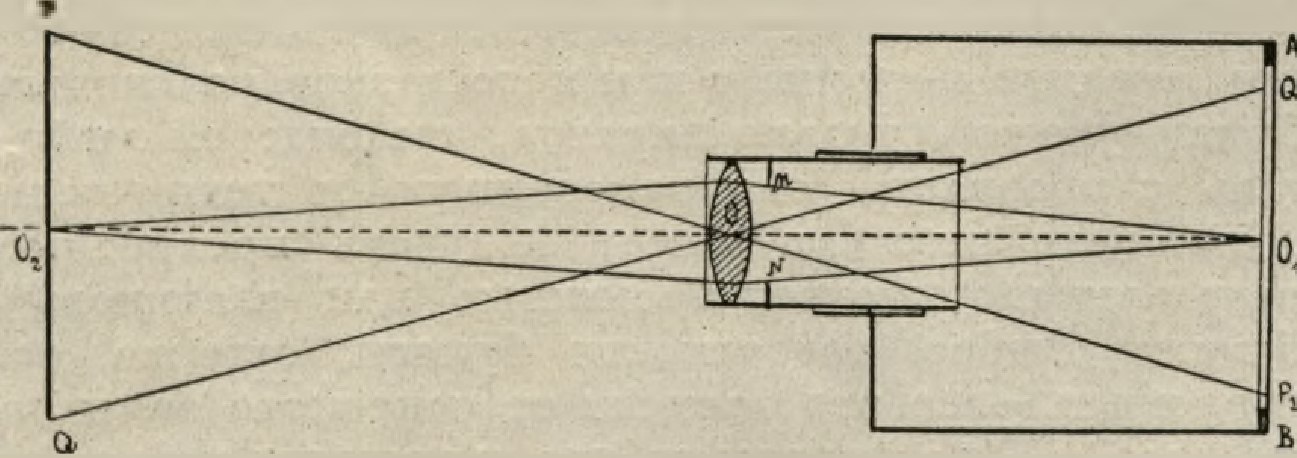
Let us build a home-made cardboard camera, having the look of an ordinary box (fig. 1), whose rear wall AB is replaced by ground glass; in the front wall let us make an opening, into which we insert a little tube with a glass from strong old-man's spectacles set into it. Directing this biconvex glass — the “lens” — at some well-lit object, we shall notice that on the ground glass of our camera there appears a reduced and inverted (head downward) image Q₁P₁ of the object PQ placed before the camera. The spectacle-glass is the lens of our camera. With such a camera, imperfect as it is, we could in reality make a photographic shot, placing in place of the ground glass a light-sensitive plate enclosed in a cassette. Such a lens, though in reality in exceptional cases it is applied, is technically very imperfect.
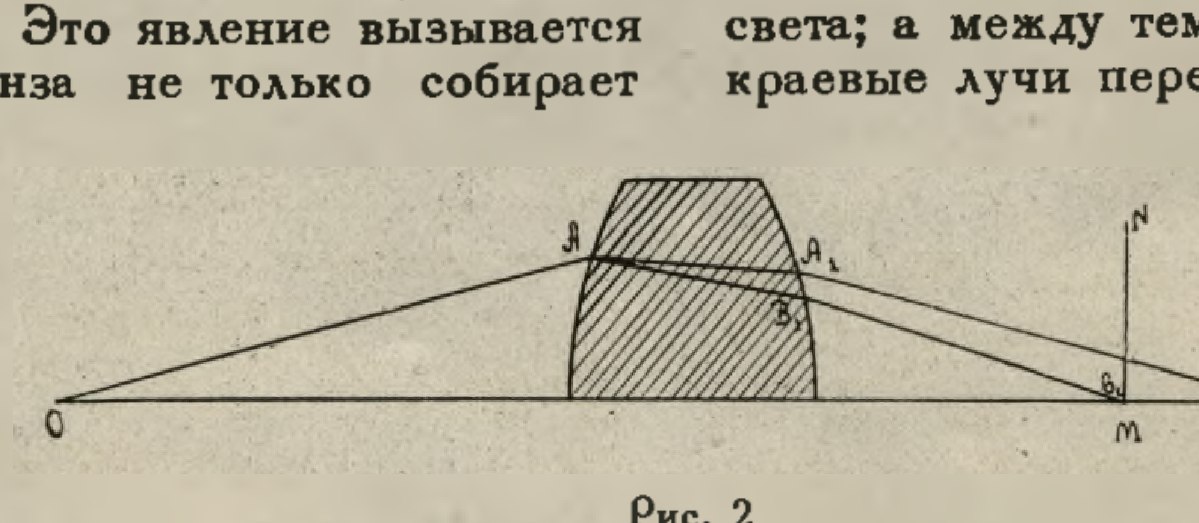
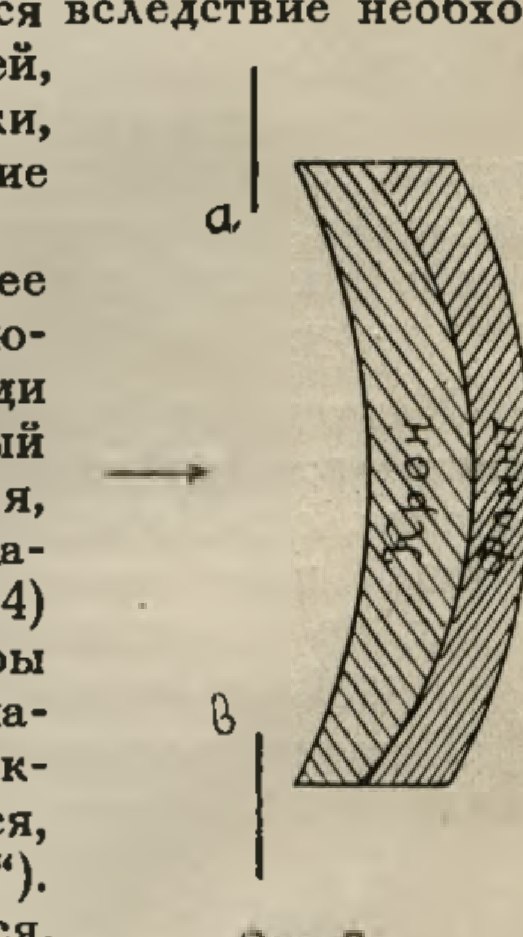
On a more detailed study of the properties of the image given by a simple lens, the following defects of this image were discovered. A sharp image to the eye is obtained only on the observance of the following conditions: (1) if the represented object is small (a point) and lies on the main optical axis (that is, on the line O₂O₁ joining the centres of the spherical surfaces that bound the lens); (2) if the pencil of rays issuing from the luminous point is narrow — that is, bounded by a narrow opening, the diaphragm MN. However, having set the image on focus, we shall still, after developing, get an image in which the sharply set objects are unsharp, and, on the contrary, those planes may prove sharp that were unsharp at the setting. This phenomenon is caused by the following: the lens not only gathers into one point rays diverging from the luminous side in different directions, but also decomposes rays into colours (fig. 2); and rays of various colour are gathered at various points — the brightest, yellow and red, are gathered at point a₁, farther from the glass than the blue and violet (at b₁). We set the image by the eye on the brightest rays at point a, but more actively acting on the sensitive plate are precisely the violet and blue rays gathering at point b₁, reckoned by the eye to the group of “dark” rays; it is they that give the image, but not in the place where at the setting there was a sharp image — that is, at point a₁, but at point b₁, where in the plane MN a little circle is formed instead of a point. This phenomenon is called chromatism; it yields to removal if one unites glass of various nature (the so-called crown-glass and flint-glass). The combination of two glasses, in which chromatism (or chromatic distortion — aberration) is removed, is called an achromatic lens, or an achromatic “pair.” From various considerations, set out in detail in courses of geometrical optics, this pair is given the following look (fig. 3), where ab is the diaphragm. This latter is placed because of the necessity of reducing the pencil of rays going from the luminous point, which is done in fulfilment of condition 2.
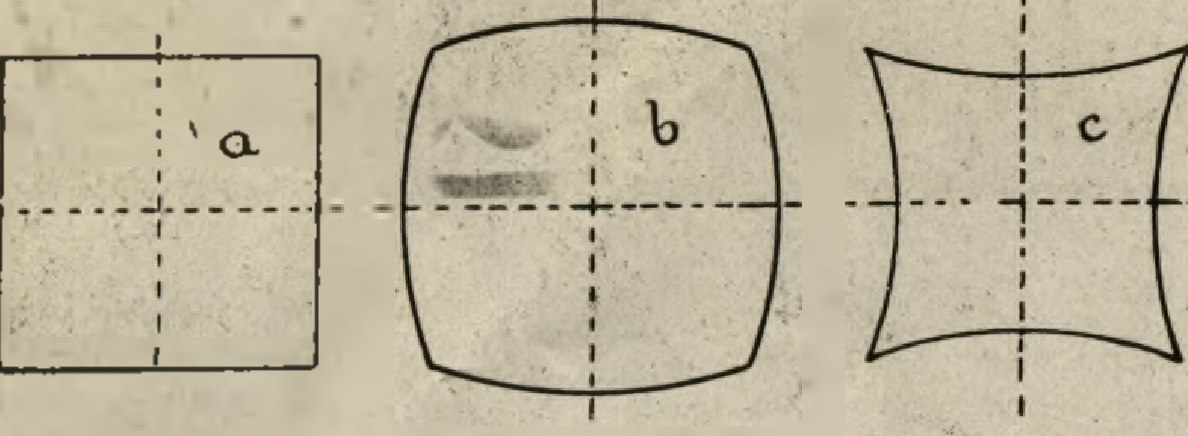
Besides the defects indicated earlier, a lens that has a diaphragm set in front shows a new defect — distortion, the distortion of straight lines, thanks to which the square a (fig. 4) is depicted in the form of figure b (“like a little barrel”); if, however, the diaphragm is placed behind the lens, then the square is depicted as in figure c (“like a cushion”). This defect is removed if the lens consists of two “pairs,” symmetrically placed in relation to the diaphragm; such a double lens is called an aplanat.
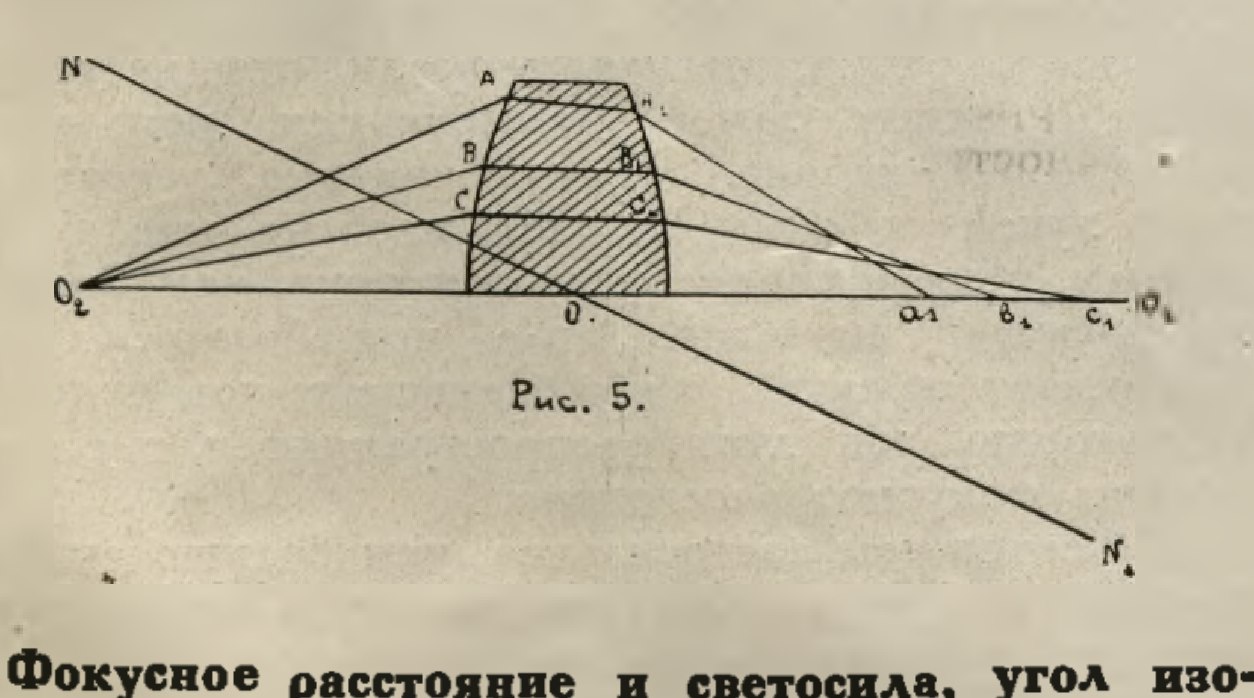
In the aplanat many other corrections are carried out too, for the symmetry of the pairs and their achromatism alone are not enough for the removal of very many of the remaining defects. In practice it is necessary to work not with narrow pencils of rays, but with wide ones, giving much light; and yet, if one enlarges the diaphragm, the edge rays will intersect nearer to the glass than the rays falling nearer to the middle of the glass, in consequence of which, at a setting on a₁, b₁, c₁, the point O₂ will be depicted as a little circle (fig. 5). This phenomenon is called spherical aberration. It is necessary to get an image of points lying far from the main optical axis, on the secondary axis NN₁; the images of such points stretch out into a cross — this phenomenon is called astigmatism. With wide pencils of rays issuing from points lying on the secondary optical axis, the image of the point stretches out into a “comma” (the phenomenon of “coma”). Finally, points lying in one plane give images lying on a curved surface (the curvature of the field of the image).
The task of removing all the indicated defects occupied the constructors for the last fifty years. The scientific collaborators of the firm of Zeiss (Jena, Germany) and of Goerz (Berlin, Germany), Dr. Rudolph and Dr. Hoegh, managed, in the nineties of the past century, by way of complex mathematical considerations, to calculate the anastigmatic lens, in which the enumerated defects are removed (the Protars of Zeiss, 1890). Anastigmats possess a flat field of the image; in them there is no astigmatism (whence their name) and no chromatic aberration; spherical aberration and coma are in them to a considerable degree softened. Thus, every point is depicted, with the help of anastigmats, as a point and not as a little circle (of this they say that anastigmats give “point” images). The field of the image with anastigmats is extensive; this means that point images they give not only of those points that lie near, but also far from the main optical axis, and the image over the whole field is equally exact (sharp). Thus, anastigmats are the most perfect lenses of the present time; this does not mean, however, that other constructions, besides the anastigmatic, have completely gone out of use: there are various conditions under which others — otherwise corrected, or even insufficiently corrected lenses — may still be applied.
2. Focal length and light-power; angle of image; depth of focus
In choosing a lens one has to take into account the following numbers, characterizing the lens: (1) the magnitude of the focal length; (2) the light-power; and (3) the angle of the image; besides, it is necessary to reckon with the quality called “depth of focus.”
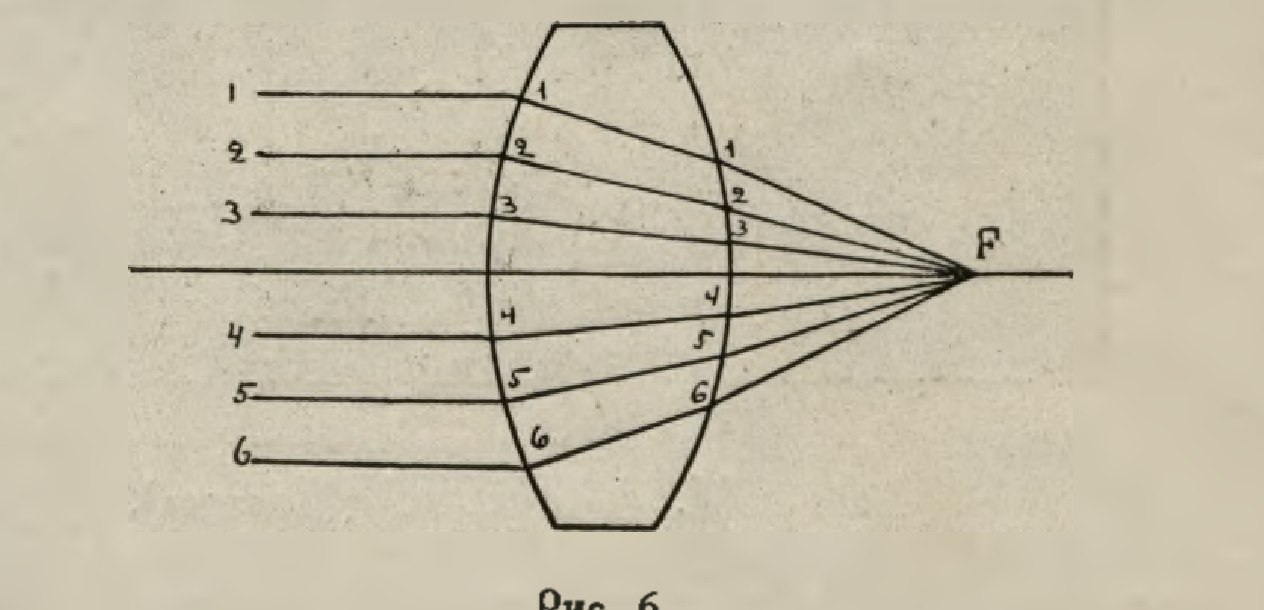
Focal length. Let us insert into our cardboard camera (fig. 1) a simple lens and take onto it the image of a distant luminous object — for example, the sun. We shall notice that the sun is depicted as a bright, sparkling little circle. Moving the tube in its mount, we shall reach that position in which the image will be the sharpest. This place, in which are gathered the parallel pencils of rays falling on the lens, is called the main focus of the lens (fig. 6). At the approach of the luminous point to the lens, the image of the point from the lens will recede. The distance of the focus from the glass is called (inexactly, however) the focal length and is designated by the letter F or Φ. In elementary physics there are deduced the formulas and laws by means of which one can, knowing the object, construct its image given by the lens. These laws suit, however, the theoretical “infinitely thin” lens. For the lenses applied in photography, whose thickness cannot be neglected, there exist other rules, deduced from the doctrine of the “principal” planes and the “nodal” points.
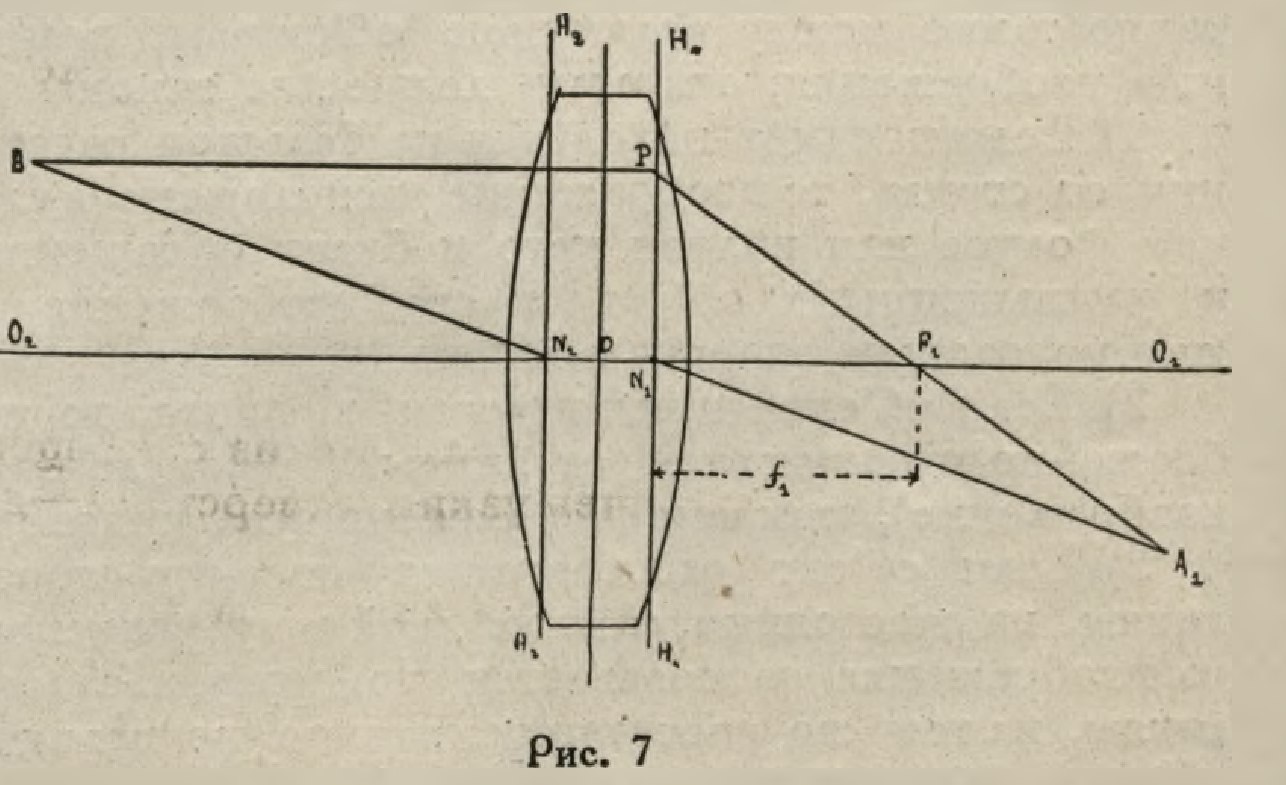
In a lens there exists a pair of planes H₁ and H₂ (fig. 7), possessing the property that rays falling on the lens parallel to the main optical axis, issuing from the principal plane H₁, are directed to the main focus F₁. The intersections of the principal planes H₁ and H₂ with the optical axis O₁O₂, the points N₁ and N₂, are called the nodal points. (The nodal points lie in this place, however, only in the case where on both sides of the lens there lies one and the same medium — for example, air, which in reality in our case takes place.) The nodal points possess the following remarkable property: a ray A₁N₂, going from the luminous point into the second nodal point, issues from the first nodal point N₁, remaining parallel to its original direction. Using these properties, one can construct the image of each point of the object, and consequently of the whole object. The position of the nodal points is determined by means of geometrical considerations. By the focal length (let us say now more exactly) is taken the distance from the focus to the principal plane (in our case, from the right focus to the right principal plane). By the distance of the object from the lens is taken its distance from the other principal plane.
Systematically studying the dependence between the position of the object and the position of the image, as also between the magnitude of the object and the magnitude of the image, the following laws were discovered: (1) if the object is at a large distance from the glass, then the image is placed in the main focus or near it, and will be inverted and reduced; the object and its image lie on different sides of the lens; (2) if the object is moved toward the lens, then the image recedes from the lens (the object catches up with the image), and the image is enlarged; (3) if the object is placed on one side of the lens, at a distance equal to a double focal length, then the image is placed on the other side of the lens, at the same distance, equal in magnitude to the object, and remains inverted; (4) if the object comes still nearer the glass, but not nearer than the main focus, the image recedes still more from the glass, remaining inverted and enlarged. A further approach of the object to the lens, nearer than the focal length, does not take place in photographing. At an equal distance of the object from various lenses, the magnitude of the image depends on the focal length: the greater this latter, the greater, other things being equal, the image itself.
Angle of image. Every more or less corrected lens gives a sharp (“point”) image on a known space, forming a circle whose centre is the point of meeting of the axis of the lens with the plate. By a sharp image is usually taken such a one in which a point, if it does spread into a little circle, the diameter of this latter does not exceed 0.1 mm. If one leads through the centre of the lens and through the edges of the image rays, then a cone is formed; the angle at the vertex of this cone is called the angle of the image (for example, the angle P₁OQ₁ in fig. 1). The largest angle of image (the largest field of sharp image) is possessed by anastigmats: with them this angle is on average 75–80°, but reaches up to 90°. With aplanats the field of sharp image is considerably smaller, and still smaller it is with the simple, little-corrected lenses.
Light-power. We have already indicated that for the removal of the edge rays diaphragms are applied (for example, MN in fig. 1); they, of course, remove part of the rays and by this make the image darker. The image will be the brighter, the greater the acting diaphragm — that is, the more rays the lens passes and the smaller the surface on which these rays spread, that is, the smaller the focal length. A lens is the more light-powerful, the greater its opening and the smaller its focal length; therefore the light-power of a lens is proportional to the ratio d/f (where d is the diameter of the opening); this ratio with simple lenses is equal approximately to F/12.5; with aplanats it is equal to F/6 to F/8; with anastigmats from F/8 to F/1.8 and even to F/1.5; the most widespread are the anastigmats with a light-power F/6.8 to F/4.5. The greater the light-power, the faster one can make the shot.
Since the knowledge of the magnitude of the openings and of the light-power is important for determining the degree of speed of the shot, a rather complex system of numbering the diaphragms was worked out, now in the majority of cases abandoned and replaced by the designation of the light-power; the connection of the diaphragm numbers with the light-power is indicated in Table I.
| Light-power | Relative exposure | Stolze system (Goerz, Steinheil, Voigtländer, Busch) | Rudolph system (Zeiss) |
|---|---|---|---|
| F/1.5 | 0.11 | — | — |
| F/1.8 | 0.16 | — | — |
| F/2.2 | 0.25 | — | — |
| F/2.7 | 0.35 | — | — |
| F/3.2 | 0.5 | 1 | 256 |
| F/3.5 | — | — | — |
| F/4.5 | 1 | 2 | 128 |
| F/6.3 | 2 | 4 | 64 |
| F/6.8 | 2.3 | 4.6 | — |
| F/7.7 | 3 | 6 | — |
| F/8 | 3.15 | — | — |
| F/9 | 4 | 8 | 32 |
| F/10 | 5 | — | — |
| F/11 | 6 | — | — |
| F/12.5 | 8 | 16 | 16 |
It should be noted, concerning the diaphragm numbers engraved on the mount of a lens, that each following number requires double the exposure of the previous.
Depth of focus. The next quality of a lens that has significance in shooting is the “depth of focus.” By this term is understood the property of the lens to give sharp images of objects situated at various distances from it. The depth is the greater, the smaller the focal length and the smaller the acting opening of the lens. Distant objects give the image almost in the main focus; when the lens is set in such a position that the image is placed precisely in the main focus, one says that the lens is set “on permanent focus,” or “on infinity.” It is important to know at what distance the nearer objects will be that still give a sharp image when the lens is set on permanent focus (on distant objects). The answer to this question is given by Table II.
| Focal length (mm) | F/4.5 | 6.3 | 7.7 | 9 | 11 | 15.5 | 18 | 22 | 36 | 44 |
|---|---|---|---|---|---|---|---|---|---|---|
| 55 | D = 6.75 | 4.75 | 4 | 3.3 | 2.75 | 2 | 1.7 | |||
| 90 | 18 | 13 | 18 | 9 | 8 | 5 | 4.5 | 3.5 | 2 | 1.5–∞ |
| 120 | 35 | 23 | 19 | 16 | 13 | 9 | 8 | 6.6 | 4 | 3.25–∞ |
| 150 | 41 | 34 | 29 | 25 | 20 | 15 | 12.5 | 10 | 6 | 5–∞ |
| 180 | 72 | 52 | 42 | 36 | 30 | 21 | 18 | 15 | 9 | 7.5–∞ |
(The table shows at what distance D from the lens, in metres, the sharp planes still begin when the lens is set on infinity.) Another question, arising at the setting, is the following: on focusing on a known plane situated at a distance l from the lens, at what distance (l₁) nearer than l, and at what distance l₂ farther than l, the planes are still sharp. These distances can be calculated by the formula l₁ = l·(D + f)/(D + l) for planes in front of l, and by the formula l₂ = l·(D − f)/(D − l) for planes lying behind l; D is taken from Table II. Example: a lens F/9, focal length 12 cm, set on 8 m. In this case D = 16 m, and l₁ = 8·(16 − 0.12)/(16 − 8) = 5.37 m; l₂ = 8·(16 − 0.12)/(16 − 8) = 15.88 m.
3. The chief types of contemporary lenses
Above were indicated three types of lens: the achromatic “pair” (fig. 3), the aplanat and the anastigmat. Achromats are used with cheap small cameras. In this type of lens the chromatic and spherical aberrations (for the central rays) are corrected. They are applied for the shooting of landscapes, where distortions have little significance. Their light-power is small — usually F/12.5–F/14. Aplanats are made by many first-class firms. Let us mention the following types: the Auscop of Voigtländer (F/7.5), the Linkeoscop of Goerz, the portrait aplanat (F/6) and the rapid-aplanat of Busch (F/6 to F/8, angle 75°), the rapid-aplanat F/5 of Suter (Basel) — they are excellent instruments. Aplanats are applied for the shooting of landscapes and portraits. They are little suited for exact work: reproductions, for three-colour photography, for photogrammetric work.
The most universal application have the anastigmats; they give a sharp image over the whole field within the limits of an angle up to 90° and have an enormous light-power; still recently a light-power F/7.7 was considered large, now the average light-power is F/4.5. In the last time (during and after the great war of 1914–17) the construction of lenses, especially in Germany and England, made great successes, expressed chiefly in the increase of the light-power of lenses, reaching F/1.5. These lenses allow a shot nine times faster than the lenses F/4.5. Anastigmats are made by all optical firms. The original constructions had from 6 to 8 glasses, cemented between themselves into two groups, divided by a diaphragm and having 3–4 glasses each. A defect of these lenses was the large number of reflecting surfaces and the thickness of the glasses composing the lens; with an unsuccessful placement of the surfaces, the light reflected from them gave on the plate a light spot that spoiled the image; while the large thickness of the glasses conditioned a loss of light reaching up to 50% of all the light falling on the plate. All the same, this construction, being very perfect and having also this merit — that the rear group of lenses itself was a good, though not very light-powerful lens — was for a long time the only one. Later, however, attempts began to create anastigmats from a smaller number of lenses — three and four, instead of six and eight, and moreover either not cemented between themselves at all, or cemented only in part. The prevailing number of new constructions of lenses relates precisely to this last type. Anastigmats with a light-power F/4.5 to F/6.8 are suitable for the most various shots — portraits, groups, landscapes, reproductions; they are therefore called universal.
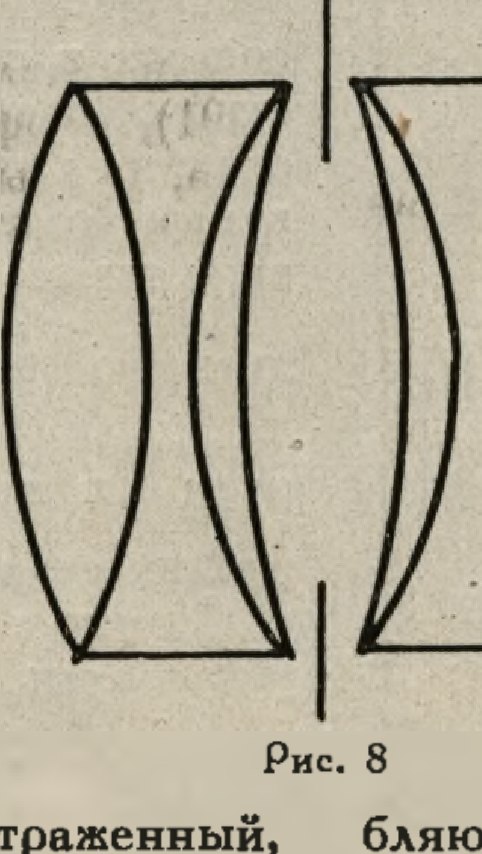
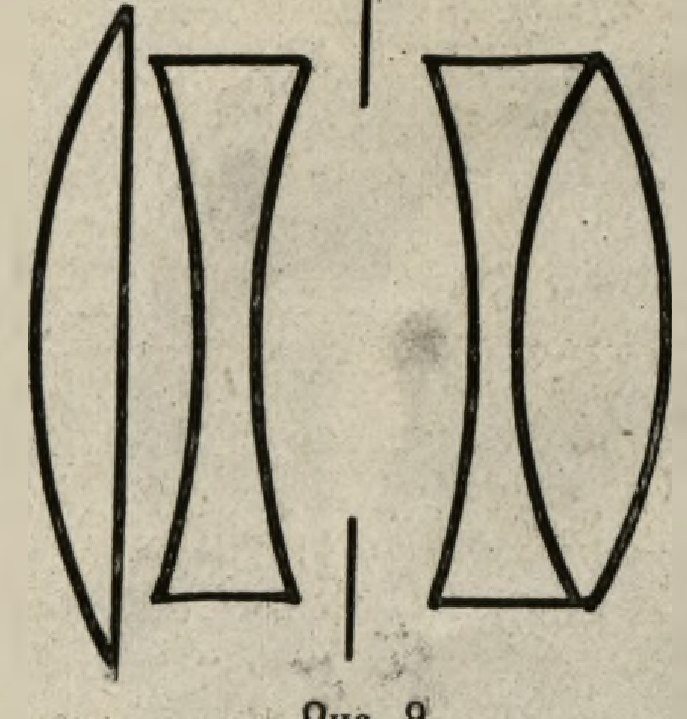
Let us name some of the best-known constructions. Symmetrical anastigmats with cemented lenses: the Dagor (firm of Goerz, fig. 8), consisting of two three-lens cemented groups; the rear group can serve as a lens with a double focal length and a light-power 4 times smaller than that of the whole lens. Light-power F/6.8, angle of image up to 90°. The Double Amatar (F/6.8) and the Double Protar (F/6.3) of the firm of Zeiss; the Collinear of Voigtländer (F/6.3), angle 70°; the Orthostigmat of Steinheil (F/6.8, angle up to 80°); the Double Plasmat of Meyer (F/4). All these lenses are universal. The rear lenses of these lenses can serve as fairly good lenses for landscape shots, and with favourable conditions of lighting also for portraits.
Of the anastigmats of asymmetrical construction, consisting of lenses partly cemented, let us name the Tessar of Zeiss, with a light-power F/2.7 (fig. 9), F/3.5, F/4.5, F/6.3 — one of the best lenses of our time (built in 1902 by the calculations of Dr. Rudolph for the firm of Zeiss); the Protar of Zeiss, ser. IIIa, F/9, angle up to 97°, consisting of four lenses cemented two by two, giving exceedingly exact images; the Ernon of Ernemann F/3.5, angle up to 53°, used for cinematographic purposes.
Of the symmetrical anastigmats (or almost symmetrical), consisting of uncemented four lenses, let us name the Dogmar and the Syntor of Goerz. In the Dogmar the front and rear halves have a different focal length, so that in one instrument are united three lenses with a different focal length. The Unofocal of Steinheil (F/4.5) is universal; the rear lens can serve as an independent lens. Of the asymmetrical three-lens anastigmats, the greatest fame is enjoyed by the Heliar of Voigtländer F/4.5, a superb instrument for portrait, cinematographic and fastest instantaneous shots; it consists, in essence, of five lenses: the front and rear groups consist of two cemented lenses, and the middle of one biconcave lens. In the course of the last decade anastigmats of exceedingly high light-power appeared; of them let us name the Kino-Plasmat F/2 of Meyer, calculated by Rudolph, and the Plasmat F/3 (of three uncemented lenses) of Meyer, the Ernostar F/1.8 of Ernemann, the Triotar F/3 of Zeiss, the Pentac F/2.9 of Dallmeyer and others. These lenses are, however, in essence less corrected than their less light-powerful predecessors. Thus the world firm of Zeiss (Carl Zeiss, Jena) indicates in its price-list that, diaphragming the Tessar F/2.7 not only to F/3.5 but even to F/4.5, we shall still get less corrected lenses than the original Tessars F/4.5 and F/3.5.
Portrait lenses. Somewhat aside from the indicated types stand the portrait lenses. Their prototype was calculated 86 years ago and built (1840) by Voigtländer. Before Petzval the construction of lenses was accomplished exclusively by the experimental path. Petzval (1807–1891), professor of mathematics at the Vienna University, was the first to show not only the applicability of the mathematical method, since then come into use, to the calculation of lenses, but also its might. Petzval's lens, which possessed, true, a small field of the image, but a light-power enormous even for our time, F/3.2, produced a complete revolution in the methods of shooting of that time, reducing the exposure, against the lenses then applied with a light-power F/14, by 20 times. And such a reduction was important, since at that time (1840) the exposure lasted up to half an hour. Moreover, it gave magnificent images in the central part of the field; therefore Petzval's lens proved especially suited for portraits and reigned undividedly in this field about 50 years. Petzval's portrait lens served as a prototype for other similar instruments and has not definitively left the stage even to our time, despite the colossal successes of theoretical and practical optics. Petzval's lens consists of two asymmetrical pairs of lenses. The front pair, consisting of crown and flint glass, is cemented; the rear part consists of two uncemented lenses. Since with this lens only the central spot is drawn sharply, by this is attained a known artistic plasticity, with the singling-out of the main thing in the portrait and the suppression of the unneeded details.
Telephoto lenses. The necessity, in shooting distant objects, of getting larger images forces one to turn to instruments with a large focal length, giving large images. However, the insignificance of the effect attained with this, the bulkiness of the instruments, and the desire to work with small plates, forced the seeking of other constructions, more convenient, possessing a large focal length but requiring a small extension of the camera. Such constructions are called telephoto lenses. While in the constructions described up to now the system consisted of groups of lenses, each of which was converging, telephoto lenses have in their construction one converging system of lenses (the front) and one dispersing, concave (the rear). The construction of a telephoto lens is usually such: into a special “tele-tube” (teletubus) is screwed from one side an ordinary lens — for example, a Tessar; into the other end, which is the rear, is screwed the “negative” element. In some constructions one can change the distance between the elements; in others it remains unchanged. There are special constructions in which the front lens is not an independent lens (the Magnar of Zeiss, the Adon of Dallmeyer). The constructions of the last time possess a large light-power (the Teletessar of Zeiss F/6.3, the Telegor of Goerz F/6.3, the Bistelar of Busch F/7, the Adon of Dallmeyer). Telephoto lenses are usually applied for the shooting of distant objects — for example, of wild animals at liberty, for military aims and so on; however, one can conveniently apply them also in shooting near objects — for example, portraits — where the unsharpness proper to these lenses is in the given case quite apt.
4. The choice of the lens and its care
A decisive significance in the choice of a lens is had by the character of the proposed shots and the size of the plate. The focal length of a lens is connected with the plate by the following relation: the focal length of a lens is best of all chosen equal to the diagonal of the plate (for example, 15 cm for a plate 9×12 cm). Then a more natural angle of view is obtained; usually, however, from the desire to use a wider angle of view, the focal length is taken equal to the long side of the plate, but not seldom it is taken equal to the small side of the plate — then the lens is wide-angle.
If the shots pursue not artistic but only technical aims, then it is desirable always to get a distinct image, sharp over the whole field. For the fulfilment of this the most suited is the anastigmat, which in general may be considered pre-eminently a universal lens. If there is not foreseen a necessity of making any special kinds of shot, then the light-power should be chosen F/4.5, F/6.3 or F/6.8. With this light-power the correction is carried out well, the angle of image is sufficient, as is also the depth of focus. A higher light-power (F/3.5, F/2.7 and higher) is required for sport, cinematographic and similar shots. These lenses possess a much smaller angle of image and a small depth. Their correction is considerably worse than that of the preceding; the diameter of such lenses is very great, so that sometimes the lens is larger than the camera itself (the Ernostar F/1.8). True, such lenses allow making instantaneous shots even in unfavourable conditions of lighting. Anastigmats with a moderate light-power (F/7.7, F/8, F/9) are well corrected, give exceedingly sharp images and possess a large angle. These qualities make them especially suited for reproductions and for shots of immobile objects — the interiors of buildings and so on. Still recently these lenses were considered suited for every kind of shot, universal; but now they are displaced from a number of shots by more light-powerful lenses.
Economic considerations not seldom force the seeking of cheaper instruments than the rather dear, though perfect, anastigmats. Then aplanats are bought. From anastigmats they differ by a smaller field of image, and so they are less universal, less suited for scientific work, reproductions, colour photography. But they are magnificently adapted for portrait and landscape shots. For the special aims of portrait photography there are used to this day the “portrait” lenses of the Petzval type; especially famous in this respect are the instruments of Voigtländer and Dallmeyer. They possess a high light-power (F/3–F/4) and a small angle of image (25–30°).
One should not think that only the exceedingly exact, sharply drawing anastigmats are the most desirable instruments everywhere and always. In artistic photography there are not seldom required instruments giving either only the sharpness of the central spot (portraits), or even a universal unsharpness, a blurring of the contours. These requirements force artists to seek softly-drawing lenses — uncorrected lenses, with which simple glasses from spectacles, set into a home-made mount, are applied. But there are also special lenses for this aim — the semi-achromats (of the firm of Busch, made by the indications of the famous photographer-artist Nicola Perscheid, F/4.5, for portrait shots), the tele-anachromats of Puligny and Puyo, monocles and others.
“Natural” perspective. The desire to work with lenses of a large light-power leads to the application of lenses having a very short focal length and, consequently, giving small images. To the same leads also work with the contemporary miniature cameras (4.5×6, 6×9 cm). The desire to get a larger image, at least of the objects of the foreground, forces the photographer to approach very close to the objects of the shot. As a result it turns out that the photographic shot presents a rather unaccustomed look: the front objects seem unnaturally exaggerated, and the rear ones unnaturally small. Of this they say that “the perspective is distorted, thanks to the short-focusness of the lens.” The perspective, however, is here not in the least distorted, being, on the contrary, mathematically exact. Of this one can convince oneself by unfolding the obtained shot into a plan by the rules of photogrammetric devices. (Photogrammetry is a department of photography in which it is indicated how, from photographic shots, one can get the plan of a locality and in general how one can measure the object shot.) But such a perspective is unaccustomed for our eye, since the lens in the given case “examines” the image from such a distance from which the eye cannot examine it. With a focal length of 7 cm, the eye, in order to get the impression of accustomed perspective, should examine the shot also from a distance of 7 cm, but this is impossible for the unarmed eye, whose distance of best vision is 24 cm. Examining the image from a distance of 7 cm with the help of the lens that shot it, or with the help of a magnifier having a focal length of 7 cm, we shall see through them the image in natural perspective. To avoid exaggerated perspective one can by setting the apparatus at a decent remove from the first planes; if, with these conditions, the front planes come out small, one should enlarge the whole shot.
The preservation of the lens and its care. Lenses are delicate and exact instruments, and so one must handle them carefully and accurately. The glass of which lenses are made is soft and tender; therefore the glass should not be touched with the fingers, the more so sweaty ones, and dust should be wiped off it only with a washed, clean, soft little rag; one should protect the surface of the lens from dust (with a cap) and not subject it to sharp changes of temperature. One should not wash the lens with any liquids, the more so spirit, from which the glasses may come uncemented. One should also not, without need, unscrew the lens, and the glasses one should on no account take out of the mount. With the observance of these conditions, lenses serve faultlessly tens of years. On examining a lens against the light one can often notice tiny bubbles of air; they present, of course, a certain defect, but to avoid it in the fabrication of the glass is possible only very rarely and accidentally; this does not harm the quality of the image, and to reject an instrument because of it is not necessary.
— A. Donde
Talk Two, “Photographic Cameras, Their Construction and Choice,” in the next No. 2 of Sovetskoe Foto.