
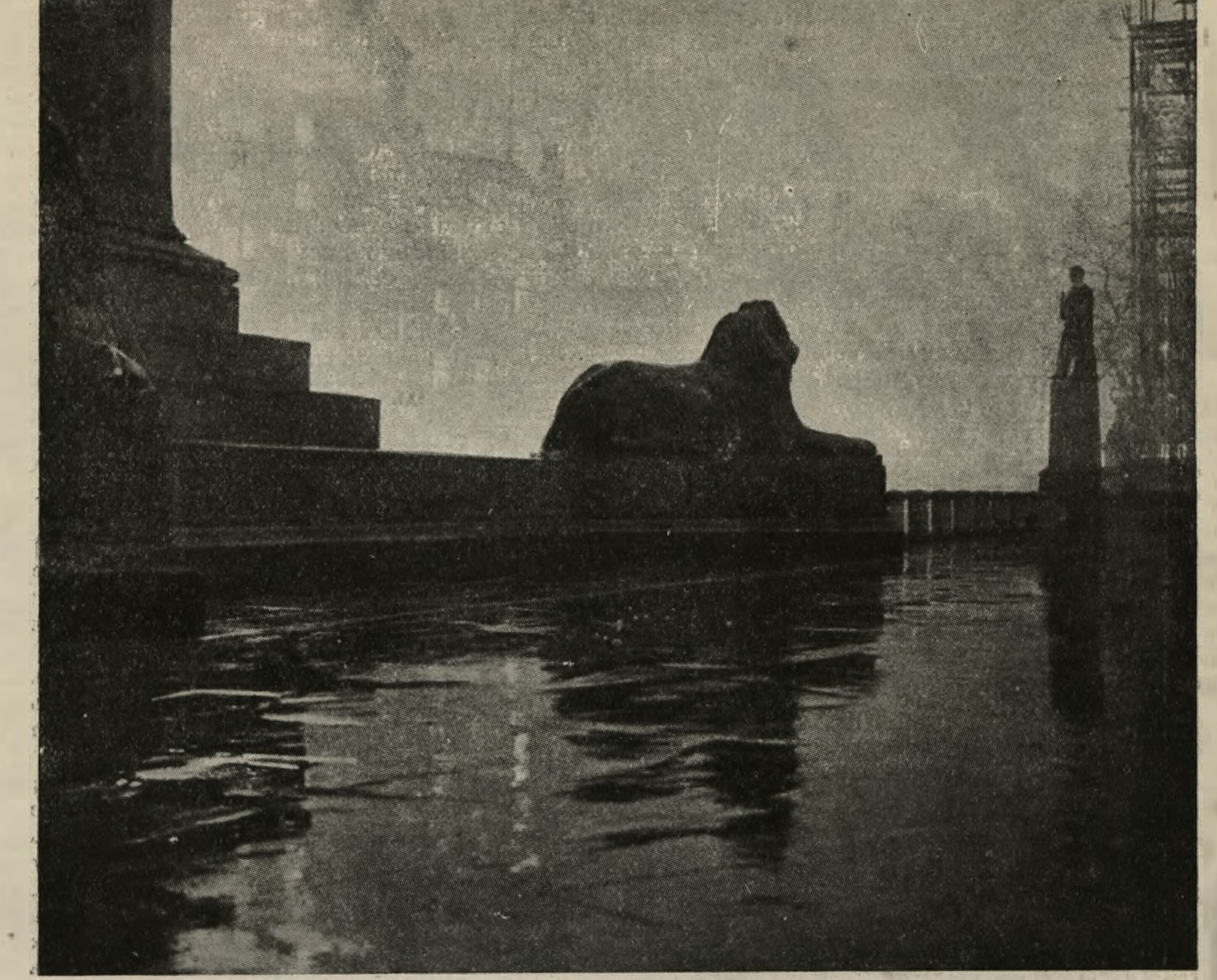
The Russian Photographic Society, uniting persons working in the field of artistic and scientific-technical photography, undertook in the autumn of 1924 steps toward developing its work in close contact with the State Academy of Artistic Sciences, for the aim of a wider, planned realization of the Society's tasks in the study of artistic light-writing, of the theory of photographic processes, and of the application in art and science of photographic methods of documentation and research.
In October 1924 the RFO took part in the photographic exhibition in Leningrad, deployed on a wide scale with the assistance of governmental and public institutions. To the exhibition was directed almost fully the artistic department of the spring exhibition of the RFO in Moscow. The works of the Society's members received a very flattering appraisal. During 1924–26 the RFO took part in international photographic exhibitions in London, Paris, Turin, Los Angeles, New Westminster and Liverpool, where the works of the Society's members, judging by the reviews of the foreign press, enjoyed success.
At the International Exhibition of Decorative Art in 1925 in Paris, in the Department of the USSR, works of RFO members were exhibited; for them the jury of the exhibition awarded fifteen awards. The exceptional success of Soviet artistic photography abroad was brightly revealed also at the photographic competition in Paris in 1926, where a number of members of the Society received awards — with this, the single gold medal assigned by the competition for works on bromide papers was awarded to the RFO member A. P. Shterenberg. If one takes into account that from the whole world 1326 works were sent, then the assignment of the highest award to a representative of Soviet photography very demonstratively testifies to the high level on which photography stands in the USSR.
The expedition to the Crimea of RFO members in the autumn of 1924 had as its task to reflect in artistic photography the nature and daily life of the Crimea. The gathered material made up the special artistic-photographic department of the Crimean exhibition, arranged in the premises of GAKhN in May 1925 by the Russian Society for the Study of the Crimea, with the closest assistance of the RFO.
In connection with the investigation of problems of artistic photography, at the sessions of the Section of Artistic Photography of the RFO were heard and discussed the reports: A. A. Sidorov, “The fixation of movement in artistic photography”; V. V. Nikitina-Gorsky, “The expressiveness of gesture in a photographic image”; A. A. Sidorov, “Surface and form in the photography of the body”; Yu. P. Eremin and P. V. Klepikov, “The Crimea in artistic photography”; A. I. Larionov, “The tasks of photography in the depiction of the art of movement”; A. I. Larionov, “The differential study of movement by the methods of cine-photo”; I. M. Nappelbaum, “On the question of composition in photography”; Yu. P. Eremin, “The Russian estate in photography”; A. A. Sidorov, “Portraits of A. V. Lunacharsky in artistic photography”; G. M. Bogolyubov, “S. A. Lobovikov as a depicter of peasant daily life”; P. V. Klepikov, “Bromide papers in artistic photography.”
The Section of Scientific and Technical Photography of the RFO, working out questions connected with the theory of photographic processes and with the technical and scientific applications of photography, heard and discussed at its sessions the reports: V. I. Nazarov, “The action of potassium bichromate on gelatin in an acid medium”; B. V. Nedzvetsky, “The sensitometry system of Hurter and Driffield”; K. V. Chibisov, “On the question of the law of blackening of the photographic plate”; Z. Z. Vinogradova, “On the question of the technique of changing the character of the negative”; K. V. Chibisov, “A survey of the theory of the latent image”; P. N. Zimin, “The theory of the movable ruler for exact focusing and the determination of the limits of a sharp image”; B. V. Nedzvetsky, “The diffraction spectrosensitometer,” and his “The sensitometry of ortho- and panchromatic plates,” and his “On the newest works at the Scientific Eastman Photographic Institute”; K. V. Chibisov, “The theory of light-filters”; D. N. Tarasenkov, “The physical interpretation of air haze and the principle of struggling with it”; K. A. Kolosov, “The Eastman sensitometer with continuous lighting”; K. V. Chibisov, “The physico-chemical substantiation of the sensitometry system of Hurter and Driffield”; B. V. Nedzvetsky, “The negative process in photo-theodolite shooting”; B. P. Podluzsky, “The century of photography”; B. V. Nedzvetsky, “The measurement of the graininess of the negative”; K. A. Kolosov, “The sensitometry of X-ray plates”; P. N. Zimin, “Distortion in photographing”; K. V. Chibisov, “On the photo-chemical nature of the grains of photographic emulsion”; K. V. Chibisov and V. S. Cheltsov, “Plates with a filter in the layer.”
The work of the Sections of Artistic and of Scientific-Technical photography, touching chiefly special and sometimes rather narrow fields, did not always stop in due measure on questions of a wider character. For the concentration of due attention on these sides of photography too, the Society found it necessary to organize a special Section of General Photography. At its sessions were heard the reports: Z. Z. Vinogradova, “The making of a duplicate of the negative as a method of changing its character”; P. V. Klepikov, “News of the foreign photo-industry”; I. N. Yaroslavtsev, “The di-iodide-mercury intensifier and its properties”; I. N. Yaroslavtsev, “Photo-plates of Soviet production and the choice of negative material”; E. O. Piotrkovsky, “Along the Military-Sukhum road”; M. P. Milovidov, “Along the Caucasian shore of the Black Sea”; P. V. Klepikov, “Bromide papers and their processing”; B. N. Genzelovich, “Photo-work on the ethnography of the Karachaevo-Cherkess region”; B. P. Podluzsky, “On the question of the application of photography in local history”; P. N. Zimin, “The destroyers of fixer”; B. P. Podluzsky, “Photography at the 1st reporting exhibition of Glavnauka of the RSFSR.”
In the aim of giving greater planned-ness to that side of the Society's activity which relates to the possibly wide distribution of knowledge about photography, the Society singled out this field into the charge of a special Cultural-Educational Section, which heard at its sessions the reports: P. V. Klepikov, “Photographic work in a journey through the Crimea, its peculiarities, and the equipment needed for it”; N. P. Ivanov, “The aims and plan of the excursion activity of the Cultural-Educational Section of the RFO.”
In view of the fulfilled 30th anniversary of the existence of the Russian Photographic Society, by the Society's members Ya. Ya. Zvyaginsky and A. M. Donde the detailed working-out of the thirty-year history of the Society and of its publishing activity was finished, as part of the work planned further for the study of the history of photography in Russia. In connection with the jubilee, a jubilee exhibition of artistic photography was arranged in the premises of GAKhN. At the beginning of 1926, in the premises of the Central House of Workers of Arts, with the assistance and participation of the RFO, an exhibition of artistic photography was also arranged. In the Lenin days, on 24 January 1925, the RFO took part in the session of GAKhN dedicated to the memory of V. I. Lenin, by arranging an exhibition of photographic works connected with the life and activity of V. I. Lenin. In January 1926, in connection with the jubilee of A. V. Lunacharsky, the RFO took part in the exhibition dedicated to A. V. Lunacharsky, organized at GAKhN.
At the 1st reporting exhibition of Glavnauka of the RSFSR in 1926, the Society took part in its artistic department, exhibiting a number of works characterizing the methods of printing applied in artistic photography; in the museum department of that same exhibition, photo-works were demonstrated from among the materials prepared for the organized exhibition “The Russian Estate in Photography.” Together with the Choreological Laboratory of GAKhN, the Society organized in 1925 and 1926 two exhibitions on the art of movement, and prepared a 3rd, to be in 1927.
— B. Podluzsky