
Talk Two of A. Donde’s “systematic exposition of the fundamentals of photography for beginners” (Talk One, on the lens, appeared in No. 1): a survey of camera types, their parts, and how to choose one.
The apparatus must be chosen to suit the tasks the photographer sets himself; a well-chosen apparatus need be neither the dearest nor the best. Three parts of it decide what it can do: 1) the lens, 2) the shutter, 3) the camera. The very possibility of undertaking a given work depends on the lens (see Talk One); the possibility of using the lens’s speed depends on the shutter — one may have an extremely fast lens for a motor-race or horse-race, yet one can only use it with a suitable shutter. The camera body itself has but an indirect bearing on the quality of the shot, but an enormous bearing on the convenience, precision and speed of work. Even a primitive camera can do complex work, but at the cost of time and fuss; one can hardly imagine a correspondent working with a home-made cardboard box.
A classification of cameras
- Type I. Cameras with a long folding bellows: a) with a movable ground glass; b) with a movable lens-board; c) with both movable.
- Type II. Cameras without a base-board and with a short bellows: a) klapp-cameras; b) reflex cameras.
- Type III. Non-folding, box-shaped cameras: a) with focusing; b) without focusing.
Type Ia — long bellows, movable ground glass
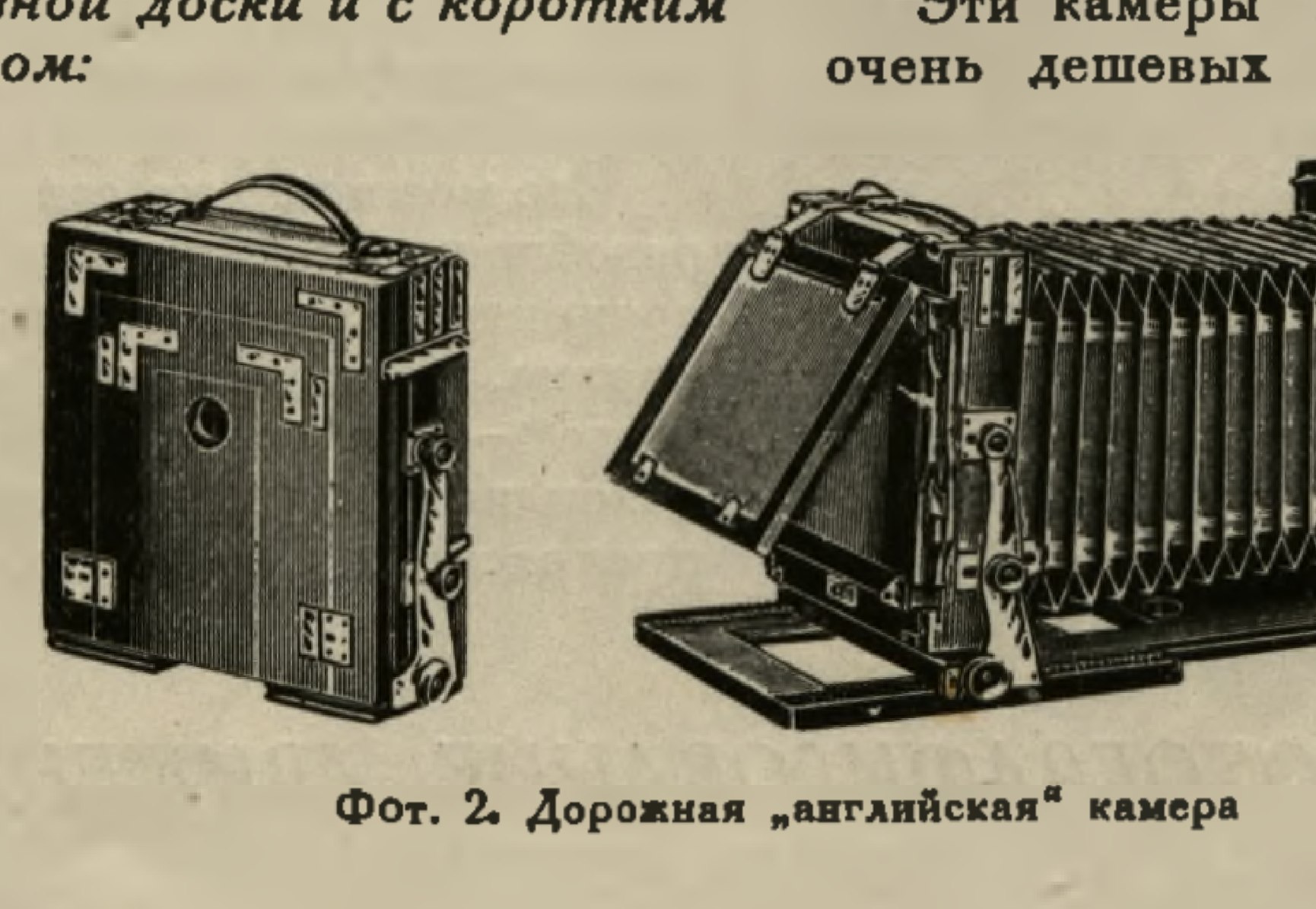
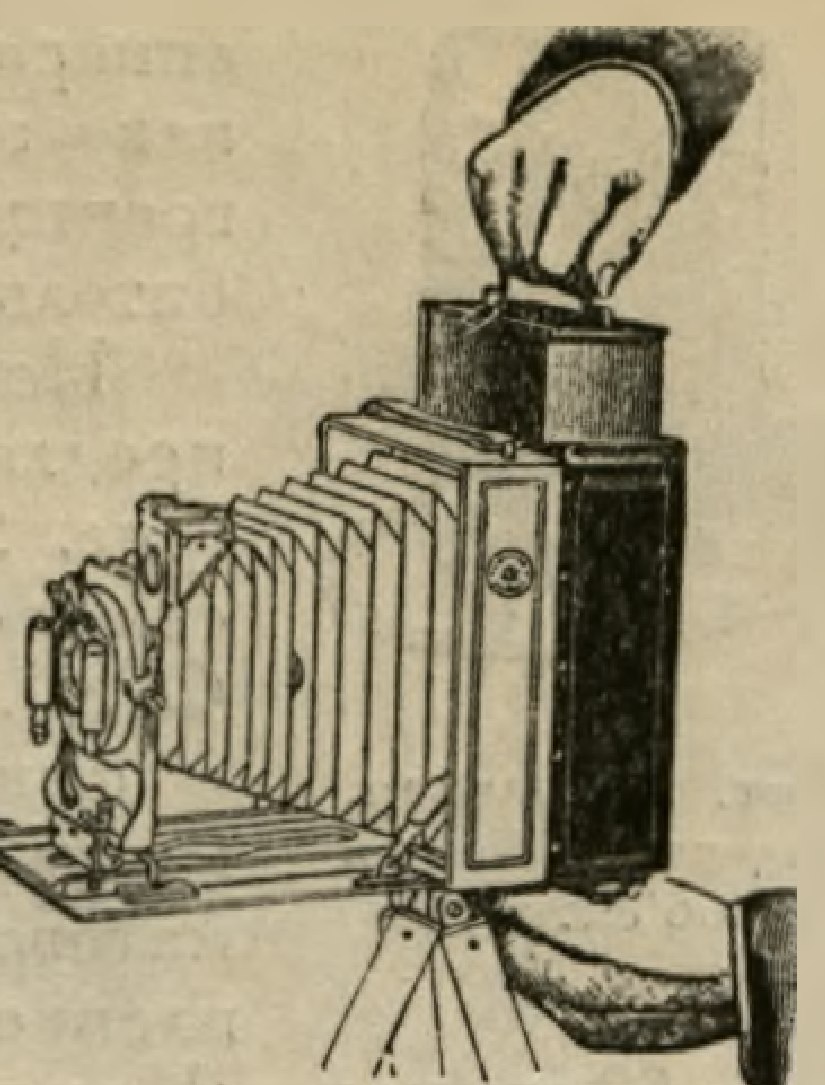
Its main parts: a front wall carrying the lens (the “lens-board”); a back wall holding the ground glass (replaced at the moment of exposure by the cassette); the two joined by an extensible folding bellows; both fixed to a base-board on which a toothed rack (cremaillere) and a geared handle let one move the back wall; the lens on a little board shiftable up, down and sideways; often the walls can be tilted to an acute angle to the base-board; and on closing, the hinged base-board folds up over the ground glass to protect it. Such a camera meets every demand of precision and convenience, its parts made in the simplest natural way without any forced attempt to lighten or shrink it. These are used for exact scientific work, for quiet home portraits and for reproductions — wherever careful, unhurried work is wanted. Good ones are built of seasoned red or walnut wood, copper-cleated at the corners, with a good leather bellows (the prismatic or “square” bellows is to be preferred over the pyramidal “conical” one); they do not dry out or warp. Because they suit travel with a scientific aim they are called, by old habit, “travelling” cameras. To this type belong Ernemann’s “Globus,” Stegemann’s cameras and Goerz’s “Insuperabilis” — though these are going out of amateur use, being mostly made as studio “pavilion” cameras of 18×24 cm and larger, whose drawbacks are that they cannot be worked hand-held, are bulky, and are slow to prepare.
Type Ib — long bellows, movable lens-board
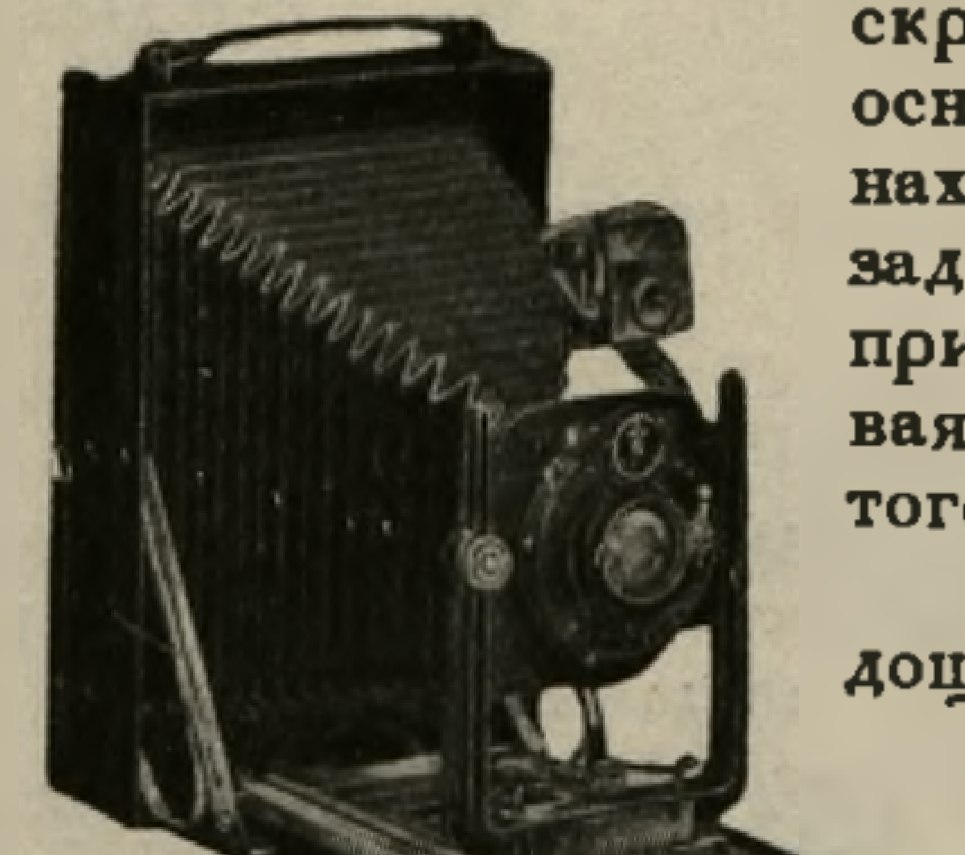
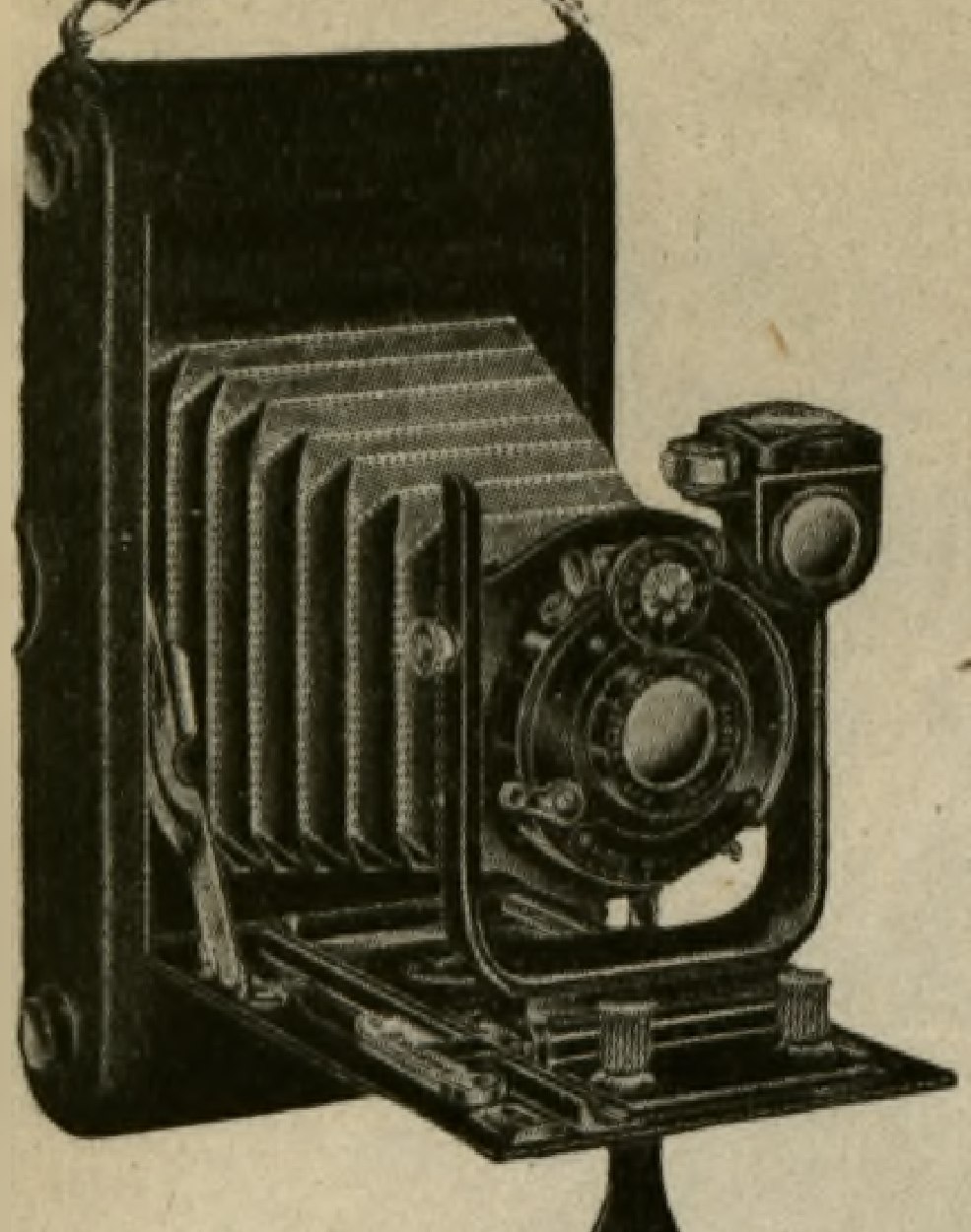
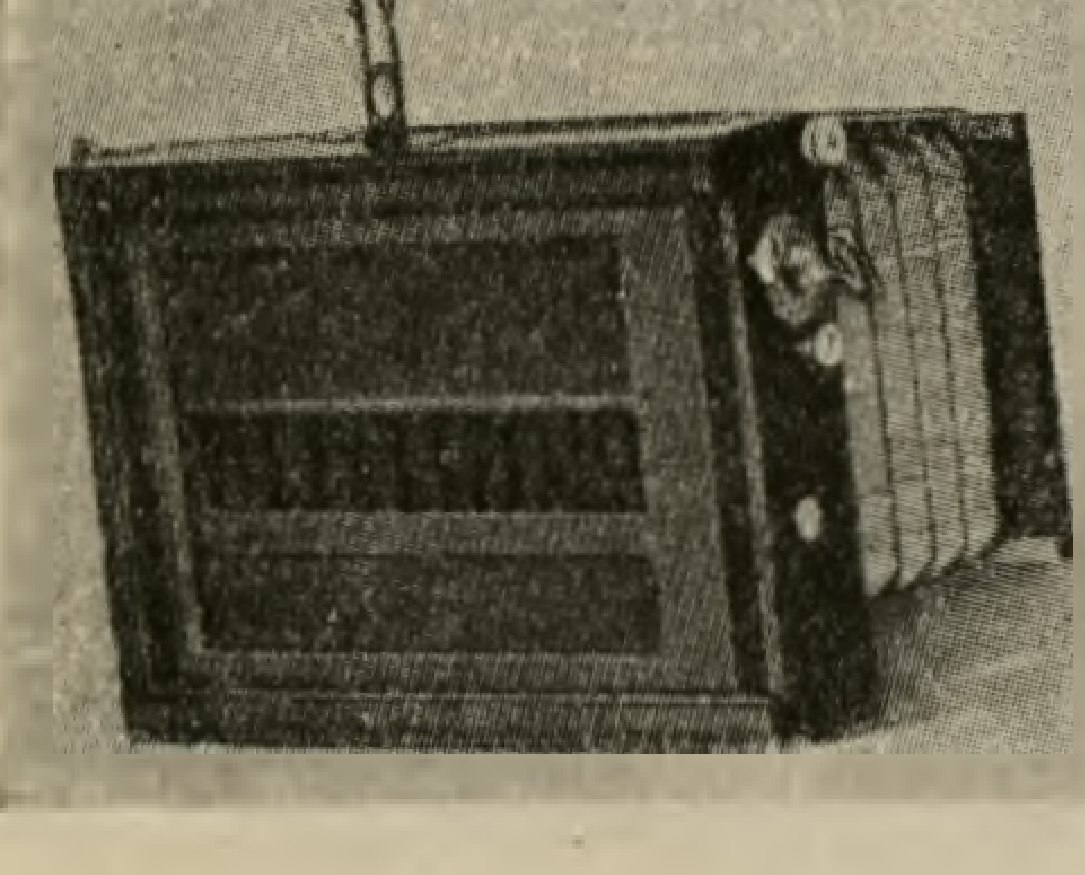
Here the moving part is the front, and on folding the base-board closes the lens, not the ground glass. They have a conical bellows; the lens-board is usually replaced by metal forks, the lens moving in any direction while the lens-standard and ground glass stay perpendicular to the base-board. The sprung base-board drops and the front is pulled out, usually setting automatically to a fixed focus (Kodak, Ernemann, Ica), further movement by cremaillere; often built wholly of metal, they focus by scale and finder without the ground glass. The bellows draw is usually “double” the focal length — enough for natural-size reproduction, though for that work type Ia (with triple draw) is handier. Unlike Ia cameras, which disassemble into the case, Ib cameras stay assembled and open ready to shoot. The 13×18 cm size is shaky and transitional; the smaller sizes (9×12, 8×10½, 6½×9, 6×9, 4½×6, 4×6½ cm, and 45×107 mm) are fully fit for hand work, and the great majority of modern cameras are built to this type. It has two varieties — for plates and for roll-film; a roll-film back cannot be removed (it holds the spool), but most film cameras now take a plate adapter, so a film camera can be made into a plate one, though not the reverse. Prototypes were the Eastman (Kodak) film cameras, and Kodak still leads here: reliable, simple, with only the necessary parts, made for tourists. Their chief rivals are the English (Adams, Butcher) and above all the German firms (Ica, Ernemann), whose cameras pile on details that look useful “on paper” — superbly made and no dearer than the English, but more complicated than need be. Examples: for film, American Kodaks (lately “autographic,” letting one write notes on the film); English Adams Vesta; German Ernemann Bob (film) and Nea (plate), Ica–Palmos (plate), Contessa-Nettel Cocarette and Picolette (film).
Type Iv — long bellows, both ground glass and lens-board movable
For the amateur these hold no more interest than type Ia. Made chiefly in England (Thornton–Pickard “Imperial”; the now-rare Acme and McKellen); to this type belong 18×24 cm pavilion cameras and large reproduction cameras.
Type IIa — no base-board, short bellows (klapp-cameras)
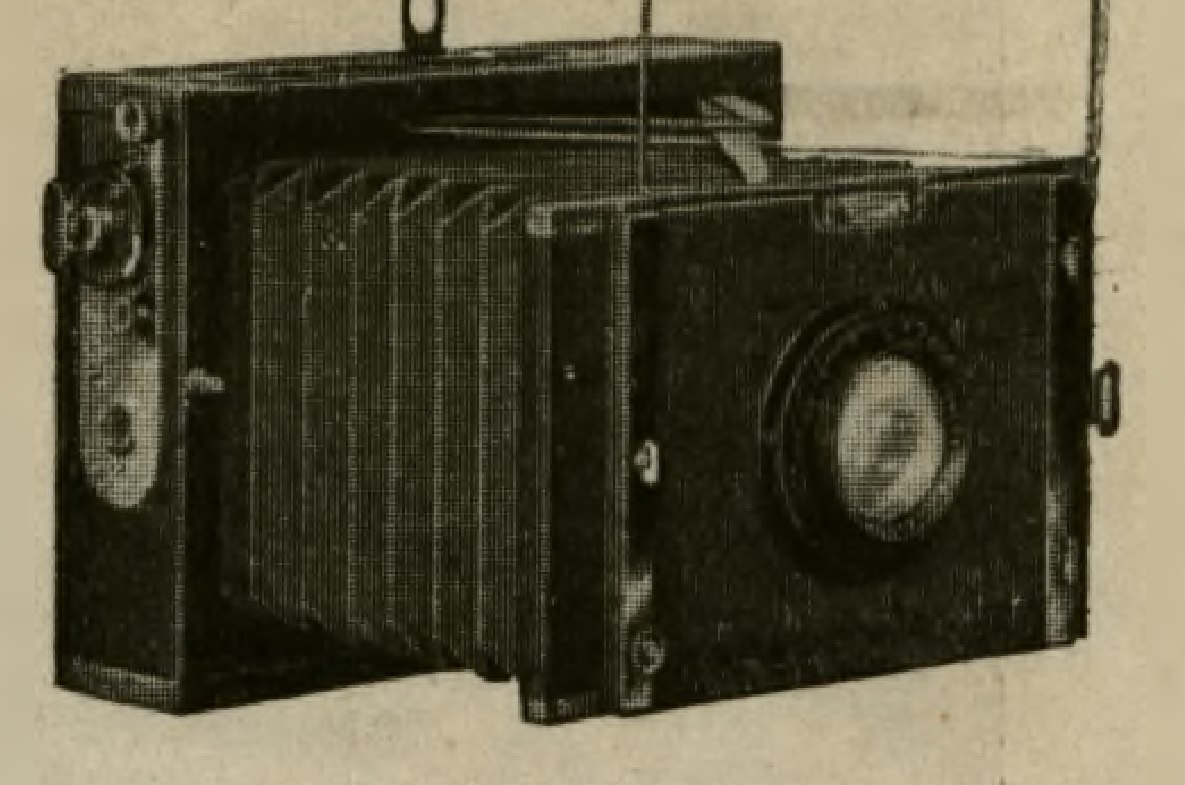
The wish to have a camera ready without preparation led to box cameras without focusing — but these are too bulky between shots. Midway stand the klapp-cameras, usually a short-bellows camera without base-board: at shooting the lens is pulled out and set automatically to a fixed focus by struts, close focusing by a worm in the lens. Quick to ready, they suit hand-held street and sport scenes (the latter needing a blind shutter). Very widespread now are miniatures of this type — Ica Bebe (4½×6 cm), Goerz Tenax, Gaumont Bloc-Notes, the folding Ica Poliskop; for film the Vest-Pocket Kodak (4×6½ cm) and the tiny Ensignette (37×58 mm). On buying a miniature (no larger than 6×9 cm) look for: a rising lens, adjustable shutter speeds, a cable or metal release, and a tripod nut; focusing may even be absent, being easily replaced by supplementary lenses.
Type IIb — reflex cameras
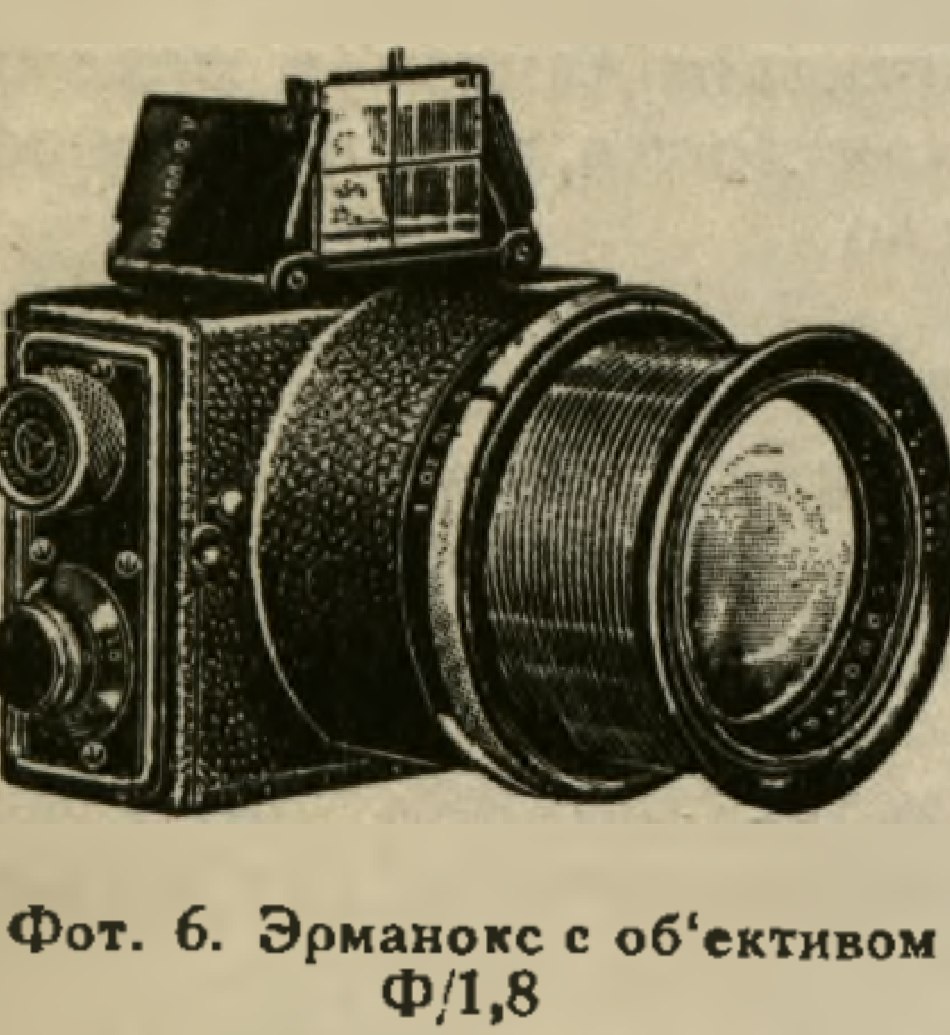
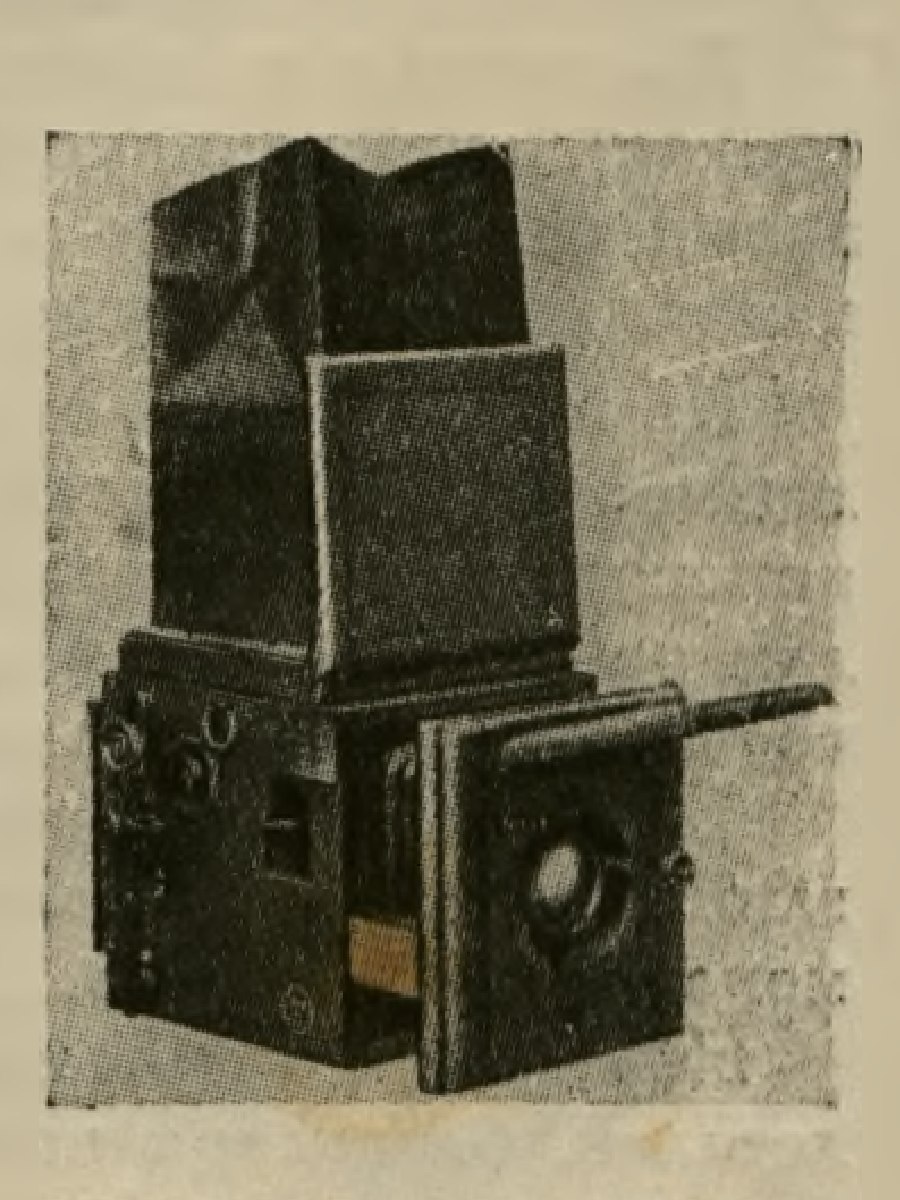
Reflexes (“reflex-cameras”) are a further development of the klapp: the ground glass lies on the top wall, and a mirror throws the image up onto it, so the picture can be watched right up to the instant of exposure — their great advantage. Mostly fitted with a blind shutter, they are ideal for sport, portraits and correspondents’ work; their drawbacks are bulk, and the chest- or belly-level viewing that exaggerates the foreground into an unnatural “frog’s” perspective. Lately given very fast lenses (F/1.8, F/2). They are dear but necessary for serious work and ever more common — English Thornton–Pickard and Adams (6½×9, 9×12 cm), Kodak Graflex (8×10½ cm, blind shutter from 0.1 to 0.001 sec.), German Ernemann folding reflexes, Voigtländer’s Stereoreflektoskope (45×107 mm) and the Mentor of Goltz & Breitmann (6½×9 to 12×16½ cm).
Type III — cameras without bellows
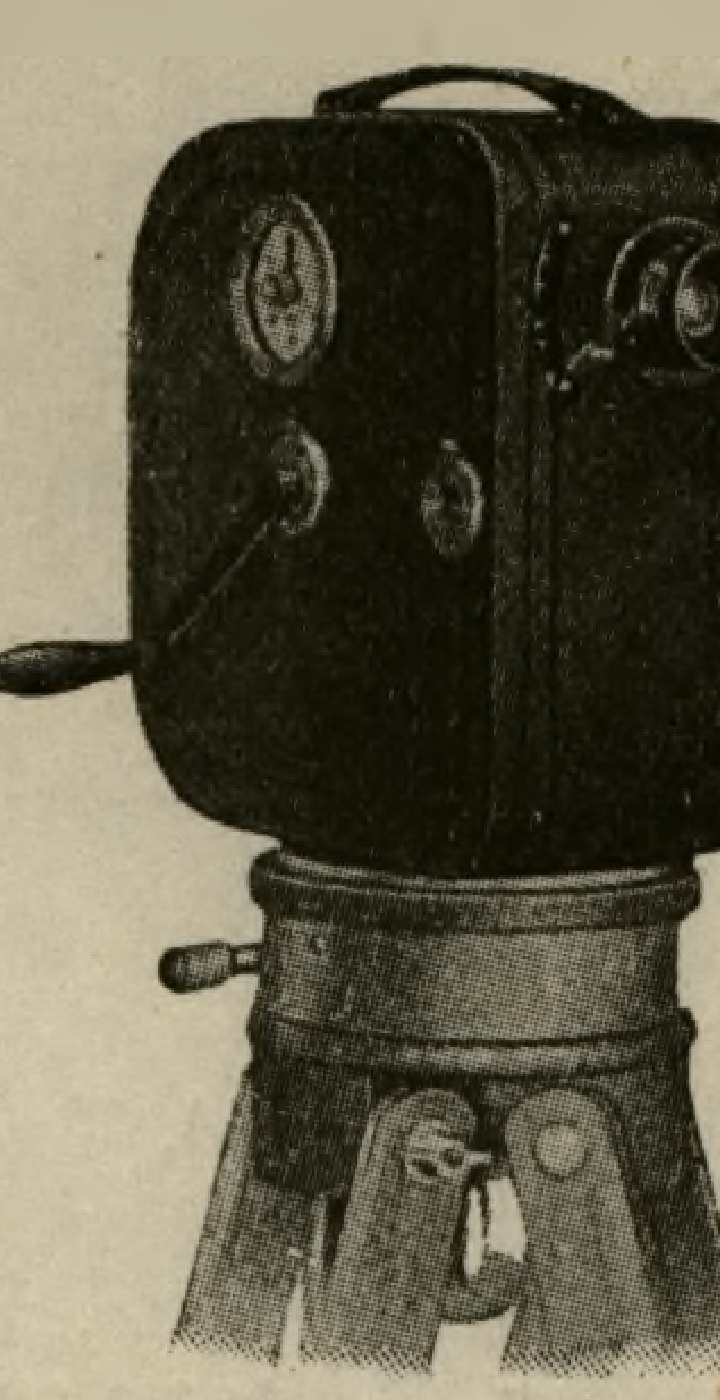
Once made up to 13×18 cm (“Archimedes”) as clumsy boxes loaded with a whole dozen plates, this type evolved into elegant little cameras with fast anastigmats: Richard’s Verascope, Ica Poliscop, Voigtländer’s stereoscope (all 45×107 mm) and Richard’s Homéos (19×24 mm singles). The outstanding “rigid” member is Ernemann’s Ermanox (built for the 4½×6 cm plate) with its Ernostar F/1.8, whose speed lets one shoot by ordinary electric bulbs or under ordinary stage lighting; lens over 4 cm across, 10 cm focal length, 10 cm total draw, worm focusing, blind shutter — but it is still very dear (about 260 rubles). Here too belong cheap box cameras (Brownie Kodaks, Ensignette-box) sold “for beginners and children” — capable of excellent results in experienced hands, though hard for the true novice; and the cine-apparatuses shooting series on long film (up to 32, averaging 16, frames a second). Of amateur cine-cameras: Ernemann’s compact Kinett (Ernostar F/2.0 or Evrinar F/3.5, 35 mm, 52 frames per metre, with a matching projector; a full amateur set 250–500 rub.) and Ica’s Kinamo, with two speeds — ordinary and, for scientific work, eight times slower (Ica-Dominar or Zeiss-Tessar F/3.5, or F/4.5, 40 mm).
Details of cameras: cassettes
Cassettes are made 1) for one plate, 2) for two plates, 3) magazine for a dozen, 4) for roll-film, 5) for a flat-film packet. Single-plate cassettes (type Ib, and in small IIa/III cameras, flat tin or aluminium ones) are compact and handy for hand cameras. Double, wooden cassettes serve plates 9×12 cm and up in tripod “English,” pavilion and “universal” cameras; they are folding (album) or not, with a little blind or an ebonite cover — album ones load more easily, and the prejudice that ebonite covers crack is not borne out by our own 25 years’ use without repair. Magazine cassettes for 12 (rarely 6) plates are too big and heavy above 9×12 cm, and best at 4½×6, 6×9 cm or 45×107 mm: an inner box pulls out carrying all but the top plate, which drops into the outer box and, on pushing in, falls below the clean plates (fig. 8 shows the magazine fitted to the camera). A roll-film cassette usually forms the film camera’s back wall (fig. 12): the loaded spool goes in one end and the free spool in the other; one nicks the backing paper, threads it to the free spool, closes the lid and winds on, watching No. 1 appear in the red window, then No. 2, and so on; after the last of the six or twelve shots one winds off the paper and removes the closed spool. A ratchet spring keeps the film taut, and in Richard’s cassette the film is pressed flat against mirror-glass. A flat-film cassette is just a box for a “film-pack”: a dozen films with black-paper tabs, the first ready at the window; after a shot its tab is pulled up, drawing the film back over a roller and bringing up the next. The first film is covered front and back, so loading and unloading need no darkroom. Kodak (American) and Agfa (German) packs are superbly made.
Shutters
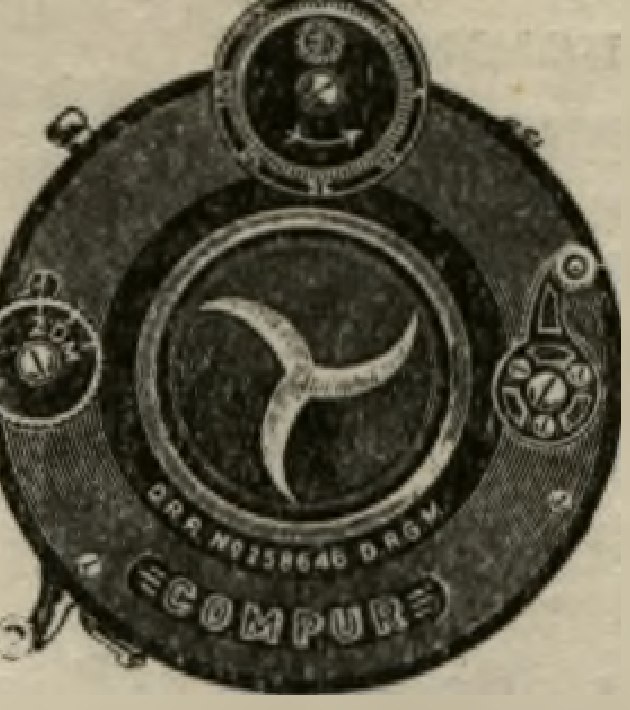
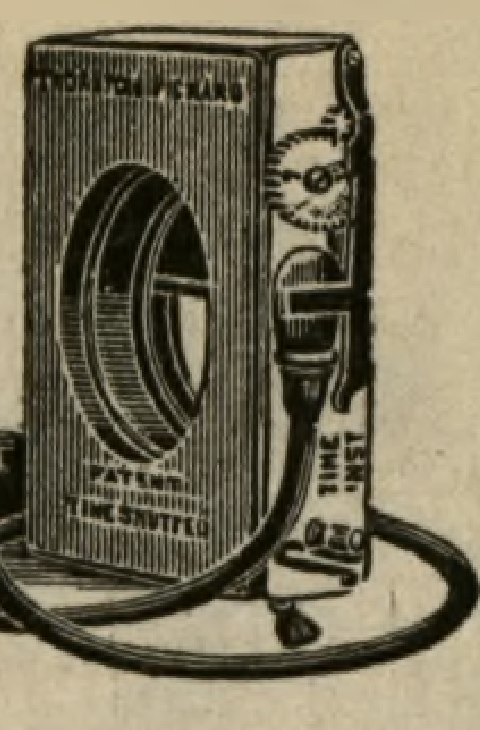
Three main systems: 1) shutters fitting onto, or just behind, the lens, with a moving cloth blind or metal flap (fig. 11); 2) diaphragm (between-the-lens) shutters, where a spring drives scissor-like half-moon flaps, a falling plate, or iris-like plates (fig. 9); 3) blind (focal-plane) shutters, exposing the plate through a slit moving just before it, with both slit-speed and slit-width adjustable (fig. 10). The first kind serves types Ia and Iv — most commonly the Thornton–Pickard with a linen blind, working well both instantly and for time exposures. The second serves all other cameras, the best known being the Bausch & Lomb shutters and lately the Compur, which allows a very wide range — from 1 to 1/300 second — opening and closing quickly and running precisely off a clock mechanism.
In judging a shutter one must reckon that much of its working time goes on opening and closing. If it acts 0.1 sec., about 0.02 sec. goes to opening, 0.02 sec. to closing, and only 0.06 sec. the lens is fully open — so the shutter, as it were, lessens the lens’s speed. The best shutter wastes least on opening and closing (Compur): at a 0.100 sec. action the full aperture works about 0.075 sec., and the ratio 0.075 / 0.100 = 0.75 is called the shutter’s characteristic number, or coefficient of useful action. The blind shutter lacks this fault — whatever the slit, it lights the plate at full aperture throughout — but it has another: since the slit crosses the plate top to bottom, a fast-moving vertical line is recorded slanted, and an object flying toward the plate comes out with its nearer part (e.g. the head) disproportionately large. The marked speeds (1/25, 1/100, 1/150 sec.) may be doubted, since springs weaken and friction changes with time; textbook checking methods are omitted here, for an inexperienced tester will err more than the shutter does — and happily these small differences scarcely matter when so much is judged by eye anyway.
The finder, the tripod, choosing and testing
In a hand camera the finder (vizier) shows the bounds of what the plate will take. The common corner-mounted little-camera finder (figs. 1, 3) does its job poorly; better is a biconcave glass with a diopter (figs. 5, 6), or — simplest and no worse — a wire frame the size of the plate, viewed from the focal distance (fig. 4). The tripod’s size and weight follow the camera’s: aluminium or copper legs of thin tubing for 4½×6 and 6×9 cm, oak for heavier cameras — lightness and stability being almost incompatible. Tilting heads are very convenient. The tripod screw has either a “German” or an “English” thread; the German is standard, the English (on Kodaks) will not fit ordinary tripods. Remarkable for simplicity is Richard’s device: his Verascopes have no threaded nut but a conical hole taking the conical pin of a ball-head — firm, quick to detach for changing plates, and improving with use as the pin laps itself in.
Our advice on choosing is simple. The amateur who cannot spend much should get a type Ib, 6×9 to 9×12 cm, with an aplanat — good for portraits, genres and landscapes. For tourists a type Ia or IIa of 4½×6 to 9×12 cm, no larger: small sizes ease and cheapen travel, and today’s optics enlarge 4–5 times easily, so a 6×9 cm shot yields even a 30×40 cm print. For scientific work — microphotography, nature, minerals, engineering — take advice from specialist comrades and the literature. All types but Ia are factory-made so accurately that a novice need hardly test them; handicraft-made type Ia cameras, however, may show two chief faults: 1) light leaks, shown as partial fog or as a second, pin-hole image on the plate — found by spreading the camera, closing the shutter, removing the ground-glass back and studying the bellows under a black cloth until the prick shows clearly; 2) an image sharp on the ground glass coming out unsharp — if the lens is achromatic, this means the plate does not sit where the ground glass was, a defect usually only a master can correct.
— A. Donde
(Talks Three and Four — “The Negative Material” and “Setting the Apparatus at Shooting, and Exposure” — in the next No. 3 of Sovetskoe Foto.)