
A merger
The largest German firms making photo- and cine-apparatus — Contessa-Nettel, Ernemann, Goerz and Ica — have united into a single joint-stock company, “Zeiss-Ikon,” in Dresden (Zeiss-Ikon A.-G., Dresden).
A simple device for timing the exposure in enlarging and contact printing
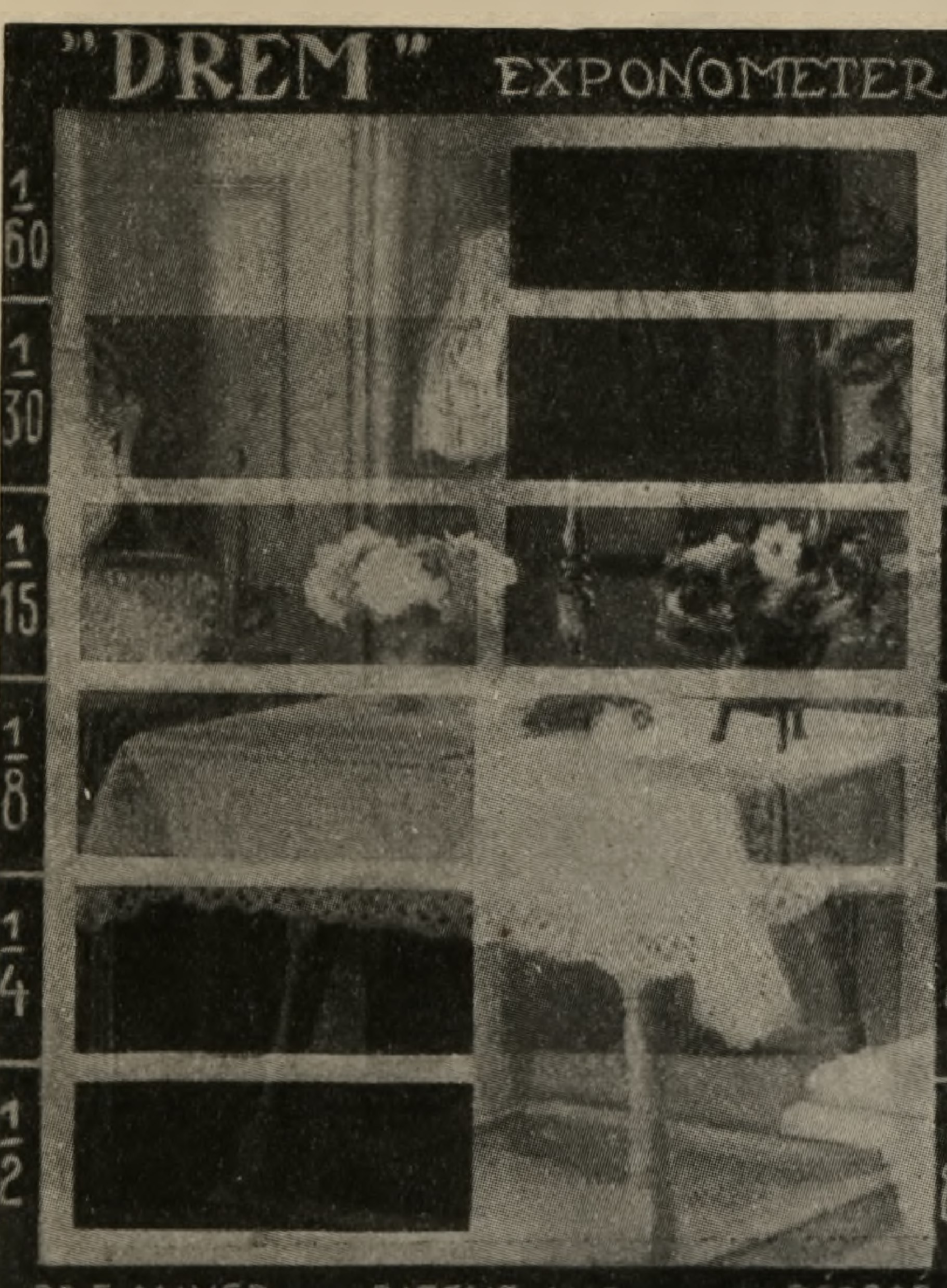
To fix the right exposure for development papers is hard even for experienced workers, who may be at a loss with an unfamiliar grade of paper, an abnormal negative, or a strange light source. The device built by Dr. Emil Mayer (Vienna), the “Dremmeter,” removes the doubt almost automatically and settles the printing time exactly. It is a diapositive on film or glass divided into 12 fields of graded density, from light to the darkest tone, each passing more or less light. Laid on the negative for contact printing, or on the paper for enlarging, it receives an exposure of any length taken at random — deliberately exaggerated up to 80 times the normal. Suppose we expose 60 seconds: after developing the test, some fields are over-printed, some under-printed, and one comes out perfectly normal, having had the right amount of light. The figure beside that field (here, say, 1/12 — see the illustration) shows how many times less to expose for a normal image — in our case 1/12 of 60 seconds, i.e. 5 seconds. The Dremmeter works faultlessly, sparing failures, vexation and wasted paper, and costs in Austria about 1 ruble.
Distance meters (telemeters)
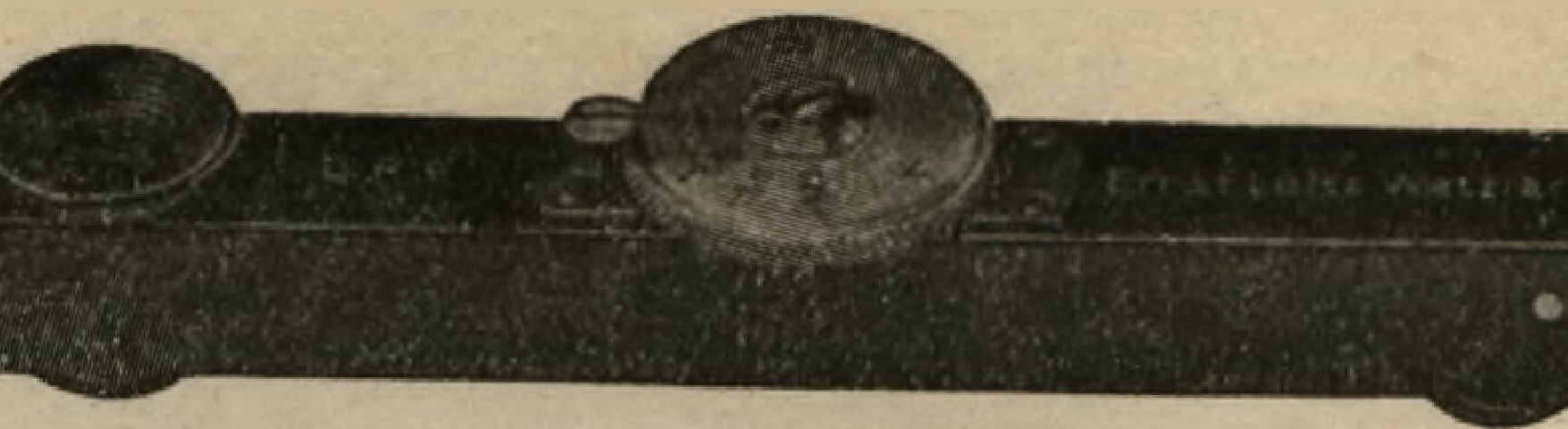
German firms (Goerz, Leitz and others) have brought out convenient, practical rangefinders to help the photographer focus by the scale, “by the metre-mark.” The rangefinder is a metal tube 10 cm long and about 1½ cm across; looking at the subject through it, one sees the object split into two halves, and turns a graduated disc until the two images merge exactly — whereupon the figure on the disc gives the distance directly. In practice the needed sharpness is easily got at distances of not less than 2½ metres, quite enough for work out of doors. The telemeter clips easily on and off the camera and costs about 15 rubles.
— V. M.