
The opening editorial — a sharp demand that the trading organs stock a cheap amateur camera, and that Soviet industry begin making one.
There are no new photographic apparatuses in the shops. Now and then old, battered cameras, imported back in pre-war days, are resold. Last year Sovkino and Goskintorg held a licence to import photo-apparatus from abroad — and what did they bring in? Goskintorg’s shops had film cameras in plenty, but there was no film: film is not made in the USSR, and importing cameras knowingly doomed to idleness was nonsense — the more so as film costs twice what plates do here, and even when it can be had, film cameras are unprofitable to run and inconvient besides. For a whole year the windows of Sovkino’s capital and provincial shops flaunted chic reflex cameras at 520 rubles and “Ermanoxes” nobody wanted at 330 r. — but of affordable amateur cameras there were none.
To our inquiries the buyers replied that the film cameras had been taken as a “forced assortment.” We have grounds to call that excuse unserious. In Germany one can buy, with no forced assortment and on acceptable credit, exactly what is wanted — and if Sovkino cannot manage it, we undertake to help; if need be, Sovetskoe Foto will help importers buy, on favourable terms, the apparatus Soviet photographers really need.
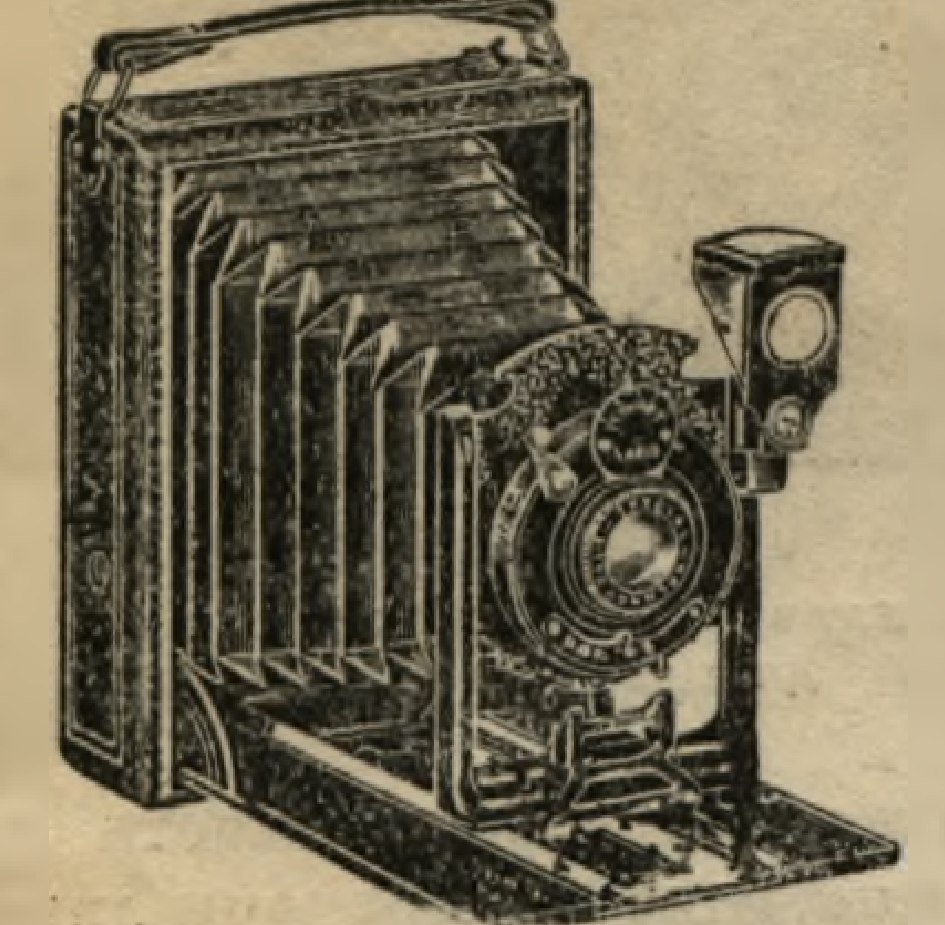
Germany offers extremely cheap cameras. Not to seem unfounded, we point to the folding cameras of the solid firm W. Kengott of Stuttgart: a handy amateur camera (see the figure) of 9×12 cm, with an aplanat F/8 in an automatic shutter giving 1/25, 1/50 and 1/100 second, can be bought — with a cassette and a metal release — for 7 (seven!) rubles apiece. Voigtländer’s folding “Vag,” with an F/6.3 anastigmat, costs 20 rubles; these are quite enough for the beginner and the photo-circle. A really good camera, Voigtländer’s “Avus” 9×12 cm with an F/4.5 anastigmat in a Compur shutter, double draw, fit for every kind of work, comes with 3 cassettes and a release for 38 rubles — enough to satisfy even the experienced amateur. Many firms carry such cameras; evidently Sovkino knows little of all this.
Whatever its mark-up, Sovkino could have sold a seven-ruble camera with 4 cassettes for, say, 15 rubles — a price the buyer would accept. Instead of one reflex it could have supplied 35 photo-circles or 35 individual amateurs; and commercially, saleable cheap apparatus is the more profitable, turning capital over far faster. (As for mark-ups: Sovkino sells cameras at 100% over its German buying price — perhaps even justified; we shall take that up another time. But even so, amateur photography could be supplied at a reasonable price.) These absurd purchases must stop: within their cut-down means the importing organs must be especially careful and not squander their small quotas — for some 40 thousand rubles the apparatus-needs of 5,000 circles and amateurs could be met.
That is one side. The other, still more important, is setting up our own production of cameras. The Photo-Cine-Trest must take this up energetically and put out a cheap one — within 10 rubles, even box-type (very handy for beginners; beauty need not be chased at first). A decline is already seen in the sale of its plates, and a cheap camera would kill two birds with one stone. In 1928 photo-amateurs must, by one road or another, be supplied with apparatus.