
Many readers with old, unmarked lenses are stumped by the two basic “constants” every lens needs for practical work. P. Radetsky gives simple ways to find them.
Focal length
The basic characteristic is the focal length — the distance between the main focus and a certain “nodal point” inside the lens, on its optical axis. In practice one may take it as the distance from the middle of the lens (roughly where the diaphragm sits) to the ground glass when focused on a very distant object, “on infinity” — and it must not be confused with the distance from focus to the front or back glass. Good modern lenses have it marked on the mount; where it is unknown, it is easily found, by either of two methods, using a camera with double bellows draw and the lens in front.
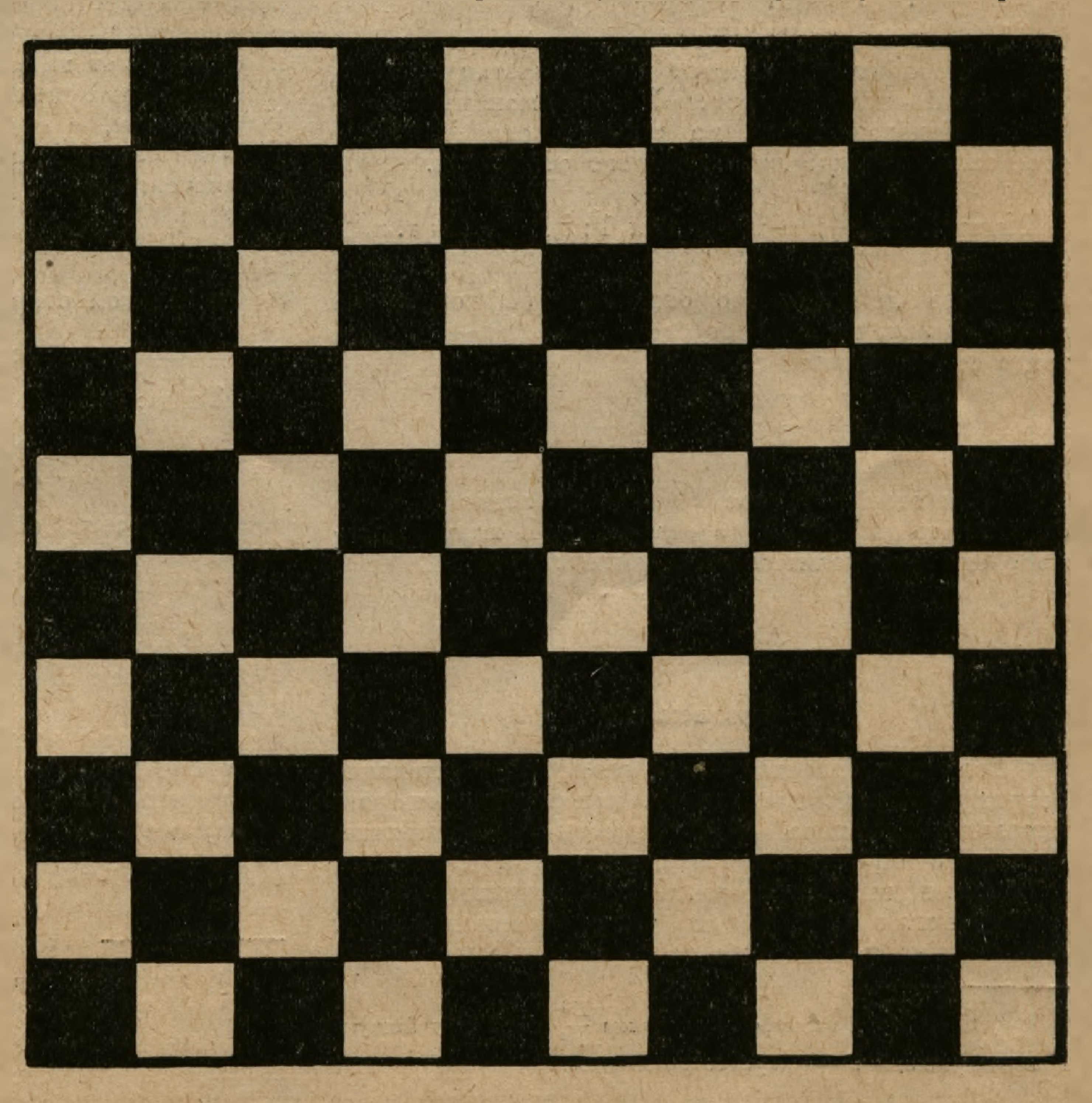
First method. Focus on a very distant object so its image is quite sharp, and mark that position of the ground glass on the camera. Then fix on the wall a scale — a square decimeter ruled into centimetres (see the chart) — set the camera near it on its tripod, and by moving both camera and ground glass get the image of the square at exactly natural size; mark this new ground-glass position, and the distance between the two marks is the focal length. Second method. Set the camera so the image of the square equals the original in size, measure with a tape the distance between original and ground glass, and the focal length is a quarter of it. Focal length is usually given in centimetres or millimetres, rounded to 5 mm (the English and Americans mostly use inches).
Active aperture
The second important characteristic is the active aperture — the pencil of parallel rays that actually passes through the lens into the camera. To find it at full diaphragm: focus the ground glass on a very distant object, then cover it with a tightly fitting piece of black cardboard or metal with a small round hole in the middle; in the dark room, under the lens cap, place against the front lens a piece of bromide paper cut to the mount’s circle, and before the hole in the cardboard burn a little magnesium ribbon. Develop the paper and measure the diameter of the blackening — that is the active aperture, again in centimetres or millimetres.
Relative aperture
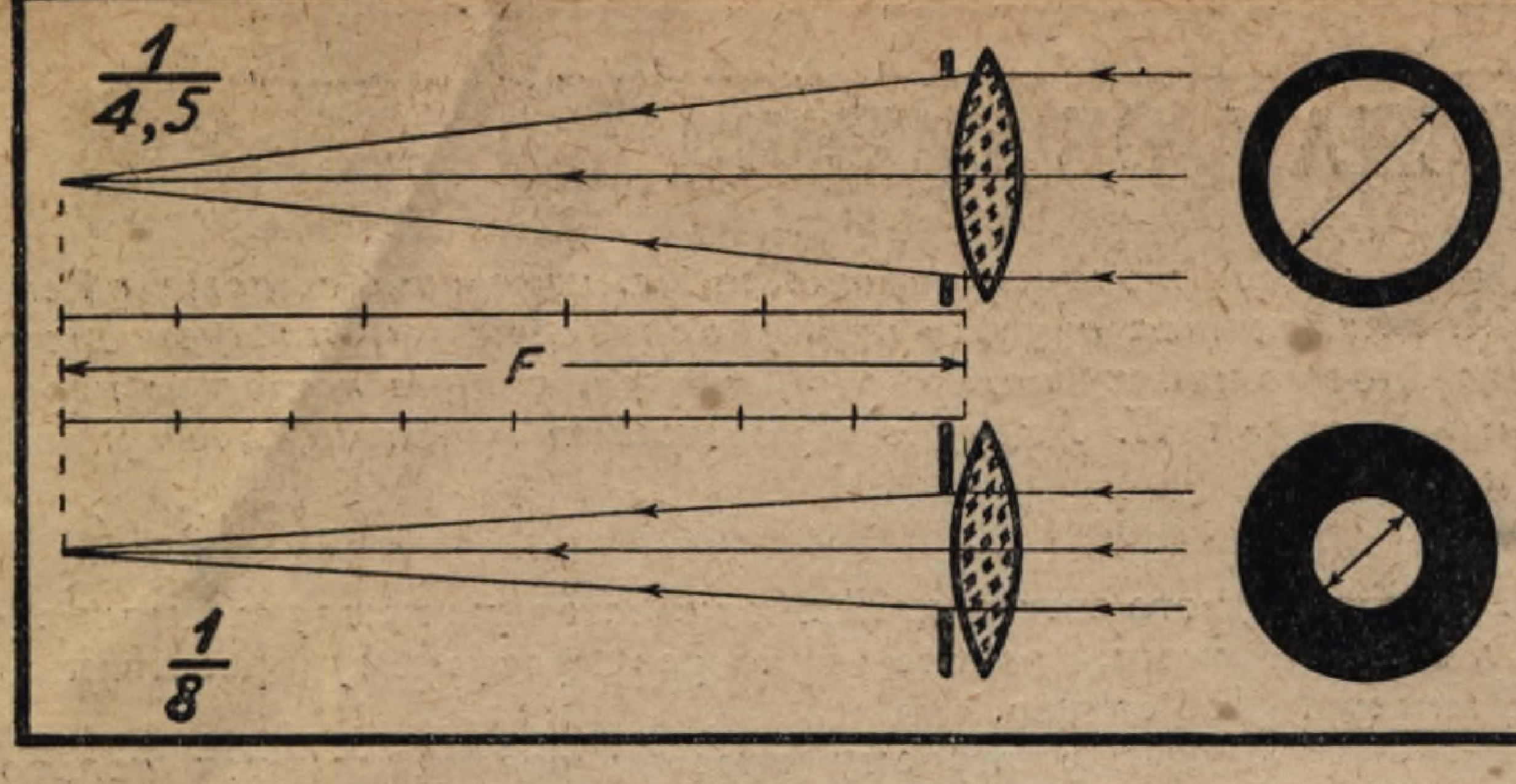
Knowing the active aperture (D) and focal length (F), one easily gets the relative aperture = D / F. It is written as a fraction with numerator 1 and a denominator showing how many times F exceeds D — for example 1/3.5, 1/5.6, 1/8 (or 1:3.5, 1:8). If D = 30 mm and F = 240 mm, then D / F = 30 / 240 = 1/8; and conversely D = F / 8.
Light-power
The relative aperture is the basic characteristic, since it fixes the comparative brightness of the image, and by it lenses can be compared by their light-power (the quantity D² / F²) — the only correct comparison. Take three lenses:
| Lens | Focal length F (mm) | Active aperture D (mm) |
|---|---|---|
| 1 | 180 | 40 |
| 2 | 270 | 60 |
| 3 | 360 | 80 |
For each the relative aperture is the same fraction, 1/4.5, so all three have the same light-power. Compare now two lenses of relative aperture 1/4.5 and 1/6.3: (6.3×6.3)/(4.5×4.5) = 39.69 / 20.25 = 2 (approx.) — so the 1/4.5 lens is almost twice as light-powerful as the 1/6.3 one. Diaphragming reduces the active, and so the relative, aperture; knowing the aperture diameter at a given stop one can compare the light-power stopped down and full (the new Zeiss system marks diaphragms by the aperture diameter). If F = 120 mm and the aperture at a given stop D = 15 mm, the relative aperture is 15 / 120 = 1/8; against a full aperture of 1/4.5, (8×8)/(4.5×4.5) = 64 / 20.25 = 3.2 — i.e. stopped down the lens is almost three times less light-powerful than wide open. Knowing the light-power matters greatly for reckoning the exposure; the photographer should know his lens’s properties and use them consciously — too little attention is usually paid to just this, whence come many vexing failures and irreparable errors.
— P. Radetsky