
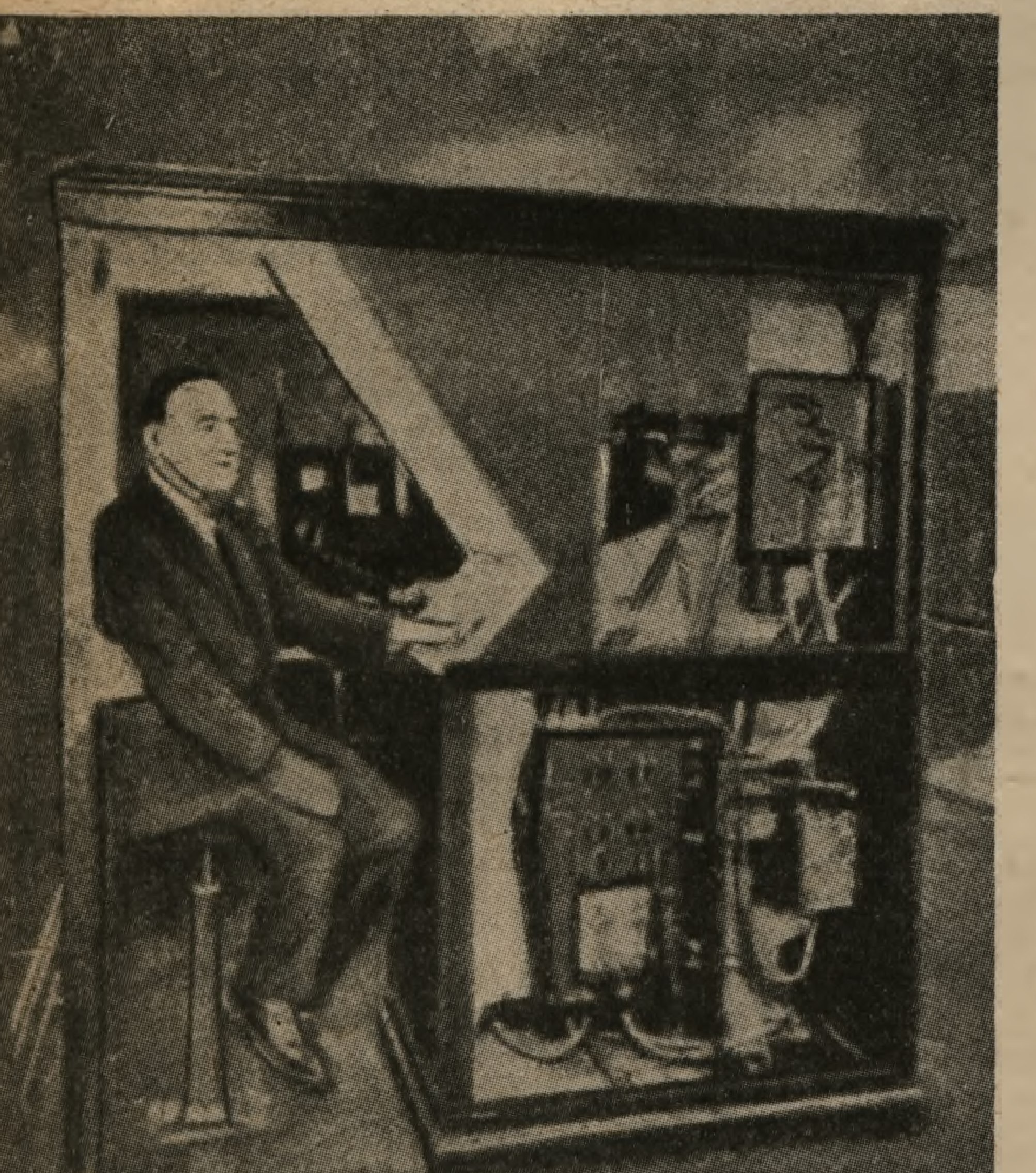
“Photographische Chronik” (No. 1, 1927) reports a sensation among professional photographers — a new American machine that dispenses finished photographs like a chocolate or cigarette vending machine, with no human hands at all. “The Edison Monthly” describes the “fotomat.”
The automaton looks like a telephone booth. The client steps inside, sees his image on a ground glass, adjusts the height of the stool, takes the pose he wants, drops in three 50-pfennig coins (70 kop.) and so sets the mechanism going. He is lit by a bright light falling through a ground glass above his head; an invisible camera comes out and makes 8 shots in 20 seconds, the sitter free to change position and expression each time. The exposed strip rolls up behind the lens, where invisible steel-and-aluminium hands carry it through four baths for development and fixing, wash it four times, cut, dry and — after 7½ minutes — drop into a little box behind the machine the strip with its 8 finished shots. Strictly it makes no negative but shoots straight onto bromide paper, the “negative” being turned to a positive by the later manipulations; the inventor says the reactions use new methods without the chemicals now usual in photography. The paper is dried by compressed air, strongly heated through special devices, which dries it in 24 seconds. The apparatus runs continuously — no need to wait for one shot to finish before starting another — and the “fotomat” can turn out 120 strips of 8 shots an hour, driven by a small 1/10-HP electromotor.
It is worth noting that the inventor is a Russian, Anatoly M. Josepho, who in early youth sold an earlier photo-machine invention to Austria for 50,000 crowns; he lost his fortune in the war and went four years ago to America to finish the “fotomat.” On 21 September 1926 a company of which he is vice-president opened a studio on Broadway in New York with five “fotomats” installed, and a large American firm has now been permitted to install them in all the crowded places of Berlin — squares, stations, department stores.
The simplicity, cheapness and huge output of the “fotomats” have badly frightened the Berlin photographers: though the machines are still on their way, the photographers’ union is already campaigning hard to keep them out, showering petitions on the Reich chancellor, the ministers of trade and industry and of the economy, the state railways and the communal authorities. The noise confirms how serious the invention is — one recalls the medieval guilds’ struggle against machines. But if capitalist Germany reacts so, then in our conditions everything argues for using this latest achievement of the human mind to serve the broad masses. It might interest our public bodies — the Children’s Commission, “Down with Illiteracy” and others — which, by installing “fotomats,” would find a not-bad source of income.
— G. K—kh