
A. Yerokhin surveys the new sub-miniature cameras — those taking tiny plates, and the new breed shooting on ordinary cine-film, among them the Leica.
D. Gorodinsky’s article in this number treats the 4.5×6 cm cameras, which are light and portable enough; but the firms did not stop there, striving for a camera that slips freely into the pocket and lets one carry much negative material there too — a real advantage in travel, where every extra pound tells; and short-focus small cameras can give shots of extraordinary sharpness and depth.
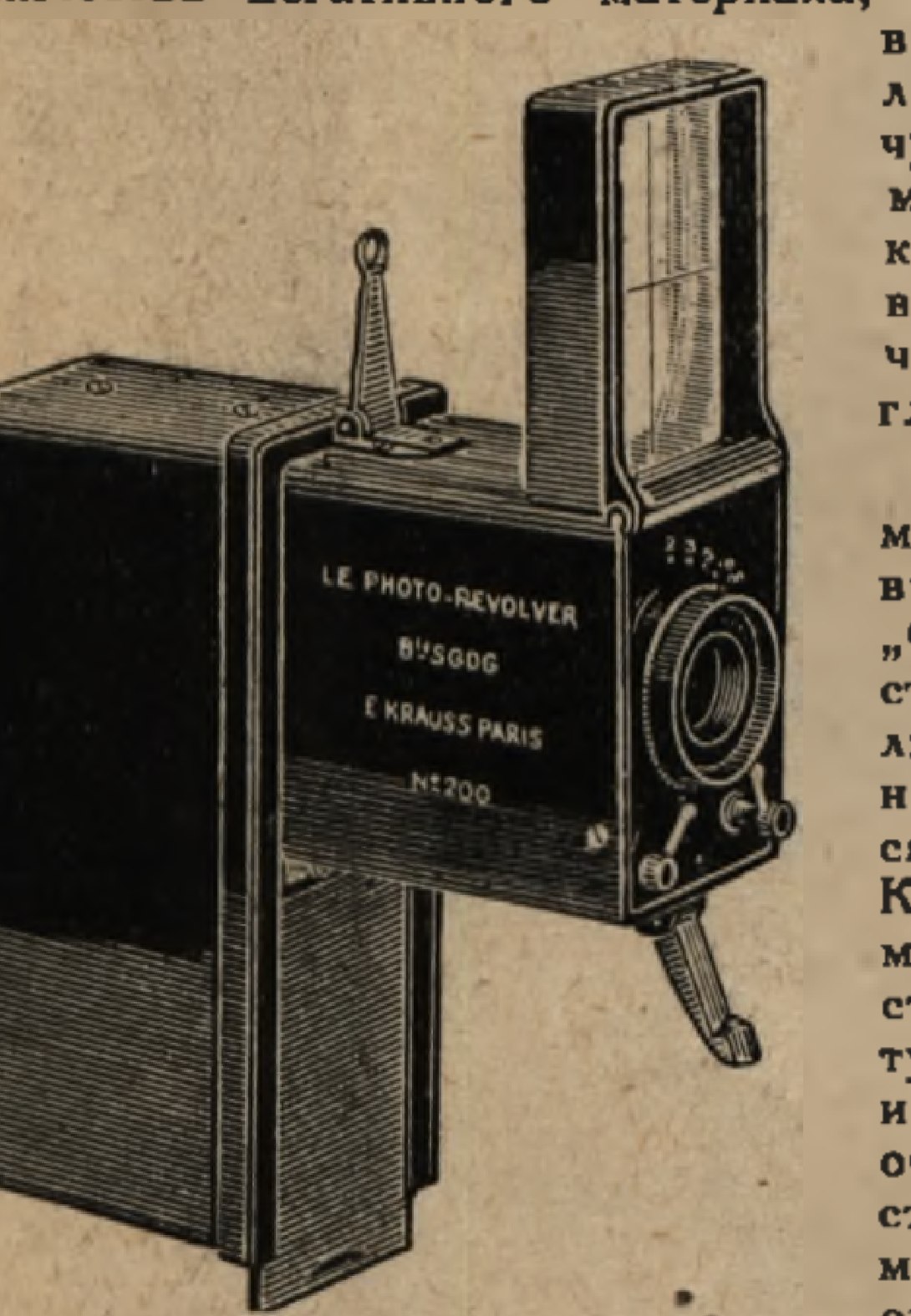
On this path the firm E. Krauss of Paris put out in 1921 the “Photo-Revolver” for 22×36 mm plates and spool film (image 20×30 mm), taking a magazine of 48 plates or a spool cassette of 25, 50 or 100 shots — unsurpassed so far for the amount loaded at once. All metal, durable and precise, with a Tessar F/4.5 of 40 mm (worm focusing to 1 m) and an always-wound shutter of four speeds (1/25 to 1/100 sec.); the camera is 42.5×29.5×50 mm, the magazine 90×34×46 mm, the whole 500 g unloaded, films loaded in daylight, with an enlarging cone for the negatives. But it looks like a revolver — the trigger-release and sight-finder complete the resemblance — so it is hardly fit for unconstrained shots in public: one shoots one-handed, as with a pistol, and the sight of a “revolver” aimed at someone, finger on the trigger, is apt to distract everyone, especially in our troubled time, and in a big city the “Photo-Revolver” could easily lead to misunderstandings. It is dear: 120 rubles in our money, 48 plates 1 r. 85 k., a 100-shot spool 1 r. 80 k.
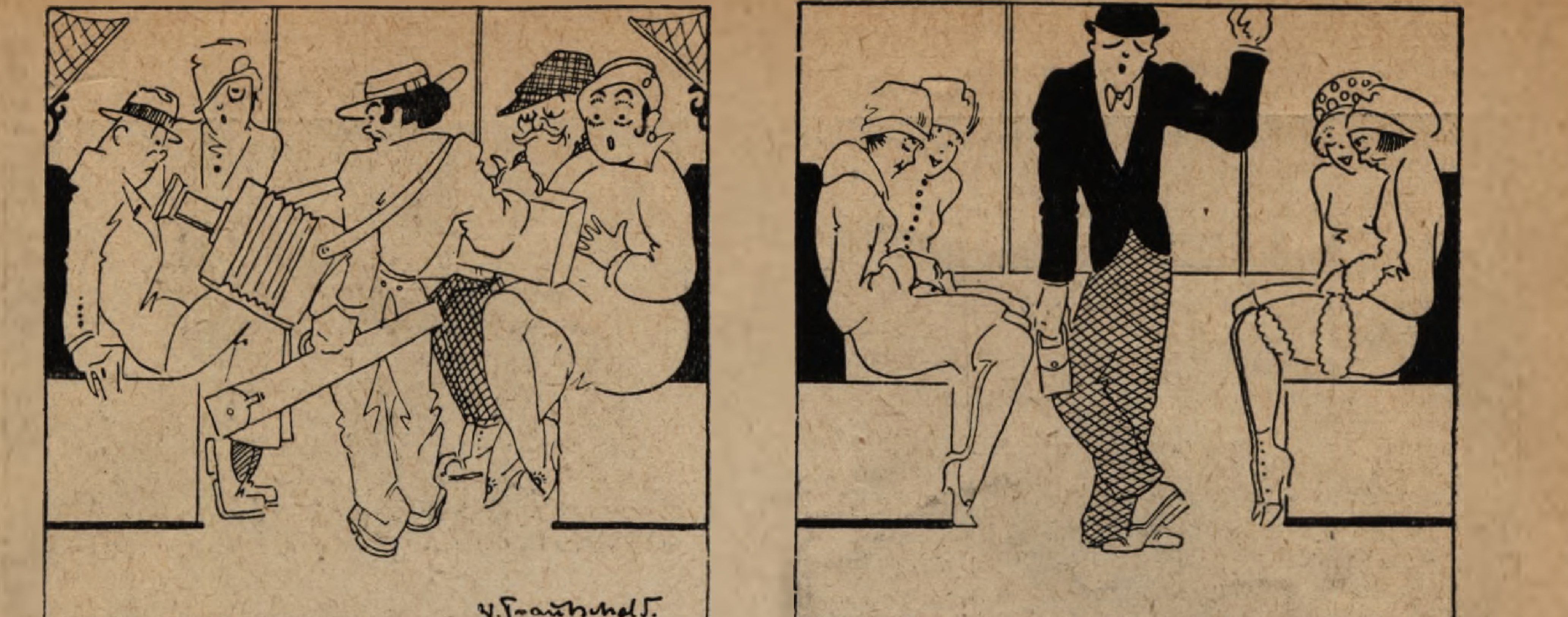
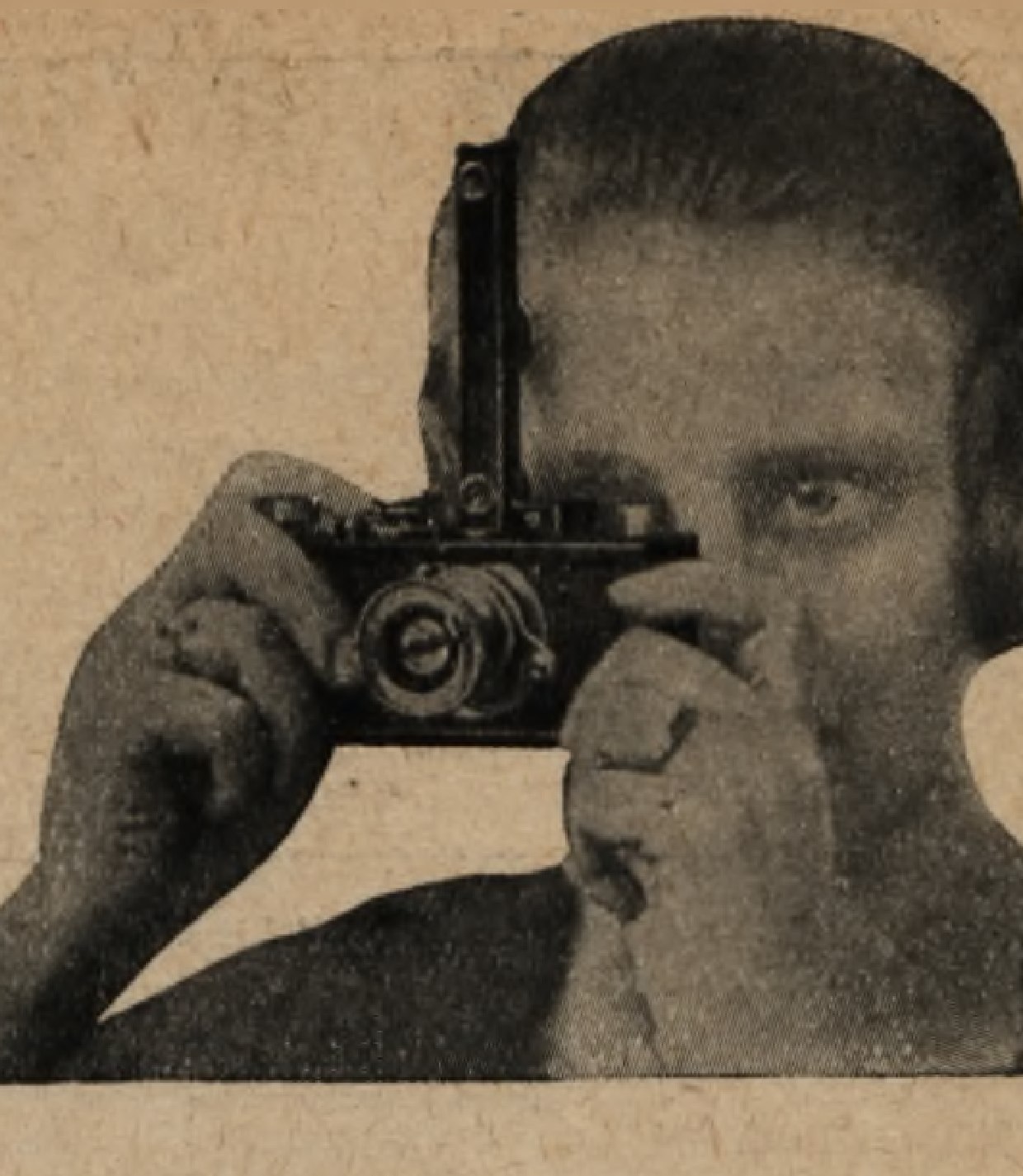
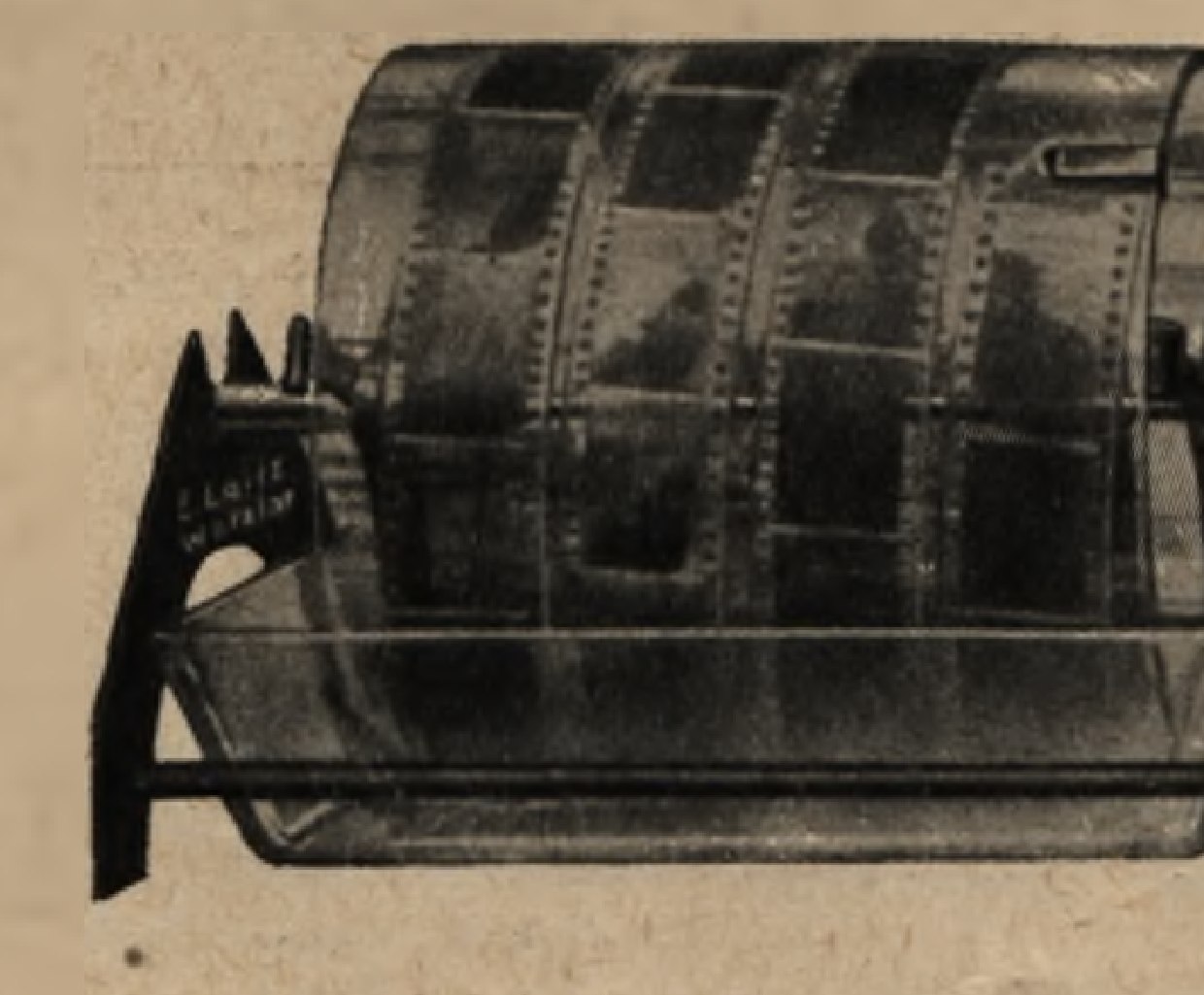
Further splitting of the plate format being irrational, constructors turned to film cameras, the natural idea being to use, instead of special formats, ordinary standard cinematographic film, made cheaply and uniformly the world over — so that one can now pocket a reserve for several hundred shots, reloaded in daylight (the two cartoons above the title vividly show the portability). A normal cine-frame is 18×24 mm, with 5 mm perforated margins each side, the film 34 mm wide; so three photo-formats are possible on it: 1) the ordinary 18×24 mm (across the film); 2) along the film, 24×36 mm; 3) along the film on non-perforated stock, 30×45 mm.
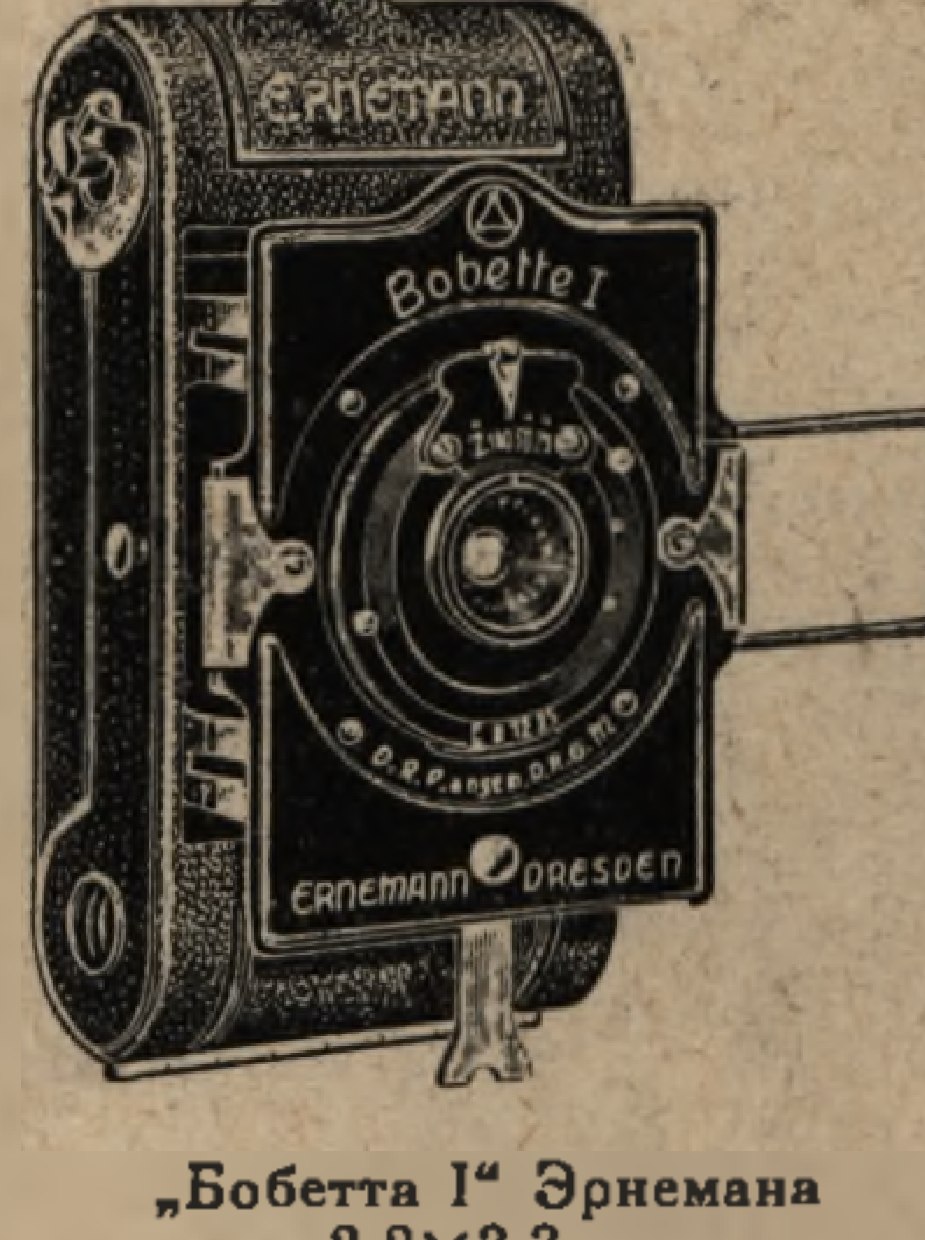
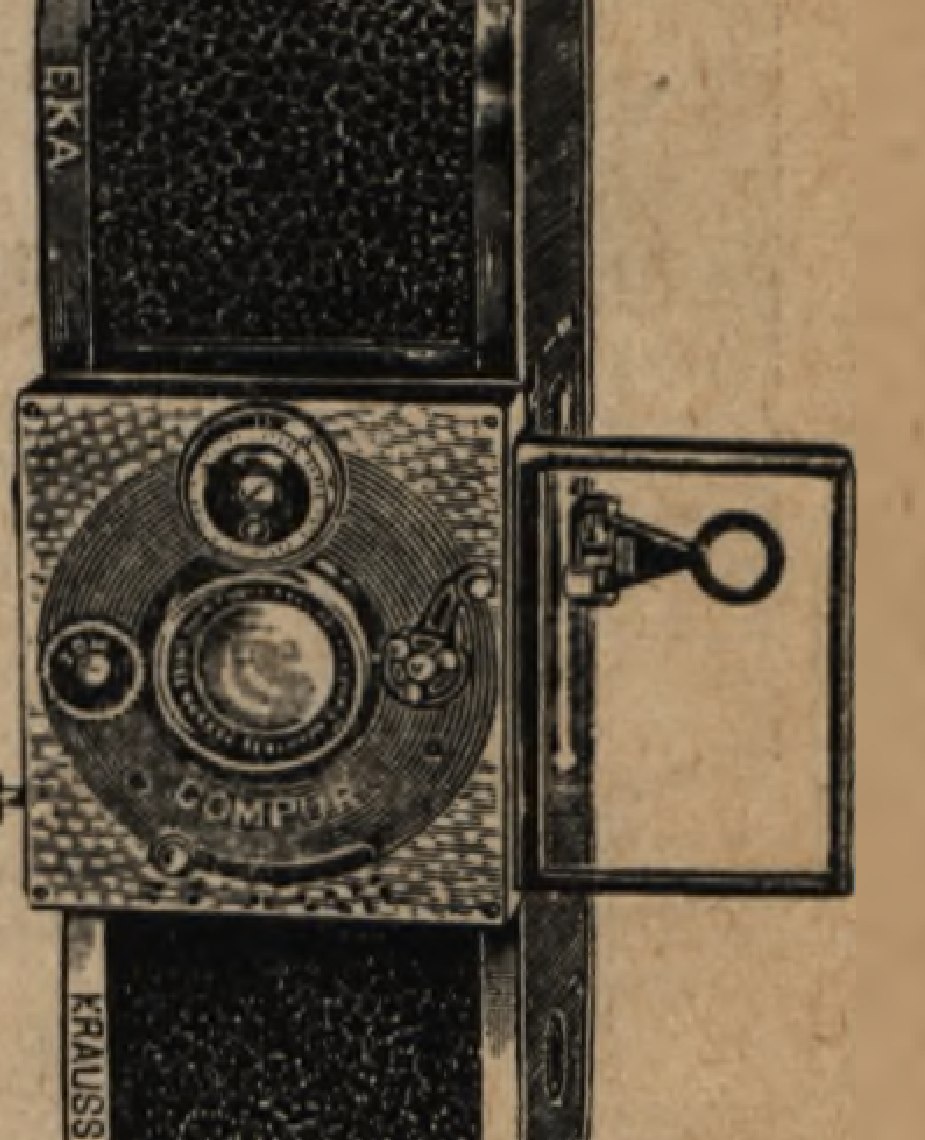
The first camera for separate shots on cine-film was Ernemann’s “Unette” (Dresden), giving 18×24 mm: a landscape lens F/12.5 of 40 mm, a shutter for instantaneous (1/25 sec.) and time shots, 3 diaphragms, no focusing (all beyond 1½ m sharp; a supplementary lens for portraits); 65×65×85 mm, 175 g, 6 r. 20 k., a 24-shot spool 55 kop. — its latest models giving 24×33 mm. For that format there is the better-perfected “Bobette I” of the same firm, metal-bodied, with a drawing front on strutted bellows and better lenses to 1/100 sec. (with “Ernoplast” F/4.5 of 50 mm, 29 rubles; the improved “Bobette II” with F/2). Krauss’s “Eka” takes non-perforated film for 30×45 mm shots, 25 or 100 at a load: all light metal, Tessar F/4.5 or F/3.5 of 50 mm in the best “Compur” shutter (1 to 1/250 sec.), 150×50×45 mm, 700 g loaded, the front drawing out by worm focusing to 1.5 m and opening the finder (which folds automatically on retraction); the film is kept taut (vital with fast optics), advances exactly one frame, and has a counter — 120 rubles, a 25-shot cassette 1 r. 40 k., 100-shot 2 r. 80 k.
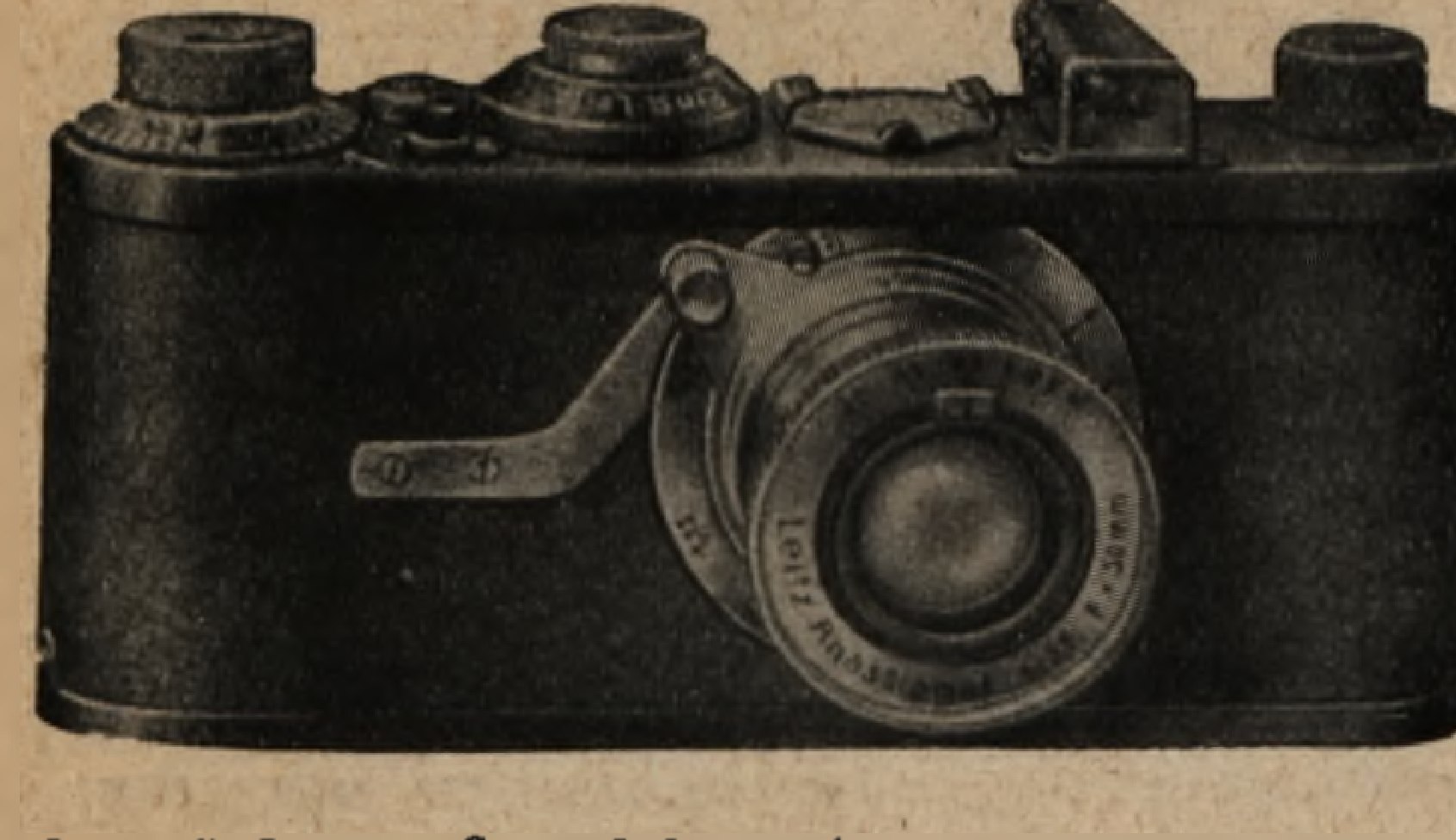
The Germans did not lag: the “Leica” (Ernst Leitz, Wetzlar) is the smallest blind-shutter camera, working on ordinary perforated cine-film for 24×36 mm shots — all metal, with a Leitz “Elmax” anastigmat F/3.5 of 50 mm in a worm mount (focusing to 1 m); the blind shutter winds with closed slit for 1/25 to 1/500 sec., a special optical finder lets one shoot at eye level, and, like the Eka, it is precisely built, prevents double exposure on one frame, and counts the shots. It is 13.2×55×30 mm, 425 g, the loaded 36-shot cassette 50 g; with 3 cassettes 133 r. 40 k., a 36-shot spool 70 kop. A “Fodis” telemeter clips on for exact focusing (there being no ground glass, as in all film cameras); lately the firm has also put out a “Leica” with a “Compur” shutter for 1, 1/2, 1/5 … to 1/250 sec.
With us, at the Leningrad Optical Factory, the first Soviet camera for cine-film — the “Photo-Goz” (18×24 mm), with Soviet optics of great speed F/2 — was built last year, but got no further than a trial; and we know of a like attempt by comrade Ivanov-Alliluyev in Moscow (detailed reports on both will follow next number). The tiny shots are of little interest in themselves, but from such negatives one gets excellent enlargements to 9×12, and in good cases 13×18 cm, and nearly every firm supplies enlargers and projection lanterns. Of cine-film cameras there is a multitude; we have given only the most characteristic.
Beyond their clear advantages for travellers and excursionists — unlimited shots with no return to the darkroom and no burdensome baggage — these cameras can serve the photo-reporter too, as an auxiliary. Their one ineradicable fault is that no single frame can be developed before the whole spool is shot, which limits their use; yet they can serve the amateur bent on experiment, easing the making of many shots. And given the extraordinary cheapness of the material (2 kopecks a shot on film in special packing, ½ kop. on ordinary cine-film — even in the USSR, at raised prices, about 1 kopeck a shot), and the use of the scrap film left over from cine-production, the spread of such miniature cameras becomes the more understandable.
— A. Yerokhin