
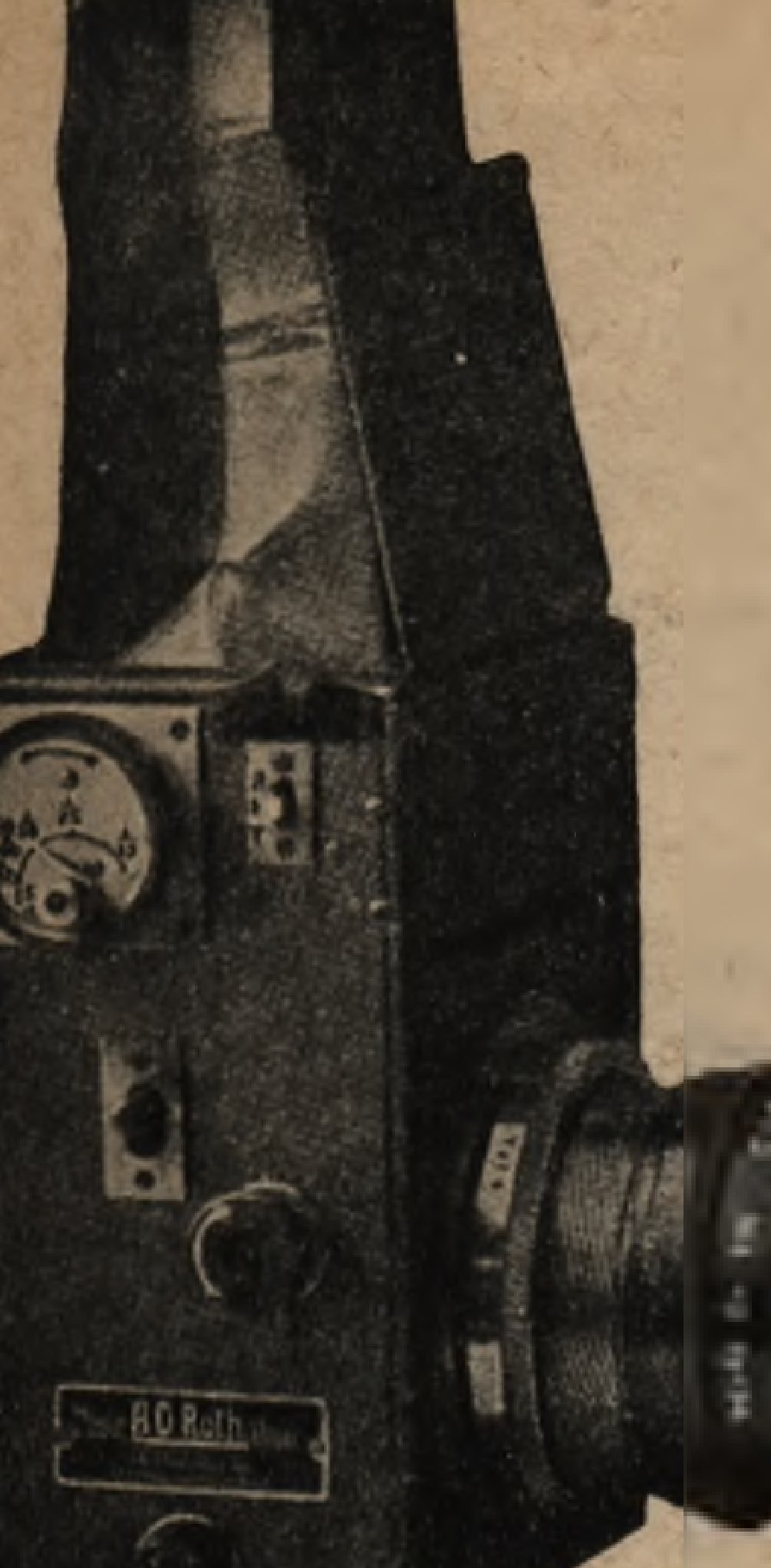
The most light-powerful reflex camera
In England a 4.5×6 cm reflex camera has just appeared with the “Plasmat” lens of enormous speed F/1.5 — an anastigmat calculated by Dr. Rudolph and built by the known firm Hugo Meyer in Görlitz. At a 9 cm focus its diameter is 6 cm, so that the area of its active aperture exceeds the area of the 4.5×6 cm plate itself; the image is extraordinarily bright and allows shots unthinkable two years ago — instantaneous in weak light (F/1.5 needs 9 times less exposure than a Tessar F/4.5). The want of depth of field is made up by the reflex’s precise focusing and the bright image; the sharpness falls off toward the edges, but one must not demand special sharpness of so fast an instrument — and in modern portrait work the shallow depth may even be a plus. In special cases it is useful, but as a universal camera for the ordinary amateur it cannot be recommended. Its blind shutter runs from 1/10 to 1/4000 second; the short bellows is supplemented by worm focusing, down to 25 cm; the back wall with cassette rotates. In England, with 6 ordinary cassettes, it costs 58 pounds sterling (548 rubles).
“Agfa” papers
The known plate-factory Agfa has decided to supply its customers with everything: besides plates and all manner of chemicals it has lately put out standard inexpensive amateur cameras, and now photographic paper too — so far gas-print and celloidin daylight paper.
“Mimosa” plates
The known photographic-paper factory Mimosa in Dresden has begun making plates too — so far four grades: “Ultra-portrait” (21° Scheiner), “Ortho-anti-halation” (18° Sch.), “Orthochromatic” (17° Sch.) and “Extra-Rapid” (16°); the factory’s long experience with emulsions gives ground to expect high quality.
23° by Scheiner!
German firms have put out plates of this extraordinary sensitivity: “Orto-Elur” of Lomberg, “Ultra-Rapid” of Eisenberger (marked even 23–24° Scheiner), and “Sonya EB,” “Sonya-Chrome” and “Orto-Isodux-Braungus” of Herzog.