
There are quite many methods of colour photography, but none settles the question: some (Lumière’s autochrome and the like) give a single diapositive, others need three separate negatives and the difficulties of a triple exposure through filters (pinatype and others). The two new paper methods described here — “Lage” and “Jos-Pe” — put the mass making of colour prints on a quite real footing.
Colour photography on paper by the “Lage” method
In recent years the whole effort in natural-colour work has been to prepare, for a colour shot, the same kind of negative as for ordinary monotone photography, from which any number of prints could be pulled. This the German firm E. Lage of Hamburg now solves, selling plates, paper and reagents with which a special negative can be got by any camera, with no attachments: one shot on one plate, without filters, yields negatives from which unlimited prints can be made. The method rests on passing the light to the emulsion through the colour media red, yellow and blue. On the basic glass plate Lage lays a first emulsion sensitive to red; this is covered with a film whose outer surface is an emulsion sensitive to blue and whose inner surface (against the plate) is sensitive to yellow. The light passes first through the outer blue layer (giving later the yellow image), then the yellow layer (the red image), and finally the red layer (the blue part) — the “blue plate,” “red film” and “yellow film.”
The plate is loaded as usual, but — being highly panchromatic — in dark-green light; shooting is ordinary, only the exposure is 15 times longer than on an ordinary 12°-Scheiner plate (earlier colour methods needed 60-fold), so that summer sun allows instantaneous shots. Then, under dark-green light: take the plate from the cassette, peel off the film, and develop the glass plate (the negative comes out rather flat), fix, wash and dry. Develop the film likewise, turning it constantly since it is two-sided; fix, wash, treat in a water solution of formalin with glycerin, and hang to dry; when quite dry, cut the edges and separate the two layers — giving the yellow and red negatives. There result three negatives of differing density — the yellow weakest, the glass flat, the red most contrasty — and this difference aids the true rendering of the colours, a weak drawing on one being made up on the other two.
Printing is on the firm’s special gas-print paper. Print first from the yellow film: a black print of normal strength is developed, washed and dried, and on its back the main contours are marked with a soft pencil; it is then bleached until the deep shadows turn faintly yellowish, washed, cleared and dried. A blue solution is tamponed on, half-dried, and the print laid in the frame on the blue negative, aligning the contours against the light; printed (even in daylight), washed and dried; then a yellow-red solution is applied and it is printed from the red negative the same way. After some ten minutes’ washing the shot takes a yellow-blue-green colour; immersed in warm water at 35–40°Ц the gelatin swells into slight relief. A short cold wash, drying between blotting paper, and a final pass with a roller charged with red paint (or a brush, as in bromoil, or both) complete it; it is then fixed in an ordinary neutral bath, washed, degreased in spirit, and may be lacquered. The “Lage” method is of great interest for scientific work (bacteriology), for art (restoring pictures) and so on. German prices, in our currency: plates per half-dozen — 9×12 cm 3 r. 45 k., 13×18 cm 6 r. 90 k.; paper per 10-sheet packet — 9×12 cm 37 kop., 13×18 cm 83 k.; reagents in 100 cu. cm flacons — bleacher 65 kop., clearer 46 kop., blue solution 1 r. 47 kop., yellow-red 46 k., developer 55 kop. — G. K—kh
Colour photography on paper by the “Jos-Pe” method
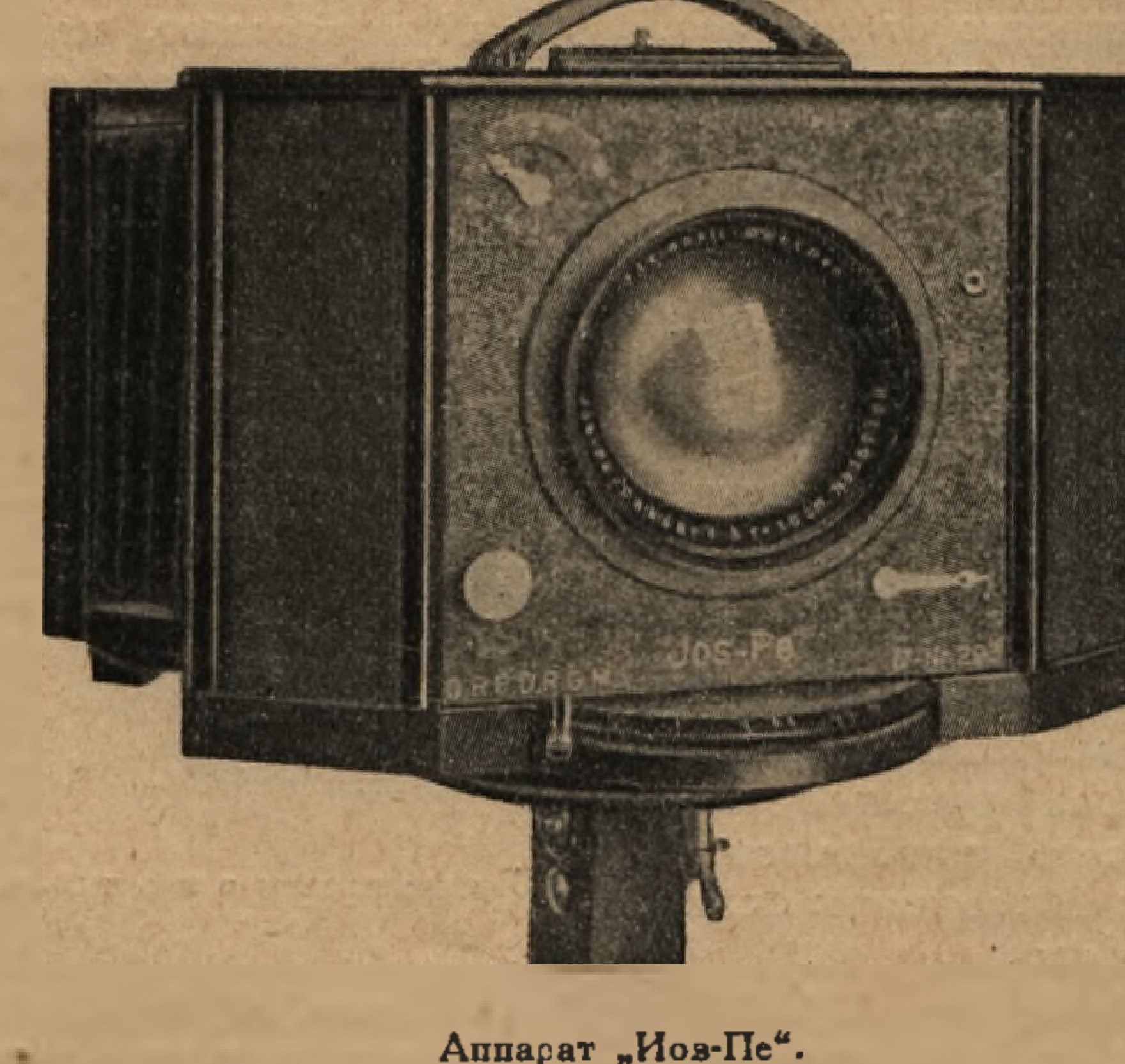
The “Jos-Pe” method uses a specially built camera to get three separate negatives at one shot on three plates at once. Its negative process (Jos-Pe G.m.b.H., Hamburg) rests on the known three-colour methods and only perfects and simplifies them: instead of three exposures, one exposure in the special camera gives, by an ingenious device, three separate negatives. Two types exist — a 9×12 cm for professional portraits (central “Compound” shutter 1 to 1/50 sec., a special Steinheil lens F/3 of 18 cm, 9 kilograms(!), 21×23×35 cm, 3,000 marks / 1,380 rubles) and a 4½×6 cm for landscape, instantaneous and amateur work (F/4 of 10.5 cm, “Compound” 1 to 1/100 sec., 12×13×19½ cm, 2,570 g, 950 marks / 437 rub.).
The camera takes three plates at once; a special Steinheil lens splits the light so that about 50% passes through the centre onto the red plate, while the rest, by two mirrors silvered on the outside just behind the lens, is shared evenly between the blue and yellow plates. The cassettes lie along a curve at the back, the red plate in the usual monotone position, each plate behind its own filter; focusing is on ground glass put in place of the red cassette, a special device bringing the other two into focus at once. Shooting is ordinary, on special high-sensitivity panchromatic “Jos-Pe” plates in three kinds — blue, green and red labels, one per negative; summer sun allows 1/100 sec. instantaneous shots, the exposure being 16 times the ordinary. The plates are taken out in darkness, given a one-minute bath in a special developer with a desensitizer (pinakryptol green) so they can then be developed in bright red light, fixed, washed, dried — and a matrix made on special positive plates or films in an enlarger or frame, exposed from the glass side.
These matrix-plates are developed with a special tanning developer (pyrocatechin without sulphite), the unfixed plates treated with a stop solution, then put in warm water to dissolve the untanned gelatin, giving matrices of gelatin relief whose thickness follows the negative’s lighting. Dipped in a dye answering to its filter, a matrix takes dye in proportion to the gelatin — more in the thick places (shadows), less in the thin (half-tones and lights); the excess is washed off and special soaked “Jos-Pe” transfer paper is rolled against it, layer to layer. The paper takes the dye by its amount on the matrix; after a few minutes it is lifted and laid on the second coloured matrix, then the third — printing first from the blue matrix, then the yellow, then the red, the contours easy to register since the matrix’s silver image is extraordinarily transparent; the final print is fixed in a special solution. These processes may be perfected and simplified further, but already, with “Jos-Pe” and “Lage,” it has become quite possible to make colour photographs on paper in any quantity — in Germany, Dürkoop’s three ateliers (Berlin and Hamburg) already shoot portraits in colour by the “Jos-Pe” method.
— G. Radchenko