

In No. 5 we surveyed the newest foreign miniature cameras for shooting on ordinary cine-film — an extraordinarily cheap, portable material. Here D. Gorodinsky reports on two Soviet attempts in the same field.
The “Photo-Goz”
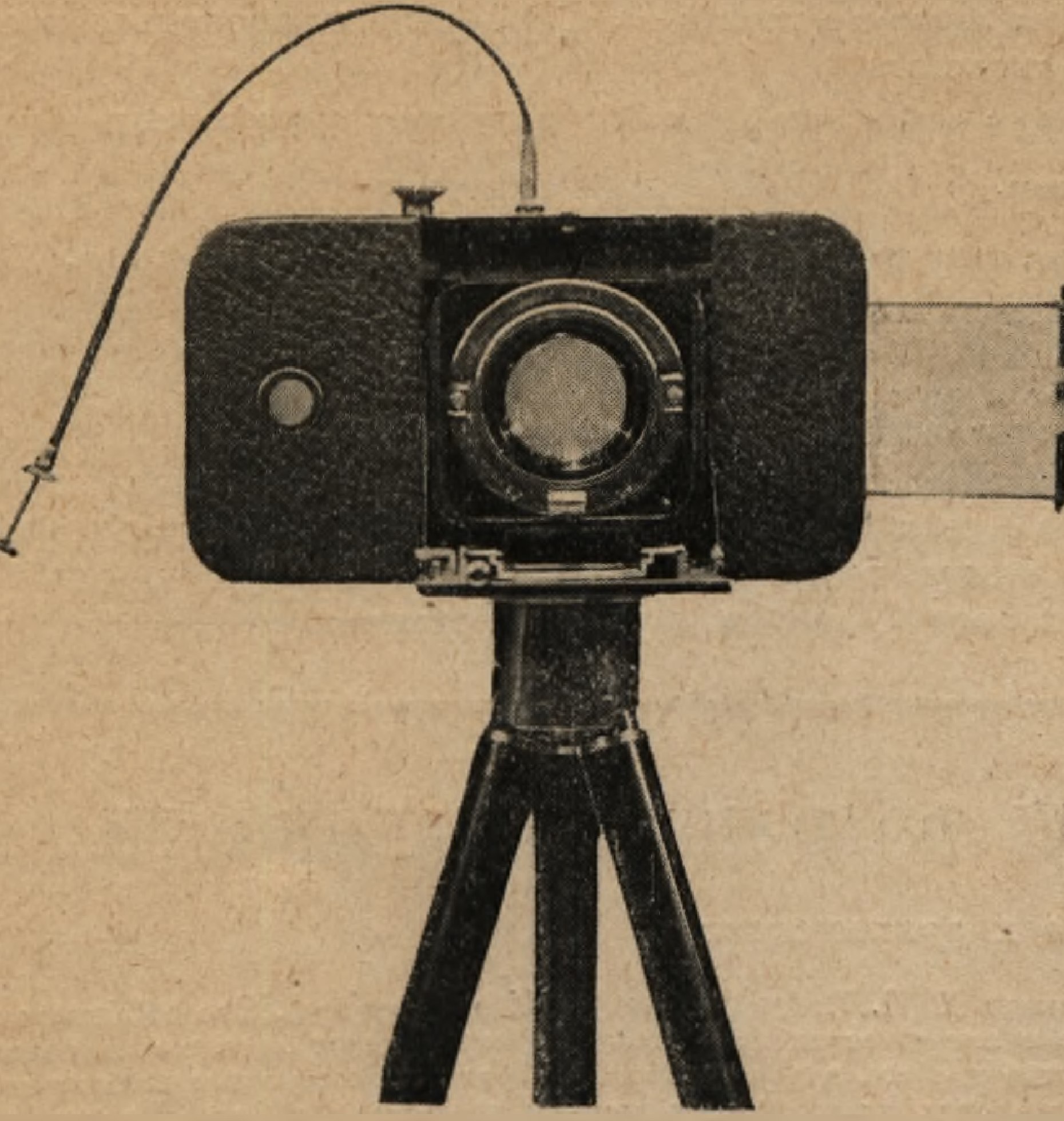
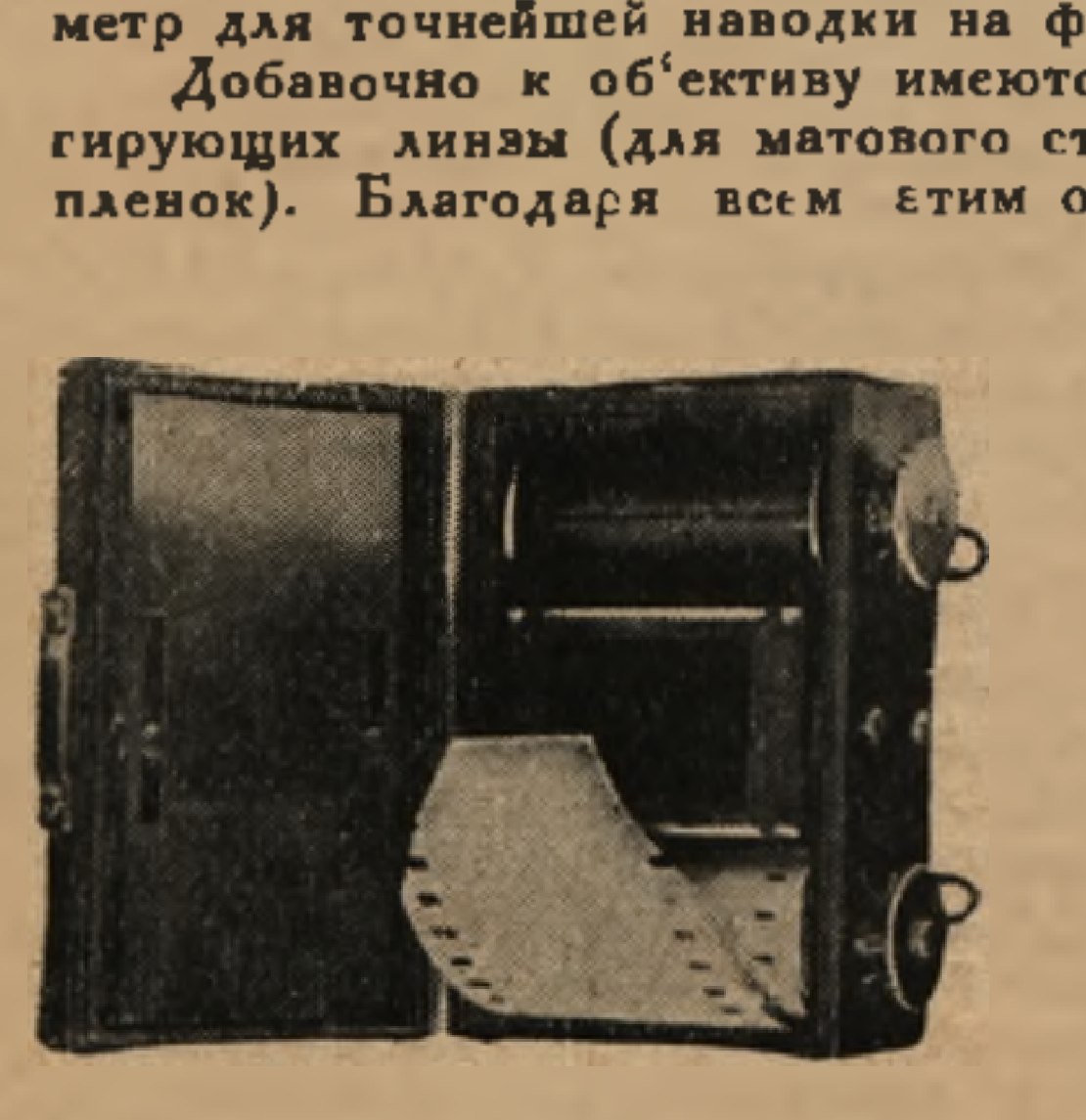
The “Photo-Goz” was built two years ago by P. F. Polyakov, a constructor at the State Optical Factory in Leningrad; its F/2 objective is also made at the factory, to the calculations of engineer Titov. And ever since it saw the light it stands alone in a cupboard, pulled out only now and then, when guests appear within the factory walls, to have its remarkable properties shown — yet it deserves attention. The camera is unusually portable, intended for shots of 18×24 mm (the normal cine-frame); it is small (140×75×80 mm), weighs 1 kg, has an F/2 objective of 60 mm focus, a double-draw bellows and an iris diaphragm marked 2, 3, 4, 6, 8, 12, 16, 24 — so that, but for the blind shutter (which, alas, has only one speed, 1/100 sec.), one could shoot at various exposures at one aperture. It has a view-finder, and, in the middle of the back, a ground glass that slides aside by a lever to give place to the magazine; at the ground glass a 6-fold magnifier, and in front a micrometer for the most precise focusing. To the objective are added two correcting lenses (for the ground glass and for the films). By all these ingenious devices the image focuses easily and sharply: I saw a music-sheet of 18×24 mm enlarged to 13×18 cm — what the naked eye could not make out became clearly legible — and on the screen 18×24 mm shots (portraits, landscapes) enlarge to 2×2 metres and more, distinct and undistorted; one could scarcely believe the depth of image attainable.
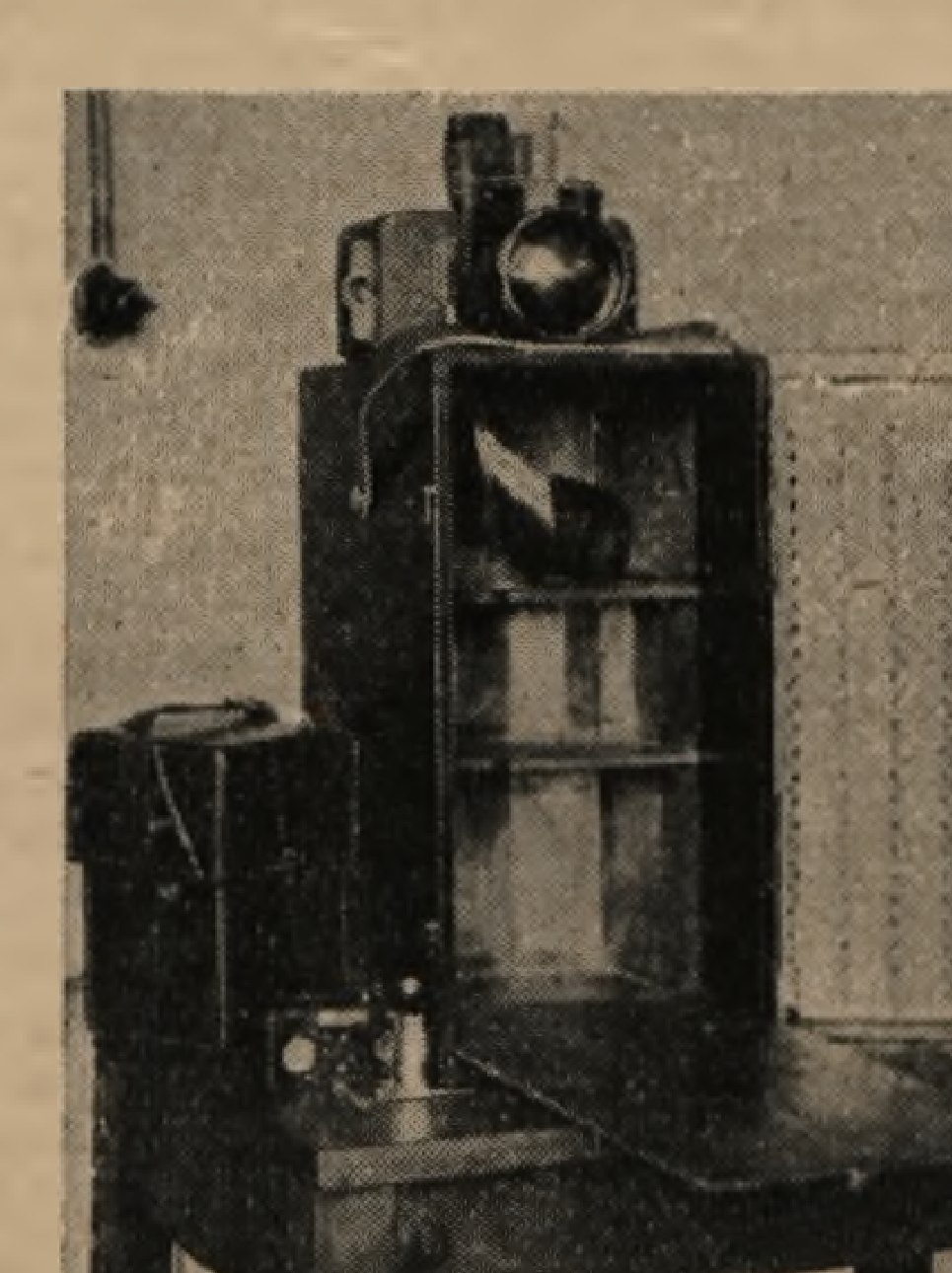
The magazine holds a metre of film — 52 shots — so that, buying up cine-factory film-ends for pennies, one can make a multitude of shots; it has a counter. Camera, spare films and the rest pack into a case that is also the rheostat, which drops the voltage from 120 to 12 and 8 and serves as a camera stand. A projection lantern, with condenser and mirror reflector, lets one show diapositives (positive film-shots) on the screen with the Photo-Goz, enlarging up to 200 times by the camera’s distance from the screen — the mirror gathering the lamp’s rays through the diapositive and objective — and can also make diapositives from negatives (copying). Thus the Photo-Goz replaces both the ordinary and the enlarging apparatus, gives shots of any size and number, costs little, takes very little room, has strong optics and many other devices. One would wish only that this, so far the sole such apparatus, might rouse interest in the proper circles, and that the factory might make photographic cameras in quantity. — D. Gorodinsky
One more Russian camera for cine-film
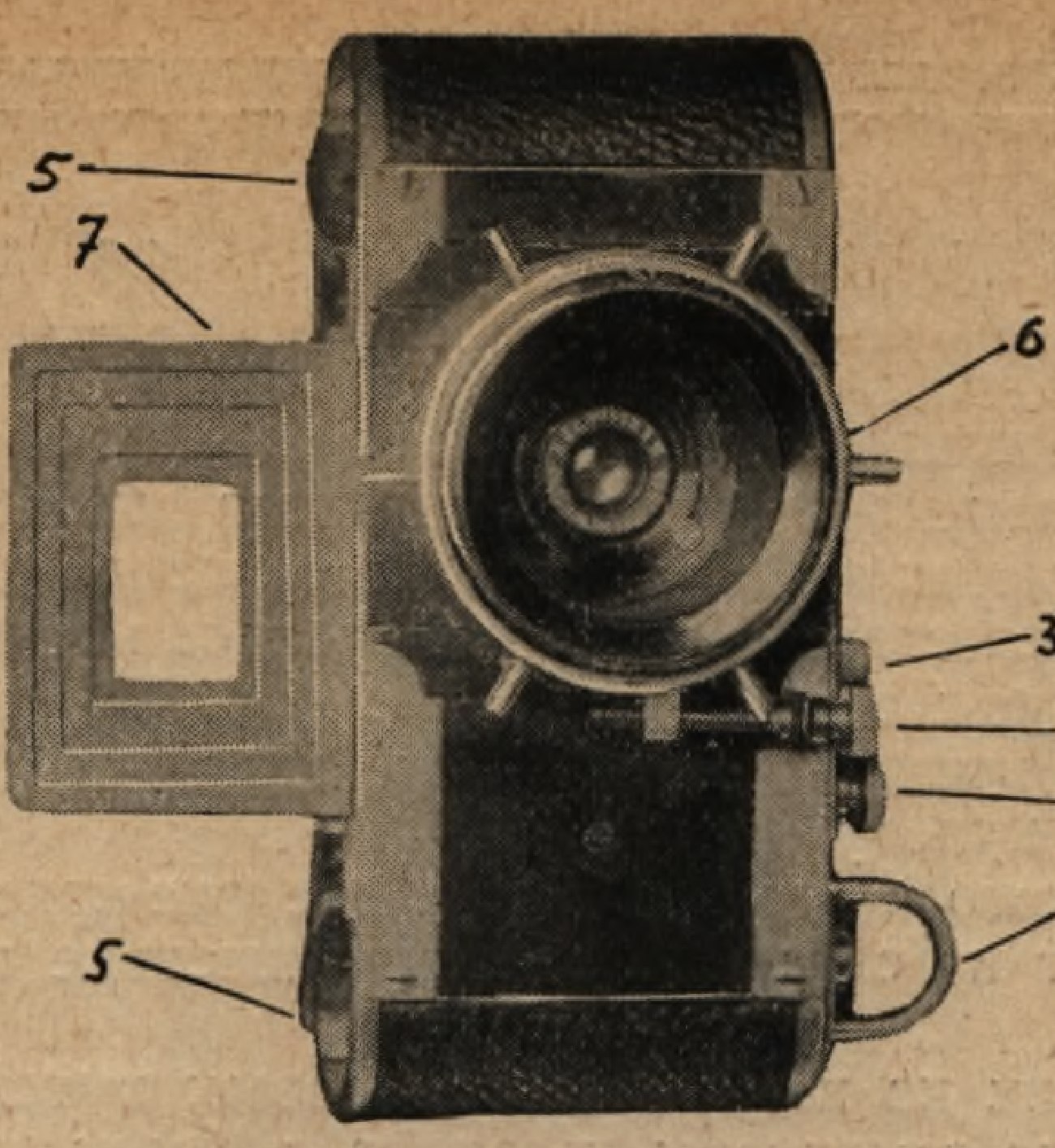
Comrade Ivanov-Alliluyev, a photographer of the Moscow Sovkino factory, has also built a camera for cine-film, entirely by his own hands and wholly of Russian material (chiefly brass). It measures 85×85×160 mm, the shot 25×37 mm — about the double normal frame; the cassette holds 6½ metres of film (about 150 shots, counting the loading loss), loaded in daylight with a loss of only some 15 cm; focusing is by the scale or straight on the film, the lens-board moving up, down and to both sides; the loaded camera weighs 1.5 kg. It has two interchangeable objectives which, by two supplementary lenses, do the work of four: a Zeiss F/6.3 of 54 mm, which with the added lens gives 42 mm at F/5.5; and a Cooke F/4.5 of 100 mm, which with the added lens works softly, like a monocle, at F/3.5 and 75 mm. With several spare cassettes and a set of objectives one can make several hundred shots — very important on trips and expeditions — and the small weight and bulk of the loaded cassettes make their transport easy. A rather large gap between frames — 6 mm — lets them be cut apart without touching the image. He is now working on further improvements, foreseeing a spring to tighten the film automatically, and a marker to stamp the gaps between frames so the undeveloped film can be cut up without risk of spoiling any frame. The parts of the camera (see the figure): 1) the screw giving the lens-board horizontal movement; 2) the screw giving it vertical movement; 3) the lever to open the shutter at focusing; 4) the key to advance the film; 5) the keys to open and close the cassettes; 6) the worm ring for focusing; 7) the frame finder with folding frames for the different objectives.
This is already Ivanov-Alliluyev’s fifth construction: the first three were cameras of ordinary type, the fourth a reflex of 6½×9 cm, built from the wish for the smallest camera and easy change of objectives — the latter achieved with a universal ring, its size 115×115×120 mm. With some improvements this apparatus could win a certain currency here, for — given the minimal use of negative material, the frame size allowing any enlargement, and the many shots it makes at one loading — it may prove very convenient and practical for amateurs and photo-reporters, especially in travel.
— N. Dribinovich