
A photographer’s itinerary down the Kama — companion to the author’s Volga piece (No. 5, 1926) — arguing that the river’s very “unexploredness” makes it richer ground for the camera than the Volga.
The Volga basin, uniting the Volga provinces and the regions on its many tributaries, is an extremely varied picture: the Volga waters a land of 44 million people and is an exceptional river system, joining the diversity of nature with the many tribes living here. To the Volga, as a source of life, various peoples stretched from of old, leaving descendants or memories in monuments of culture. In No. 5 of Sovetskoe Foto for 1926 I wrote of the great interest the Volga and a voyage down it hold for the photo-amateur — but the Kama is no less.
The full-flowing Kama is one of the great trade routes of antiquity: along it, even into ancient Greece, went precious gems and gold from the Urals, furs from Siberia and the Kama country, and long before the Russian state the route from Persia and far India to the mouth of the Northern Dvina passed by it. The name “Kama” is probably Finnish — in Votic it means “long,” and the Votyaks call it “Budzhim-kam,” the long river. It is sixth in length in Europe, and towns and settlements stretch along it in a long ribbon. Here is Cherdyn, on the right bank of the Kolva — once, by its many archaeological finds, the capital of the Finnish tribes whose land was called Biarmia, now a transshipment point: a little town of only 4,000 that yet has a museum, an archaeological society, even a water-supply. Beyond it, Solikamsk, founded by Novgorodians, long a strongpoint of Russian colonization, several times burned by the Permyaks, Ostyaks and Voguls; of the 17th century only the voevoda’s house, the cathedral and some underground passages of unknown purpose survive — and it has 13 churches, 2 monasteries and 20 chapels for its 4,000 people. Near it, on the right bank, the village Pyskor, once site of a famous monastery and centre of a salt-boiling district whose wells go 230 metres deep (salt-boiling began at Usolye early in the 16th century; at Usolye, in a family of Stroganov serfs, was born Voronikhin, builder of the Kazan cathedral and the Mining Institute in Leningrad), with the first soda factory of the Cis-Urals, built 50 years ago.
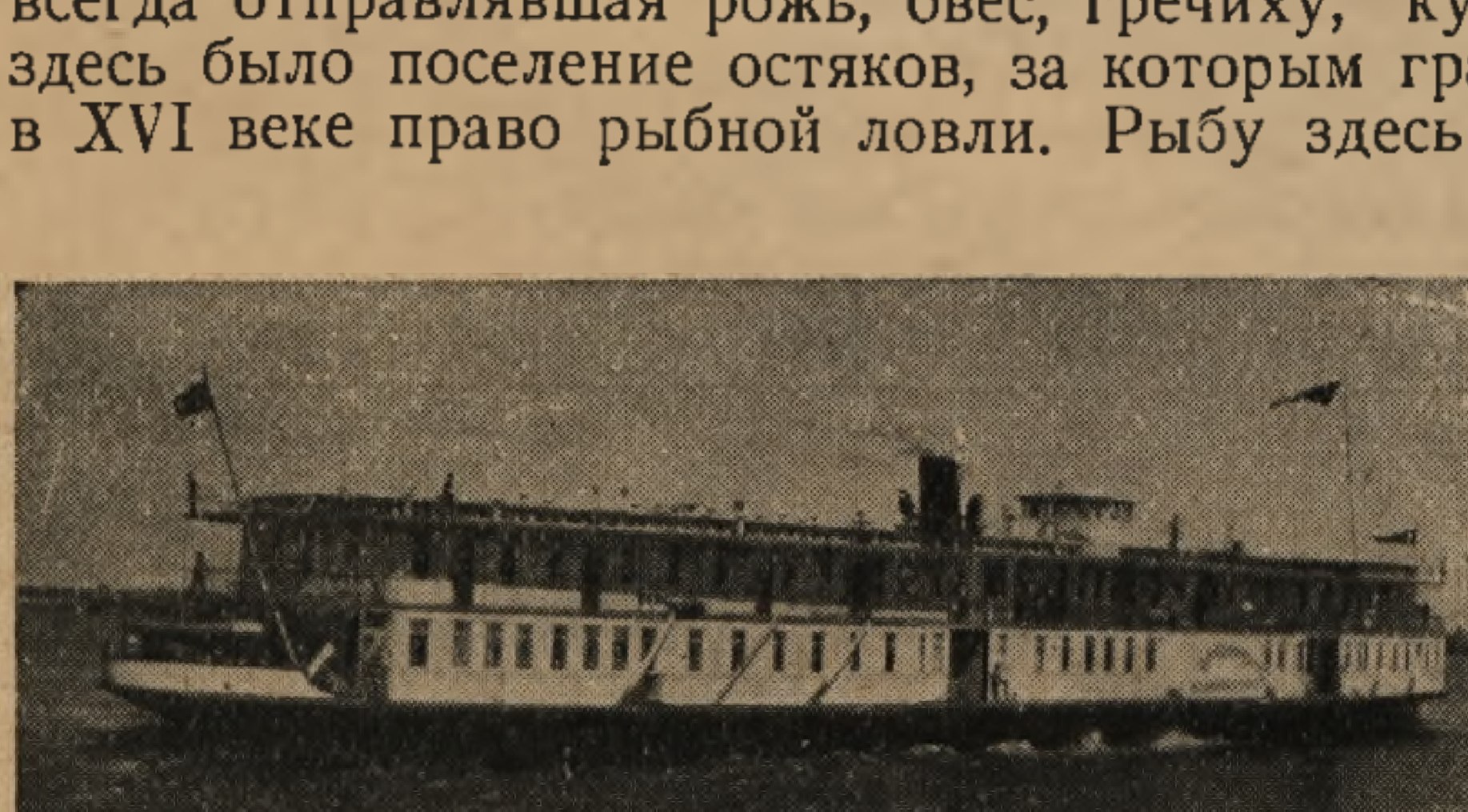
And on, past many wharves and wonderful places marked by far antiquity: along the fast Kama, past smoking Morovilikha, the steamer rounds a bend and moors at Perm. On its site stood the Russian village Egoshikha, where in 1724 a state copper-smelting works was built — a base of the Kama “free bands” that held the reach until the Pugachev rising was crushed; in 1780 Egoshikha was renamed Perm, and late in the 18th century the Perm province was formed, larger in area than Italy. Perm has an electric station, telephone, a stone theatre, public gardens, higher schools, a biological station studying the Kama’s microscopic life, and an excellent scientific museum, the oldest on the river, with many volumes of valuable work; about 80,000 live there; the writer Reshetnikov and the wireless-telegraph inventor Popov got their first schooling here, and Herzen and Korolenko served exile. From Perm stretches the longest run on the Kama, the river in high banks with a canal-like valley clothed in spruce and fir; then Nytva and Tabor, where the pink outcrops of Perm nature first reach real power, and endless factories; then Okhansk, which before the war shipped much egg abroad, and Belyaevka, ever sending rye, oats, buckwheat and tow; then the town Osa, once an Ostyak settlement granted fishing rights by Moscow charter in the 16th century, taken by Pugachev in 1774, now a district centre of the Sarapul okrug with tar-burning, turpentine and cart crafts. Beyond Osa the Kama splits into several arms; then Elovye-babki, a big grain wharf, and Galevo, wharf of the Votkinsk works that made the sheet iron and white tin which in the 18th century roofed the Tsarskoye Selo palaces — and here too Pugachev once held sway.
In Votkinsk, in the factory-director’s family, the famous composer Tchaikovsky was born. Then Galyany, and from Galyany to Sarapul the high right bank of the Kama stands like a pink wall decked with the dark green of firs, the low left bank overgrown with dense forest. Sarapul, an okrug town of the Ural region and one of the chief places on the Kama, descends from the south in terraces to the wide valley of the little Sarapulka; on the east bounded by the Kama, on the west resting on a magnificent conifer forest with a picturesque maze of ravines — the southern slopes in oak, linden and hazel, the northern in dark spruce-fir. The motives and words of its folk songs, and the names of some plants, point to a very ancient tie with Novgorod; the word Sarapul is Chuvash for the yellow or beautiful fish, the sterlet, and the town was once famous for its fisheries. Then Elabuga, with the famous Ananino burial ground 5 km off (the Ananino culture is of the bronze and early iron ages), the town itself said to be founded in the mid-16th century; then Chistopol, the largest Tatar-republic town after Kazan, of unknown founding (tradition has it that the first settlers, peasants fled from their landlords, were tracked down and exiled, and the place became a “clean field”), with about 20,000 people and the birthplace of the chemist Butlerov; below it the village Rybnaya Sloboda, whose people under Boris Godunov were bound to “provide fish to the sovereign,” once notable for lace and jewellery crafts. The last wharf on the Kama is the town Laishev, the oldest Russian settlement here, built in the mid-16th century as a border town.
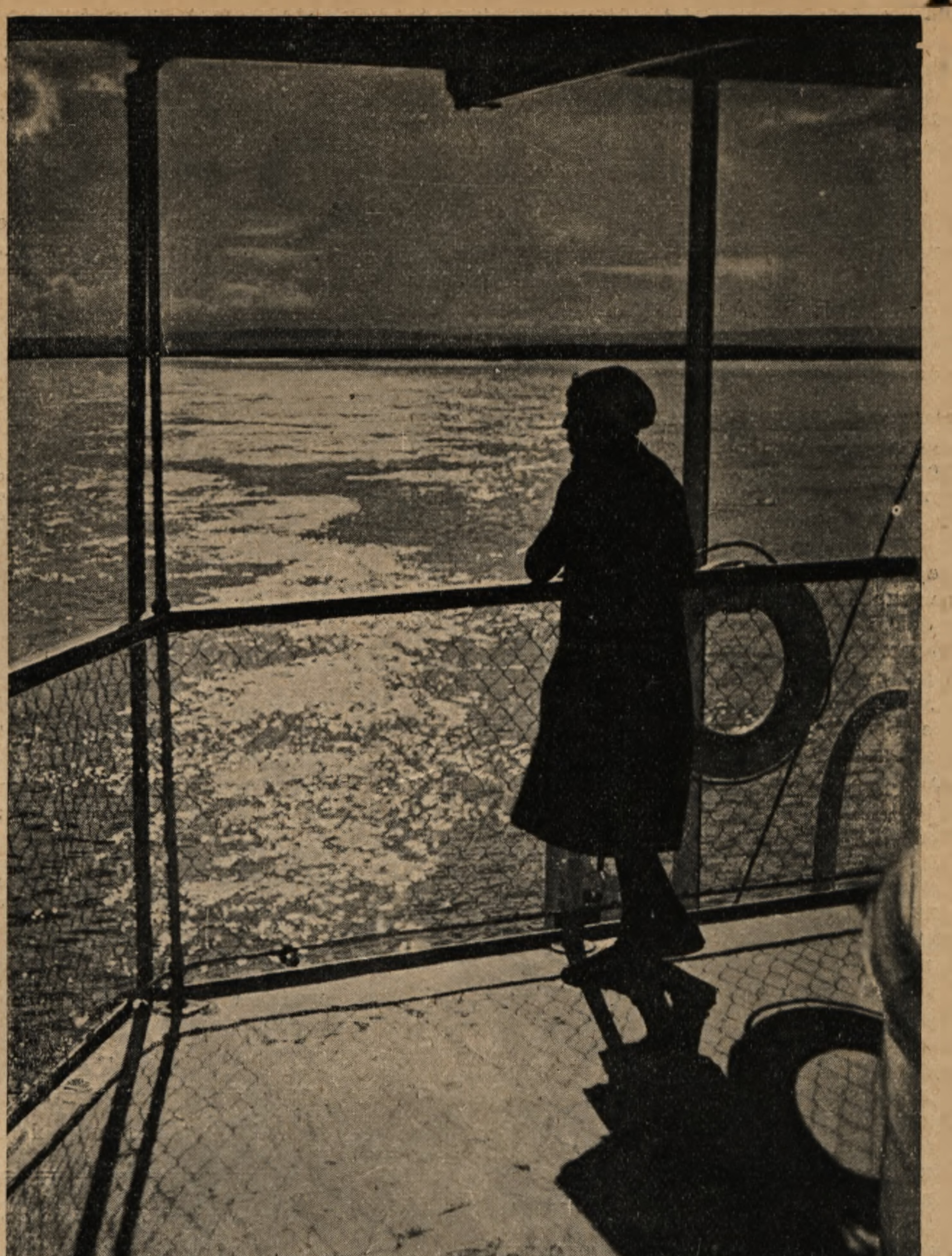
From Laishev the banks sharply change: endless meadows on both sides, only here and there a thin minaret or an Orthodox church; in the Kama basin you meet the most varied tribes. The wave of excursionists heads mainly to the Volga, the Kama being thought “more boring,” with its great regional centres; but the Kama surpasses the Volga in stern beauty — and its very “unexploredness” by photographers gives it a special advantage over the Volga, which has inspired hundreds of photographers to an enormous number of shots.
— Esbe