
Moscow
In the photo-cine amateur section of the ODSK, the recent plenum adopted a number of important resolutions. With the summer holidays beginning, it proposes that the amateurs of all ODSK cells — workers and employees on leave — use their stay in the village, on the outskirts, in the national republics and in rest-homes to shoot the life of the village, the national minorities, the daily life of the rest-homes, nature and landscape, and use the free time to raise the quality of their work, linking up with local ODSK bodies, photographers and specialists. As cine-organizations’ expeditions set out to shoot on location, local ODSK amateurs are asked to prepare photo-material of landscapes, production, human types and ethnography, for the cine-directors’ use; such series, by general and special assignment, will go to the Central Council of the ODSK so the directors can use them even before leaving, and for scenario work. Meeting the amateurs’ requests, the plenum elected a commission to work out a programme of photo-amateur lessons — detailed, by cycles and parts, theoretical and practical, allowing for the various kinds of circle (workers’, employees’, Red-Army, VUZ-student, schoolchildren’s and village). The programme will carry lists of photo-literature with reviews and references, plans of an amateur laboratory, and estimates for a laboratory of three types (100, 150 and 250 rub.); it draws on material in print (Sovetskoe Foto) and in various bodies (ODSK, MGSPS, RFO, GIZh), and will be published, fully worked out, as a separate booklet. For the approaching 10th anniversary of October the plenum approved arranging, at the ODSK Central Council in Moscow, a central photo-exhibition from the work of all ODSK bodies, and recommended such exhibitions locally too.
Leningrad
The photo-section of the LTI (Leningrad Technological Institute) recently marked its first anniversary; at the solemn meeting a photo-report of its work, made up of a whole series of diapositives, was shown. The section enjoys enormous popularity among the students — best proved by its colossal growth, from 14 members last year to 160 now — and in activity and equipment is held one of the most exemplary in all Leningrad; besides much practical and experimental work, it periodically gives the students popular lectures on all branches of photography, excursions and so on.
Nikolaev
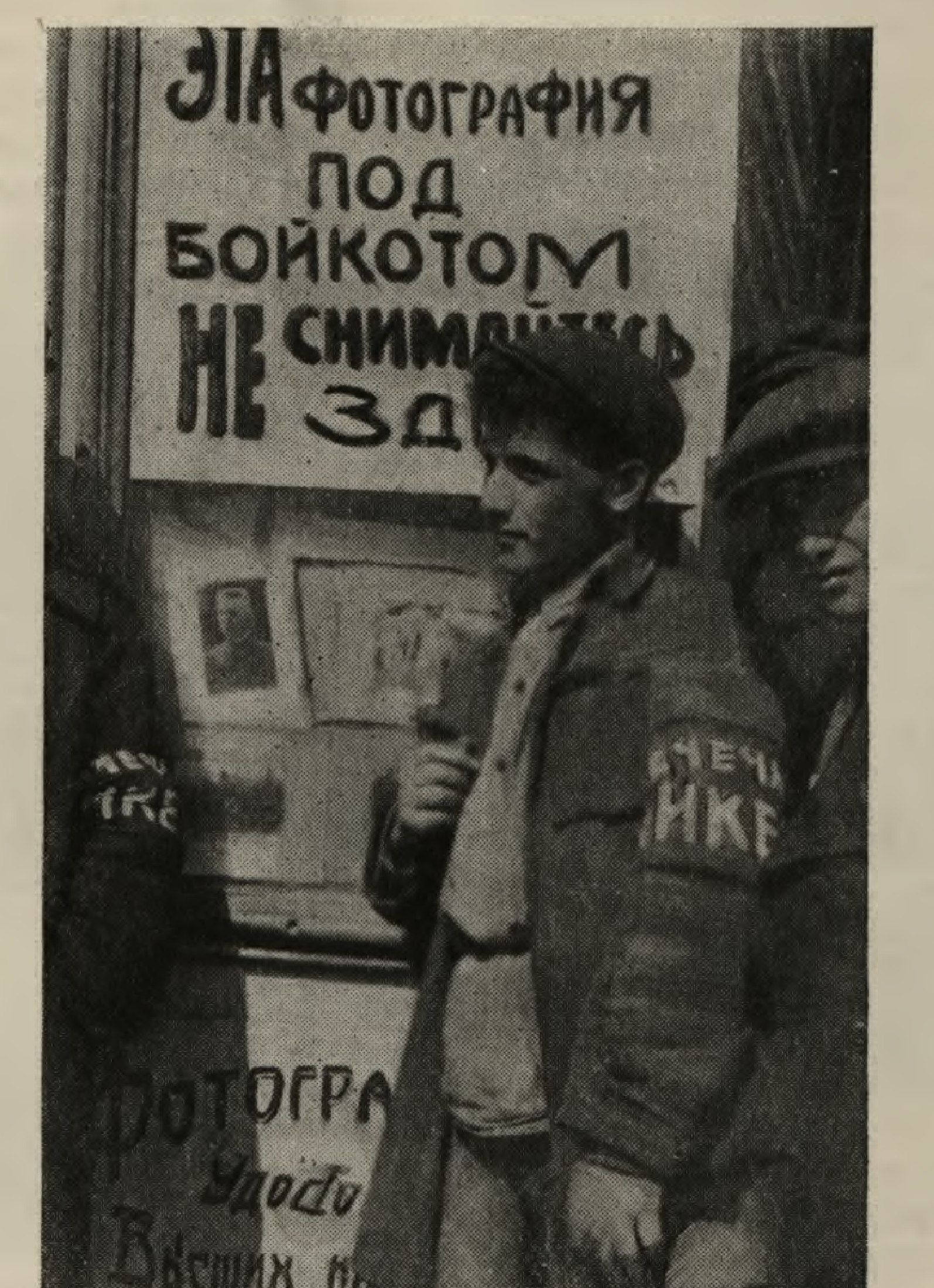
A strike. On 23 April the city of Nikolaev was stirred up: the worker-photographers declared a strike and boycott against several malicious exploiter-owners, and a strike committee formed. On 27 April volunteers organized pickets at the committee’s disposal; the local paper supported the worker-photographers, diapositives with pro-striker slogans were shown in the cinemas, and in the theatres citizens were called to boycott the owner-photographers. Nikolaev is a small provincial town, but the strike showed the worker-photographers’ excellent organization and discipline and their ability to defend their interests — and, besides, the USSR is not England: in a day the owners, gnashing their teeth, accepted all the Union’s conditions. The strike ended in the workers’ full victory.
Baku
At the Photo-Bureau of the Society for the Research and Study of Azerbaijan, free photo-courses in the Turkic language were opened for fellow-countryman students; 120 VUZ students registered, among them about 40 Turkic women, on whom the Society lays especially great hopes, since they, better than men, can capture the life of the woman of Azerbaijan’s backward villages — for them the entrance will be free not only into the dwelling but into the Eastern woman’s hiding-places; graduates are to gather district material in the holidays. Soon the Society will open courses on the fundamentals of photographic theory and technique; it is forming its own cooperative, and even now, by collective purchase direct from the makers, materials cost members 10–12% below the market.
In May the Society opened its first photographic exhibition in the party-club hall — more than 4,000 shots on the most varied themes (photography in science and medicine, production, daily life), with an interesting corner of cameras and cine-apparatus. Its faults: no systematization or captions, weak coverage of the region’s life and ethnography, of the city, construction, production and daily life. Worker comrade Kryukov’s shots stood out in technique and artistry; the work of comrades Rovnyakov, Vidovich and Albitsky deserves note; and some, plainly, quite misunderstood the exhibition’s aims — photographer Shirman exhibited… little cats with bow-ties, little dogs in top-hats, little dogs with boxes — though part of his work shows an outstanding technique. The exhibition aroused great interest; this first review of Baku’s photographic forces is to be welcomed.
Odessa
Photographic life in Odessa has moved markedly forward: most enterprises have their own photo-circles of many members, serving the wall-newspapers and even the local press; the Odessa Scientific-Photographic Society, with many members and a most extensive library, has widely unfolded its work; and at the central Odessa Izvestiya a photo-circle unites the amateur photo-correspondents of various enterprises, with an exhibition of worker-photographers’ work soon to open there. A gap with us is the lack of a state shop of photo-accessories to serve amateurs.
Tashkent
A photo-circle has been organized at the local committee of the Fergana district land department; the district branch of the agricultural-workers’ union released the means to fit out a photo-laboratory.
Photo-paper for photo-circles. With the help of the editors of Sovetskoe Foto, the Moscow photo-circles were supplied in early June with foreign photographic paper on their applications, at an extremely cheap price: one 50×60 cm sheet of bromide paper cost 1 ruble, 100 sheets of 18×24 cm — 15 r., a hundred postcards — 5 r. 50 kop. The next distribution will be announced specially, and may be extended to provincial circles too.