
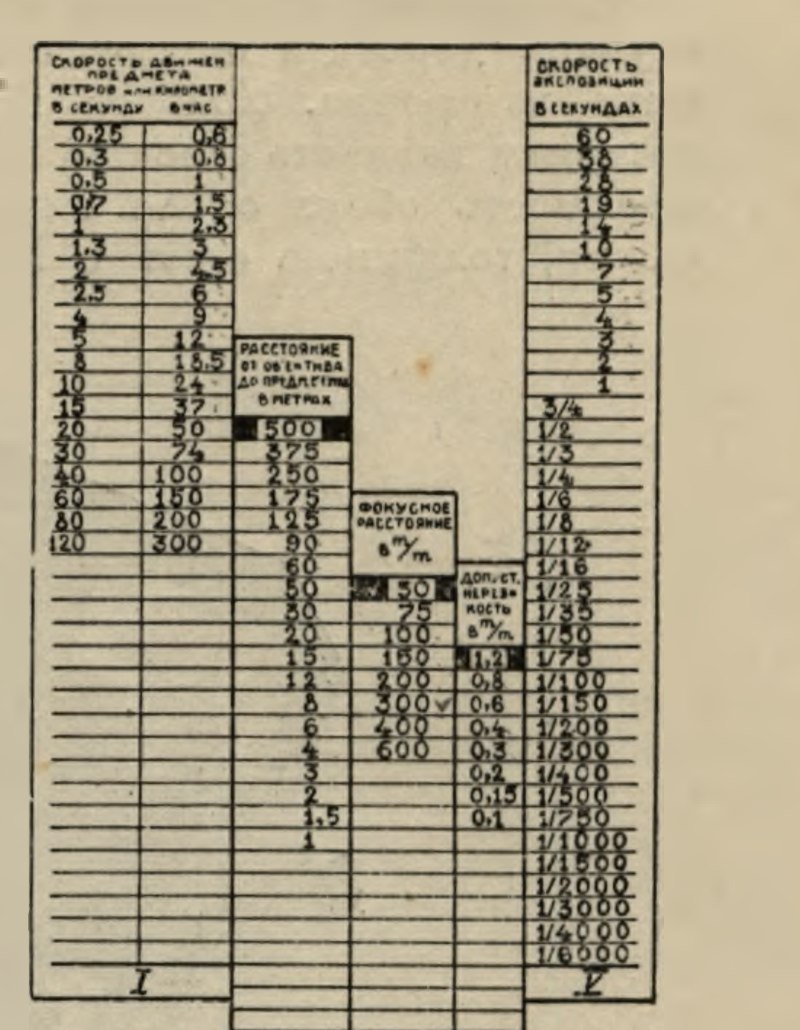
A. Sigunov gives a home-made slide-chart that finds, without formulas, the shutter speed needed to freeze a moving subject.
In photographing moving objects there are many failures from a wrongly set shutter speed; ready-made tables are almost not on sale, and to use formulas is too cumbersome — yet such a table is not hard to make oneself, using a formula and some indications from G. Nauman’s article in No. 6 of Sovetskoe Foto for 1926. The drawing below needs almost no explanation. The table can be cut from the journal and pasted on card: the first and fifth strips (speed of the object’s movement and exposure in seconds) are pasted down fixed, the rest are made sliding and a little longer than the preceding; the whole is covered on top with glass or film and edged on three sides, except the lower (the author made a table of 10×15 cm format).
To find the needed exposure speed, one successively brings the first line of the second strip (ringed in black) opposite the object’s speed of movement, then the first line of the third strip opposite the distance from lens to subject, then the first line of the fourth strip opposite the lens’s focal length, and in the fifth strip, against the line of permissible unsharpness, reads off the needed exposure speed. For example, one wishes to photograph an object moving at 50 km an hour, 50 metres from the camera, with a lens of 150 mm focal length, at a permissible unsharpness of 0.3 mm; making the needful shifts of the strips in the table (see fig. 2) one gets the answer — 1/300 second.
Those who always work with one lens may leave out the third strip entirely, making corresponding changes in the fifth strip and taking into account that the exposure speed is inversely proportional to the focal length. For example, with a lens of 150 mm focus, one must begin the fifth strip not at 60 seconds but at 19 sec., and for a lens of 100 mm focus — at 28 sec., and so on. One may likewise exclude the fourth strip, stopping at some definite sharpness — say 0.2 mm; for this, again, one must raise the fifth strip by 5 lines, i.e. begin at 10 seconds; the exposure speed is directly proportional to the unsharpness of the image. In general one may say that, discarding several lines (from the top) in strips II, III and IV, one must discard the same number of lines in strip V, also from the top — as though shifting the whole strip higher. A sharpness of 0.2 mm gives a quite clear shot, partly keeping the impression of movement; for illustrational aims an unsharpness of 0.3–0.4 mm is permissible, since greater sharpness is lost anyway in making the screened cliché.
In using this table one must bear in mind that the speed is reckoned for movement of the object along the perpendicular to the camera’s axis; if the shooting is done at an angle of 45°, the speed is permissible twice as slow; and in shooting at an angle of 90° (the object moving straight at the camera) — three times as slow.
— A. Sigunov
The opening of the 1st All-Union Light-Technical Exhibition is set for 14 August in Moscow, in the building of the Polytechnic Museum. The exhibition has, among others, a Department of Photo-Cine-Processes, in which collections of modern photo- and cine-apparatus will be shown and model processes of photo-cine shooting demonstrated in a special photo-cine studio. Foreign firms take part in the exhibition too.