
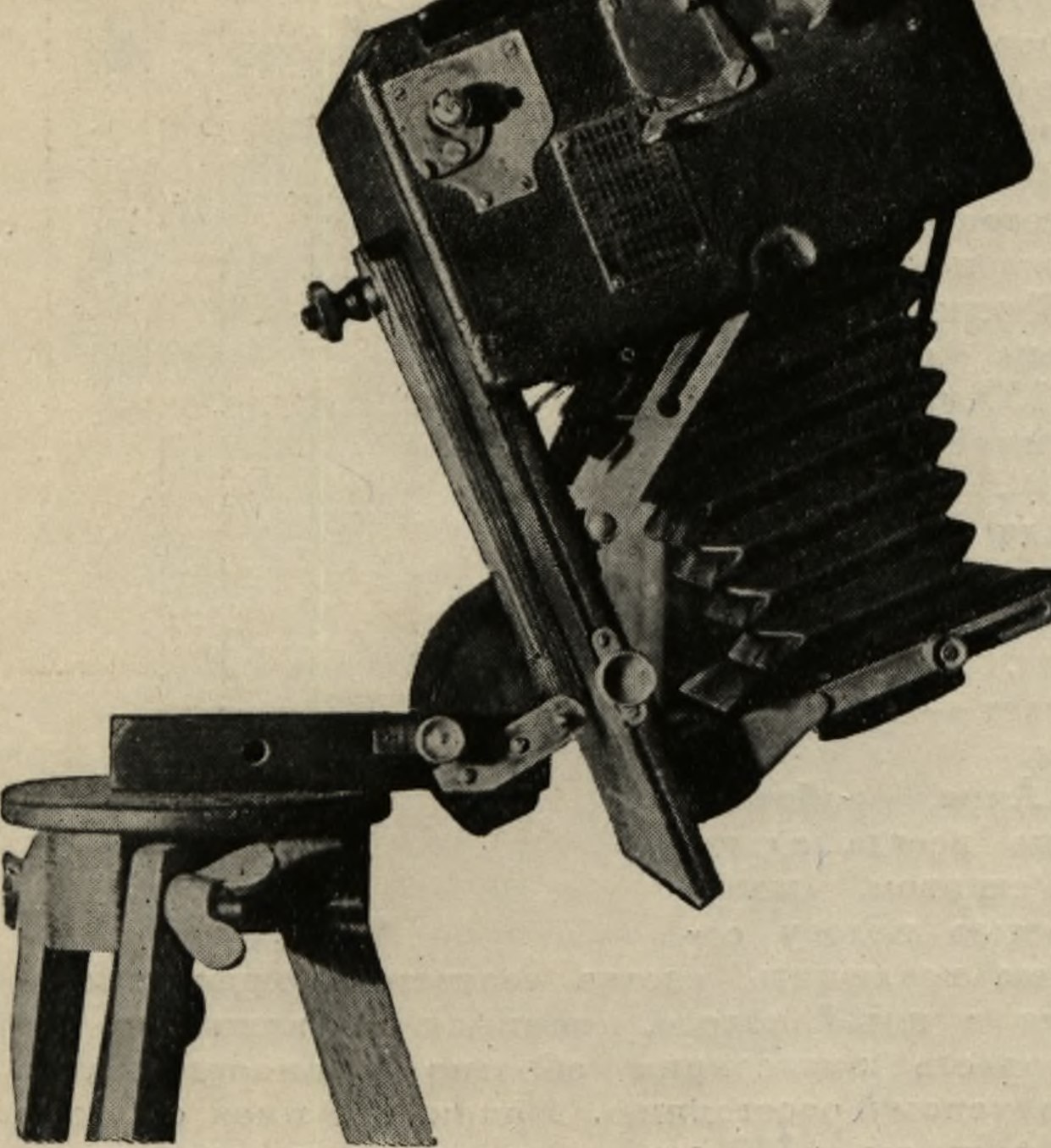
Three home-workshop tips — a tilting tripod head, a copying frame and developing trays.
A tripod head for camera tilts
Shop tripod heads are in most cases dear and unstable; a home-made one is cheap and strong. To make it one must buy, or have a locksmith make, a tripod nut and screw (both costing about 1 rouble). Two oak boards, one 1 cm thick, the other 2 cm, are joined at one edge by home-made hinges of nail and tin. To the upper thin board, nearer the edge, a semicircular wooden stop is fixed perpendicular, on a let-in tenon (see the figure). In the lower board a matching slot is made, in which the stop can travel as the upper board is raised; and in one side a set-screw is passed, holding the stop-post through the slot. The lower board is fitted with the nut, and in the upper the tripod screw is fixed — and the head is ready. For downward tilts the camera is screwed on with the lens toward the hinges; for shooting upward — screwed on the reverse way.
— P. G.
How to make a copying frame
Of plywood 4–5 mm thick saw out with a fret-saw a frame — inside 12×17 cm, outside 18×24 cm. Then of card or plywood, no thicker than a 13×18 cm negative, cut with a knife another frame — by the outer edge the same as the first, by the inner 1 cm wider, i.e. 13×18 cm. Glue the two frames together, and into the cut-out formed lay an old washed-out 13×18 cm negative; after that, on both sides of the frame (along the length), paste a strip of 4- or 5-mm plywood, 3 cm wide and 24 cm long, so that the glass will hold in the frame. Then of the same 4- or 5-mm plywood saw out two rectangles 9×12 cm, join them by two little hinges and face the other side with cloth — this makes the frame’s lid. Now one must make two little springs that would press both halves of the lid tight to the glass. The springs are made of an old alarm-clock spring, which must first be “let down,” i.e., heating it red in the stove, let it cool in the ashes; then, cutting from it two strips 16 cm long, punch in one end of each a hole for a screw. Of the same spring or of brass make two staples into which the springs will enter when locking; in the staples too one or two screw-holes must be made. When the springs and staples are made, they must be hardened again, i.e. heated red and quickly dropped in cold water, when the springs regain their elasticity, after which they are fixed by screws to the frame. The negative and paper are laid in as usual.
Trays
One would think, what use could the tin boxes of “Odol” tooth-powder be? Yet these boxes serve me as trays for developing 4½×6 and 6×9 cm plates. One need only coat them inside with oil or enamel paint so they do not rust. These “trays” are handy in that their lids guard the plates being developed from the action of light; and, thanks to the lids, the solutions poured into the “trays” can be left in them without decanting into bottles each time.
— S. Fedyunin