
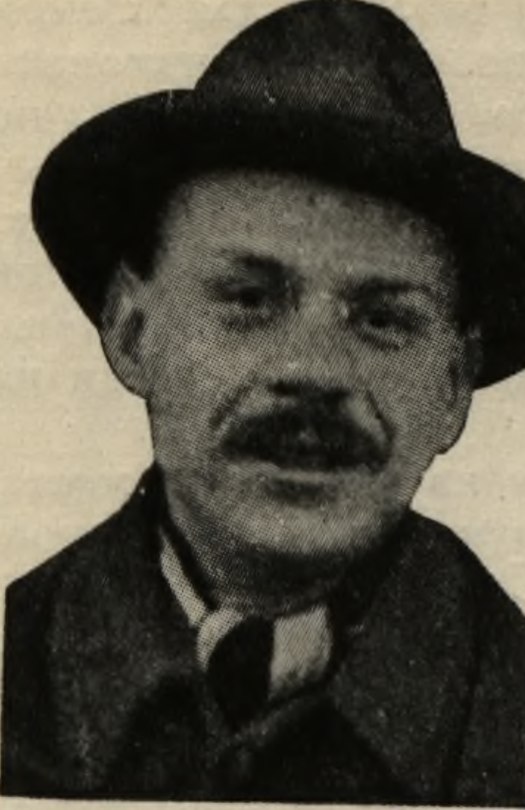
S. Kravtsov-Kryga of “Nova Gromada” (Kharkov) on the reporter’s method — and on the plight of the photo-journalist in the provinces.
As a photo-journalist I hold to some peculiar methods and ways of work. In contrast to comrades whose system and method of work remains the carrying-out of editorial assignments, I keep to a different view, defending the initiative work of the photographer-journalist. The photo-camera and the automatic pencil always go with me, and this gives me the chance to reflect our daily life and our construction in shots really “as it is.” And most often it happens that such photographs are the centre of an essay, that the text is written to them, and not the reverse, as is practised with us for the most part. I purposely made several experiments which convinced me that labour processes, daily life and all that is characteristic in them are best seized extempore, and that, going the way of staging photo-frames, as is practised at every step, we involuntarily become creators of that sentimental idealisation of our reality with which one ought rather to struggle.
Then, as a photo-journalist, I count it my duty to bind as closely as possible with contemporary photo-amateurism, since it — and by no means the routine milieu of the professionals — is the cadre replenishing our, so far young, army of photographer-journalists. I work chiefly with small-sized cameras — light, portable and cheap. Besides, nobody now seeks in shots that once canonical “Dagor” sharpness, and enlargements from a size of, say, 4½×6 cm or from a half-plate 45×107 mm up to 10×15 cm and even larger are quite fit as illustrative material. For ordinary work I use mostly a “Stereoflektoskop” 45×107 mm with Heliars, and a Voigtländer F/4.5 — a very exact camera combining the merits of a reflex with the use of the “Compur” shutter, which I prefer to blind shutters even in their best constructions. For shots in bad weather, in the theatre, and also for sport, I use a “Minimum-Palmos” 4.5×6 cm with a Zeiss “Tessar” F/2.7 and a blind shutter.
Now a few words on the needs of photo-journalists. We lack connection, organisation, and here Sovetskoe Foto has much to do, remembering first of all that such an organisation is needed not in Moscow alone. One must then see to the widest and most exact legal fixing of the rights and privileges of photo-journalists. Our administrators, especially in the localities, do not always clearly picture the tasks of photo-reportage and fairly often brake the work by inept interference. Finally, one should think about supplying photo-journalists and the most active amateurs with apparatus and materials. With us, for example, in the Ukraine, the state of the photo-market is deplorable — in Moscow, one must suppose, things are better — and this much brakes the work. Without putting the matter off until the supply of our photo-market in general is set right, one must see to supplying at least the photo-journalists for now. It seems the organs of Narkomtorg could ease the getting of photo-products by our few photo-journalists from abroad in personal-consumer parcels, as was the case up to 1 November 1926 and as is now practised with hunting arms and even such articles as drawing and painting materials. And if this is in no way possible, then the Narkomtorg organs should themselves take up satisfying the photo-journalists’ needs, setting up a bureau of photo-orders at the organs of tech-import, or something of the kind. In any case, something must be undertaken, for the present state threatens a breaking-away from Western and American photo-technique. And to whose good will that be?
— S. Kravtsov