
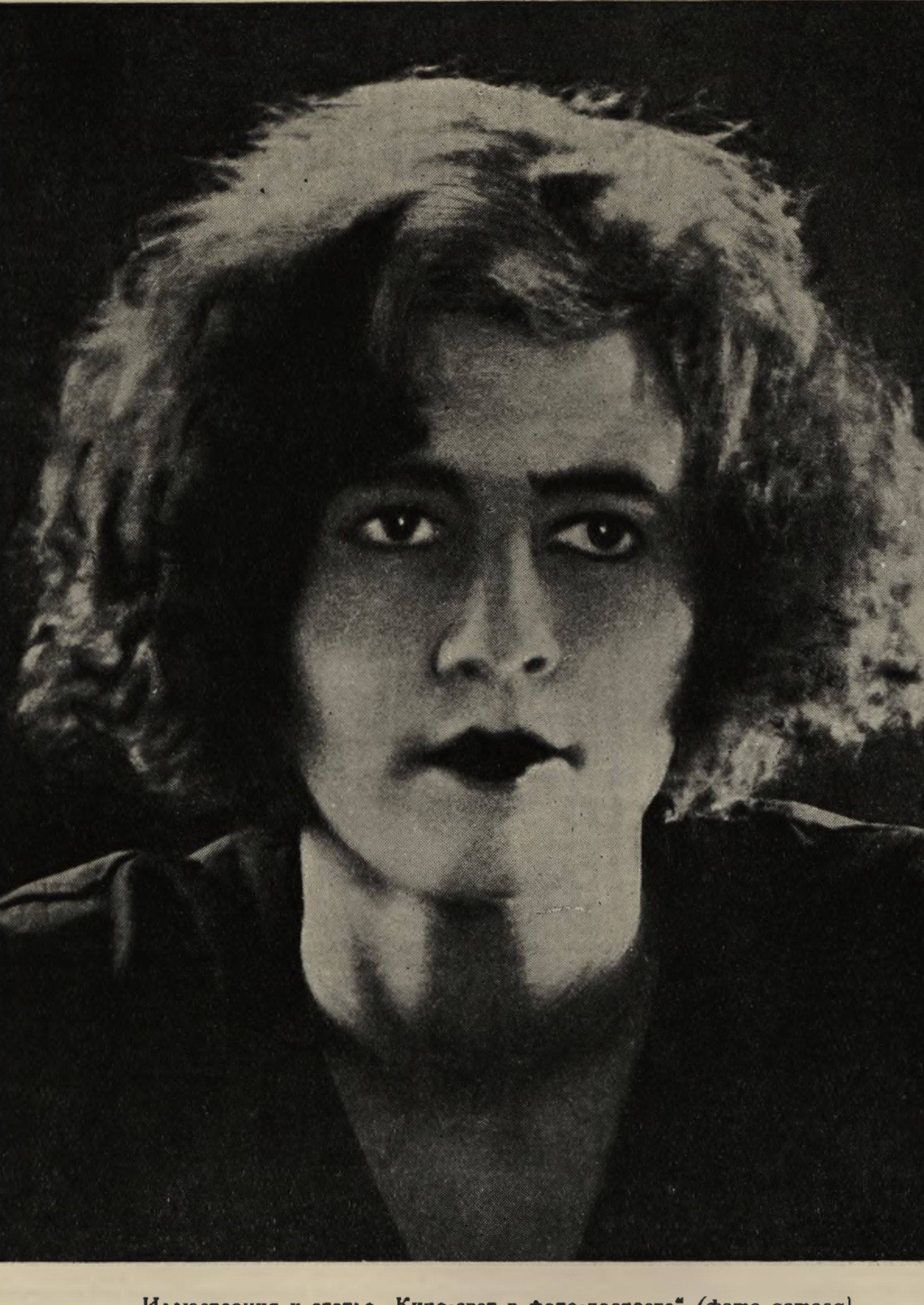
A. Chernyshev brings the cinema’s “sea of light” into the home portrait — a decorating light added to the ordinary one, got without mercury lamps or floodlights.
In the cinema we can find models of splendidly made portraits — the so-called “close-ups,” when the actor’s head or part of his face fills the whole screen. Colossally impressive is that “sea of light” often enclosed in the frame. The head is surrounded by a halo; it seems itself to radiate light. At times the intensity of light is so great that one gets the impression of light laid on light — namely when the highest light-point, the highlight, lies on the light side of the face. Here light from an auxiliary means becomes an acting person — on a par with the actor’s play it serves the greatest expressiveness of the frame. Everyone knows that the cinema uses powerful lighting apparatus, thanks to which the most varied and astonishing lighting effects can be reached. In photographing a portrait one can get a like “cinema-light” outside the studio, without mercury lamps and floodlights. Working at home, one can manage with very modest lighting appliances, which, probably, the rank-and-file photo-amateur will have. For the decorating light, of which we shall speak below, a minimum of equipment is needed: one half-watt lamp and a few centimetres of magnesium ribbon.
The principle of distributing the light is this: one sets up a “general lighting” and a “decorating lighting.” The aim of setting the first is to give an ordinary, even and harmonious lighting, for which the light source should be moved off a corresponding distance from the subject. For the general lighting one may use daylight, taking it from the window and combining it with electric or magnesium light. As in any other portrait shooting, here one must remember top, side and direct lighting. Sharp shadows should be removed with reflectors. This is not complex. Each amateur will be able in this case to show initiative, improvising a reflector of pieces of white card, sheets and so on; one may use ordinary mirrors too. General schemes of such set-ups the reader will find in E. Piotrkovsky’s articles (Sov. Foto Nos. 8 and 9 for 1926).
Now to this “normal” lighting one must add the “decorating” (adorning) light. The decorating light, in contrast to the first, general lighting, is set as close to the subject as the frame mentally outlined allows. The magnesium ribbon, for instance, may be brought to within 40–50 cm of the face. To get a glowing halo of hair, it is handy to place the light sources thus: above, as close as possible, hang a half-watt lamp, and on both sides place 20 centimetres of magnesium ribbon. Rules or exact indications for placing the decorating light at this or that point cannot be given: we do not yet possess the “algebra of light.” For the most ordinary, classically correct lighting of a portrait there are as yet no mathematical formulas, no immovable laws; the less can they be expected for the decorating light. Each amateur may place it as he pleases and where he pleases: on the light and the shadow side, above and below — and get in every case the most interesting and extraordinary effects. Yet if we have no exact indications of how one should do it, there are known guiding moments which say how one should not do it. To beginners I shall point out the chief of these, touching the peculiarities of setting the decorating light.
- The strength of light should be reckoned not by eye, not by sensation, but theoretically — by centimetres: e.g., setting on both sides two identical light sources symmetrically and then moving one off some small distance, we shall get on the negative a difference in the lighting of the two sides; whereas by eye, in shooting, we may not notice this difference of lighting at all.
- Using half-watt lamps and magnesium in the lighting, one must remember that magnesium light acts more strongly on the plate’s sensitive layer than electric (e.g., 200 watts and 15 cm of magnesium).
- Bringing into the shooting a greater than usual amount of light, one must not forget either to shorten the exposure time or to take a smaller diaphragm (by the wished degree of sharpness).
- One must most carefully fence the lens from direct light rays getting into it; besides, for greater sureness one may fit the lens with a hood lined inside with black velvet or paper.
In conclusion one must say that, using so strong, “devouring” a light, one must especially remember form and the harmonious distribution of light and shade. If we care exclusively that the light and shade spots be expressed to the maximum and thereby bring the contrast between light and shade to absurdity, we get, as it were, a drawing in Indian ink where there will be two tones, black and white; we get something wholly anti-artistic, recalling a bad poster with a cheap, eye-striking effect. One must carefully avoid “blots,” which come from there being no half-tones in the shot, no gradualness of transition from the strongest light to the densest shadows. Too strong a light smooths out form, destroys relief and thereby, as it were, asserts the flatness of the image. Contrasts are good, contrasts are needed, we seek them, but one must know how to tie them, throwing a bridge between light and shade. Bringing in the “general lighting” spoken of above, we get half-tones. Introducing into the shot, alongside bright lights and shadows, half-tones — we get a harmonically finished whole.
— A. Chernyshev