
D. Gorodinsky visits the GOZ — the State Optical Factory in Leningrad — and sees a Soviet anastigmat the equal of a Zeiss Tessar.
GOZ is the State Optical Factory in Leningrad. The factory has existed many years, but few know that it is in a position to make things specially interesting to the readers of our journal — lenses and photographic cameras. At present the factory is busy chiefly with making cine-projection apparatus, spectacle glasses and binoculars. Over 500 workers are employed in the mechanical, joinery, optical, assembly, electro-technical and many other shops.
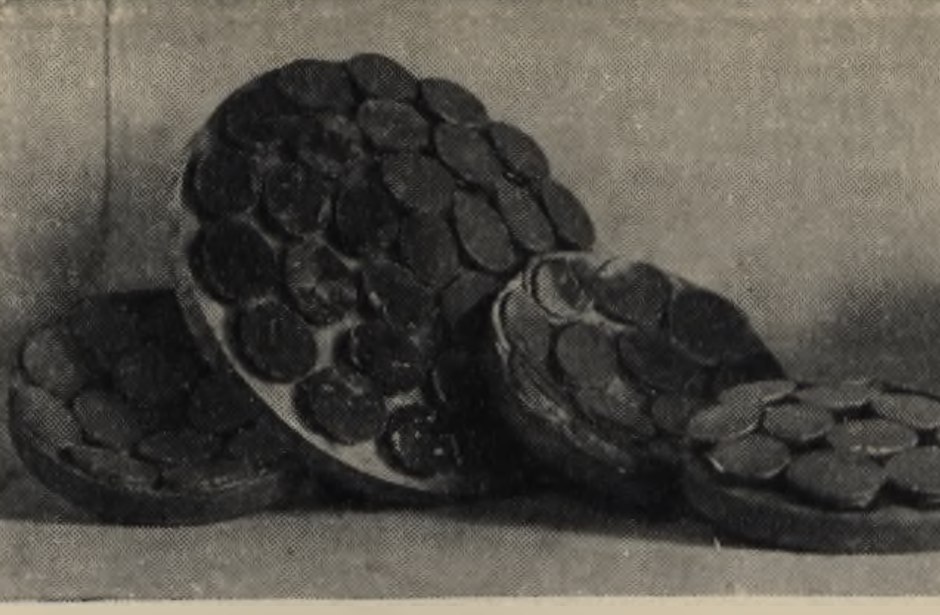
It is unusually interesting to trace how ordinary thick matte glass turns into spectacle glass, into a lens. First the glass is cut along to the wished thickness. A round copper disc with bits of diamond set in the edges, constantly wetted with kerosene, making up to 2,000 revolutions a minute, cuts the glass almost as easily as the machine in a sausage-shop cuts ham into thin slices. The glass got is cut into little squares. These are rounded off. They are given the form of a circle or oval. The glasses are glued on properly turned copper cups or mushrooms, by whether the glass needs a concave or a convex surface. Each cup and each mushroom answers to a known template of exactly calculated curvature. The whole system of cups and mushrooms (sometimes the system consists of one cup and one mushroom) is set in motion, revolves. First comes a rough finishing of the glasses with emery. Then the glasses and lenses are ground more exactly. By means of a control glass gauge the lenses are checked against Newton’s spectral rings. The lenses, in case of need (in assembling complex lenses), are cemented, gathered into mounts, centred, set on the optical axis, and finally checked by the optico-mechanical laboratory. The scientific work is led by the scientific calculating bureau within the factory walls, at whose head at present stands Prof. V. S. Ignatovsky. The scientific calculating bureau indicates which sorts of glass to take, what curvature to give, and so on.
I was interested chiefly in the possibility of making lenses at the factory. I was shown a lens made by the factory of light-power F/4.5. I saw shots made with this lens and must confess that, to my eye, they differ in nothing from shots made with a Zeiss Tessar. “To take up the making of lenses,” they said to me at the factory, “we must get an order of at least 10,000 lenses a year.” Here is why with us there is as yet no making of lenses.
— D. Gorodinsky