
The “Lios” actinometer of Dr. V. Schlichter
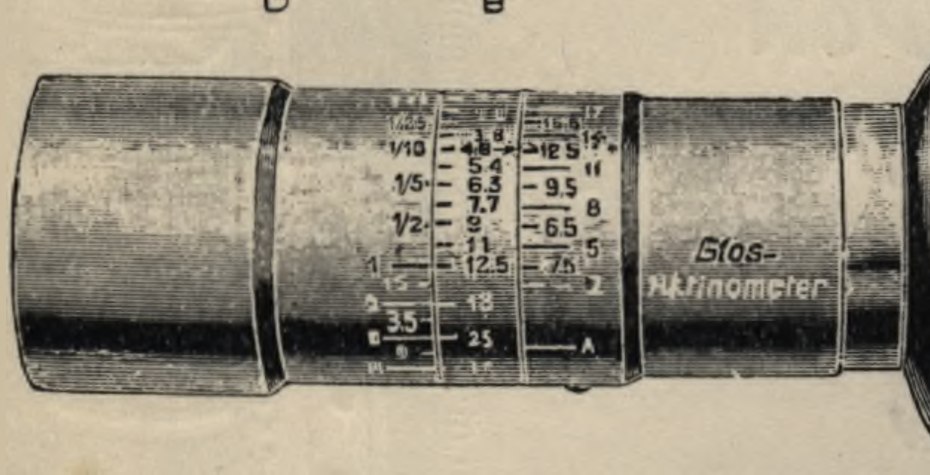
The outward look of the actinometer is shown in fig. 1. The actinometer has the form of a tube, on one side of which is a lens (in the drawing, at left), and on the other a cup for the eye. On a fixed ring various figures are marked, answering to the plates’ sensitivity (by Scheiner). By this ring is another ring, which can be turned at will, with marks for the various diaphragm values — from F/1.5 to F/50. By the diaphragm ring is a third, turnable ring, on which, against the diaphragm figures, the exposure figures are marked. So that the photometer may be set by one’s focal sight, the tube can be drawn out; and so that it may be used by one eye and the other, the cup can be turned through 180°. If we aim the Lios actinometer at some bright object and turn the ring so that the largest possible exposure figures stand against the diaphragm figures, and look inside the photometer, we shall see in it, as shown in the next drawing, a moderately lit so-called field of the device (a white circle), in which from above is a less bright blue circle (darkened), the so-called field of observation. Between the field of the device and the field of observation is a ring. As we turn the second ring, the brightness of the field of observation will lessen, while the brightness of the device’s field stays unchanged. In the construction of the fields of device and observation lies the essential side of Schlichter’s actinometer.
If, in shooting some object and at a known sensitivity of the plates on hand, we wish to determine the exposure length, then first, by turning the second ring, we set on it the marked arrow (which stands by the diaphragm figure 4.5) against the corresponding figure on the first ring (the plates’ sensitivity by Scheiner). Then, aiming the actinometer at the object shot and at the same time looking inside the device, we turn the first ring to the left (counter-clockwise) until the field of observation ceases to stand out against the field of the device, i.e. until it merges in tone with it. In turning one must count off 15 seconds with the reckoning that the setting of the fields of observation and device in one tone should fall on the 15th second, since just 15 seconds are needed for the eye to adapt to the surrounding light. Then the device can be taken from the eye, and for each diaphragm figure the exposure length read off at once. The limits of measuring light-strength by the actinometer are extremely wide. The scale of exposure length runs from 1/5000 second to 5 hours. Until now there was in general no optical photometer allowing such measurement of light-strength. The price of the actinometer is 12 marks (5 r. 50 k.).
— D. Gorodinsky
The cheapest cameras
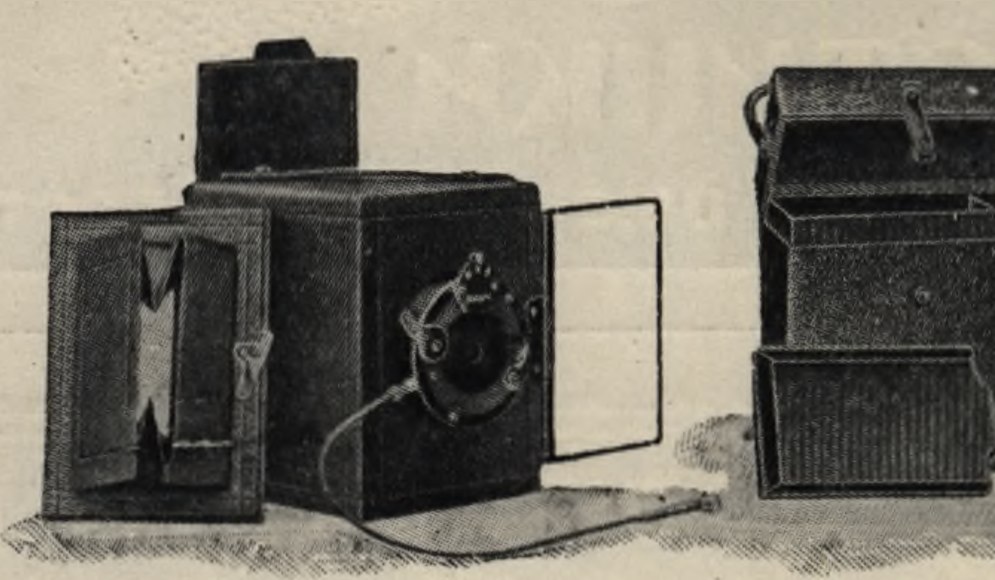
The firm of Paul Kühnel in Tharandt (Saxony) has chosen as its speciality the mass making of extremely cheap photographic cameras. The camera shown in the upper drawing at left, for 6×9 cm plates, with shutter, ground glass, finder, cassette and case, costs in our money 1 r. 84 k. The camera body is of wood. Another camera, 4.5×6 cm, shown in the same drawing at right, costs with shutter, finder and cassette only 67 kop., or with case 99 kop. But the cheapest camera is the one called by the firm “Foto-Chudo” (“Photo-Marvel”) and shown separately at right, a camera for 4.5×6 cm plates, without cassette and ground glass but with shutter — this little device costs… only 30 (thirty!) kopecks. Of course these are rather toys, and serious work with such cameras cannot be done, but for shots in bright sun or of immovable objects admitting a long exposure (landscapes, buildings) they are fit and give satisfactory results. Quite suitable for the photo-amateur is a camera of the normal folding type for 9×12 cm plates (see the lower drawing at left), with aplanat and shutter, to be bought of the named firm for 6 roubles. A metal 9×12 cm cassette costs twenty kopecks there. Thus, for the cost of one reflex, our trading photo-organisations could order, for the satisfaction of the existing cassette-hunger, fifteen hundred cassettes, which would bring the photo-amateurs essential benefit, since now the price of a rough, hand-made cassette in the Moscow shops reaches 2–3 roubles.
— A. K.