
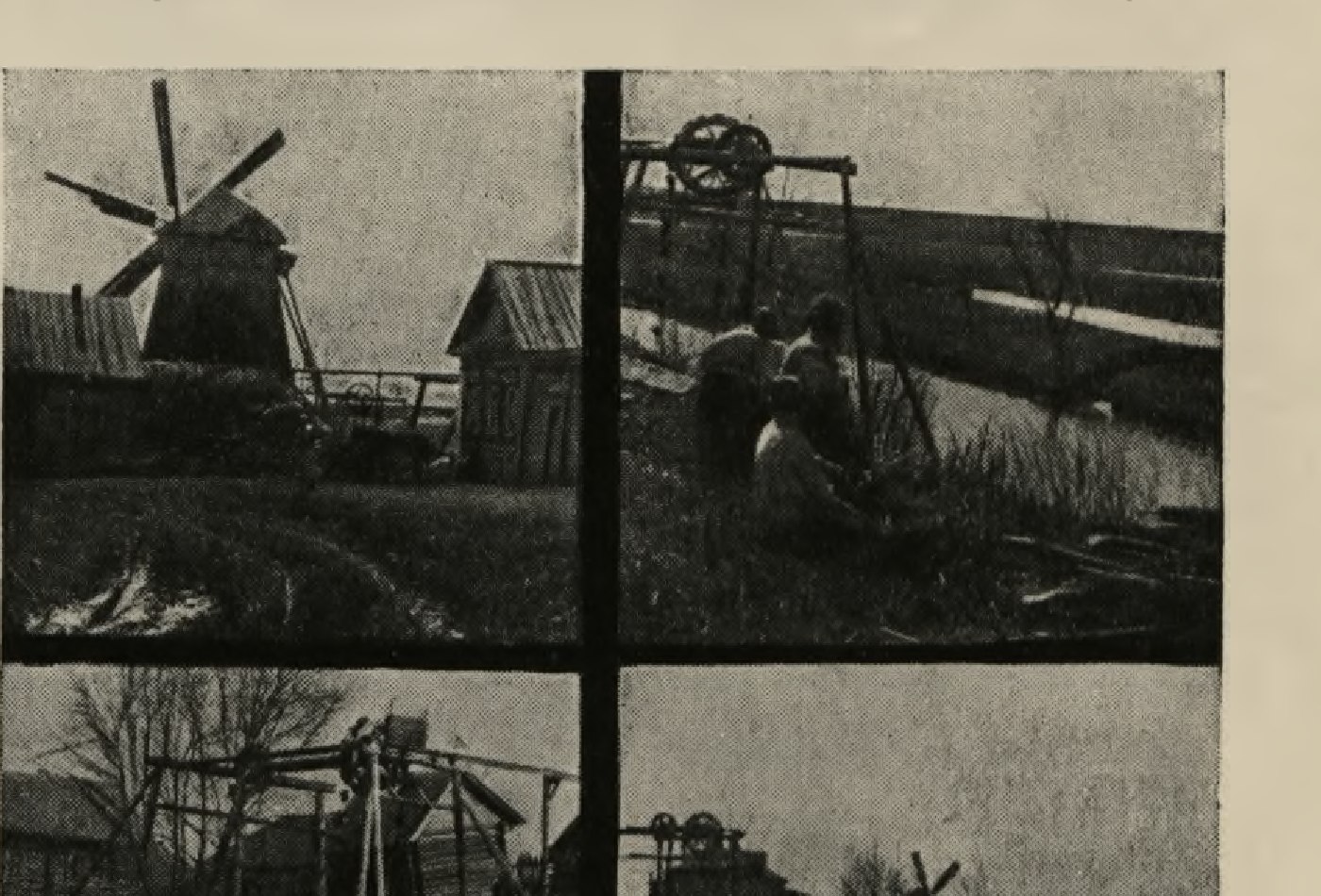
I. Maslenikov’s thrifty dodge — eight shots on one 9×12 plate, got with nothing but a divided ground glass and a set of home-made cassette shutters with windows.
The matter concerns a way of making several shots on one and the same photo-plate. Such a way, of course, gives nothing new to photography, for it has long been practised among professionals, chiefly for making “miniatures”; but for that purpose specially-constructed cameras are usually used. Yet, as is known, what is accessible to the professional photographer is usually inaccessible, by reason of the sharp limitation of his budget, to the photo-amateur, who has not always the means to order himself a special camera for shooting several shots on one and the same plate. The way of such multiple shooting tested by me calls for no great expense, and requires only half a sheet of ordinary dark Bristol board, to be had in any photographic shop for forty (40) kopecks a sheet. Since the most widespread camera size among amateurs is 9×12 cm, I shall base my reckoning on just that size.
Suppose we wish to get on one and the same plate of 9×12 cm up to eight different shots. One must note that such a division of the plate into eight parts is the most convenient, for the reason that each of the shots got on this plate will make up 1/8 of the given plate and can quite well bear enlargement up to 13×18 cm, if not more — which, understandably, will depend on the lens with which such multiple shooting is done. The preparation of the camera itself for such shooting is limited to ruling its ground glass into eight parts, for which one line is drawn along the length of the ground glass and three lines across its height (every three centimetres). Thus (see drawing 1) the ground glass of our camera will prove divided into eight equal areas: four in the upper row and four in the lower (with the camera held horizontal), and each such area will be 3×4½ cm. In making the multiple shots we shall have to aim the subject successively on each area separately, and, so as not to confuse the areas, one may adopt the rule: use first the upper row — say, from right to left — and then pass to the lower row, also from right to left.
The essence of such multiple shooting comes to this: that we must expose some part of the plate (in this case 1/8), leaving the rest of it wholly darkened, and this exposed part of the plate must strictly correspond to the area of the ground glass on which we placed and aimed the subject. Such a partial and successive exposing of the plate is reached by means of a series of special cassette shutters, which (shutters) will differ from the ordinary (blind) shutter by having windows cut in them, strictly corresponding to this or that ruled area of the camera’s ground glass. As is seen from drawing 2, the window of the first shutter is cut near the shutter’s grip so that it corresponds strictly to the upper right area on our ground glass. The windows on the following shutters are cut on one line with the window of the first shutter, each following window being cut three centimetres to the left of the preceding one. Of course, all these shutters with windows must enter the cassette tightly enough.
Having such shutters with windows and the ground glass ruled into areas, we can begin the multiple shooting on one and the same plate. To get the first shot we aim the first area of the ground glass (upper right) on the subject, then take out the ground glass and set in its place the cassette, closed with the blind shutter. After this we close the shutter of the lens, draw out the blind shutter of the cassette and replace it with the shutter having a window in the upper right corner, and at last make the exposure. To make the second shot one must first replace the inserted window-shutter with the ordinary blind one, and only then draw out the cassette and again set in the ground glass, after which the former manipulation is repeated: we aim the subject on the second area, insert the cassette and replace the blind shutter in it with a window-shutter, and so on up to the fourth shot, when the upper row of areas — the upper half of the plate — is already exposed. To pass to exposing the areas of the lower row it is not at all needful to have eight shutters: one can use the first four, for which it is enough simply, on inserting them into the cassette, to turn them windows downward and continue the shooting on the lower half of the plate by the same method as on the upper.
The shots got in this way can be enlarged (all at once or separately) up to the size of an open letter (a ninefold enlargement by area) and even to 13×18 cm (a sixteenfold enlargement by area) at the most moderate loss of sharpness. If the photo-amateur finds shots of 1/8 of a 9×12 cm plate too small for this or that particular case, he can by the same method shoot on 1/4 and even 1/2 of the same plate, so that the shots come out 4½×6 and 6×9 cm respectively. In the last two cases one must make two more shutters for each case with a somewhat different cutting of the windows (see drawings 3 and 4). One must note that, as material for the window-shutters at a shot-size of 1/8 plate, dark dense Bristol board can quite satisfy; but for shooting larger shots (4½×6 and 6×9 cm) this board may prove unfit, because on inserting such a shutter into the cassette it will begin to break or bend near the window-cut. Therefore for larger shots it is better to use thin, perfectly smooth tin (so as not to scratch the plate), painting it with black paint.
Naturally, such multiple shots on one and the same plate will come out best with an anastigmatic lens, covering all areas of the plate evenly and sharply, while with an aplanat or the simplest lens the shots nearest the plate’s edges will prove insufficiently sharp. Then the smaller shots (at 1/8 and even 1/4 of a 9×12 plate) are best made from a stand, since aiming by the finder (or rather, by some part of it) becomes very difficult; shots on 1/2 of the plate can already be made without a stand and instantaneously. For the more experienced amateur this economical way of shooting has still greater value in that it makes him less dependent on the darkroom: having six cassettes, he can make up to four dozen shots, enlarging them afterwards to the size of an open letter and even to cabinet size. Such a load proves very solid, and with it one may boldly set out, if not to the North Pole, then on the most distant country walk.
Finally, such a way of shooting has an indisputable advantage over the ordinary one from the optical point of view too, since at a given focal length of the lens (in amateur cameras sometimes very short) it gives the chance to get results analogous to those of shooting with a long-focus lens exceeding the normal focal length by two and even three times — of great use for portrait work. The shots made on 1/8 of a 9×12 plate can, at a moderate loss of sharpness, be enlarged to the size of an open letter or to cabinet size and even more, for which self-made enlarging apparatus with a light-source of two half-watt 100-watt lamps working by reflected light will serve (a scheme of such an attachment-camera was described in No. 4 of Sovetskoe Foto for the current year). The seeming cumbersomeness of the described multiple shooting, and the possibility of confusing the shots — shooting two on one area and leaving blanks on the rest — wholly disappear even after a little practice: aiming on the areas and alternating the window-shutters will go at the usual speed of shooting on whole plates, and the possibility of confusing the areas falls away entirely if one works out the habit of shooting in a strict sequence — from right to left, first along the upper half of the plate and then along the lower. Many amateurs, wishing in the process of experimental-research shooting to economise on photo-material, use inserts in the cassettes for shooting on plates of smaller format; but in that case the number of shots possible without going into the darkroom is strictly limited by the number of cassettes on hand (usually three or six), whereas with the multiple way described by me they get the chance to make, without going into the darkroom or re-loading cassettes, two and even four dozen shots. The difference is so great that it speaks best of all in favour of the full expediency of applying such a way of shooting in the everyday practice of the photo-amateur.
— I. Maslenikov